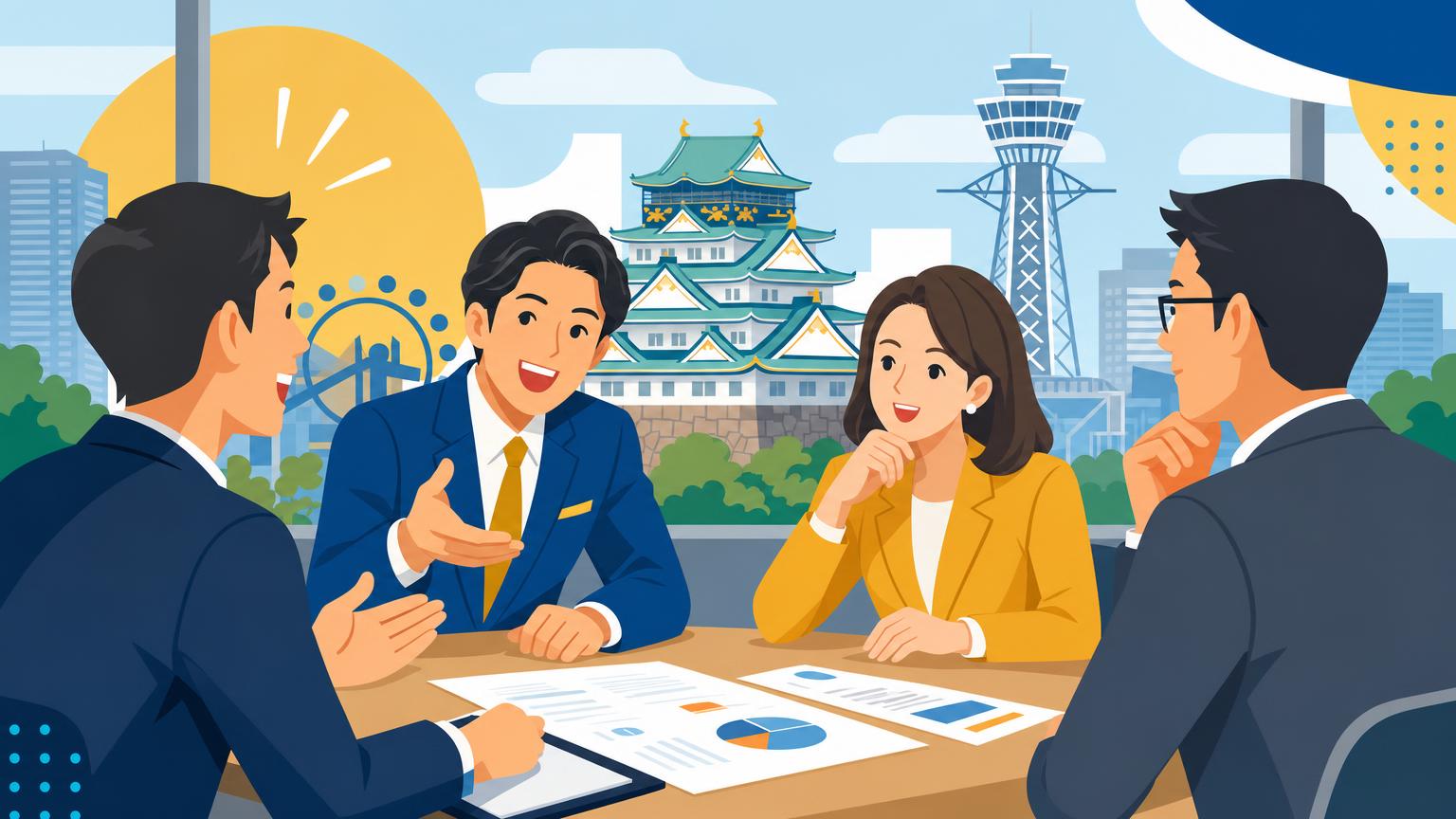
You may notice it during a meeting in Osaka before you understand what is happening. A colleague interrupts with a practical question. Someone laughs at a very serious proposal. A manager asks, “But will this actually make money?” before discussing the impressive concept behind it. A supplier who seemed formal at first suddenly speaks plainly over coffee, then gives you the most useful advice of the day.
For many foreign residents, this can create a puzzle. Is the conversation becoming less professional? Is the joke a sign that the other person is not taking the deal seriously? If an Osaka-based businessperson asks direct questions about price, risk, or profit, are they being aggressive? And if they spend half an hour discussing food, family, or the neighborhood before talking about the contract, is that wasted time?
Usually, the answer is no. You are seeing the modern influence of Osaka’s akindo spirit: the mindset of the merchant. Akindo does not mean that every Osaka worker is a trader, salesperson, or natural negotiator. It describes a practical way of judging relationships and ideas. What is useful? What is fair? Can this work in the real world? Can both sides continue doing business after today?
This spirit helps explain why workplace communication in Osaka can feel warmer, more direct, more humorous, and sometimes more demanding than communication in Tokyo. It also explains why a foreigner can misunderstand Osaka in two opposite ways. You may mistake openness for informality, or directness for hostility. You may think a relaxed conversation is unrelated to business when it is actually building the trust that makes business possible.
The map below is not a sightseeing guide. It simply helps place the everyday business environment in context: the dense commercial districts, older merchant neighborhoods, transport corridors, offices, workshops, restaurants, and residential areas that make Osaka feel like a city where work and ordinary life constantly overlap.
What “Akindo” Really Means in Osaka
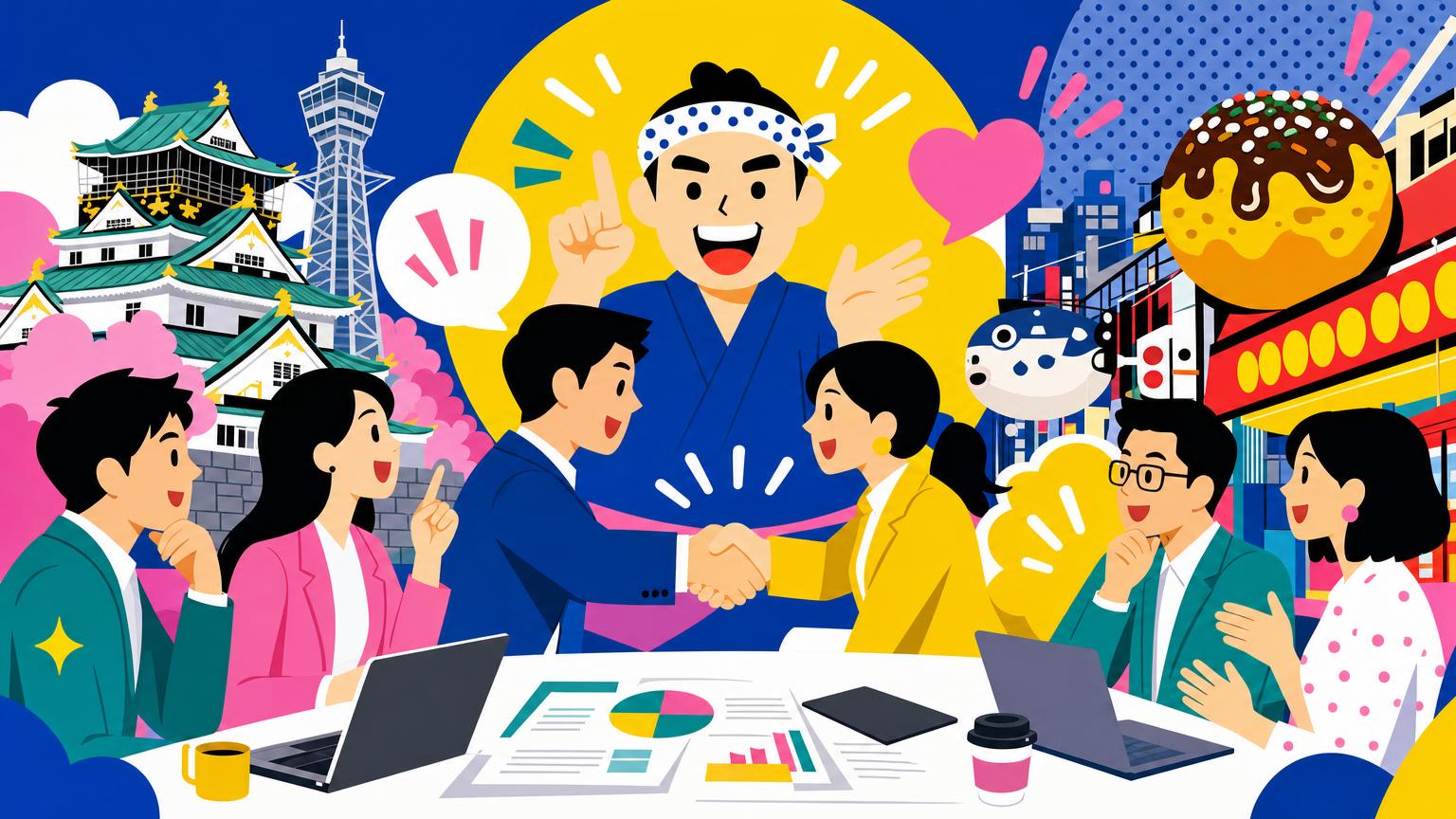
The word akindo is often translated as “merchant,” but the cultural concept is broader than someone who simply buys and sells goods. It describes a person who survives by understanding people, assessing value, managing risk, and maintaining useful relationships over time.
That final point is important. The Osaka merchant tradition is not simply about earning the highest possible profit from a single transaction. It is about remaining in business. A good deal should benefit both sides enough for the relationship to continue. A customer should feel that they received value. A supplier should find the payment and conditions workable. A partner should not leave the negotiation feeling deceived.
This does not mean Osaka business culture is automatically gentle or generous. Merchants can be tough. They notice waste, compare prices, and ask uncomfortable questions. They may negotiate more firmly than you expect because they view negotiation as part of responsible business rather than as a personal conflict.
The underlying question is often straightforward: Does this make sense in the real world?
A presentation may be beautifully designed, but someone will still ask how it can be implemented. A new service may sound exciting, but someone will ask who will pay for it. A proposal may be socially admirable, but someone will ask how much staff time it will require. An ambitious plan may be welcomed, but only after its risks have been discussed honestly.
For foreigners working in Osaka, this can be refreshing. You may receive useful feedback sooner than you would in a more formal environment. You may also feel exposed because people are less willing to conceal uncertainty behind elegant language.
The “Kitchen of Japan” and the habit of judging value
Osaka’s commercial identity was shaped by trade, distribution, food, manufacturing, finance, and urban services. The city developed as a place where goods moved, prices were assessed, and merchants relied on repeat relationships. The traditional image of Osaka as the “Kitchen of Japan” is not only related to food. It also reflects the city’s role in organizing, storing, selling, and distributing value.
That history continues to appear in everyday workplace thinking.
A business discussion may quickly move from an abstract goal to questions such as:
- Who is the customer?
- What problem does this solve?
- How much will it cost to maintain?
- What happens when something goes wrong?
- Can the staff realistically do this every day?
- What does the other side gain?
These questions can sound blunt if you come from a workplace where enthusiasm is expected before criticism. In Osaka, practical criticism can indicate that the proposal is being taken seriously. If no one asks difficult questions, the idea may not have entered the real discussion yet.
Akindo is not the same as “cheap”
Foreign residents sometimes describe Osaka people as especially conscious of price. There is some truth in this observation, but “cheap” is too shallow and often unfair.
The akindo mindset is closer to value awareness. Osaka people may pay more for something that is durable, delicious, efficient, or genuinely useful. They may resist paying extra simply because a product carries a prestigious name or because a salesperson uses impressive language.
At work, this distinction influences how you present your proposal. Do not assume that a higher price will automatically communicate higher quality. Explain what the additional cost will accomplish. Show how the plan reduces labor, prevents mistakes, improves customer retention, or creates a measurable benefit.
A Tokyo-style presentation may place greater emphasis on brand position, strategic importance, or formal alignment. In Osaka, those points may matter, but they are often followed by a more concrete question: “So, what changes for the customer?”
Why Osaka Workplace Communication Can Feel Different from Tokyo
The contrast between Osaka and Tokyo should not be treated as a rulebook. Both cities are home to conservative corporations, creative start-ups, family businesses, universities, hospitals, factories, international companies, and highly diverse workers. A Tokyo office may be casual, while an Osaka office may be extremely formal.
Still, regional tendencies are noticeable. Tokyo often feels more centralized, status-conscious, and sensitive to protocol, particularly in large corporate settings. Osaka often feels more commercially direct and relational, with a greater willingness to test an idea through conversation.
The difference is not simply “formal Tokyo versus friendly Osaka.” More accurately, it concerns how people manage distance, uncertainty, and trust.
Formal distance in Tokyo and practical closeness in Osaka
In Tokyo, especially when dealing with major headquarters or government-adjacent organizations, communication may preserve a careful professional distance. The meaning of a statement may be softened through indirect expressions. A decision may pass through several layers before becoming visible. Meetings can place considerable emphasis on process, internal alignment, and following the proper sequence of approvals.
The same process exists in Osaka, but people may try to make the working relationship more comfortable at an earlier stage. Someone may use humor, ask about your food preferences, or mention a local neighborhood before formal business begins. The conversation may seem less controlled, yet it can help both sides understand each other more quickly.
That informal opening does not necessarily mean the hierarchy has disappeared. A senior person remains senior. A client remains a client. Internal approval may still be required. The difference is that Osaka communication often allows human warmth to appear alongside the hierarchy rather than keeping it entirely outside the meeting.
Honne, tatemae, and the value of a clearer signal
Two Japanese terms are useful here. Tatemae refers to the public or socially acceptable position a person presents. Honne refers to a person’s genuine feelings, preferences, or intentions.
No Japanese city has a monopoly on either concept. Every workplace uses some degree of tatemae. People everywhere avoid embarrassing others, protect relationships, and choose their words carefully.
What may feel different in Osaka is the way honne can be invited into the conversation. A colleague may say, “Honestly, that schedule is difficult,” after only a few minutes of discussion. A supplier may tell you that your budget is unrealistic. A manager may use a joke to make criticism easier to hear. Someone may complain openly and then continue working with you without resentment.
This does not mean that every direct statement represents the speaker’s complete inner truth. Osaka communication still includes politeness, strategy, and face-saving. A joke can soften a serious refusal. A complaint can be a request for adjustment. A friendly tone can conceal a firm boundary.
The practical lesson is to listen for the business meaning beneath the emotional style.
If someone says, “That is a little difficult,” do not immediately interpret it as a minor inconvenience. It may mean that the proposal is nearly impossible. If someone laughs and says, “You are asking for a lot,” do not assume they are agreeing. They may be opening a negotiation. If someone tells you, “Let’s think about it,” politely ask what information they need before making a decision.
Humor as a pressure valve, not a lack of seriousness
Humor plays an important role in many Osaka interactions. It can reduce tension, show that a person is approachable, and create a shared atmosphere in which disagreement feels safer.
In a meeting, an Osaka colleague might make a light comment after raising a serious concern. The joke does not erase the concern. Instead, it gives everyone a moment to breathe before addressing it.
For example, imagine that a foreign employee proposes a new scheduling system. The department head listens and then says with a smile, “Very impressive. Now tell me who is going to train the twenty people who already say they are too busy.” The room laughs, but the underlying issue is real: implementation capacity.
A foreigner who focuses only on the humor may miss the negotiation. A foreigner who reacts defensively may make the conversation more difficult than necessary. A better response would be to acknowledge the practical concern: “That is fair. I should include a training plan and estimate the staff hours.”
Humor does not always indicate friendship, and seriousness does not always require a solemn voice. In Osaka, both can exist in the same sentence.
How the Akindo Spirit Shapes Negotiation
Negotiation in Osaka is often less about demonstrating strength and more about finding a workable exchange. People may still bargain firmly, but the preferred outcome is often an arrangement that can withstand contact with reality.
This influences the rhythm of a conversation. Rather than moving straight through a prepared script, the discussion may revolve around practical conditions. What can be delivered? By when? With which staff? At what level of quality? Who takes responsibility if the plan changes?
A foreign professional may expect to win a negotiation by making a strong opening offer and defending it. In Osaka, a better approach is often to demonstrate that you understand the other side’s operating conditions.
Price is only one part of value
An Osaka buyer or partner may ask about price early, but price is rarely the only concern. They may also value reliability, flexibility, response speed, after-sales support, and the amount of work required from their own staff.
Suppose you are offering software to a small Osaka company. You explain that the system includes advanced analytics and a sophisticated dashboard. The owner asks, “Can my staff use it without calling you every week?” This is not a rejection of technology. It is a calculation of value.
If the software costs more but reduces errors and training time, explain that clearly. If the system requires a major change in routine, be honest about the burden. A merchant-minded buyer respects a realistic explanation more than a polished promise that later becomes inconvenient.
“Can we actually do it?” comes before “Does it sound good?”
A proposal can fail in Osaka because it is too difficult to operate, not because people dislike the idea. The akindo spirit pays close attention to the gap between a plan and its day-to-day execution.
When negotiating, prepare concrete answers about:
- The first action required after reaching an agreement
- The staff member responsible for each step
- The expected time before results appear
- The costs that may arise later
- The process for correcting mistakes
- The conditions under which either side can adjust the agreement
This level of detail is useful everywhere, but it is especially important when dealing with small and medium-sized businesses, family-run companies, wholesalers, restaurants, manufacturers, and service providers. These workplaces may have limited staff and little patience for solutions that create hidden work.
A “no” may be a request for a better offer
Negotiation in Osaka can involve more visible resistance than foreigners expect. Someone may quickly reject your first idea, point out a weakness, or tease you about the price. Do not automatically interpret this as the end of the relationship.
The response depends on the context. A direct “No” is still a no, and you should not continue pushing after a clear refusal. However, an objection such as “That is expensive” may be an invitation to explain the value, adjust the scope, or propose a trial.
You can ask a practical follow-up question:
“Is the main concern the total budget, the payment schedule, or the expected return?”
This gives the other person several ways to clarify the issue without losing face. It also turns a vague objection into a business problem that can be addressed.
Concessions should be exchanged, not simply given
If you reduce the price, ask what change makes that possible. Perhaps the contract can be extended, the delivery schedule can be made more flexible, or a feature can be removed. If you accept a shorter deadline, clarify what support or decision-making speed you need from the other side.
This is consistent with the akindo idea of balance. A concession is not a dramatic gesture of generosity; it is part of building an arrangement in which both sides understand the exchange.
Avoid making a large concession too early. It may confuse the other side or lead them to wonder whether your original offer was inflated. Begin by providing a reasonable explanation of your position, then adjust in response to specific conditions.
Building Trust Before the Contract
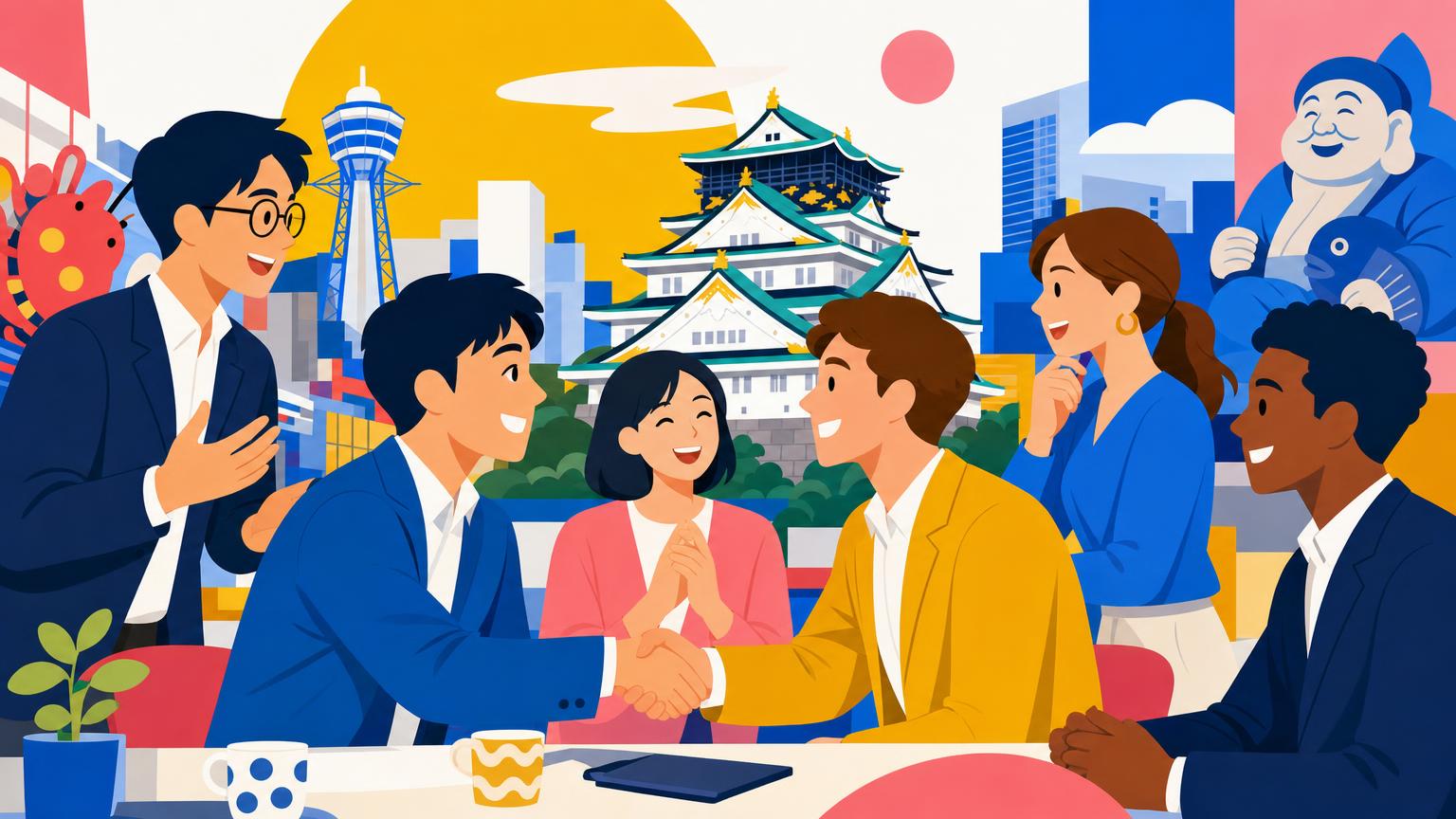
For a foreign resident, one of the most important lessons is that trust in Osaka is often developed through repeated, ordinary contact. The decisive moment may not be the presentation itself. It could be the conversation before the meeting, the follow-up call, the meal after work, or the way you respond to a small mistake.
This may feel inefficient if you come from a culture that keeps social and professional life sharply separate. In Osaka, that boundary can be more flexible. People may want to know whether you are reliable as a person before they decide to rely on your company.
Small talk can be a practical test
When an Osaka colleague asks where you live, what you eat, or how you are adjusting to everyday life in Japan, they may simply be making conversation. However, they may also be observing how you respond to ordinary human interaction.
Do you answer warmly? Do you ask a question in return? Can you laugh about a minor misunderstanding? Do you complain about Japan in a way that sounds curious, or in a way that seems contemptuous? Do you show that you are trying to understand local life rather than treating Osaka as a temporary backdrop?
You do not have to share private information. A brief, natural answer is enough. If you live in Tennoji, Nakazakicho, Juso, Kyobashi, or elsewhere in the region, you could mention what you enjoy about the area. If you are still studying Japanese, you can say so without apologizing repeatedly. The goal is not to perform a local identity but to demonstrate openness.
Food conversations often carry social meaning
Food is an easy subject in Osaka because eating is part of everyday social life. Conversations about restaurants, lunch routines, ingredients, local specialties, and neighborhood shops can help people find common preferences.
This does not mean that every business relationship should be developed through expensive dinners. In fact, an overly elaborate meal may create pressure. A casual lunch near the office, coffee after a meeting, or a simple invitation to join colleagues may feel more natural.
The key idea is kuidaore. The term is often associated with eating until you nearly ruin yourself, but in modern Osaka it suggests the city’s enthusiasm for food, enjoyment, and the social energy surrounding meals. In workplace life, this can mean that meals are more than mere fuel. They provide opportunities to relax, compare opinions, and see another side of someone’s personality.
A colleague who is quiet in the office may become more expressive at lunch. Someone who avoids disagreeing during a formal meeting may explain the real issue over a bowl of noodles. A senior employee may use a restaurant conversation to offer advice that would feel too personal in front of the entire team.
Listen carefully, but do not assume that every off-the-record comment represents an official decision. Social trust and formal authority are connected, but they are not the same.
Do not confuse hospitality with agreement
Osaka hospitality can be warm and energetic. You may be invited to eat, shown around an office, or introduced to several people. You may hear encouraging remarks and receive generous attention.
That does not necessarily mean the deal has been approved.
Some foreigners mistakenly interpret a friendly atmosphere as a business commitment. The opposite mistake is also frequent: they assume that because no one has provided a clear answer, the relationship is breaking down.
Keep the social and formal signals distinct. After a friendly conversation, send a concise follow-up confirming what was discussed, what remains undecided, and what the next steps will be. This is neither cold nor distrustful. It protects the relationship by avoiding conflicting memories of the meeting.
The Osaka Communication Style in Everyday Office Life
The akindo spirit is evident not only in major negotiations but also in small workplace habits. It can be seen in how people discuss schedules, solve problems, voice complaints, serve customers, and decide whether a new rule is useful.
Practical complaints can be a form of cooperation
A colleague who points out that your process is confusing may be helping you. A shop worker who explains that your request will create extra work may be protecting the operation. A team member who says, “That will not work on a busy Friday,” may be sharing knowledge that no spreadsheet contains.
Foreigners sometimes interpret this kind of comment as negativity. In Osaka, criticism can be an expression of participation. People who feel completely detached may say nothing, simply follow the instruction poorly, or avoid responsibility.
The key is to distinguish constructive resistance from personal hostility. Constructive resistance usually includes a reason, an example, or an alternative. Personal hostility attacks the individual without helping the work. Both exist in every city, so focus on the content rather than the accent or volume.
Speed matters, but not reckless speed
Osaka often rewards taking action. People may prefer a rough first step over a perfect plan that never gets started. A test, sample, pilot project, or limited launch can be persuasive because it produces evidence.
However, speed does not mean people want careless promises. If you say you will send a document tomorrow, send it tomorrow. If you do not know, say that you will check. If a deadline is impossible, raise the issue early instead of hoping the problem will disappear.
The merchant perspective values momentum because markets change, but it also values reputation because a damaged relationship is costly. Fast action and dependable follow-through must work together.
Practical language is appreciated
Foreign professionals sometimes overcompensate in Japanese business settings by using language that is too elaborate. They worry that a simple explanation will sound unsophisticated.
In Osaka, clarity is often more impressive than complexity. Explain the problem, the options, the cost, and your recommendation. If your Japanese is limited, use short sentences and confirm important points in writing. If you are speaking English, avoid filling uncertainty with long, abstract phrases.
A useful communication pattern is:
“We can do A by Friday. B would take another week. The risk with A is ____. My recommendation is B because ____.”
This style respects the other person’s time and makes negotiation easier. It also gives them something concrete to respond to.
Kansai-ben and the Meaning Behind the Words
Language can reveal the emotional temperature of an Osaka conversation, but foreigners should be cautious. Kansai-ben is not one uniform dialect, and speech in Osaka varies according to neighborhood, generation, workplace, and social background. Kyoto, Kobe, Nara, and Osaka each have their own distinct flavor.
You do not need to imitate the dialect to be accepted. Forced Kansai-ben can sound theatrical, particularly when you use phrases borrowed from comedy or television. It is generally better to understand a few expressions and respond naturally.
“Mokatte makka?”
Mokatte makka? literally asks, “Are you making money?” It is a well-known Kansai-style greeting associated with merchant culture. In modern office life, however, it is not a universal greeting to use with every colleague or client.
Among people who know each other, it may be used playfully. Between strangers, it can sound old-fashioned, performative, or overly familiar. A foreigner who suddenly begins a formal meeting with it may get a laugh, but not necessarily admiration.
The deeper lesson is more important than the phrase itself. Osaka business culture has long been comfortable discussing livelihood, sales, and practical results. Money is not always treated as an embarrassing subject. Even so, timing and relationships still matter.
“Honma?” and “Sei?”
Honma? means something like “Really?” or “Seriously?” Depending on the tone, it can express surprise, doubt, interest, or amusement. Sei? may be used to ask, “Is that so?” or “Are you sure?”
When you hear these expressions, pay attention to the speaker’s voice and the surrounding context. A cheerful “Honma?” may invite you to explain further. A flat or skeptical version may indicate that your claim is being tested.
“Maido” and familiarity
You may hear maido, a shortened form associated with a familiar customer relationship and often connected to the phrase maido arigato gozaimasu. It conveys a sense of repeated business and mutual recognition.
Do not assume that every use signals deep friendship. In commercial settings, it can simply be a conventional expression. Still, it reflects a world in which ongoing exchange matters: the customer comes back, the shop remembers, and the relationship becomes part of the business.
Use local expressions as signs of listening, not as costumes
A well-timed “honma?” may be appropriate if a colleague has already used it with you and the atmosphere is casual. A simple “ookini,” meaning thank you in a regional style, may be appreciated in some situations, although its use and naturalness vary.
The safest approach is to prioritize sincere Japanese over decorative dialect. Pay attention to how people around you actually speak. Ask what a phrase means, and use it only when you understand its level of familiarity.
The goal is not to sound like a television version of Osaka. The goal is to show that you are paying attention.
What Foreigners Often Misunderstand About Osaka
Osaka can feel accessible to foreign residents because people may speak more openly, joke more readily, or offer practical help. But accessibility is not the same as simplicity. The city has its own social boundaries, and understanding them takes time.
“Friendly” does not mean available
An Osaka colleague may chat with you easily in the elevator while still maintaining a clear boundary around private matters. A shopkeeper may joke with you and still expect you to follow the rules. A manager may tease you and still evaluate your performance strictly.
Warmth is not a promise of unlimited access. Respect working hours, personal space, and professional responsibilities.
Directness does not mean people want confrontation
Osaka communication can be direct, but most people are not inviting you to argue aggressively. If someone points out a problem, respond to the issue rather than escalating the emotion.
You can be clear without becoming combative:
“I understand the concern. I see two ways to address it.”
“That deadline is difficult for us, but we can offer this alternative.”
“I may have misunderstood. Do you mean the budget is fixed, or that you need a lower first payment?”
This style reflects the practical spirit: acknowledge reality, then work through the options.
Humor does not cancel hierarchy
A senior colleague may joke with a junior employee while still expecting appropriate respect. A client may laugh with you and still require an accurate proposal. An owner may speak casually while retaining final decision-making authority.
The tone of the conversation is not the whole structure. Notice who approves, who pays, who does the work, and who carries the risk.
A casual atmosphere may hide careful evaluation
Some Osaka businesses appear relaxed because people are comfortable talking around the issue. That does not mean they are making decisions casually. They may be observing how you respond to uncertainty, whether you listen to operational concerns, and whether you keep your promises after the pleasant meeting ends.
Do not judge seriousness by facial expression or volume. Judge it by follow-up behavior.
How to Adapt Without Losing Your Own Style
Adapting to Osaka workplace culture does not mean becoming a different person. You do not need to perform exaggerated humor, imitate Kansai-ben, or pretend to enjoy every conversation. Instead, you need to become more observant of how trust and value are communicated.
Be warm, then be specific
Begin with human connection, but do not leave the business purpose unclear. After a conversation about restaurants, football, family, or neighborhoods, naturally shift to the purpose of the meeting.
A useful transition might be:
“Speaking of making daily operations easier, I wanted to ask about the delivery schedule.”
This allows the relationship and the task to coexist.
Explain your limits early
The akindo spirit values a realistic boundary more than a beautiful promise. If you cannot meet a deadline, say so before the other side builds a plan around it. If your budget is fixed, explain what that means for the scope. If your Japanese is not strong enough for a complex legal discussion, arrange professional support.
Being honest about your limits can increase trust because it prevents surprises later.
Give people something they can evaluate
Do not present only a vision. Bring a sample, draft, estimate, schedule, comparison, or small trial. Make the proposal easy to discuss.
If you are asking for a major change, show what the first week would look like. If you are requesting investment, explain the assumptions. If you are asking a busy colleague to adopt a new process, show exactly how much time it will add or save.
Concrete information gives Osaka counterparts a way to engage with your idea in their own practical language.
Treat disagreement as information
If someone challenges you, resist the urge to defend every part of your proposal immediately. Ask what problem they see. The objection may reveal a missing cost, an unrealistic assumption, or a concern about internal approval.
You can still disagree. The important thing is to make the disagreement useful.
Follow up in a way that preserves warmth
A cold, overly legalistic follow-up can make a relaxed relationship suddenly feel distrustful. On the other hand, a vague, friendly follow-up can create confusion.
Aim for both:
“Thank you for the helpful discussion today. I understand that the main concern is staff time during the first month. I will send a revised plan by Thursday with two training options. We can then decide whether a small trial is practical.”
This message is polite, specific, and collaborative. It shows that you heard the real concern rather than simply recording the official topic.
Osaka Versus Tokyo in Specific Workplace Situations
The following contrasts are tendencies rather than universal rules. Your actual experience will depend on the company, sector, and people involved. Even so, they can help you interpret the atmosphere more accurately.
When presenting a new idea
In a Tokyo-centered corporate environment, you may be expected to show that the idea aligns with the broader strategy, internal policies, and organizational priorities before discussing the details.
In Osaka, listeners may ask more quickly how the idea benefits customers, reduces costs, or creates a practical advantage. They may also raise the operational burden early on.
Your best preparation is to provide both levels of explanation. Show the strategic rationale, but also explain who will do what on Monday morning.
When discussing price
A formal Tokyo negotiation may emphasize approved pricing structures, procurement procedures, and the decision-maker’s authority.
An Osaka negotiation may focus more visibly on the value of the offer. The other side may compare alternatives, ask what is included, or test how flexible you are.
Do not automatically respond by lowering the price. Clarify the trade-off. A lower price with reduced service may be acceptable. However, offering full service at a lower price may damage your credibility if it cannot be delivered.
When something goes wrong
In any Japanese workplace, people may first try to contain the problem and protect the relationship. In Osaka, you may hear the practical cause discussed more openly after the immediate embarrassment has passed.
You might be asked, “Why did this happen?” in a way that sounds sharp. Respond with facts, responsibility, and prevention. Avoid giving a lengthy emotional defense. Explain what happened, what you have already done, and what will change.
When meeting after work
In Tokyo, after-work networking can be highly structured, particularly within large organizations or industry groups. In Osaka, the same event may feel more conversational and centered around food, with more room for jokes and personal stories.
In both cases, attendance may matter, but you should not assume that every invitation is compulsory. Ask what kind of event it is, who will attend, and whether colleagues expect you to stay for the entire time.
If you drink alcohol, you are not required to drink in order to participate. A respectful explanation is usually enough. The purpose is often the relationship itself, not the alcohol.
Daily Life in Osaka and the Workplace Mindset
The akindo spirit becomes easier to understand when you notice how work connects with ordinary city life. Osaka is dense yet varied. Office towers stand alongside older shopping streets. Small restaurants operate near major stations. Family businesses exist beside international firms. People may commute across neighborhoods where the social atmosphere changes within a short distance.
This mix encourages practical adjustment. You learn which shops remember their customers, which stations become crowded at certain times, which apartment rules matter, which local events affect traffic, and which neighborly habits make daily life smoother.
Foreign residents often discover that Osaka rewards participation more than passive observation. Learn the recycling rules in your building. Greet the owner of the small shop you visit regularly. Notice when a neighborhood becomes busy. Understand that a favor may create a relationship rather than simply solve a single problem.
These are not business tricks. They are part of the same social logic: repeated interaction creates recognition, and recognition creates trust.
Small businesses may have long memories
In a large corporation, one employee may leave and the account may be reassigned. In a small Osaka business, the person who helped you may remember your name, your preferences, and whether you handled a problem responsibly.
This can be reassuring, but it also means that reputation travels through ordinary interactions. Be patient with older systems. Explain your needs clearly. Do not regard a small business as less professional simply because it does not communicate in the polished style of a multinational company.
A family-run supplier may understand its customers more deeply than a large firm. A neighborhood contractor may know how local buildings actually function. A small restaurant owner may serve as an important community connector. The akindo perspective values knowledge built through repeated service.
The city’s warmth has boundaries
Osaka may be easier for some foreigners because casual conversation happens more readily. However, local identity is not an invitation to treat people as entertainment. Do not expect everyone to perform humor, dialect, or hospitality for you.
Respect the difference between a genuine relationship and a stereotype. If you want to understand Osaka, pay attention to how people carry out ordinary tasks, not only how they behave in memorable conversations.
Practical Phrases for Negotiation and Clarification
You do not need advanced Japanese to communicate effectively, but a few simple phrases can help make your intentions clear. Use polite forms appropriate to the relationship, and confirm important matters in writing.
When you need to identify the real concern
“Is the main concern the price, the schedule, or the workload?”
In Japanese, you might say: “Ichiban no shinpai wa, nedan desu ka, sukejuuru desu ka, sore tomo sagyou no futan desu ka?” The exact wording can be adjusted with a Japanese colleague or teacher, but the structure is useful: identify the issue rather than guessing.
When you want an honest opinion
“May I ask for your honest view?”
This can invite honne, but it does not guarantee a completely unfiltered answer. Give the other person room to respond without pressure. A casual setting may help, but do not demand criticism in front of people who might be embarrassed by it.
When you need to slow down
“I want to make sure I understand correctly. Could we confirm the two most important conditions?”
This is particularly useful when a conversation becomes lively and several people start speaking at once. Asking for confirmation is not a sign of weakness. It helps prevent an energetic discussion from becoming an inaccurate agreement.
When you disagree
“I understand the concern, but I think the risk can be managed in this way.”
Avoid framing the disagreement as a victory. In a relationship-oriented business environment, the aim is not to defeat the other person, but to strengthen the plan without damaging future cooperation.
A Practical Approach for Foreign Professionals in Osaka
If you are beginning work in Osaka, think of your first few months as a time for listening. Notice who speaks first, who summarizes the practical issue, who uses humor, who makes the final decision, and who quietly influences the process.
Pay attention to what happens after meetings. Does someone call a supplier directly? Does a manager ask a junior worker about the real situation? Does the official plan change following an informal conversation? These details will teach you more than a list of etiquette rules.
Before a negotiation
Prepare the financial and operational facts. Know your minimum acceptable conditions, but also understand where you genuinely have flexibility. Prepare a brief explanation of value that does not rely on abstract corporate language.
Learn who will use the product or service. If possible, gain an understanding of the company’s actual work rhythm. A proposal that works in a large Tokyo headquarters may not work in an Osaka office with fewer staff and more overlapping responsibilities.
During the meeting
Allow time for conversation. Do not rush to fill every pause, but do not assume that a lengthy discussion means the issue is being avoided. Watch for the point when the practical concern emerges.
If people laugh, remain open. If they challenge the proposal, listen for the useful information. If someone gives you a local recommendation, respond naturally, but do not allow hospitality to distract you from confirming the business conditions.
After the meeting
Send a short, accurate follow-up. Confirm what was agreed upon, what was merely discussed, and what each side will do next. If there is a cultural or language misunderstanding, address it early and without drama.
Then follow through. In Osaka, a dependable second interaction can matter more than an impressive first impression.
The Deeper Meaning of Akindo in Modern Osaka
The modern Osaka workplace is not a preserved merchant town. It encompasses global companies, remote workers, engineers, designers, researchers, public institutions, logistics firms, creative professionals, and people who have moved to the city from other parts of Japan or from other countries.
Yet the akindo spirit remains useful because it describes a practical approach to human cooperation. It asks whether an idea can function beyond the presentation. It values trust that is tested through repeated action. It recognizes that negotiation is part of maintaining balance. It allows room for humor without treating humor as proof of agreement.
For foreigners, the most important adjustment may be learning to hear Osaka communication on two levels.
On the surface, the conversation may be lively, casual, or teasing. Beneath that, people may be assessing value, responsibility, risk, and reliability. The person joking with you may also be carefully judging whether you can deliver. The person who complains may be giving you an opportunity to improve the arrangement. The person who talks about food may be building the relationship that will make honest negotiation possible later.
Osaka is not automatically easier than Tokyo. Its warmth may make entry easier, but its practical expectations can still be demanding. You may be welcomed into conversation quickly and still need months to earn deep trust. You may receive frank feedback and still need to understand the indirect signals surrounding formal decisions.
If you approach the city with curiosity, restraint, and a willingness to discuss real conditions, the akindo spirit can become an advantage. You will learn when to be direct, when to soften a point with humor, when to ask about the honest concern, and when to stop talking and let a relationship develop through repeated, ordinary contact.
That is the heart of modern workplace communication in Osaka: neither business without manners nor friendliness without standards, but a practical exchange between people who want the relationship—and the work—to continue functioning after the meeting ends.