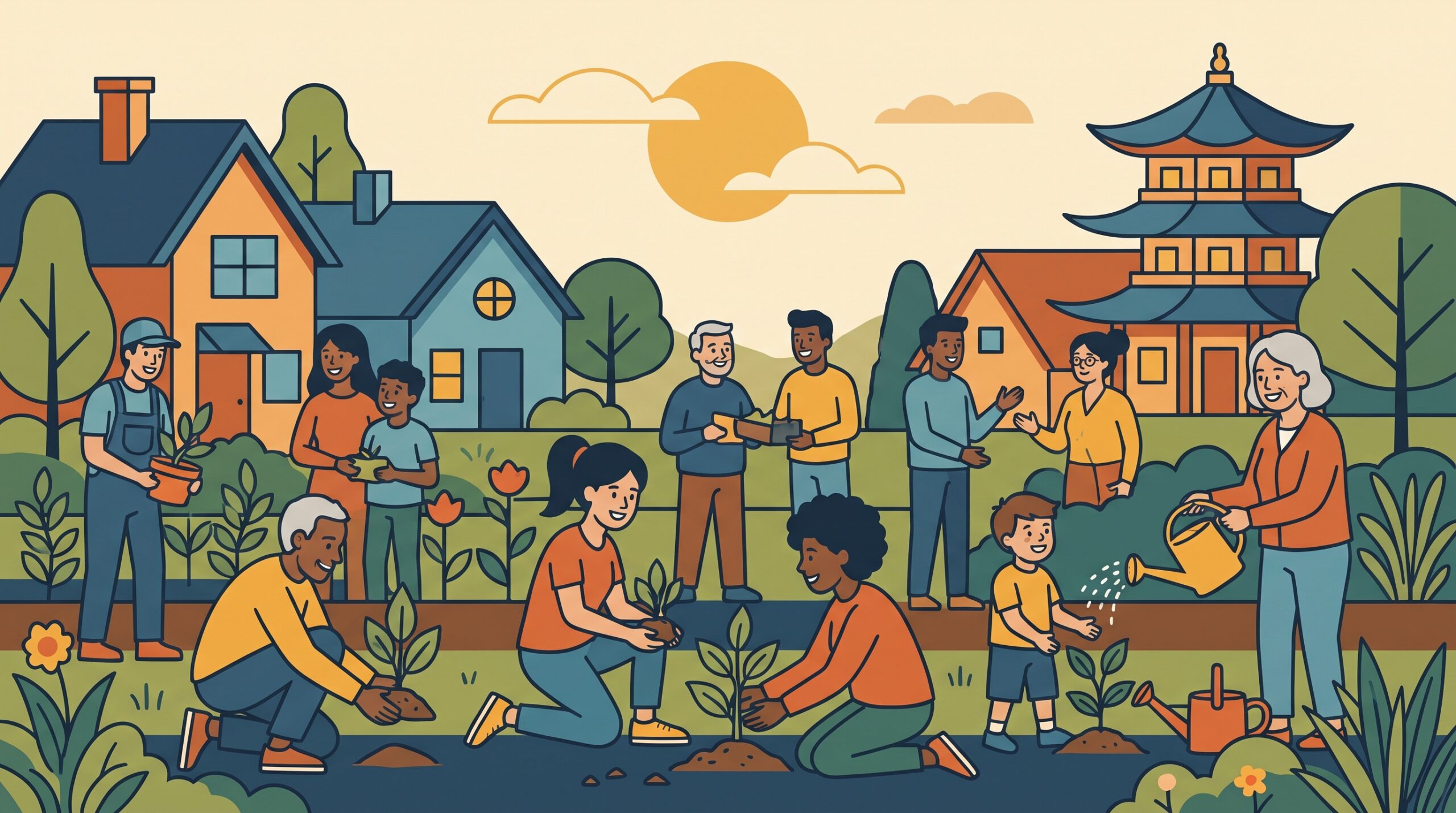
When most people picture Osaka, their minds immediately flood with flashing neon lights, the chaotic energy of Dotonbori, and the loud, rhythmic chants of street vendors selling takoyaki. The city is often painted as a playground of food, commerce, and unapologetic exuberance. But when you step off the main avenues and wander into the quiet residential wards of Tennoji, Fukushima, or the charmingly retro streets of Nakazakicho, a completely different world emerges. The neon fades into the soft glow of streetlamps. The loud hustle is replaced by the gentle clatter of bicycles and the quiet murmur of neighbors chatting over low walls. As someone who spends long vacations exploring the hidden corners of cities around the world, I have always been fascinated by what holds a neighborhood together. Behind the stylish facades and the fashionable streetwear of the locals lies a deeply ingrained, almost invisible social fabric. In Japan, this fabric is woven by the neighborhood association.
For a foreign resident moving to Osaka, the concept of a neighborhood association might seem like a relic of the past or an unnecessary bureaucratic hurdle. You might rent a beautiful apartment, organize your chic interior, and think your relationship with the neighborhood ends at your front door. But in Osaka, community life does not stop at the threshold. It spills out into the streets, into the garbage collection areas, and into local festivals. Understanding how these associations work is the key to truly understanding the heartbeat of this city. It is the difference between simply residing in Osaka and actually living in it. As a woman who values safety, community, and the aesthetic harmony of a neighborhood, I have learned that the secret to a secure and vibrant local life lies in this very system. Before we dive into the intricate rules, the unspoken expectations, and the lively community culture of Kansai, let us ground ourselves in the physical geography of the city where these daily dramas unfold.
What is a Jichikai? Understanding Neighborhood Associations in Osaka

To understand the rhythm of daily life in Japan, you first need to grasp the concept of the Jichikai. Literally translated, it means an autonomous community council or neighborhood association. This is a hyper-local organization formed by residents of a specific area to manage shared spaces and common interests within the neighborhood. Although the Jichikai is not a branch of the city government, it works closely with municipal authorities to help the neighborhood run smoothly.
In a vast city like Osaka, the city administration cannot handle every minor issue on every narrow street. The city depends heavily on the Jichikai to serve as the community’s eyes, ears, and hands. They ensure that the local park is cleaned, streetlights function properly, and elderly residents living alone are checked on during heatwaves. This system is based on mutual reliance—an unspoken agreement that the quality of your daily life largely depends on the strength of your relationships with your immediate neighbors.
Jichikai vs. Chokai: Local Terminology in the Kansai Region
If you search for Japanese neighborhood associations online, you will almost exclusively find the term Jichikai. However, Osaka fiercely preserves its local identity, dialect, and unique customs. When you move into a residential neighborhood in Osaka and speak with your landlord or real estate agent, you might never hear the word Jichikai. Instead, they will refer to the Chokai, or sometimes the Shinko-chokai.
While Jichikai is the standard nationwide term commonly seen in formal paperwork, Chokai is the preferred colloquial and organizational term in Kansai. A Chokai operates just like a Jichikai, but the terminology reflects the city’s historic division into cho, or small town blocks. When a neighbor knocks on your door to introduce themselves, they’ll say they represent the local Chokai. Knowing this regional term is your first step toward local integration, signaling that you’re attentive to Osaka’s specific cultural landscape rather than applying a generic understanding of Japan. Recognizing the Chokai means speaking their language—both literally and figuratively.
Are They Similar to HOAs (Homeowners Associations)?
For many expats from North America, the idea of a mandatory neighborhood association immediately brings to mind Homeowners Associations, or HOAs. While a natural comparison, it’s fundamentally inaccurate. Approaching an Osaka Chokai with an HOA mindset will lead to a profound misunderstanding of its purpose.
An American HOA primarily exists to protect property values and enforces strict aesthetic rules. It will fine you if your grass grows a quarter-inch too long, if your front door is painted the wrong shade of blue, or if you park a commercial vehicle in your driveway. It is punitive, legalistic, and often adversarial.
By contrast, the Osaka Chokai cares nothing about the color of your door or property value. Their concern lies with the community’s survival, safety, and social cohesion. The Chokai is founded on shared civic responsibility, focusing entirely on practical and communal matters. Who will clean up shattered glass after a typhoon? The Chokai. Who organizes the children’s patrol to ensure kids walk safely to school? The Chokai. This organization is rooted in mutual aid rather than aesthetic control. For a young woman living alone, this focus is especially reassuring—you quickly realize the neighborhood isn’t watching for faults but rather watching out for your safety.
The Core Roles of a Jichikai in Osaka
The theoretical idea of community support sounds appealing, but how does it actually play out in the daily grind? The role of the Chokai in Osaka is highly practical. It entails physical work, continuous communication, and a shared responsibility for the ordinary realities of urban survival.
Managing Local Garbage and Recycling Stations
One undeniable truth about living in Japan is that garbage disposal is taken very seriously. In Osaka, managing the local garbage station is the most important, visible, and often contentious duty of the Chokai.
In most residential wards, garbage isn’t collected from individual homes. Instead, residents bring their sorted trash to designated communal spots on specific mornings. These spots are completely overseen by the local Chokai, which uses membership fees to buy the heavy blue nets used to cover garbage bags and prevent crows from tearing them apart. They also purchase the brooms and dustpans for cleaning the area.
More importantly, the Chokai organizes a rotation system for maintaining the garbage station. When it’s your turn, you must go to the station after the garbage truck leaves, sweep up any leftover debris, fold the blue net, and ensure the area is clean for pedestrians. Refusing to join the Chokai means using a communal resource without helping to maintain it. In Osaka, where fairness and straightforwardness are highly valued, free-riding on neighbors’ efforts quickly leads to social exclusion. The local aunties will notice, remember, and silently judge. Participating in the trash rotation is the simplest, most concrete way to show respect for your neighborhood.
The Kairanban (Circular Notice) System Explained
Despite living in an era of instant digital communication with group chats, email threads, and community apps, neighborhoods in Osaka still rely on a system called the Kairanban.
The Kairanban is a physical clipboard containing notices from the city ward, updates from local police about recent scams or suspicious activity, schedules for local cleaning days, and information about upcoming festivals. This clipboard is placed in the mailbox of the first house on the block. The resident reads the notices, stamps their personal seal or signs the routing slip, and then physically walks next door to drop the clipboard in their neighbor’s mailbox.
To foreigners, this analog system may seem oddly inefficient. Why not just email a PDF? But efficiency isn’t the true purpose of the Kairanban. Its aim is micro-interaction. It imposes a physical rhythm on the neighborhood, ensuring neighbors implicitly acknowledge each other’s presence. If the clipboard stays at one house for three days, the next-door neighbor knows to check in on the elderly resident. It’s a slow, steady heartbeat that keeps the community connected. When the Kairanban arrives at your door, you’re taking part in a ritual that has united Osaka neighborhoods for decades.
Earthquake and Disaster Preparedness in Kansai
Japan is a seismically active country, and the Kansai region holds a deep collective memory of the 1995 Great Hanshin Earthquake. When the earth shakes violently, emergency services are quickly overwhelmed. Firefighters and paramedics cannot reach everyone immediately. In the critical first hours after a major disaster, your survival depends entirely on the people living within a fifty-meter radius.
This is when the Chokai moves from being a quaint neighborhood group to a vital lifeline. These local associations keep stockpiles of emergency supplies, helmets, and first-aid kits. They organize annual disaster evacuation drills in local parks. They maintain confidential maps identifying residents who are elderly, disabled, or foreign and may need extra help with evacuation or understanding emergency instructions.
Foreign residents searching online for official municipal guidance, often looking for PDF documents detailing their civic roles in Osaka, will find the city government strongly stresses this point. Joining the Chokai integrates you into the local disaster response network. It ensures that if disaster strikes, someone knows you’re there and will look out for you. From a personal security and peace of mind perspective, the small monthly fee to join the association is the most affordable and effective disaster insurance you can get.
Osaka’s Unique Community Culture and Local Festivals
To truly understand the essence of the Chokai, you need to grasp the psychological and cultural differences between Osaka and other Japanese cities, especially Tokyo. The people of Osaka approach community life with a unique spirit, marked by warmth, straightforwardness, and a deep passion for a lively celebration.
Community Bonding Through Local Matsuri
In Tokyo, a neighborhood festival can often feel like a polite, well-organized, and somewhat distant event. In Osaka, a local matsuri is an intense, sweaty, loud, and deeply communal burst of energy. Whether it’s the thrilling, fast-paced danger of the Danjiri pulling in southern Osaka or the rhythmic, mesmerizing dance circles of a local summer Bon Odori, these festivals are the very heart and soul of the neighborhood.
Who organizes, funds, and carries out these festivals? The Chokai. The association spends months coordinating logistics, obtaining permits, hanging lanterns, and constructing yagura towers. The vibrant happi coats worn by festival participants aren’t just costumes; they serve as uniforms that identify the specific street or block you belong to. From an aesthetic and fashion perspective, seeing a neighborhood mobilize in matching, crest-emblazoned coats is striking; it’s a visual expression of unity.
Living in Osaka, the Chokai isn’t just asking you to sweep the street—they are inviting you to join in the celebration. Taking part in the local matsuri, even by simply attending and buying a shaved ice from a neighborhood stall, signals your willingness to share in their joy. It breaks down cultural barriers far more quickly than any formal introduction could.
The Friendly and Direct Nature of Osaka Residents
It’s a common cliché that Osaka people are friendly, but simply calling them friendly overlooks the nuances of how they engage with others. Tokyo people are polite; they give you space, respect your privacy, and may ignore you out of courtesy. Osaka people are warm, intrusive, and boldly caring. They won’t ignore you.
If you put out your trash on the wrong day in Tokyo, a neighbor might silently stew or leave a politely worded anonymous note on your door. In Osaka, a local auntie will likely come right up to you, point at the bag, and tell you directly that you got the day wrong. She might scold you loudly in rapid-fire Kansai dialect, but right afterward, she’ll probably offer you a piece of hard candy from her purse and ask where you bought your jacket.
This directness can be surprising to foreigners who expect typical Japanese reserve, but it’s a gift. It means you always know exactly where you stand. The Chokai works on this same principle of boisterous, direct community care. They don’t want you to be a silent, isolated ghost in your apartment. They want to know you, complain to you, and include you. Embracing this warm friction is essential to thriving in the city.
Do Foreign Residents in Osaka Have to Join the Jichikai?
This is the most practical question every new expat encounters when signing their lease. The landlord mentions the Chokai, hands over a registration form, and you’re left wondering: Is this really mandatory? What happens if I refuse? How do I navigate this system when I barely speak the language?
Understanding Membership Fees and Civic Duties
Legally, joining a neighborhood association in Japan is completely voluntary. The Supreme Court of Japan has ruled that no one can be forced to join. However, the social reality in an Osaka neighborhood differs significantly from the strict letter of the law.
The membership fee, called chokai-hi, is usually quite small, ranging from two hundred to five hundred yen per month. Sometimes it’s collected annually in cash by a neighborhood representative; other times your landlord automatically includes it in your monthly rent. While you can legally decline, doing so often causes unnecessary social friction. When you refuse to pay a few hundred yen a month, you signal to the community that you don’t care about street sweeping, disaster preparedness, or the blue nets that keep crows away from your garbage. You signal that you want the benefits of a safe, clean neighborhood without contributing to the unseen efforts that maintain it.
For foreign digital nomads or property buyers looking to establish a long-term presence, opting out is a poor strategy. Official guidance from Osaka municipal offices strongly encourages foreign residents to join, specifically to prevent the isolation of non-Japanese speakers during emergencies. Paying the small fee is a gesture of goodwill, showing that you respect the unspoken rules of the community you’ve just joined.
How to Navigate the Language Barrier
The most common reason foreigners hesitate to join the Chokai is the language barrier, and this anxiety is entirely understandable. The Kairanban circulars are written in dense Japanese, and community meetings are conducted in fast, colloquial Kansai dialect. You might worry that joining means sitting through hours of conversation you can’t understand, or worse, being assigned administrative tasks you can’t handle.
But the wonderful reality in Osaka is that perfection is rarely expected, especially from foreigners who show genuine effort. Local residents know you don’t speak perfect Japanese. They don’t expect you to become Chokai president or manage the association’s finances. What they value is your presence and positive attitude.
Navigating the language barrier requires practical strategies rather than fluency. When the Kairanban arrives, use a translation app on your phone to scan the page and grasp the basic schedule. Stamp your seal and pass it along promptly. When neighborhood cleaning day comes, you don’t need to give a speech; just show up with gloves, grab a broom, and sweep gutters alongside local grandfathers. A smile, a cheerful greeting in whatever Japanese you can manage, and a willingness to pitch in for thirty minutes will earn you more respect than perfect grammar ever could.
Living in Osaka is a rich, dynamic, and wonderfully chaotic experience. The city thrives on human connection, shared responsibilities, and a collective spirit that ensures no one slips through the cracks. The Chokai is at the heart of this spirit. By understanding its role, joining its rhythms, and embracing the direct, warm nature of your neighbors, you’re not only securing a peaceful daily life—you’re unlocking the true, hidden beauty of Osaka, turning a foreign city into a place you can genuinely call home.