Step off the Shinkansen at Shin-Osaka Station, take the subway down into the beating heart of the city, and you will immediately notice a shift in the atmosphere. The air feels thicker. The volume of the streets turns up. The physical distance between people seems to shrink. If you are coming from Tokyo, where public spaces are governed by an unspoken agreement of silent, frictionless efficiency, Osaka can feel like an entirely different country. As an event planner born and raised in Tokyo who now spends half my life organizing local festivals down here in the Kansai region, I still remember the intense culture shock of my first grocery run in Osaka. I was not just a customer; I was suddenly an active participant in a daily, unscripted street theater.
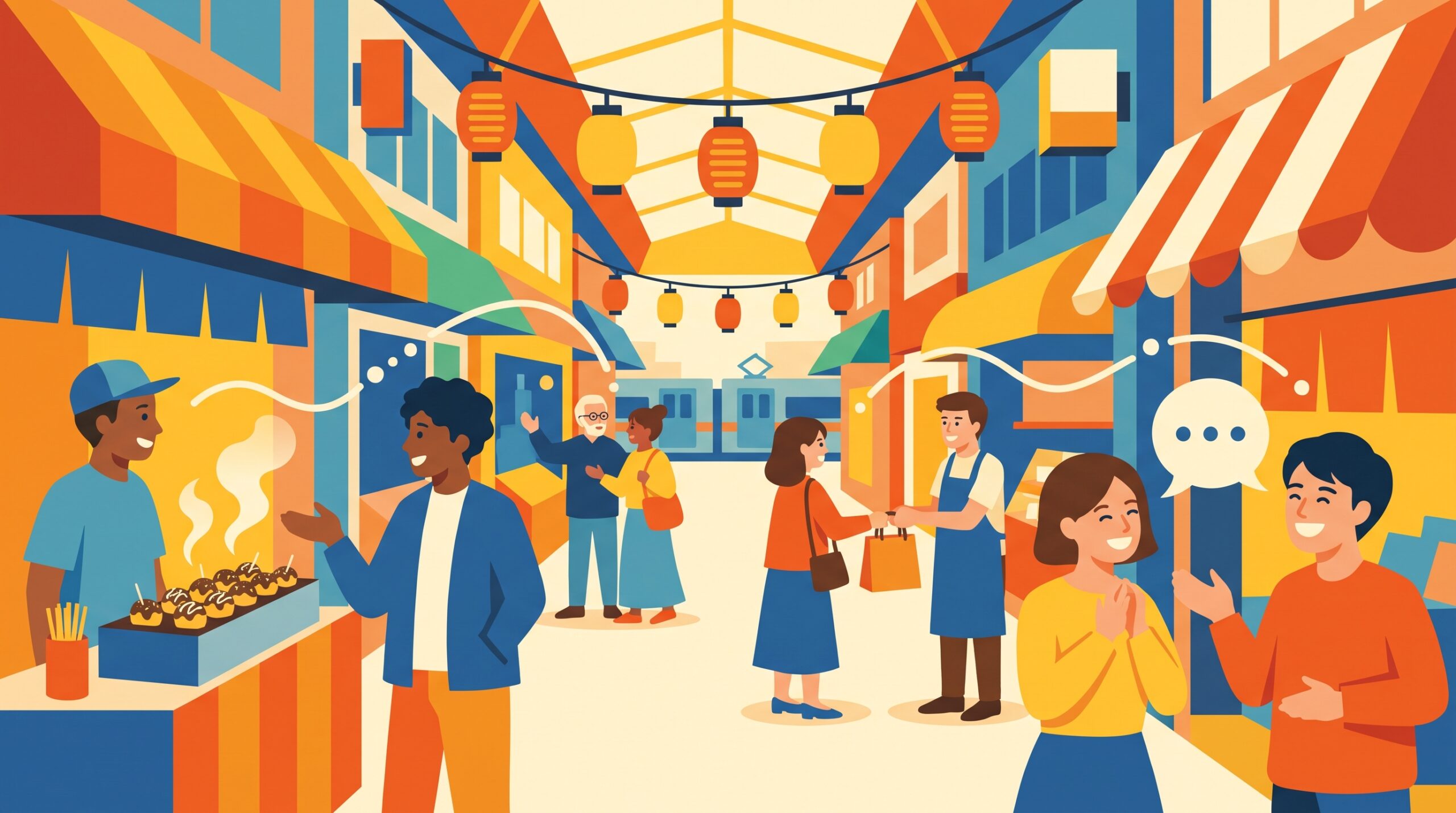
To truly understand daily life in Osaka, you have to look past the neon glow of Dotonbori and the towering walls of Osaka Castle. You have to step away from the polished department stores of Umeda and venture into the shotengai. The shotengai, or local covered shopping arcade, is the undisputed soul of Osaka. It is where the city’s true pulse can be felt. It is where food is bought, gossip is exchanged, alliances are formed, and the rhythmic, musical banter of the Kansai dialect bounces off the vaulted glass ceilings.
For foreign residents settling into life in Japan, navigating these arcades can initially feel intimidating. The sensory overload of bright handwritten price tags, the aggressive smell of fried food, and the booming voices of shopkeepers shouting their daily specials can make you want to retreat to the quiet aisles of a sterile supermarket. But doing so means missing out on the very essence of what makes Osaka an incredible place to live. The shotengai is not just a place of commerce. It is a living, breathing community center. It is a place where communication is the currency that matters just as much as the yen in your wallet.
Many guidebooks will simply tell you that Osaka people are friendly. They throw around the word friendly as if the entire city is just waiting to give you a hug. But that is a surface-level cliché that fails to capture the complex, rhythmic, and sometimes demanding nature of Osakan social interaction. The friendliness here is not passive. It requires your engagement. It operates on a specific frequency, a back-and-forth volley of words, gestures, and reading the room. If you want to move beyond being a perpetual outsider and start feeling like a true local, you need to understand the underlying mechanics of this communication. You need to understand that when a shopkeeper yells out, they are not just announcing a sale. They are inviting you into a conversation.
Unpacking the Allure of Communication in Osaka’s Shotengai
To understand why communication is the absolute foundation of the Osaka shotengai experience, we must shed modern assumptions about retail and explore the city’s historical DNA. Osaka has always been a city of merchants. Long before Tokyo became the political capital, Osaka was known as the Kitchen of Japan, a vast logistics and trading center where rice, produce, and goods from across the archipelago were bought and sold. This merchant culture is not a relic in a museum; it is a living mindset that governs how people interact on the streets every day.
The Merchant City Legacy and the Culture of Face-to-Face Sales
In Tokyo, retail transactions are mostly designed to be seamless. You pick up an item, place it on the counter, the clerk scans it, you pay, they say a polite, standardized phrase, and you leave. It is an elegant system of efficiency, but it is fundamentally a one-way broadcast. The clerk speaks at you, not with you.
Osaka, in contrast, thrives on friction—the good kind. The merchant city legacy dictates that a transaction is a relationship. When you approach a produce stand in a local shotengai, the daikon radish is not merely tagged with a price; it comes with a story, and the shopkeeper wants to share it. They’ll tell you where it came from, how to cook it, and why it’s better than the daikon sold three shops down. Face-to-face sales, or taimen hanbai, are the lifeblood of these arcades.
What makes this communication charming is its raw honesty. An Osaka shopkeeper will often advise you against buying something if they feel it isn’t good today. They might look you in the eye and say the strawberries are a bit sour this week, so hold off and try the mandarin oranges instead. This level of candor builds instant trust. It breaks down the rigid barrier between consumer and seller. When a shopkeeper offers this kind of unsolicited advice, they treat you not as a walking wallet, but as a neighbor. This is the essence of Osaka’s retail charm: commerce infused with humanity.
Human Warmth, Giri Ninjo, and the Community Woven by Osaka Obachan
You can’t discuss the atmosphere of an Osaka shotengai without mentioning giri ninjo and the powerful cultural force known as the Osaka Obachan. Giri ninjo roughly means duty and human emotion, or empathy. It’s an old-fashioned Japanese concept that survives in its purest form within Kansai’s covered arcades. It embodies the unspoken rule that people should look out for one another, that rules may be bent for kindness, and that community harmony matters more than strict rule-following.
The Osaka Obachan—the quintessential middle-aged or older neighborhood woman—is the ultimate enforcer of this giri ninjo. You’ll see them in the shotengai, often wearing bold patterned clothes, riding bicycles with umbrella stands on the handlebars, moving through crowds with undeniable authority. They are the social glue of the arcade. An Obachan doesn’t just shop; she patrols. She knows the shopkeepers, their children, the local gossip, and won’t hesitate to strike up a conversation with a complete stranger if she feels like it.
For a foreign resident, being approached by an Obachan can be surprising. They may comment on what you’re buying, ask where you’re from, or offer candy from their purse. The famous Ame-chan culture—where older women carry hard candies specifically to hand out as social icebreakers—is a perfect example of Osaka communication. The candy is an excuse to talk. It’s a small, sweet bridge built between strangers. When you understand these interactions stem from a deep-rooted culture of communal empathy, the shotengai stops feeling like a crowded marketplace and begins to feel like a large, shared living room.
How Osaka’s Communication Style Contrasts Sharply with Tokyo
The difference between my native Tokyo and my adopted city of Osaka is most obvious in the soundscape of the shopping streets. In Tokyo, the standard greeting is Irasshaimase, meaning welcome. It is polite and professional but a closed loop. You’re not expected to respond to Irasshaimase; in fact, replying might confuse staff. It’s background noise designed to make the space seem busy without demanding anything from customers.
In an Osaka shotengai, the soundtrack is entirely different. You’ll hear Irasshaimase, but it is often drowned out by the more powerful and versatile Maido. Maido literally means every time but functions as a communication multi-tool. It means hello, thank you, and thanks for your continued patronage. Most importantly, Maido is an invitation. When a fishmonger locks eyes with you and shouts Maido, they acknowledge your presence and throw a conversational ball into your court.
This requires a completely different psychological stance from the customer. In Tokyo, you can stroll through shopping streets encased in an invisible bubble of anonymity. In Osaka, shopkeepers actively use verbal “needles” to pop that bubble. They employ humor, exaggerated reactions, and direct eye contact to draw you into their orbit. If you stand in front of a butcher shop looking unsure, they won’t wait for you to ask a question; they’ll lean over the glass case and ask what you plan to cook for dinner. This absence of boundaries is often misunderstood by foreigners. It is not rudeness or disrespect for privacy but an active inclusion tactic. It’s their way of saying you are here, you belong, and you’re expected to be part of the scene.
Deep Dives into Four Iconic Osaka Shotengai for Authentic Local Interaction
If you want to experience this rhythmic, dynamic form of communication firsthand, you need to know where to go. Osaka is home to hundreds of shotengai scattered throughout its wards, each offering its own unique flavor, demographic, and conversational style. These are not tourist traps designed for sightseeing; they serve as vital arteries of daily life. For residents or long-term visitors aiming to grasp the true essence of the city, these four arcades serve as ideal classrooms for learning the local social rhythms.
Tenjimbashisuji Shotengai: Japan’s Longest Arcade and a Center for Standing Bars and Delis
Spanning an impressive 2.6 kilometers across three different subway stations, the Tenjimbashisuji Shotengai stands as a remarkable testament to Osaka’s retail culture. Strolling from one end to the other offers a cross-section of the city’s society. It’s a marathon of sensory experiences, filled with drugstores, knife shops, tea vendors, clothing boutiques, and an endless variety of food stalls.
What makes Tenjimbashisuji essential for understanding communication in Osaka is its high concentration of delis, butcher shops selling freshly fried croquettes, and especially tachinomi or standing bars. The dynamic at a specialty deli here is incredibly fast-paced. You’ll find shops offering dozens of types of traditional Japanese side dishes, presented in large bowls. Shopkeepers are masters of upselling, but they do so through lively banter. If you point to the potato salad, they will instantly ask if you want simmered hijiki seaweed to pair with it because it’s particularly good today. Their rapid-fire Kansai dialect almost sounds like a melody.
The real magic happens in the standing bars lining the side alleys of the arcade. Tachinomi culture in Tenjimbashisuji acts as the ultimate equalizer. With no seats, there are no physical barriers to movement. You stand shoulder to shoulder with office workers loosening their ties, local retirees nursing inexpensive glasses of shochu, and young couples on budget-friendly dates. Communication here is inevitable. If you try to order a drink and the bartender can’t hear you over the noise, the older man next to you will likely shout your order on your behalf. This is the Osaka way. Personal space is temporarily suspended in favor of collective enjoyment. If you spend more than thirty minutes in a Tenjimbashisuji tachinomi without someone asking where you’re from or making a joke about the baseball game on the TV overhead, that would be a true rarity.
Senbayashi Shotengai: Energetic Greetings and a Deep Downtown Vibe
Heading northeast from the city center along the Keihan Main Line, you’ll arrive at Senbayashi Shotengai. This is truly deep local territory. Senbayashi is renowned among Osakans as the battlefield for cheap prices. It’s a fiercely competitive retail environment where greengrocers, clothing stores, and daily goods shops vie for the attention of a highly discerning, budget-conscious local clientele.
The communication style in Senbayashi is loud, proud, and completely unpretentious. This is where you hear the raw, unfiltered volume of Osaka retail. Shopkeepers stand outside with megaphones or simply use their naturally booming voices to shout out the price of cabbage. The energy here is contagious. Because the shoppers are mostly local regulars who have frequented the same shops for decades, the banter is incredibly familiar. You’ll hear shopkeepers calling customers by their first names, playfully scolding them for not visiting recently, or debating the merits of different pork cuts.
For foreign residents, Senbayashi is an excellent place to practice active listening. The vendors don’t tailor their Japanese to tourists; they speak pure, rapid local vernacular. Yet beneath the loud exterior lies a deep well of patience for those who make an effort. If you approach a fishmonger in Senbayashi and ask how to prepare a particular seasonal fish, they’ll likely pause their shouting, lean in, and offer a meticulous, step-by-step recipe, complete with hand gestures. Senbayashi teaches that the loud, chaotic volume of Osaka is not aggression—it’s a vibrant expression of life.
Komagawa Shotengai: Lively Face-to-Face Sales Blending into Everyday Osaka Life
In the southern part of the city, within Higashisumiyoshi Ward, lies Komagawa Shotengai. It is laid out in a cross shape and is widely regarded as one of Osaka’s three great shotengai, alongside Tenjimbashisuji and Senbayashi. Komagawa maintains a strong 昭和-era nostalgic atmosphere. It feels like a place where time slows down a little, allowing for longer, more meaningful exchanges between buyers and sellers.
Komagawa is famous for its dense concentration of traditional, specialized food vendors. Here you’ll find the tofu maker who has been grinding soybeans in the same spot for fifty years, the tsukemono pickle vendor with wooden barrels lining the storefront, and the butcher who knows exactly how thin you prefer your beef slices. Communication here is less about shouting and more about sustained, everyday relationships.
Shopping in Komagawa means participating in a daily ritual. Conversations typically revolve around the seasons, the weather, and family health. It’s an excellent spot for new residents to establish a routine. Visit the same vegetable stand in Komagawa three times, and the shopkeeper will remember your face. By the fourth visit, they’ll likely anticipate your preferences. Here you learn that Osaka communication isn’t just about witty comebacks and jokes—it’s also about building quiet, dependable trust. The smile you receive from a Komagawa vendor when handing over your change stems from the satisfaction of mutual recognition. They are acknowledging that you’ve become part of their daily rhythm.
Sennichimae Doguyasuji Shotengai: Professional Banter and Specialized Expertise
Just a short walk from the tourist chaos of Namba and Dotonbori, Sennichimae Doguyasuji Shotengai offers a different kind of interaction. This is the kitchenware street. It’s where chefs, restaurant owners, and takoyaki masters in Osaka come to purchase their tools, ranging from massive industrial fryers to delicately forged sashimi knives.
Because the primary customers here are professionals, the communication style is distinct. It’s less about loud bargaining and more about deep, technical knowledge shared with dry Osaka wit. The shopkeepers are craftsmen and experts in their fields. When you visit a knife shop or ceramics store here, you’re dealing with people who have encyclopedic knowledge of their products.
The banter in Doguyasuji is a fascinating mix of respect and pragmatism. A shopkeeper might politely advise that a particular expensive knife is too advanced for a beginner and recommend a more practical, affordable option. This reflects the core of Osaka merchant honesty. They prefer making a smaller sale and gaining a lifelong customer rather than a quick profit from someone less informed. For foreign residents setting up a kitchen, engaging with these vendors is a masterclass in specialized Japanese. Ask about maintenance, materials, and the history of the tools, and the shopkeepers will respond with detailed enthusiasm, showcasing the deep pride they take in supporting the city’s culinary infrastructure.
Essential Techniques for Enjoying Communication in the Shotengai
Knowing where to go is only half the challenge. The true difficulty—and the real pleasure—lies in engaging with the people. For many foreigners, language barriers and the fear of making cultural mistakes can cause them to freeze, limiting interactions to silent purchases at chain stores. But Osaka is remarkably forgiving. The city values effort far more than perfection. To experience the warmth of the shotengai, you need to adopt a particular mindset and learn some practical techniques for navigating conversations.
Starting Simple with Greetings Like Konnichiwa and Ookini
The easiest way to show you’re open to communication is through your greetings. In Tokyo, you can enter and leave a small shop in total silence. In an Osaka shotengai, silence is a missed opportunity.
When you enter a small shop, especially one where the owner sits behind the counter, a bright, audible Konnichiwa is your entry ticket. It instantly changes the mood, shifting you from an anonymous customer to a welcomed guest.
But the real secret weapon in Osaka is the word Ookini. Ookini is the standard Kansai dialect expression for thank you. It’s used interchangeably with Arigatou gozaimasu but carries a much warmer, more local feeling. Using Ookini as a foreigner immediately breaks the ice. It shows you’re not just living in Japan but are attuned to Osaka’s local culture.
Timing is everything with Ookini. The best moment to say it is at the very end of the transaction, just as you’re taking your bag or receiving your change. The shopkeeper will hand you your items and say Maido or Ookini, and if you respond with a smile and a genuine Ookini, you’ll almost always get a surprised, delighted reaction. It’s a linguistic high-five that proves you’re listening to the city’s rhythm and trying to join in.
Engaging with Face-to-Face Vendors at Greengrocers, Delicatessens, and Konamon Stalls
The real test of your communication skills comes at the taimen hanbai, the face-to-face counters. Whether you’re buying sweet potatoes from a greengrocer, selecting tempura at a deli, or waiting for a fresh batch of takoyaki at a street stall, you have the vendor’s full attention for anywhere from thirty seconds to a few minutes.
Avoid looking at your phone during this time. Look at the food. Look at the vendor. The easiest way to start a conversation is by asking for a recommendation. Point at a vegetable you don’t recognize and ask how to eat it. Ask what’s freshest today. The phrase Kyou no osusume wa nan desu ka? (What is today’s recommendation?) is a magic key to unlocking the shopkeeper’s expertise.
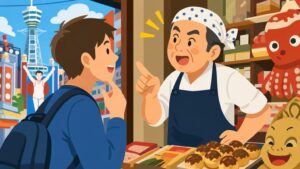
At a konamon stall—places selling flour-based foods like okonomiyaki and takoyaki—the interaction often centers on the cooking process itself. Making takoyaki is a visual spectacle. Standing at the counter and simply marveling at their speed with a phrase like Sugoi desu ne (That’s amazing) will inevitably elicit a proud smile and spark a chat. They might ask how long you’ve lived in Japan or if you can handle spicy foods. Answer honestly. The goal isn’t grammatical perfection; it’s sharing a human connection over a hot grill.
Mustering the Courage to Step into Standing Bars and Local Hangouts
If retail counters are the introduction to Osaka communication, tachinomi standing bars are the masterclass. Walking into a crowded, smoky standing bar in a shotengai can feel daunting. Everyone seems familiar with each other. Menus are often handwritten on pieces of paper pinned to the wall with heavily stylized Japanese characters that defy dictionary translation.
The key here is humility paired with confidence. Walk in, raise one finger to indicate you’re alone, and let the bar master guide you where to stand. The concept of tsumeru—squeezing together to make room for a newcomer—is fundamental here. As people shift to accommodate you, offer a slight bow and a quiet greeting to your immediate neighbors.
Once you have your drink, the best approach is simply to appear approachable. You don’t have to force a conversation. In a genuine Osaka tachinomi, conversation usually finds you. Someone will notice you wrestling with the handwritten menu and offer a recommendation. When that happens, accept it graciously. If a slightly tipsy older gentleman wants to practice his English with you, go with the flow. Interactions here are fluid, fleeting, and incredibly warm. This is where barriers of nationality, age, and occupation dissolve in the shared pleasure of a cheap beer and good company.
The Art of the Comeback and Reading the Air
Osaka is Japan’s comedy capital, home to the massive Yoshimoto Kogyo entertainment group and the birthplace of countless manzai comedy duos. This comedic culture strongly shapes daily communication. Conversations here often follow a rhythmic pattern of boke and tsukkomi: a funny or absurd statement followed by a sharp, grounding response.
While no one expects foreigners to master Japanese stand-up comedy, understanding this pattern is key to reading the air. If a shopkeeper makes a joke—often an over-the-top claim like a certain fish will make you ten years younger—they’re throwing you a boke. The correct response isn’t to take it literally or look confused. Instead, laugh, smile, and ideally offer a gentle tsukkomi, a mild rebuttal. A simple Honto ni? (Really?) said with a skeptical but friendly tone often completes the comedic exchange.
This playful banter signals affection. It shows they feel comfortable enough to drop the stiff, formal customer-service act. When an Osaka shopkeeper teases you, you’ve officially been accepted. Learning not to take yourself too seriously is the most important mindset shift when living in this city.
Moving Beyond Transactional English and Embracing Flawed Japanese
Many foreigners fall into the trap of thinking that because they can’t speak perfect Japanese, they shouldn’t try at all. They rely on translation apps or silently point at menus. While shopkeepers in Osaka are generally accommodating and many are learning basic English to assist tourists, relying solely on English creates an invisible barrier between you and the authentic shotengai experience.
The beauty of communication in Osaka is its remarkable tolerance for mistakes. Locals appreciate the effort. If you fumble a sentence, use the wrong particle, or mispronounce a word, they won’t judge you. They’ll likely help complete your sentence, laugh warmly, and give you what you need. Embracing your imperfect Japanese is a superpower. It shows vulnerability, and vulnerability builds instant rapport.
Throw in a few Kansai dialect phrases, like Meccha oishii (Very delicious) instead of the standard Totemo oishii, or Bochibochi denna (So-so, or getting by) when asked how you’re doing. The shock of a foreigner using deep local slang is universally delightful in Osaka. It breaks the tension and immediately brands you as someone who embraces local culture rather than merely observing it from afar.
Precautions, Manners, and Reading the Local Vibe
While the Osaka shotengai is a place filled with warmth and lively interaction, it is by no means a lawless playground. It functions as a neighborhood ecosystem with unspoken rules and boundaries. For foreign residents or long-term visitors aiming to integrate smoothly, understanding the arcade’s etiquette is just as crucial as knowing how to greet people. Ignoring these boundaries can quickly change the local attitude from welcoming to annoyed.
Respecting the Rush Hour and Acknowledging Shop Rules
One common mistake newcomers make is forgetting that a shotengai primarily serves as a place for locals to buy their daily necessities. In the late afternoon, typically between four and six o’clock, the arcade fills with people purchasing ingredients for dinner. The pace speeds up. Shopkeepers operate at full capacity, serving a line of regular customers.
This is not the time to linger at a busy counter practicing your Japanese or asking deep philosophical questions about a particular vegetable. Reading the atmosphere means recognizing when a shop is too busy for conversation. If there is a line behind you, keep your transaction quick, offer a brief Ookini, and move on.
Additionally, many specialty shops have strict rules about handling merchandise. At a fruit stand, for instance, it is generally considered rude to squeeze or poke the fruit yourself. Always ask the vendor for items—they are the experts and will select the best produce for you. Respecting their authority over their goods is a fundamental sign of courtesy.
The Misunderstood Concept of Negiri or Haggling
There is a persistent myth, fueled by outdated guidebooks and TV shows, that Osaka is a city where haggling is expected everywhere. The concept of negiri, or negotiating prices down, does exist in Osaka culture but is widely misunderstood by outsiders.
Nowadays, you absolutely do not haggle at chain stores, supermarkets, restaurants, or standard retail shops. Attempting to negotiate the price of a bowl of ramen or a t-shirt in a fixed-price boutique will only cause awkwardness and embarrassment.
Where negiri does occur in the shotengai, it is generally limited to specific situations, such as buying multiple expensive items at a specialty shop or at the end of the day when a deli is trying to clear perishable inventory. More importantly, negiri is not a hostile negotiation but a playful routine.
A local might jokingly say, “If I buy five apples, what are you going to do for me?” with a big grin. The shopkeeper may respond, “I’ll go bankrupt, but fine, I’ll throw in a mandarin orange.” It’s a volley of words, not a desperate attempt to save a few yen. As a foreign resident, unless you have built a strong, joking relationship with a vendor and have a solid grasp of linguistic nuances, it’s better to avoid trying to haggle. Enjoy the exchange but pay the listed price. If the vendor likes you, they may unexpectedly throw an extra croquette into your bag. This concept of omake, the freebie, is the true reward of good communication in Osaka.
Spatial Awareness in Narrow Shopping Streets
Shotengai are naturally narrow, often crowded with a chaotic mix of pedestrians, parked bicycles, display racks spilling out from storefronts, and delivery scooters weaving through the crowds. Spatial awareness is a key part of local manners.
Don’t stop suddenly in the middle of the arcade to check your phone or a map. If shopping with friends, avoid walking three abreast and blocking the entire pathway. When pausing to look at a storefront, tuck yourself close to the display so traffic can flow around you.
Bicycle traffic in the shotengai is often a contentious matter. In some arcades, riding bikes is strictly forbidden during certain hours; in others, locals slowly pedal through the crowds, ringing their bells. Always be aware of your surroundings and be ready to step aside. The street’s rhythm depends on everyone moving considerately for the collective flow.
Photography Etiquette and the Importance of Consent
The dense visuals and retro charm of an Osaka shotengai make it an irresistible environment for photography. The colorful signs, smoke from grills, and expressive faces of shopkeepers are undeniably photogenic. However, turning locals’ daily lives into your personal photo safari without permission is deeply disrespectful.
Many shops display small signs prohibiting photography. Even if there is no sign, thrusting a camera lens into the face of a shopkeeper who is working is a violation of local harmony. If you want to photograph a storefront or your food, always ask first. A simple Shashin wo totte mo ii desu ka? (Is it okay if I take a picture?) goes a long way.
Often, if you take time to converse with the vendor, make a purchase, and build a friendly rapport, they will happily agree to a photo and might even pose with a big smile. The photograph should come as the result of a positive interaction, not be taken silently from the environment.
Navigating Linguistic Nuances and Avoiding Offense
While Osaka communication tends to be informal and relaxed, there are still boundaries of respect. The Kansai dialect is known for rough, casual pronouns. You may hear older men address each other bluntly or hear the word Aho frequently.
In Tokyo, calling someone an idiot is deeply insulting. In Osaka, Aho is often a term of endearment, part of the comedic toolkit used to tease someone playfully for a silly mistake. However, this casualness doesn’t automatically apply to newcomers. Until firmly established within a social circle or local bar, it’s best to stick to polite, standard Japanese when addressing others.
Avoid using rough slang or overly familiar terms with shopkeepers you’ve just met. Let them set the tone. If an older shop owner chooses to speak casually, you can relax, but always maintain a baseline of respect. The goal is to be approachable and friendly, not presumptuous.
Embracing the Role of a Respectful Guest in a Living Community
Ultimately, understanding communication in an Osaka shotengai means recognizing that you are entering a living, breathing community that existed long before you arrived and will continue long after you leave. The noise, the banter, the slight lack of privacy, and the spirited warmth are all woven into the social fabric that holds the city together.
Living in Osaka offers a rare chance to experience urban intimacy disappearing from many modern mega-cities. It requires dropping your defenses, making eye contact, and participating in the joyful, messy rhythm of daily commerce. It means accepting that a trip to buy carrots might take twenty minutes because you ended up chatting about the Hanshin Tigers baseball team with the grocer.
When you learn to embrace this rhythm, when you stop hearing shouting shopkeepers as sensory overload and start seeing them as neighbors greeting you, the city truly opens up. You cease to be a foreigner observing Osaka from the outside and become part of the ongoing conversation. The shotengai becomes more than just a place to shop; it becomes where you truly live. And the next time you pass your favorite stall and hear a booming Maido directed at you, you’ll know exactly how to smile, nod, and return the Ookini with warmth.