Step off the Shinkansen at Shin-Osaka station, and you might notice it right away. It’s not just the language, the distinct melodic cadence of the Kansai dialect that replaces the flatter tones of Tokyo. It’s something in the air, a certain electricity in the way people talk to each other. A conversation between a convenience store clerk and a customer, two friends waiting for a train, or a boss and their subordinate doesn’t always follow the script you might have learned. It feels faster, more playful, more like a rally in a tennis match than a simple exchange of information. It often sounds like a performance, complete with setups, punchlines, and exaggerated reactions. You’re not imagining it. You’ve just walked onto the biggest stage in Japan: everyday life in Osaka. And the play they’re all performing, whether they know it or not, is rooted in the century-old tradition of manzai, Japanese stand-up comedy.
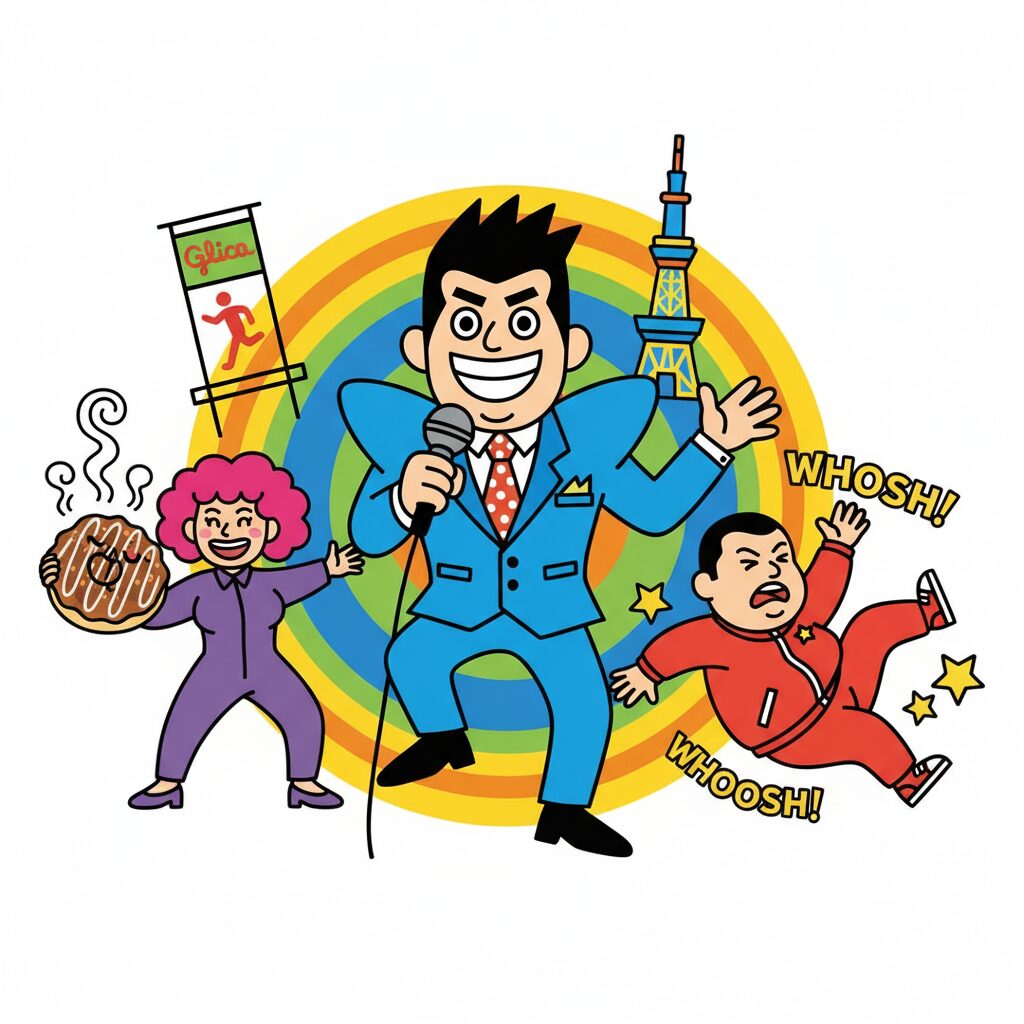
At the heart of manzai is a simple, powerful partnership: the boke and the tsukkomi. The boke is the funny man, the airhead, the one who says something absurd, out of place, or just plain wrong. The tsukkomi is the straight man, the one who points out the absurdity with a sharp retort, a quick correction, or a theatrical sigh. This isn’t just a formula for television comedy shows filmed in the city. It is the fundamental, unspoken operating system for social interaction in Osaka. It dictates the rhythm of conversations, shapes relationships, and defines the city’s character. For anyone living here, or trying to understand what makes Osaka tick, grasping this dynamic is more important than knowing the train map. It’s the key to decoding why Osakans seem so direct, so engaging, and so very different from their compatriots in the east. This isn’t about telling jokes; it’s a philosophy of communication built on the idea that every interaction is an opportunity for connection, and the fastest way to connect is to share a laugh.
Osaka’s urban canvas not only pulses with the rhythmic interplay of manzai-inspired conversation but also offers a rich exploration of its layered identity through the Juso residential and entertainment duality, where everyday life earns a fresh, dynamic context.
The Unspoken Rules of Boke and Tsukkomi in the Wild
Before you can recognize the pattern, you need to understand the parts. At first glance, it appears straightforward: one person says something silly, and the other person calls them out. But in reality, it’s a subtle interplay of social savvy, perfect timing, and a mutual wish to make the ordinary amusing. This game unfolds all around you, from the fish market to the boardroom.
What Are Boke and Tsukkomi, Really?
The role of the boke is often misunderstood. The boke isn’t simply a fool. In fact, playing the boke well demands quick thinking and a sharp sense of social cues. Their task is to deliberately introduce a hint of chaos into the conversation. They might pretend to be clueless, exaggerate absurdly, or state an obvious untruth with a perfectly straight face. This act creates a gap—an empty space that begs to be filled logically. The boke basically tosses an easy-to-hit ball to their partner, looking at them with expectant anticipation. They are offering a gift: the chance to deliver a perfect punchline.
The tsukkomi is the one who takes that gift. Their role is to ground the conversation in reality. When the boke sends things spiraling into absurdity, the tsukkomi skillfully brings it back down. This happens through a tsukkomi—a correction or a comeback. The classic expression is the iconic “Nande ya nen!” which means “Why?!” or “What the heck?!”, but it’s much more than that. It acts as a verbal full stop, marking the joke’s completion. A good tsukkomi isn’t harsh or patronizing. They aren’t mocking the boke; they’re working together. They’re like the drummer delivering the cymbal crash after the punchline. Timing is key. A perfect tsukkomi is quick, sharp, and delivered with just the right dose of theatrical disbelief. Together, they form a small but satisfying cycle of tension and release, a complete conversational rhythm.
Spotting the Dynamic on the Street
Once you know what to watch for, you’ll notice it everywhere. It shows up in the briefest interactions, turning potentially awkward or frustrating moments into warm flashes of shared humanity.
Picture this scene in a neighborhood supermarket. An elderly woman is at the checkout, and the young cashier accidentally scans her daikon radish twice. In Tokyo, this might be met with a polite but firm correction—a moment of slight discomfort. In Osaka, the woman leans forward with a playful sparkle in her eye and says, “My, you must think I’m planning to make a ton of pickles this week.” This is a perfect, gentle boke. She’s not upset; she’s inviting a playful exchange. Without missing a beat, the cashier bows slightly and chuckles, “I’m so sorry! I guess I’m just really hoping you’ll share some with me!” A perfect tsukkomi. The tension vanishes, replaced by a shared laugh. The transaction becomes more than just a transaction; it becomes a connection.
Or imagine two friends waiting on a crowded train platform. One looks at his phone and almost walks into a pillar. The other doesn’t just say, “Watch out.” Instead, he lightly taps his friend on the shoulder and says, “Are you trying to become one with the station? You’re not a pillar, you know!” The first friend, smiling as he rubs his arm, might respond, “I was just testing its structural integrity for everyone’s safety.” Boke meets tsukkomi. A clumsy moment turns into a spontaneous little performance.
This dynamic even happens with first encounters. Tell an Osakan you’re from a snowy country like Sweden, and they might reply deadpan, “Wow. So is it true you ride polar bears to school?” This isn’t ignorance. It’s a test, a friendly probe to see if you’re willing to join the game. A literal, serious answer will kill the conversation. But a playful reply, like “Of course. The parking situation is much better than with a car,” will earn instant approval. You’ve passed the test—you understand the rhythm.
Why This Rhythm? The Cultural DNA of Osaka
This conversational style is no accident. It directly reflects Osaka’s unique history and the values that have shaped its people for centuries. While Tokyo’s culture was shaped by the strict hierarchies of samurai and bureaucrats, Osaka’s culture was born in the lively, competitive, and deeply human world of merchants. This fundamental difference is the root of many of the contrasts you notice between the two cities today.
It’s Not About Being Funny, It’s About Connection
The main aim of the boke-tsukkomi exchange isn’t necessarily to provoke a big laugh. More often, it’s about creating a sense of engagement and closeness. To deliver a timely tsukkomi, you must listen with your full attention. You can’t be half-listening while scrolling on your phone. You have to be present, observing and waiting for the right moment. This intense level of active listening is a form of respect. It conveys, “I am here with you, and what you’re saying matters to me.”
This sharply contrasts with the Kanto region, where respectful listening is often shown through quiet nods and formal interjections like “Sō desu ne” (That is so). To an Osakan, that can feel passive or distant. A lack of playful exchange might be mistaken for a lack of interest or warmth. The constant back-and-forth, gentle teasing, and shared laughter—that’s how Osakans build rapport. It’s a way of quickly breaking down the formal barriers of Japanese society and finding common ground. It’s why Osakans are stereotyped as “friendly.” Their friendliness isn’t passive; it’s an active, engaging practice.
The Merchant City Legacy
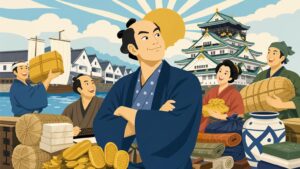
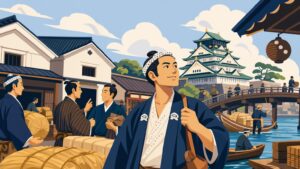
To understand Osaka, you must grasp its history as “the nation’s kitchen” (tenka no daidokoro), Japan’s commercial center for centuries. In the bustling markets of a city founded on trade, there was no room for strict formality. Merchants needed to quickly size up their customers, build trust, and seal deals. Wit was a crucial tool. A quick, clever joke could disarm a cautious customer, leave a memorable impression, and transform a haggling session into a pleasant interaction.
In this setting, communication became a practical art. The ability to “read the air” (kūki o yomu), respond instantly, and keep a lively, positive mood was directly tied to one’s livelihood. There was no place for the rigid, top-down communication style of the samurai class. In the marketplace, everyone stood on a fairly equal footing, and success depended on connecting with others as equals. This pragmatism and emphasis on human relationships, lubricated by humor, became embedded in the city’s DNA. It’s a legacy that lives on today in the fast-paced, witty banter heard in shops, offices, and homes throughout Osaka.
Navigating the Boke-Tsukkomi World as a Foreigner
For a non-Japanese resident, this continuous flow of banter can be both thrilling and intimidating. Watching it is one thing, but actively joining in is quite another. The anxiety about saying something wrong, missing the joke, or making a cultural faux pas is very real. Yet, engaging in this environment is less about becoming a comedian and more about mastering the role of a good audience member.
The Foreigner’s Dilemma: To Boke or Not to Boke?
So, should you try to be the boke? Most of the time, especially when you’re new to it, the answer is probably no. A forced or awkwardly delivered boke in Japanese can easily be mistaken for a genuine mistake or mere confusion, causing the conversation to stall uncomfortably. The timing and subtlety required are incredibly challenging to get right.
Instead, the simplest and most effective role for a foreigner to assume is a version of the tsukkomi. You don’t need a clever comeback in perfect Kansai-ben. Your natural reactions are often enough. When an Osakan friend shares an absurdly exaggerated story, a straightforward “No way!” or “You’re kidding me, right?” in English, paired with a laugh and a look of disbelief, serves perfectly as a tsukkomi. You’re acknowledging their humor, playing your part, and closing the conversational loop. A sincere laugh is the most universal tsukkomi of all. The Osakan isn’t expecting you to be a manzai expert; they’re simply inviting you to enjoy the moment. Your genuine appreciation is the only entry ticket needed.
Common Misunderstandings and How to Avoid Them
Without knowing the unwritten rules, it’s easy to misread the intentions behind the words.
One frequent mistake is confusing playful teasing with a real insult. If an Osakan coworker notices you brought a convenience store bento for lunch and says, “Oh, living the high life today, are we?” they’re not making fun of your meal. They’re including you. They’ve picked up on a small detail about your day and are using it as a springboard for some lighthearted banter. The wrong response is to get defensive. The right one is to join in. “Of course! It’s the gourmet chef’s special.”
Another point of confusion can be the seemingly loud or aggressive nature of the tsukkomi. A sharp “Nande ya nen!” might sound harsh to the untrained ear, and the accompanying light tap on the arm could feel too physical. It’s important to see this as pure performance. The volume and energy are part of the act; they serve to highlight the punchline. There is no real anger involved, just as a slap on stage isn’t an act of true violence. It’s a communication style that operates at a higher volume—both literally and emotionally. Once you view it as theater, you stop mistaking the energy for aggression and start enjoying it as enthusiasm.
The Language of Laughter: Kansai-ben and the Comedic Toolkit
It’s no accident that the heartland of Japanese comedy is also the birthplace of the Kansai dialect. The language itself, with its distinct vocabulary, grammar, and intonation, perfectly suits the rapid-fire tempo of boke and tsukkomi.
“Nande ya nen!” – The Ultimate Tsukkomi
This three-word phrase embodies the spirit of the Osaka tsukkomi. It’s a versatile, potent expression capable of conveying a wide range of emotions. When shouted quickly, it delivers a sharp jab of disbelief. When drawn out slowly, it becomes a comical whine of despair. It is far more vivid and emotional than the standard Japanese equivalent, “Dōshite desu ka?” Other key phrases enrich the comedic landscape. “Honma ka?” (Really?) questions the boke’s statement. “Akan!” (No way! / That’s no good!) decisively shuts down a silly idea. And the well-known “Chau chau” (a quick repetition meaning “wrong”) serves as a playful, almost musical correction. These words are brief, punchy, and full of character, making them perfect for comedic timing.
The Sound and Rhythm of Osaka Speech
Beyond individual words, the very melody of Kansai-ben naturally enhances humor. Compared to the relatively flat, monotonous intonation of standard Tokyo Japanese, Kansai-ben features a rollercoaster of highs and lows. Sentences rise and fall in pitch, creating an inherent musicality that turns even the simplest statement into something engaging and story-like. This natural rhythm allows speakers to instinctively build setups and punchlines within regular conversation. A sentence may ascend in pitch, building anticipation, before dropping on the final word, delivering the comedic punch. Listening to a conversation in Osaka is like experiencing a jazz performance—full of improvisation, syncopation, and a playful rhythm that is absent from the more classical style of Tokyo speech.
More Than Just Jokes: The Practical Side of the Dynamic
While it’s easy to focus on the humor, it’s a mistake to assume this communication style is solely for amusement. The principles of the boke-tsukkomi dynamic are deeply woven into the practical, serious aspects of life in Osaka, permeating everything from business to community building.
In Business and Negotiations
Step into a business meeting in Osaka, and you might be taken aback. Although the ultimate objectives are just as serious as in Tokyo, the approach to reaching them can be quite different. An Osaka businessperson may open a tense negotiation with a self-deprecating joke, a little boke to ease the tension. For instance, they might gesture toward their own presentation and say, “I hope you can stay awake through this next part.” This isn’t a sign of weakness; rather, it’s a strategic move to lower defenses and foster a more collaborative, human-to-human atmosphere. It indicates a desire to move past rigid formality and cultivate a genuine relationship. For outsiders used to a strict separation of professional and personal spheres, this can be surprising. But in Osaka, building personal trust through shared humor is often essential for successful business dealings.
Building Community and Resilience
Most importantly, humor serves as the social glue that keeps the community connected. It acts as a shared coping mechanism for everyday frustrations. When a train is delayed, the Tokyo reaction might be a quiet, collective sigh and a stoic glance at the watch. In Osaka, however, you’re more likely to hear a stranger joke, “Well, I guess we’re all living here now!” sparking a chorus of knowing chuckles. This instinct to find absurdity in hardship and turn complaints into jokes nurtures a strong sense of shared identity and resilience. It conveys, “This is frustrating, but we’re all in it together, so let’s have a laugh.” This collective ability to not take life too seriously, even in tough times, gives the city a profoundly human and supportive atmosphere.
Living in Osaka offers an immersive education in a different style of communication. It’s a style that prioritizes engagement over reservation, wit over formality, and connection over protocol. The boke-tsukkomi dynamic is the invisible software guiding these interactions—a cultural code that explains why the city feels so vibrant, so direct, and at times, so wonderfully chaotic. It’s the city’s pulse, a constant, rhythmic beat of setup and punchline.
You don’t have to become a stand-up comedian to thrive here. You simply need to learn to appreciate the performance. Listen for the rhythm, watch for the playful sparkle in someone’s eye, and don’t hesitate to respond with a genuine laugh or a shake of your head. Recognizing that you’ve been invited to join this conversational dance, even just as an appreciative audience member, is the first and most important step to truly understanding the warm, witty, and deeply engaging heart of Osaka.