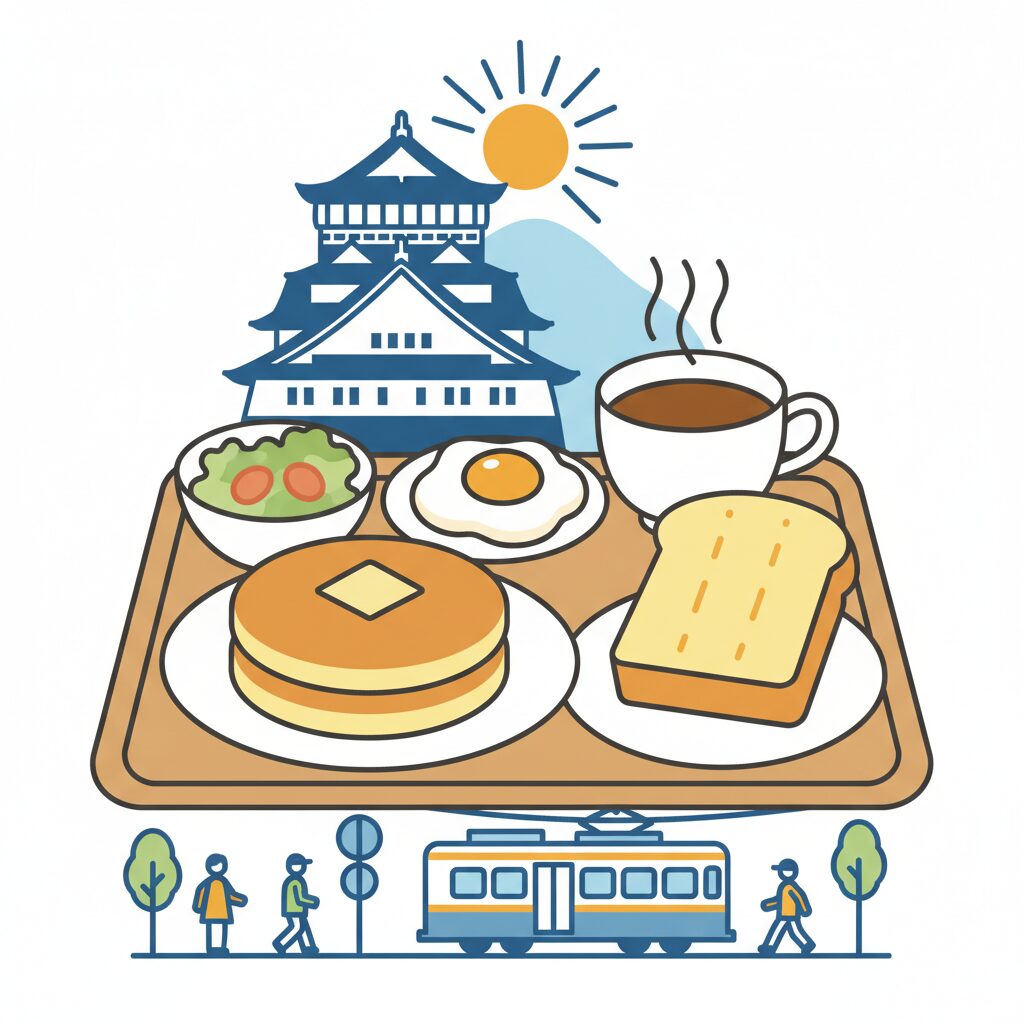
Step off the train at any given station in Osaka on a weekday morning, just as the city is starting to hum. You’ll see the familiar currents of urban life: salarymen striding with purpose, students chatting on their way to school, shopkeepers rolling up their metal shutters. But look closer, into the side streets, away from the main thoroughfares. You’ll see them. Small, unassuming storefronts, often with names rendered in stately, old-fashioned katakana. Their windows might be slightly fogged with condensation, hinting at a warm, lived-in world within. And somewhere, taped to the glass or standing on a modest A-frame sign, you’ll see the two words that act as a secret handshake for locals: モーニングサービス. Morning Service.
For the uninitiated, the phrase is a puzzle. Is it a religious gathering? A special sale? It sounds formal, almost reverent. You peek inside and see no pews, only plush, worn-out velvet chairs, the soft glow of amber lights, and the silhouette of a lone figure reading a newspaper behind a cloud of steam. The price listed is astonishing, something around 450 or 500 yen. For what? The sign often shows a picture: a cup of coffee, a thick slice of toast, and a boiled egg. All of that for the price of the coffee alone? It doesn’t compute. It feels like a trick, a typo, a relic from a bygone economic era. This, right here, is your first lesson in understanding Osaka. This isn’t a trick. It’s a philosophy. It’s the city’s heart, served on a small ceramic plate. The Morning Service, or simply ‘Morning’ as it’s known, is not just breakfast. It is a foundational ritual, an economic statement, and a social anchor all rolled into one. It’s the quiet, consistent engine that tunes the city’s rhythm before the daily chaos kicks in. To understand ‘Morning,’ you have to look past the toast and coffee and see the intricate web of values it represents: pragmatism, community, and a fierce, unspoken pride in doing things the Osaka way. It’s where the city’s soul comes to sit, sip, and prepare for the day ahead.
This rich urban tapestry not only fuels early morning rituals but also echoes in how residents navigate the Osaka rental landscape, blending age-old traditions with modern living.
The Unspoken Contract of Value: More Bang for Your Yen

At its heart, the Morning Service is an unbelievably good deal. Let’s examine the classic elements. First, the coffee. This isn’t a mass-produced drink from an automated machine. In a genuine kissaten (喫茶店), the traditional coffee shops native to the Morning Service, coffee takes center stage. It could be a dark, rich roast, meticulously prepared using a siphon or flannel drip method by the shop’s owner, universally called the ‘Master.’ This coffee alone might reasonably be priced at 450 yen or more. Yet, during the morning hours—typically from opening until around 11 a.m.—ordering this coffee initiates an unspoken agreement: the rest of the meal often comes included or for a nominal extra charge of fifty to a hundred yen. There’s the toast, rarely a flimsy, sad slice from a plastic bag. It’s atsugiri (厚切り) toast, a thick, proud piece of fluffy white bread, toasted to golden perfection on the outside while staying soft and pillowy inside. It’s served pre-spread with butter or margarine that melts into its deep grooves. Alongside the toast is the modest yude tamago (ゆで卵), a hard-boiled egg—simple, protein-rich, and reliably satisfying. Some cafés add a small touch: a tiny cup of yogurt, a miniature salad with a light dressing, or a few banana slices. The entire set provides a nutritionally balanced, fulfilling start to the day at a price that defies contemporary economic logic.
To fully appreciate this, you must understand the Osaka merchant spirit. This city was built by merchants, and the values of akinai (商い), or trade, run deeply in its fabric. There’s a common misconception, sometimes spread by Tokyo residents, that Osaka people are kechi (ケチ), or stingy. This is a fundamental misunderstanding. The Osaka mindset isn’t about being cheap; it’s about being kashikoi (賢い), or wise. It’s about recognizing and demanding value. An Osaka shopper can instinctively assess the cost-performance ratio of anything, from a handful of vegetables to a new apartment. They detest waste and dislike paying extra for unnecessary frills. The Morning Service perfectly captures this philosophy. It’s not about cheapness; it’s a demonstration of maximum efficiency and mutual respect between customer and proprietor. The customer receives a fantastic deal—a full breakfast for the price of a drink. The Master, in turn, secures loyal, regular patrons who fill the shop during what might otherwise be quiet hours. It’s a win-win—a beautifully balanced equation of commerce and community. This sharply contrasts with breakfast culture in other cities. In Tokyo, for instance, morning choices might lean toward trendy bakeries with pricey pastries or artisanal cafés where a single, elaborate latte takes center stage. Those places focus on aesthetics and trendiness. Osaka’s Morning Service emphasizes substance and practicality. It quietly yet firmly asserts: a good start to the day should not be a luxury. It should be an affordable, accessible right. This deeply rooted belief in tangible value is one of the most significant cultural distinctions between Osaka and the rest of Japan. It’s not about spending less; it’s about getting more. And every morning, in thousands of kissaten across the city, this philosophy is served with a fresh cup of coffee and a perfectly toasted slice of bread.
The Kissaten as a ‘Third Place’: Your Neighborhood’s Living Room
Step into a classic kissaten during the morning hours, and you’re entering more than just a coffee shop. You’re stepping into what sociologists refer to as a ‘third place‘—an essential social setting distinct from the usual two realms of home and workplace. The atmosphere plays a crucial role in the experience, serving as a carefully maintained bubble of Showa-era charm. The lighting is consistently warm and dim, casting a soft, amber glow. The furniture is solid and inviting: chairs and booths upholstered in dark red or brown velvet, smoothed over decades of use. The air is filled with the rich, soothing aroma of brewing coffee, occasionally blending with the faint, nostalgic smell of tobacco from a bygone age (though indoor smoking is now much less common). A large, dark wooden clock might hang on the wall, its pendulum swinging in a slow, mesmerizing rhythm. The background sound is usually subdued—soft jazz, classical music, or simply the gentle clinking of ceramic on saucers and the rustle of turning newspaper pages.
This is the neighborhood’s living room, inhabited by a cross-section of local residents. In one corner, you’ll find a group of elderly regulars, the ‘gossiping aunties’ and ‘newspaper uncles,’ who have met at the same table, at the same time, for years. They are custodians of local stories, their quiet chatter an integral part of the shop’s ambient sound. In another booth, a salaryman in a crisp suit carefully reads a physical newspaper—a rare sight in the digital age—holding it open wide and folding it with practiced, geometric precision. He’s not merely catching up on the news; he’s engaging in a ritual of solitude and focus before diving into the day’s meetings. A university student might be tucked away at a small table, absorbed in a textbook, nursing a single cup of coffee for an hour. The kissaten provides a calm, studious environment without the sterile silence of a library. And at the counter, you will almost always find the ‘Master.’ The Master is the soul of the kissaten. Often a person of a certain age, they move with quiet, efficient grace behind the counter. They are more than a barista; they are a conductor, an observer, and a discreet social anchor. They know their regulars by name—not from a CRM system, but from memory. They know Mr. Tanaka prefers his coffee black, Mrs. Sato likes her toast a bit extra crispy, and the university student is studying for his law exams. This personal recognition is deeply meaningful. It transforms a simple business transaction into a genuine moment of human connection. It fosters a sense of belonging, a feeling of being ‘seen’ in a vast, often anonymous city.
For a foreigner, it might be easy to overlook these places, dismissing them as old-fashioned or outdated. They lack the sleek, minimalist design of modern cafes. Their menus don’t feature elaborate, Instagram-worthy creations. But to judge them this way is to miss the essence entirely. The kissaten isn’t selling a trend; it’s offering stability and comfort. In a world that never stops accelerating and changing, the kissaten remains a steadfast constant. It’s a refuge from the noise and pressures of the outside world. It’s a place where you can be alone but not lonely. For many Osaka residents, their local kissaten is as much a part of their daily routine as brushing their teeth. It’s where they gather their thoughts, connect with neighbors, and find a moment of peace. This network of neighborhood living rooms forms a vital part of Osaka’s social fabric, nurturing a sense of local identity and community often harder to find in the more transient, fast-paced districts of Tokyo.
The Rhythm of the Osaka Morning: A Ritual, Not a Rush
The most notable distinction between a Morning Service at an Osaka kissaten and a typical breakfast experience in many other cities worldwide is the pace. The entire ritual is a conscious act of slowing down. It stands in direct opposition to the grab-and-go culture. You don’t simply ‘pop in’ for a Morning Service; you settle in. The experience starts the moment you push open the heavy wooden door, often causing a small, tinkling bell to signal your arrival. This sound doesn’t demand immediate service; rather, it gently acknowledges your presence, inviting you to embrace the quiet rhythm inside. You select your seat, without any pressure. The Master may nod at you but won’t rush over with a menu. You are given time to remove your coat, arrange your bag, and simply breathe. The process is unhurried, a stark contrast to the frantic energy of the train station you might have just left behind.
Notice the movements of the regulars. They are unhurried and precise. A man carefully takes off his glasses, polishes them with a handkerchief, and then unfolds his newspaper. A woman stirs her coffee slowly, the spoon creating a soft, rhythmic clinking against the porcelain. There is no frantic phone scrolling here, no loud business calls. While smartphones are present, they are used discreetly. The main activities are reading, quiet conversation, and contemplation. The kissaten offers the tools for this reflective state: shelves stocked with the day’s major newspapers and a broad selection of weekly magazines and manga. This is a space designed for analog immersion. The sensory experience is rich. You hear the low hiss of the siphon coffee maker, a piece of exquisite, scientific glassware that transforms brewing into performance art. You smell the toast browning, a universally comforting aroma. You feel the solid weight of the ceramic coffee cup in your hands, a tangible anchor to the present moment. This deliberate slowness is a form of cultural resistance. It counters the modern demand for constant productivity and efficiency. It creates a protected space in the morning, a buffer between the peace of sleep and the demands of the day. In Tokyo, the morning often feels like a race—a sprint through crowded stations, a quick stop at a convenience store, and eating or drinking while walking or riding the train. The goal is to fuel up as fast as possible to reach the workday’s starting line. The Osaka Morning Service offers a radically different philosophy. It proposes that the day begins not with haste but with a pause. It is a form of civic meditation, a shared commitment to start the day with intention and calm. By taking part in this ritual, you are not merely having breakfast; you are attuning yourself to a different, more humane rhythm of life. It’s a rhythm that values reflection over reaction and presence over productivity.
A Guide to Morning Etiquette: Reading the Room

For someone new to Osaka, entering a traditional kissaten might feel somewhat intimidating. These are not anonymous chain shops; rather, they are well-established local institutions with their own unspoken rules. However, navigating the Morning Service experience becomes easy once you grasp the basic etiquette. Your adventure begins on the street. Look for the magic words モーニングサービス or simply モーニング on a sign. Often, you’ll find a carefully crafted, though sometimes slightly faded, plastic food model displayed near the entrance, showing you exactly what to expect. This practical Japanese custom removes all uncertainty.
Once inside, take a moment to gauge the atmosphere. If the shop is quiet, you can usually pick any available table. But if it’s busy, avoid occupying a four-person booth alone. Choose a smaller two-person table or a seat at the counter instead. A simple nod or a quiet ‘ohayo gozaimasu’ (good morning) to the Master is a courteous gesture. Ordering is typically straightforward. Most of the time, the Morning Service is a set menu linked to your drink order. You don’t order ‘the Morning Service’ per se. Instead, you order your coffee (‘Hotto ko-hi-,’ for hot coffee, or ‘Aisu ko-hi-,’ for iced coffee), and the food comes with it. The Master might ask, ‘Morning ni shimasu ka?’ (‘Will you have the Morning set?’), to which you can simply nod or say ‘hai, onegaishimasu’ (‘yes, please’). Some places offer several options labeled ‘A Set,’ ‘B Set,’ and so forth. ‘A’ almost always features the classic toast-and-egg combo. ‘B’ might swap the toast for a sandwich, and ‘C’ could be something different, like a hot dog bun. The menu is often handwritten in Japanese, but pointing at the plastic food model or the sign outside is perfectly fine.
After placing your order, the key is to blend into the calm ambiance. This is not the setting for loud conversations or phone calls. If you need to answer your phone, it’s polite to step outside. Laptops are somewhat of a grey area. In a more modern or spacious cafe, using one is usually acceptable. But in a small, traditional kissaten filled with regulars, opening a large laptop can feel intrusive and out of place, disrupting the analog, contemplative mood. The best approach is to observe others. If no one else is using a laptop, it’s probably best to stick to reading a book, a newspaper, or quietly using your phone. When you’re finished, don’t overstay, especially if people are waiting for a table. Although the pace is relaxed, the tables remain the Master’s livelihood. When you’re ready to leave, you don’t ask for the check at your table. Simply gather your belongings and approach the cash register near the entrance. The bill will be waiting there. Cash is often preferred, and sometimes mandatory, in these older establishments, so it’s wise to have some on hand. Place your money in the small tray provided and take your change from the same tray. A simple ‘gochisosama deshita’ (‘thank you for the meal’) as you leave is the polite and standard way to end your visit. Following these easy steps will show respect for the establishment and its regular patrons, turning you from a curious outsider into a welcome participant in this beloved daily ritual.
Beyond Toast and Coffee: The Evolution of Morning Service
While the classic trio of toast, egg, and coffee remains the gold standard, the culture of Morning Service is not stuck in the past. It is a living tradition that has adapted and evolved, reflecting the shifting tastes and competitive landscape of Japan’s cafe culture. Visit different kissaten around Osaka, and you’ll discover a charming variety of interpretations of the morning meal, each with its own local flair. Some venues have expanded their menus to include a ‘sandwich morning,’ featuring a classic tamago sando (egg salad sandwich) or a mix sando with ham and vegetables. Others may offer a ‘hot dog morning,’ with a toasted bun and a savory sausage. In some more traditional shops, you might even find a Japanese-style set, a ‘wafu morning,’ which could include a warm onigiri (rice ball), a bowl of miso soup, and some pickles. These variations highlight the flexibility of the concept: the core principle of value remains, while the details can be customized according to the Master’s specialty and the customers’ preferences.
The most influential force in the modern evolution of Morning Service has been the rise of large coffee chains, most notably Komeda’s Coffee. Hailing from Nagoya, another city famed for its strong morning culture, Komeda’s has effectively systemized and franchised the kissaten experience. When you order any drink at Komeda’s before 11 a.m., you receive a complimentary thick slice of toast, with a choice of toppings such as boiled egg, egg salad, or red bean paste (ogura an). Komeda’s has, in essence, taken the independent kissaten model and expanded it for a national audience. The experience is different, naturally. The comfortable but standardized booths, the push-button call bells, and the uniform menu lack the unique, personal charm of an independent shop run by a single Master for thirty years. Yet, its widespread popularity is a testament to the lasting appeal of the Morning Service concept. It demonstrated that the desire for a comfortable place to sit and enjoy a value-driven breakfast was not merely a nostalgic relic but a strong consumer demand. The success of chains like Komeda’s has, in a way, helped preserve the culture by maintaining it in the mainstream awareness. It introduces the concept to a younger generation who might not otherwise step into a traditional kissaten. At the same time, it underscores what makes the independents so special. You visit Komeda’s for reliability and convenience. You visit your local kissaten for character, community, and connection.
Why This Matters for Living in Osaka
At first glance, Morning Service may seem like just an affordable breakfast. However, if you live in Osaka or are considering it, understanding this daily ritual is like discovering a key to the city’s operating system. It’s a small detail that unveils a wealth of insight about the local culture, its values, and what sets it apart from Tokyo and other Japanese cities. Embracing the Morning Service tradition offers a direct glimpse into the Osaka mindset. It’s an everyday lesson in the local interpretation of value—not cheapness, but smart, practical, and no-frills quality. It reflects an appreciation for substance over style, a feeling that permeates many aspects of Osaka life, from its cuisine to its fashion. When you learn to spot a good Morning Service deal, you’re beginning to see the world through the eyes of an Osaka native.
Moreover, it is one of the most effective ways to connect with your local neighborhood. Finding “your” kissaten is a rite of passage for residents—a way to establish roots. After a few visits, the Master will recognize you. You’ll start noticing familiar faces every morning. You become part of the quiet, everyday fabric of the community. In a sprawling metropolis, these small connections are incredibly grounding. They create a village-like atmosphere within the vast urban environment, making the city feel more manageable, more human, and less anonymous. This is a big part of what people mean when they say “Osaka is friendly.” It’s not just about strangers striking up conversations on the street; it’s about social spaces like the kissaten that encourage regular, low-key, and genuine human interaction. The next time you’re walking through your neighborhood in the morning and spot that simple sign for モーニングサービス, don’t just pass by. Step inside, take a seat, and order a coffee. As you sip your drink and enjoy the free toast, know that you’re not simply having breakfast. You’re taking part in a living tradition. You’re tuning into the city’s rhythm. And you’re getting one step closer to understanding the practical, warm, and wonderfully unpretentious heart of Osaka.