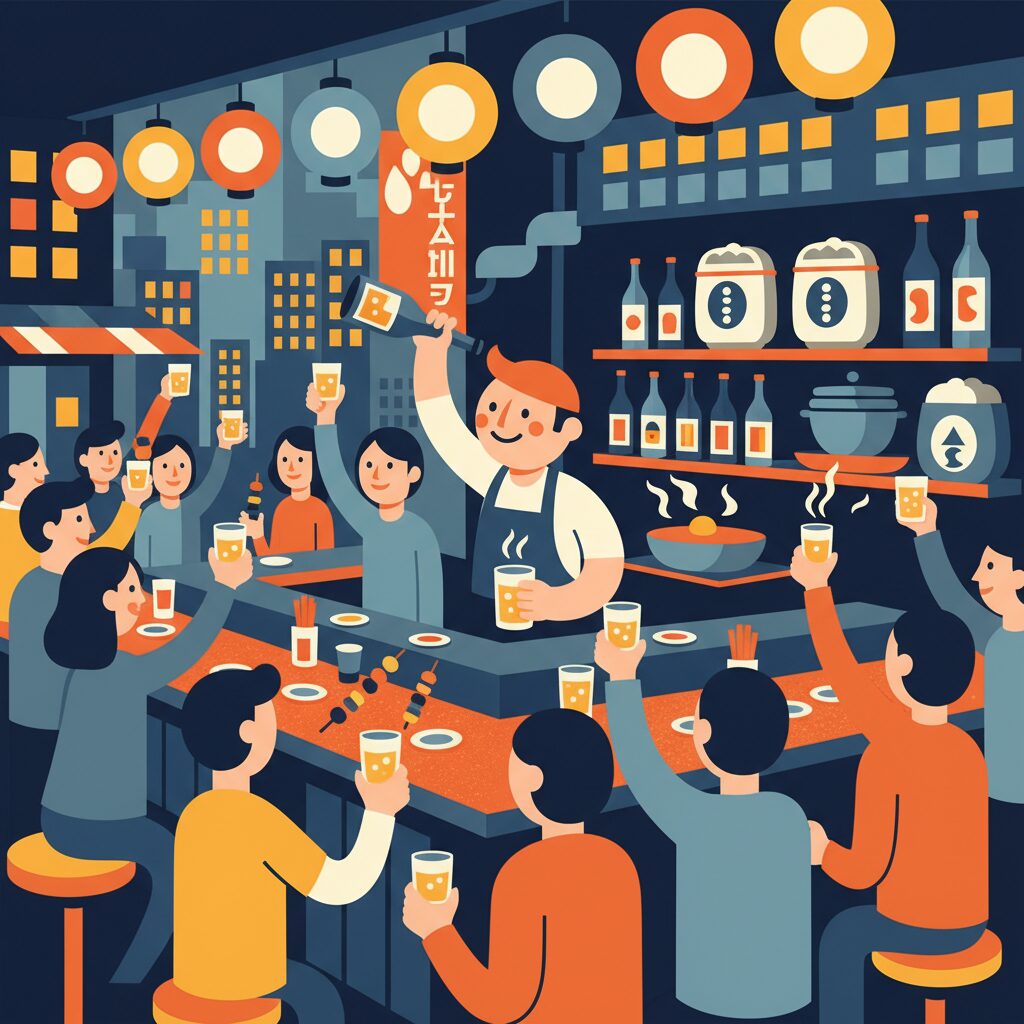
Walk through the covered shotengai arcades of Tenma or Kyobashi on any given weeknight, and you’ll feel it. It’s a blast of warm, savory air hitting you in the face, a wall of sound composed of clinking glasses, sizzling grills, and the distinctive, guttural laughter of Osakans. You peer through a steamed-up glass door into a space no bigger than a walk-in closet, packed shoulder-to-shoulder with people. They’re standing, drinking, eating, and talking over each other with an energy that feels both chaotic and magnetic. This is the tachinomi, the standing bar, and for a newcomer, it can look like an impenetrable social fortress. Your first instinct might be to keep walking, to find a quiet spot with a proper menu and, you know, chairs. But to do that is to miss the point of this city entirely. The tachinomi isn’t just a place to get a cheap drink; it’s the beating heart of Osaka’s social life, a nightly theater where the city’s true character is on full display—pragmatic, unpretentious, and unapologetically communal. Forget what you think you know about reserved Japanese interactions. Here, in these cramped, fluorescent-lit spaces, is where you’ll truly understand what makes Osaka tick. This isn’t a list of the “top ten” spots. This is your social playbook for stepping inside, holding your own, and walking out feeling like you’ve just been let in on the city’s best-kept secret.
Embracing Osaka’s vibrant tachinomi atmosphere also opens doors for professional connections, so checking out our standing bar networking guide may be the next smart move to elevate your local experience.
What Even Is a Tachinomi? Decoding the Stand-Up Bar
At its core, the name gives you all the information you need: tachi (立ち) means ‘to stand,’ and nomi (飲み) means ‘to drink.’ It’s essentially a standing-and-drinking spot. However, this straightforward definition overlooks the deeper cultural significance. In a city like Tokyo, a bar often serves as a destination, a place with a distinct concept and a carefully crafted atmosphere where you settle in for the night. An Osaka tachinomi, however, is an entirely different creature. It functions as a social pit stop, a practical transition from the rigid rhythm of the workday to the quiet solitude of home.
More Than Just a Bar Without Chairs
A tachinomi embodies efficiency. The space is usually small, dominated by a counter behind which the owner, the taisho or master, runs the whole operation. There might be a few wall-mounted shelves for regulars to rest their glasses, but furniture is strictly against the tachinomi philosophy. The absence of chairs isn’t accidental; it’s intentional. It promotes a quick turnover of customers. You’re not supposed to get too comfortable. Instead, you drop in for one or two drinks and a small snack, exchange a few words with your neighbor, and move on within an hour. It’s a place of constant movement, a human whirlpool in the city’s flow. This transient nature fosters a unique social atmosphere. Since no one stays long, social barriers are naturally lowered. Everyone is just passing through, sharing a brief moment, which ironically makes connecting easier.
The Economics of Standing: Why It’s So Damn Cheap
In Osaka, the idea of cospa—cost performance—is almost a religion. People here don’t just want low prices; they want excellent value. The tachinomi is the ultimate shrine to cospa. By doing away with chairs, the need for a larger space is eliminated, resulting in lower rent. It also reduces the need for many staff. This streamlined business approach directly leads to cheaper prices for customers. A draft beer might cost ¥300, a glass of sake ¥250, and a plate of grilled skewers just ¥150. This isn’t about stinginess; it’s a deep cultural respect for a straightforward, no-frills system. You aren’t paying for decor, ambiance, or a seat—you’re paying for the drink in your hand and the food on your plate. This practical mindset is quintessentially Osaka. Built by merchants, the city’s transactional, value-focused spirit influences everything, right down to how its people relax after work.
The Unspoken Rules of the Standing Game
For newcomers, the bustling, fluid chaos of a busy tachinomi can feel overwhelming. There are no hosts to welcome you, no menus handed out, and no explicit directions. Yet, an unspoken but distinct etiquette governs the space. Learning to navigate it is your key to fully enjoying the experience.
Entering and Finding Your Spot
Your first step happens before you even enter. Pause at the door and scan the counter. Is there a small gap? Catch the eye of the taisho. A slight nod from them signals your green light. Don’t just push in and claim a spot. The space is shared, and you need permission—however subtle—to become part of the environment. Once inside, mind your footprint. Take your backpack off your shoulder and either hold it in front of you or place it at your feet. The counter is meant for drinks and food, not your belongings. You’ll see regulars expertly compact, keeping their elbows in and presence minimal but acknowledged. If you need to slip past someone to reach an open spot, a quiet “sumimasen” (excuse me) and a slight bow will suffice. You’re entering a well-established community, even if it shifts moment to moment. Show that you recognize the importance of shared space.
The Art of the Order: Quick, Clear, and Confident
This tends to be the biggest challenge. You might not find a printed menu. Instead, handwritten strips of paper (tanzaku) display the day’s specials on the wall. The writing, often fast and stylized kanji, can be tricky even for native speakers. Don’t worry. Start with a simple, classic line: “Toriaezu, biru.” (とりあえず、ビール). It means, “For now, a beer.” It’s the universal opener that buys you time to observe. Watch what regulars order. Look at the plates of food, or otsumami, arrayed along the counter. See something appealing? Point and say, “Are, hitotsu kudasai.” (That one, please). Confidence matters more than perfect grammar. The taisho is a multitasking pro, simultaneously pouring drinks, handling money, and chatting with several customers. They value directness. Hesitation slows the flow. Safe drink choices include nama-biru (draft beer), chuhai (a shochu highball often flavored with lemon or other fruit), or nihonshu (sake). For food, classics like doteyaki (beef sinew stewed in miso), kushikatsu (deep-fried skewers), or a simple plate of edamame are reliable picks.
The Payment System: Cash is King
Many of the most traditional tachinomi run on a cash-on-delivery system, commonly called kyasshu on. You’ll receive a small tray or bowl to place a ¥1,000 or ¥5,000 bill in. When you order, the taisho takes your drink, places it before you, and removes the exact amount from your tray, returning any change. This efficient system prevents any confusion over the bill at closing time. It also acts as a visual budget; when the cash in your tray runs out, it’s probably time for you to wrap up, too. Come prepared. Carrying several ¥1,000 notes and some coins is a pro move. Trying to pay a ¥350 drink with a ¥10,000 bill is a rookie error that disrupts the rhythm. This cash-based, immediate payment system reflects Osaka’s merchant spirit: transparent, fast, and trusting customers to manage their own tabs.
The Osaka Social Code: How to Actually Talk to People
Okay, so you’ve got your drink and found your spot. Now what? This is where Osaka fundamentally differs from Tokyo. In a Tokyo bar, an unsolicited conversation from a stranger might be met with suspicion. In an Osaka tachinomi, the close quarters and shared experience make conversation nearly unavoidable. The invisible barriers between strangers here are simply more permeable.
Breaking the Ice Without Feeling Awkward
The key is to be observant. The easiest way to start is by focusing on a shared point of interest: the food. Turn to the person next to you and comment on their dish. “Sore, oishisou desu ne.” (That looks delicious). Or try a more direct, “Sore, nan desu ka?” (What is that?). Osakans, for the most part, take pride in their food culture and are happy to explain it. Another reliable opener is complimenting the bar itself. A simple “Koko, ii mise desu ne” (This is a great place) to your neighbor can often spark conversation. They might reply by sharing how long they’ve been coming here, which opens the door for you to mention you’re new to the city. The “Where are you from?” question will come up quickly. Don’t see it as a tired cliché. In Osaka, it’s a genuine expression of curiosity. People are fascinated by outsiders and eager to practice their English or simply engage with someone from a different background. They view it as mutual entertainment.
Understanding the “Tsukkomi” and “Boke” Dynamic
To truly grasp Osaka, you need to understand the basics of manzai, the local style of two-person stand-up comedy. It centers on a boke (the funny, air-headed character) and a tsukkomi (the sharp, straight man who corrects the other, often with a light slap). This comedic rhythm is woven into everyday conversation here. Someone will say something slightly silly or exaggerated (the boke), and a friend—or even a stranger in a tachinomi—will respond with a playful jab (the tsukkomi). If you say you love takoyaki, an Osakan might grin and say, “Of course you do! Everyone does! You’re not special!” This isn’t an insult. It’s a tsukkomi—a sign of affection and an invitation into the conversational game. In Tokyo, such a direct comment might be seen as rude. In Osaka, it means you’re being accepted. Learning not to take this playful teasing personally is key. If an older salaryman starts teasing you about your Japanese, lean into it, laugh, and tease him back. You’ll earn instant respect.
The Role of the “Taisho” (The Master)
The taisho is the bar’s gravitational center. They are more than just a bartender; they’re the host, the conductor, and the keeper of the community’s social memory. They know the regulars by name, remember their drinks, and often act as a social lubricant, introducing newcomers to regulars. Building a rapport with the taisho is the ultimate power move. Ask for their recommendation: “Taisho, osusume wa?” (Master, what do you recommend?). It shows respect for their expertise. Watch them work. Their movements are economical and precise, honed by years of practice. By acknowledging their central role, you demonstrate your understanding of the culture of the space. A happy taisho makes for a happy bar, and they’ll often reward your interest by making sure you’re included in the conversation.
Navigating the Exit: The Graceful Departure

Just as there’s an art to entering a tachinomi, there’s a certain elegance to leaving one. The experience is meant to be brief, and lingering too long can upset the delicate social harmony.
Knowing When to Leave
The essence of tachinomi is often embodied by the term senbero, which literally means ‘getting tipsy for 1,000 yen.’ It suggests a short, affordable, and cheerful outing. Two or three drinks and a snack is the typical visit. The aim isn’t to get drunk; it’s to enjoy a quick buzz and some social interaction before heading home. Be mindful of the bar’s rhythm. If a line starts forming outside and the space feels crowded, that’s your signal. Finishing your drink and freeing your spot for the next guest is the considerate thing to do. It’s an unspoken rule here. This isn’t a place to settle in with a book. It’s a dynamic environment that depends on the steady flow of its patrons.
The “Gochisousama” Goodbye
When it’s time to leave, catch the taisho’s eye. Offering a clear and sincere “Gochisousama deshita” (a polite phrase for “Thank you for the food and drink”) is important. It shows more respect than a simple “arigatou.” If you’ve been chatting with those next to you, a slight nod and a quiet “osaki ni” (excuse me for leaving first) adds a thoughtful touch. There’s no need for lengthy or dramatic goodbyes. Your exit should be as smooth and unobtrusive as your entrance. You slip out gracefully, leaving your spot open and your goodwill intact. The goal is to be remembered as someone who understands and respects the place’s rhythm, so you’ll be welcomed back with a warm nod the next time you arrive.
What This All Says About Osaka
Ultimately, the humble tachinomi serves as a perfect microcosm of Osaka itself. It captures the city’s core values in a way no museum or landmark ever could. It’s a masterclass in pragmatism and cospa, embodying the belief that a good time doesn’t have to be expensive or fancy, just genuine. It reflects the local communication style—direct, playful, and with little patience for the polite fictions common elsewhere. On the surface, it may seem chaotic, but it operates on a deep, unspoken sense of community and care. People look out for one another, make room for each other, and share laughs together. For a foreigner seeking to understand the soul of Osaka, the tachinomi is the ideal classroom. It’s where the city’s reputation for being ‘friendly’ and ‘open’ is tested every night, and where, if you’re willing to stand tall and follow the local customs, you can feel less like a visitor and more like part of the beautiful, noisy, and wonderfully human fabric of the city.