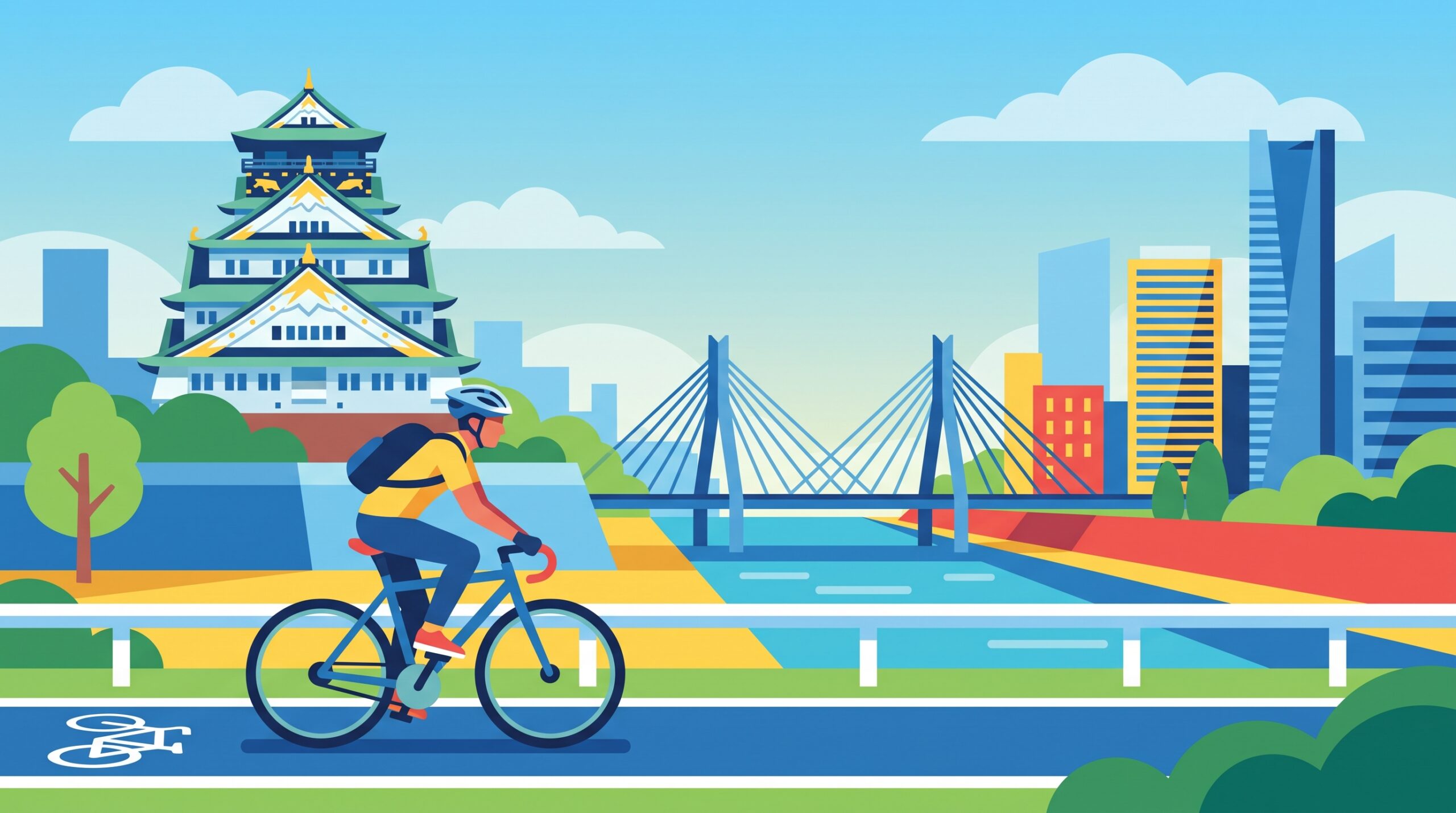
There is a specific rhythm to a Tuesday morning in Osaka, a pulse that you cannot feel from the insulated seat of a taxi or the crowded interior of a commuter train. It begins before the sun fully clears the high-rises of Umeda, starting as a low hum in the residential neighborhoods of Fukushima, Nakazakicho, and Tennoji. By eight o’clock, that hum has crescendoed into a symphony of squeaking brake pads, rattling plastic front baskets, and the rhythmic clicking of internal gear hubs. This is the sound of a city waking up and moving. If you want to truly understand Osaka—not the neon-drenched tourist caricature of Dotonbori, but the real, breathing, pragmatic metropolis—you have to look at how its people get around. In Osaka, the undisputed king of the commute is the bicycle. For a foreigner arriving in the Kansai region, purchasing that first bicycle feels like unlocking a secret level of the city. Suddenly, the gaps between train stations disappear. The sprawling grid of concrete and commerce becomes your personal playground. You are untethered from the tyranny of the train schedule and the claustrophobia of the rush-hour crush.
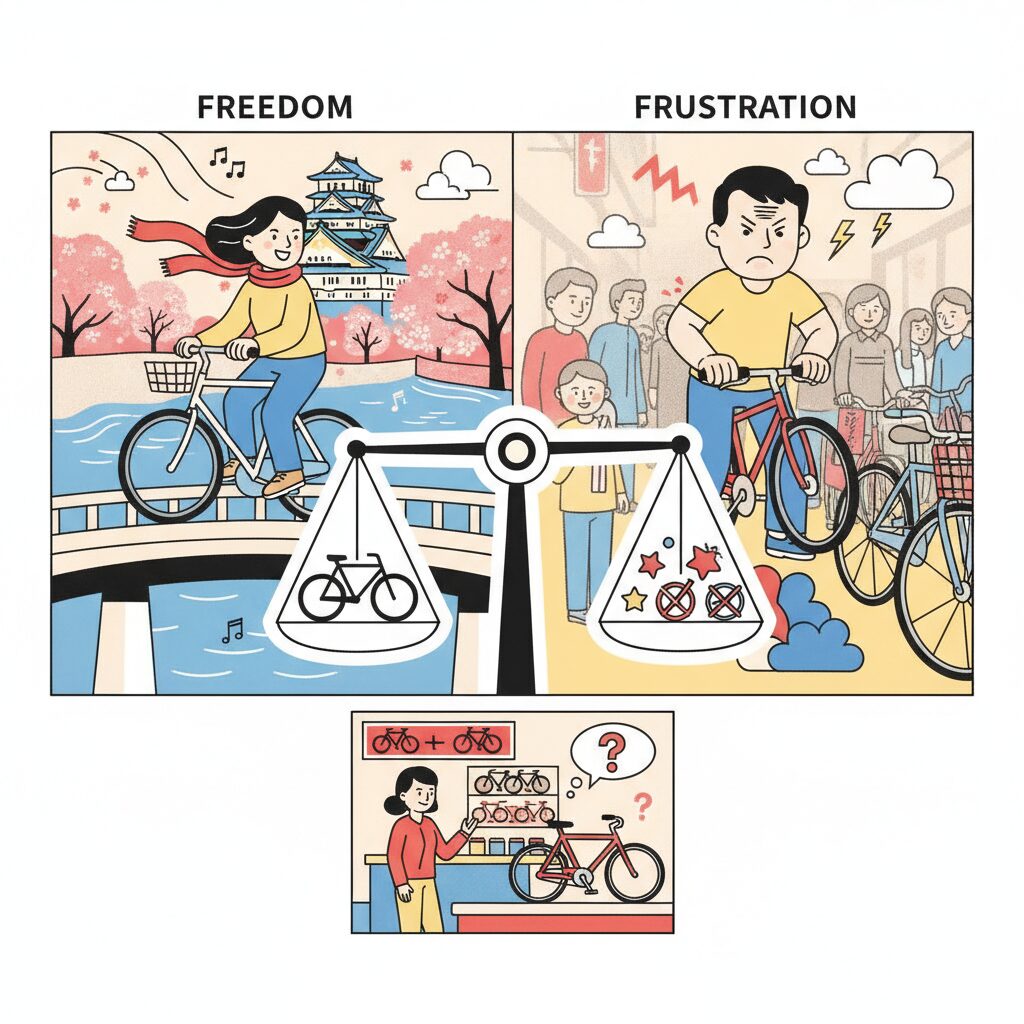
Yet, this newfound liberation is not without its heavy caveats. The cycling life in Osaka is an intense duality of absolute freedom and sudden, bureaucratic frustration. It is a daily negotiation between the sheer joy of cruising down a flat, sunlit avenue and the heart-sinking panic of returning to a spot where you thought you safely parked, only to find an empty space and a yellow warning sticker plastered to the pavement. The city operates on an intricate web of unspoken social contracts, strict legal mandates, and aggressive local ordinances that are rarely explained to newcomers in plain English. Unlike Tokyo, where the hills and the deeply ingrained culture of train reliance keep bicycle commuting somewhat localized to specific neighborhoods, Osaka is a vast, interconnected flatland. It practically begs you to ride. But to survive and thrive on two wheels here requires more than just physical balance; it requires a deep understanding of the local mindset, the merchant-city impatience, and the labyrinthine rules governing insurance, registration, and parking.
To the uninitiated expat, international student, or digital nomad, the cycling culture here can seem utterly chaotic. You will see mothers balancing three children on a single frame, businessmen in crisp suits holding umbrellas in one hand while steering with the other, and delivery riders weaving through tight crowds with the precision of fighter pilots. But underneath this apparent chaos lies a highly structured system. This guide is designed to dismantle that system, laying bare the profound benefits and the hidden traps of relying on a bicycle for your daily life in Japan’s most vibrantly pragmatic city. We will explore why the local geography makes cycling irresistible, dive deep into the essential legal requirements that could save you from financial ruin, map out the perilous landscape of bicycle parking, and weigh whether the ultimate freedom of the pedal is worth the inevitable frustrations of the process. Before you make the decision to join the rolling masses, you must understand the terrain—both the physical pavement and the cultural landscape that surrounds it.
Why Osaka is a Cyclist’s Paradise for Commuting
Flat Terrain and Accessible City Layout
To grasp why cycling is so deeply ingrained in Osaka’s culture, one first needs to consider the terrain beneath the wheels. Osaka is essentially a city built on a river delta. Shaped over time by the Yodo River and its many tributaries, most of central Osaka is remarkably and delightfully flat. This geographic fact is the primary reason why daily life in Osaka feels so different from living in Tokyo or Yokohama. In Tokyo, even a simple trip to the grocery store might involve steep hills, making electric-assist bikes a necessity just to carry home a bag of rice. In Osaka, gravity rarely works against you. From the northern hubs of Shin-Osaka and Umeda, stretching through commercial centers like Honmachi, Shinsaibashi, and Namba, down to the southern area of Tennoji, elevation changes are so minimal they’re hardly felt.
This flatness makes commuting accessible to all. You don’t need to be a top athlete or invest in an expensive, multi-geared carbon-fiber road bike to get around. A heavy, single-speed city bike will easily handle 90% of your trips. The city’s layout further enhances this benefit. Central Osaka follows a large, logical grid system, intersected by wide boulevards such as Midosuji and Sakaisuji. Because the terrain doesn’t require roads to twist around natural barriers, navigation becomes a simple matter of geometry. Often, you can see your destination miles ahead, framed by straight corridors of concrete and glass. For newcomers trying to build a mental map, this clarity is incredibly reassuring. You can cross three wards in thirty minutes without breaking a sweat, moving smoothly from quiet residential streets in Nishi-ku to towering office buildings in Chuo-ku.
The Psychological Impact of a Flat City
The city’s physical flatness also brings about a psychological leveling of the society. In Osaka, everyone cycles. At a red light, you’ll find yourself alongside a high-powered executive in a tailored suit, a university student in sweatpants, an elderly woman carrying leeks in her basket, and a chef transporting fresh fish from Kuromon Market. Cycling carries no stigma; it isn’t seen just as a hobby for fitness enthusiasts or a fallback for those without cars. Instead, it’s universally accepted as the most efficient method for urban mobility. This broad participation creates a unique civic rhythm. The people of Osaka are known for their pragmatism, historically a merchant class driven by efficiency, speed, and the desire to eliminate wasted time. Waiting for trains, ascending or descending subway stairs, and adhering to strict schedules mean a loss of freedom. The bicycle erases that loss, offering a direct, point-to-point solution that aligns perfectly with Osaka’s ethos of quick, fuss-free efficiency.
Beating the Train System in Central Wards
When examining daily commutes, the real advantage of cycling in Osaka becomes clear. Take a typical trip from Fukushima to an office in Honmachi, for example. Taking the train requires a ten-minute walk to the station, a three-minute wait for the loop line, a transfer at Umeda, navigating the sprawling underground maze to the Midosuji line, another three-minute wait, a two-stop ride, and a final ten-minute walk to the office. This journey can easily exceed forty minutes under stressful, crowded conditions. By bicycle, that same trip is a straightforward, uninterrupted fifteen-minute ride. You decide when to leave and which route to take. You avoid being packed shoulder-to-shoulder with strangers, breathing recycled air in a subway car. Over a year, the time saved by cycling instead of using the train adds up to days of reclaimed life. This revelation often marks a turning point for expats: realizing they can outpace the famed Japanese railway system through the power of pedals alone.
Expanding Bicycle Lanes and Infrastructure
For decades, cycling in Osaka meant sharing crowded sidewalks with pedestrians, resulting in stressful near-collisions and constant bell-ringing. Recently, however, the city government has launched a major effort to modernize cycling infrastructure, bringing the daily commute into a safer, more organized era. Today, marked bicycle lanes run boldly along the edges of major roads, reflecting a significant shift in urban planning that acknowledges the sheer volume of cyclists who need dedicated space.
The Blue Arrow Phenomenon
One of the most noticeable changes is the introduction of bright blue arrows painted on the left side of the streets. Accompanied by bicycle symbols, these arrows direct two-wheeled traffic flow. They encourage cyclists to leave crowded sidewalks and join vehicular lanes, drawing a clear visual line between heavy cars and vulnerable bicycles. For commuters, these blue lanes act as efficient arteries, allowing smooth, rapid progress instead of stop-and-go riding on sidewalks. Yet, challenges remain. Delivery trucks often block the blue arrows, forcing cyclists to merge suddenly into fast-moving traffic or jump back onto the sidewalk. It demands constant vigilance to anticipate taxi doors opening or aggressive commercial vehicles maneuvering around.
Navigating Shared Sidewalks with Pedestrians
Despite the growing network of blue lanes, many parts of the city still allow or require cycling on sidewalks. This creates the real cultural tension of commuting in Osaka. Japanese law mainly designates sidewalks for pedestrians, with broad exceptions for bicycles, resulting in a grey area over right-of-way rules. The local norm is a delicate dance of assertive accommodation. Cyclists are expected to weave smoothly through foot traffic without causing alarm. Ringing a bell to push pedestrians aside is generally seen as rude and confrontational. Instead, Osaka riders use a subtler technique of ‘silent intimidation’—squeezing brake levers just enough to make the pads squeak, offering a discreet auditory hint they are approaching. Navigating covered shopping arcades, or shotengai, tests these skills most intensely. Zones like the enormous Tenjinbashisuji officially require dismounting during busy times, yet locals often pedal slowly through crowds. For newcomers, observing and mimicking this careful balance between asserting movement rights and respecting pedestrian vulnerability is key to blending into the community’s rhythm.
The Cultural Anatomy of the Osaka Cyclist
The Mighty Mamachari: Japan’s Minivan
You can’t talk about commuting in Osaka without paying homage to the vehicle that makes it all possible: the Mamachari. The name roughly means “mom’s bicycle,” but this label vastly undersells the engineering brilliance and cultural importance of these bikes. The Mamachari is the unquestioned workhorse of the Japanese urban environment. It’s not built for speed, nor for style, and certainly not for off-road use. It’s designed purely for rugged, reliable, everyday utility.
Looking closely at a Mamachari reveals a masterclass in functional design. Its frame is typically made from sturdy, step-through steel, letting riders mount and dismount with ease no matter their attire—be it a business suit, tight skirt, or traditional dress. The handlebars sweep back to encourage a relaxed, upright posture, perfect for keeping an eye on the bustling traffic. The real brilliance, however, lies in its built-in features. Every proper Mamachari boasts a large front basket, able to carry a week’s groceries, a heavy briefcase, or even a small dog. The rear wheel includes an integrated lock—a metal ring that clamps around the spokes and secures with a physical key—eliminating the need for bulky chain locks. A dynamo hub powers a front light that switches on automatically at dusk, meeting local regulations without the hassle of battery charging. Full fenders shield riders from rain and grime, while a chain guard keeps trousers clean of grease.
The Beauty of Practicality
In the West, bicycles are often seen as expressions of personal identity or sports gear, treated with care and sometimes displayed as art. In Osaka, the Mamachari is a tool, subjected to the same pragmatic neglect as a garden shovel or rain boots. These bikes endure torrential rainy seasons and scorching summers, gathering rust on the handlebars, dents in the baskets, and creaky noises from their bottom brackets. Yet they persist. This battered utilitarian appearance perfectly reflects the Osaka spirit—it’s not about looking affluent or polished, but simply about getting the job done. Owners often equip their Mamachari with practical, rather than flashy, upgrades: umbrella holders mounted on handlebars (though riding with them can be legally dubious), handlebar mitts for freezing winter rides, and elaborate impact-absorbing child seats fixed to front and rear axles. Riding a Mamachari means setting aside vanity and embracing the pure, functional essence of Japanese city life.
The Unspoken Sidewalk Hierarchy
The Osaka commuting scene follows a clear, unspoken social order. At the bottom are pedestrians, who theoretically have full right of way but must remain constantly alert. Above them are Mamachari riders—the slow, steady glaciers of the streets—moving with inexorable momentum. They don’t dart or swerve, so everyone else must navigate cautiously around them. Above the Mamachari are cross-bike and road-bike commuters, often salarymen or students, racing aggressively through tight gaps in traffic.
At the top are delivery riders, the street’s apex predators. Traveling on motorized electric-assist bikes loaded with massive backpacks, they operate under extreme time pressure. Traffic lights are mere suggestions to them; they weave recklessly from blind corners and ride with calculated, fierce determination. Understanding this hierarchy is vital for your safety. When commuting, you need to read the body language of those in front of you. You must anticipate that a mother with two children needs more space, and that a delivery rider could brake suddenly or make an unexpected U-turn without warning. The Osaka mentality is deeply rooted in personal responsibility beneath a veneer of chaos. The unspoken rule is simple: do whatever you want, as fast as you want, as long as you absolutely don’t collide with anyone else. The moment metal hits flesh, the illusion of order shatters, and the harsh realities of Japanese liability law come crashing down.
Essential Rules for Cycling in Osaka
Mandatory Bicycle Insurance in Osaka Prefecture
If there is one key takeaway from this article, it should be this: bicycle liability insurance is legally required in Osaka Prefecture. This is not merely a recommendation or best practice—it is the law. For many expats from countries where bicycle insurance is unfamiliar or unheard of, this mandate can come as a surprising shock. However, the reasoning behind the law is both sobering and practical.
Over the past decade, Japan has seen a significant rise in serious accidents where cyclists hit pedestrians, particularly the elderly. Because traditional bicycles require no license and have no mandatory registration, victims often faced overwhelming medical expenses with no clear way to seek compensation. The turning point came with several high-profile court cases where cyclists—often high school students—were held responsible for causing severe injuries or fatalities to pedestrians. The courts ordered enormous compensation amounts, sometimes nearing one million US dollars, which bankrupted families overnight. Recognizing that the average person couldn’t bear such liabilities, local governments stepped in. Osaka Prefecture was among the first to legally require all cyclists within its jurisdiction to carry specific personal liability insurance covering damages to third parties.
Navigating Convenience Store Kiosks for Insurance
Fortunately, although the requirement is strict, obtaining the insurance is remarkably easy and surprisingly affordable, reflecting the city’s practical approach. There’s no need to meet with an insurance broker or complete lengthy paperwork. The entire process can be done in about ten minutes at digital kiosks found inside convenience stores such as Lawson, FamilyMart, or 7-Eleven.
Simply approach the machine (often a Loppi at Lawson or the multi-copy machine at 7-Eleven), use the touch screen to navigate to the insurance section, and select bicycle insurance. Since these machines often lack comprehensive English translations for these legal menus, using a translation app on your phone to read the screen in real time is highly recommended. The annual premium typically costs between two thousand and four thousand yen—a small price for coverage that protects you against up to one hundred million yen in liability claims. You enter your name, address, and phone number; the machine prints a receipt, which you then take to the register to pay. The clerk will provide a small pamphlet with your policy details. Keep this document safe. While police don’t conduct random stops solely to check insurance, if you’re involved in even a minor accident and cannot prove coverage, the legal and financial consequences will be severe.
Bicycle Registration (Bouhan-toroku)
In addition to mandatory insurance, there is another important administrative requirement in Osaka: Bouhan-toroku, or bicycle anti-theft registration. Every bicycle sold or used in Japan must be registered to its owner in a national police database. When you buy a new bicycle from a store, the staff will handle this process at the time of sale. You pay a small fee (usually about six hundred yen), fill out a form with your name, address, and phone number, and the shop mechanic attaches a small tamper-proof yellow or orange sticker to the bike frame. This sticker bears a unique ID number linked directly to your identity.
This system is designed to prevent theft and recover stolen bikes, and it works effectively. However, foreign residents often encounter complications with Bouhan-toroku when using second-hand bicycles. If you purchase a bike from a friend, a second-hand shop, or online, you must officially transfer the registration into your name. This requires the original owner’s registration paperwork, a signed transfer of ownership form (joto shomeisho), your residence card (Zairyu card), and the bicycle itself. You bring all these to the local police box (Koban) or a registered bike shop to complete the transfer. Riding a bicycle still registered to someone else is taken very seriously by the Japanese police.
The Dreaded Police Stop (Shokumu-Shitsumon)
Understanding Bouhan-toroku is essential due to an often uncomfortable part of daily life in Japan: the Shokumu-Shitsumon, or police questioning. Police in Osaka frequently conduct random stops of cyclists to check registration stickers against their database to identify stolen bicycles. Foreign residents—especially those who appear non-Japanese—report being stopped more frequently than locals.
Imagine you’re cycling home from the supermarket when two officers suddenly step out from the shadows of a Koban with glowing red batons and signal you to stop. This can be intimidating, but it’s important to stay calm, polite, and cooperative. They will ask where you’re headed, request your residence card, and radio the bike’s registration number to their dispatch. If the bike is registered in your name, the check takes about five minutes, ending politely. However, if you purchased the bike from a departing expat and haven’t transferred registration, the situation escalates quickly. Police will suspect the bike is stolen. You may be detained at the Koban while they attempt to contact the registered owner, which can take hours. If the owner cannot be reached or has left Japan, you risk having the bike confiscated or facing theft charges. Although the bureaucracy is frustrating, riding with your paperwork in order provides peace of mind.
Basic Traffic Laws and Safety Guidelines
For a long time, the informal rule for cycling in Osaka was “just don’t hit anyone, and anything goes.” However, the National Police Agency has recently launched crackdowns on dangerous cycling behaviors, introducing new laws and strictly enforcing existing ones. The days of casual, reckless cycling are ending, and penalties for violations are harsh.
The main rules are simple but often ignored by locals, which can mislead foreigners into a false sense of security. First, bicycles are legally classified as light vehicles and must obey vehicular traffic lights, not pedestrian signals—unless on designated pedestrian paths. Second, you must ride on the left side of the road. Riding against traffic on the right side is very dangerous and now heavily fined.
The “holy trinity” of forbidden behaviors includes: no riding while using a smartphone, no riding while wearing earphones or headphones that block traffic sounds, and no riding while holding an umbrella—even though the image of an Osaka commuter steering with one hand while holding a clear plastic umbrella in the other is iconic. Police issue “red card” warnings for these offenses. Accumulating multiple warnings or causing an accident will require attending a costly and demanding traffic safety course at the police center, and failing to comply results in heavy fines.
How to Get a Commuter Bike in Osaka
Buying New vs. Used Bicycles (Mamachari vs. Cross Bikes)
Once you’ve familiarized yourself with the rules of the road, the next step is getting your bike. Osaka’s bicycle market is extensive, catering to all budgets and preferences. Your first choice is whether to buy new or used, and whether to go for a practical Mamachari or something sleeker like a cross bike or hybrid.
For most commuters, a brand-new Mamachari represents the most sensible investment. Large retail chains such as Cycle Base Asahi dominate the market. Stepping into one of these bright, spacious stores ensures a hassle-free buying experience. Prices are fixed, inventory is vast, and staff work efficiently. A typical single-speed Mamachari with an automatic light and basket costs between fifteen thousand and twenty-five thousand yen. Adding a multi-gear system may raise the price to around thirty thousand yen. Buying new from a major retailer offers the huge advantage of on-the-spot Bouhan-toroku registration, fully inflated tires, tuned brakes, and often affordable maintenance packages that cover flat tires and chain lubrication for the first few years.
If your journey is longer—such as traveling from the northern outskirts of Suita to the central business district—the heavy, upright Mamachari posture may become tiring. In this case, a cross bike is appealing. These hybrids combine the lightweight frames and multiple gears of road bikes with the flat handlebars and wider tires of mountain bikes. They’re fast, agile, and great for climbing Osaka’s river bridges. However, they lack built-in locks, baskets, and fenders, so you’ll need to buy those separately and face a higher risk of theft.
The Art of Finding a Quality Used Bike
For those on a tight budget, the second-hand market can be very tempting. Osaka is filled with small independent recycle shops and specialized used bicycle dealers. You can often find a functional Mamachari for under ten thousand yen. However, buying used requires a keen eye. Don’t just focus on rust on the frame—surface rust is common in Japan’s humid climate and usually harmless. Instead, examine key wear points. Squeeze the brake levers to ensure they feel firm, not spongy. Inspect brake pads for uneven wear. Spin the wheels to check they run true without wobbling, which may indicate loose or broken spokes. Most importantly, check the tires for dry rot—small cracks in the sidewall rubber that hint the bike has been left outside under the summer sun for years. A cheap used bike can end up costly if you immediately need a mechanic to replace tires and brake cables. Moreover, as noted earlier, make sure the shop provides proper documentation for transferring the Bouhan-toroku registration. Never buy a used bike from a private seller without this paperwork.
Long-Term Rental and Bike-Sharing Apps
If you’re living in Osaka only temporarily or want to avoid the hassle of ownership, maintenance, and parking, the city’s growing bike-sharing networks offer an attractive alternative. Two key players dominate: Docomo Bike Share (locally branded as Hubchari) and Hello Cycling.
These services function through smartphone apps linked to your credit card. You use the app’s map to find the nearest parking port, reserve a bike, and unlock it using a digital code or by tapping a registered IC transit card like ICOCA. The major benefit of these shared bikes is that nearly all are electric-assist. The battery helps as you pedal, making bridges and headwinds feel much easier. You can ride from Umeda to Namba, drop the bike at a designated port near your destination, and walk away without worries about registration, flat tires, or impoundment.
The Battery Anxiety of Shared Bikes
However, relying solely on bike-sharing for a daily, time-sensitive commute presents new challenges. Bike availability at your local port can be unpredictable. On a nice Tuesday morning, you might leave your apartment at 8:00 AM only to find the nearest port completely empty because earlier commuters have taken all the bikes. Alternatively, when you arrive at work, your destination port may be full, preventing you from parking and ending your rental. This forces you to ride to another port and walk back. Additionally, you must always check the battery level shown in the app before renting. Choosing a bike with only ten percent charge risks the battery dying mid-ride. When electric assist stops working, the bike becomes very heavy and hard to pedal, turning an easy commute into a tiring, sweaty ordeal. The freedom of not owning a bike is constantly balanced against the annoyance of uncertain availability.
Navigating Bicycle Parking (Churinjo)
How to Find and Use Paid Parking Lots
If Osaka’s flat terrain offers the greatest freedom for cycling, then finding a place to park undoubtedly ranks as its biggest frustration. In many Western cities, you simply lock your bicycle to a street sign or lamppost and walk away. In Osaka, however, doing so almost guarantees your bicycle will be confiscated by the city. You cannot park just anywhere—you must use designated bicycle parking lots, known as Churinjo.
The infrastructure around Churinjo is extensive, intricate, and highly mechanized. Near every major train station, shopping mall, and commercial building, you’ll find both surface-level racks and enormous underground parking vaults. For daily commuters, securing a monthly parking pass at the nearest Churinjo is a top priority when starting a job or moving into a new apartment. These passes typically cost between two thousand and four thousand yen per month, providing a guaranteed spot or access to a specific locked area.
For errands or visits to new parts of the city, you rely on temporary hourly parking. These street-level racks are marvels of Japanese mechanical engineering. You roll your front wheel into a metal trough; after a few minutes, a mechanical jaw snaps shut around the wheel, locking the bicycle securely in place. When you return, you use a central payment machine, enter the number of your parking rack, insert coins or tap your IC card, and the jaw releases. The rates are very reasonable—often free for the first hour and about one hundred and fifty yen for every subsequent twelve hours. The true challenge is not the cost but finding an empty rack in busy areas like Shinsaibashi or Umeda on a weekend afternoon. You’ll often find yourself circling blocks, sweating in the humidity, desperately searching for a green light signaling an open slot.
The Subterranean Eco-Cycle Parking Systems
In some of the more modern districts, you’ll encounter the pinnacle of Japanese parking technology: the subterranean Eco-Cycle vaults. These resemble small, futuristic kiosks on the sidewalk. You place your bicycle on a designated platform, swipe your membership card, and the machine physically swallows your bicycle, lowering it into a vast, automated cylindrical silo deep underground. It’s secure from theft, sheltered from rain, and requires no physical effort to fit your bike into a compact space. Retrieving it is equally simple; swiping your card prompts a robotic arm to fetch your bicycle and deliver it to the surface in less than twenty seconds. These facilities represent the ultimate blend of space-saving design and commuter convenience.
Avoiding Bicycle Impoundment Zones
Strict adherence to the Churinjo system is enforced through a relentless municipal policy of bicycle impoundment, known as Tekkyo in Japanese. City governments see illegally parked bicycles as both an eyesore and a serious safety risk, blocking pedestrian walkways and hindering emergency vehicles. As a result, large areas of central Osaka are designated as “No Bicycle Parking Zones,” marked by noticeable red and white signs, often showing illustrations of a bicycle being towed away by a truck.
Enforcement is carried out by teams of municipal workers, often older men in green or blue uniforms, driving flatbed trucks. Their efficiency is intimidating. Leaving your bicycle outside a convenience store in a no-parking zone, even for just five minutes to buy a bottle of green tea, risks your bike being swept away. The workers don’t care if the bike is locked—they’ll cut chain locks or simply lift the heavy Mamachari, lock included, onto their truck.
The Walk of Shame to the Impound Lot
Discovering your bicycle has been impounded is a common ordeal for Osaka residents. You return to where you left your bike. The spot is empty. Panic sets in—was it stolen? Then, you spot a small, brightly colored paper tag stuck to the pavement or wrapped around a nearby pole, explaining in dense Japanese that your bicycle was removed by the ward office.
This marks the beginning of the walk of shame to the impound lot. These lots are seldom conveniently located; they’re often at the city ward’s remote edges—under highway overpasses, near industrial canals, or far from train stations. You must travel there, present your ID and bicycle lock key, and pay a hefty retrieval fee—usually about two thousand five hundred to three thousand yen, payable only in cash. Then you sift through thousands of confiscated bicycles, searching for your dusty, unceremoniously dumped machine. It’s a frustrating, time-consuming process designed to be punitive. The threat of Tekkyo fundamentally changes how you use the city—you lose the spontaneous freedom to pull over wherever a shop catches your eye. Every stop becomes a calculated risk: “Is this a no-parking zone? Is there a Churinjo nearby? Is it worth the risk?”
Best Routes and Areas for a Bike Commute
The Midosuji Boulevard Bike Lanes
Once you’ve mastered the rules, secured your bicycle, and learned to respect the impound truck, the actual riding experience begins. There is no better place to appreciate the vast scale of Osaka’s commute than Midosuji Boulevard. Midosuji serves as the city’s backbone, a broad, multi-lane avenue stretching straight from Umeda in the north to Namba in the south. It is lined with hundreds of towering Ginkgo trees, which turn a brilliant, fiery yellow in autumn, creating a visually stunning scene.
Historically, Midosuji was a nightmare for cyclists. The sidewalks were overcrowded with pedestrians, and the heavy volume of high-speed car traffic made the road extremely hostile. However, the city has recently created impressive, dedicated bike lanes on both sides of the boulevard. These lanes are physically separated from vehicular traffic by curbs and barriers, offering a wide, smooth ribbon of asphalt exclusively for two-wheeled travel.
Rush Hour on Midosuji
Cycling down the Midosuji bike lane during the morning rush hour is like participating in a grand, urban ballet. You join a slipstream of hundreds of other commuters, all gliding silently at a steady, brisk pace. The city’s towering presence surrounds you—the luxury boutiques of Shinsaibashi and the corporate skyscrapers of Honmachi. Because the lane is segregated, you can truly pick up speed without constantly fearing a taxi clipping your shoulder. It represents the ultimate freedom of commuting in Osaka. You move faster than the gridlocked cars to your right and feel far more comfortable than those squeezed into the subway tunnels beneath your tires.
Scenic Riverside Commuting Paths
While Midosuji embodies the commercial core of commuting, the true heart of cycling in Osaka lies along its rivers. Known affectionately as the “City of Water,” Osaka’s municipal government has transformed the banks of its major rivers into expansive, car-free parks with continuous paved trails. For commuters living in the northern or eastern wards, these riverside paths provide a peaceful, high-speed alternative to navigating the city’s traffic lights.
The Yodogawa River Park Trail
The most notable trail runs along the Yodogawa (Yodo River), which marks the northern edge of the central city. The paved paths here extend for dozens of kilometers without a single intersection or traffic light. If you’re commuting from areas like Juso, Tsukamoto, or even farther out in Suita and Ibaraki, you can access the riverbank and ride nearly uninterrupted all the way to the edge of Umeda.
Riding along the Yodogawa offers a profound psychological release from the claustrophobia of urban density. The sky fully opens above you. You share the path with early morning joggers, baseball teams practicing on the grass, and the occasional stray cat. The air feels noticeably cleaner, scented with flowing water and freshly cut grass. The only challenge here is the weather: because the river valley is wide and exposed, you are completely at the mercy of the wind. A strong headwind blowing in from the bay can turn an easy twenty-minute ride into a demanding, exhausting workout.
Similarly, the paths along the O-gawa (Old Yodo River), meandering past the Osaka Mint and Sakuranomiya, offer breathtaking seasonal commutes. In spring, this route passes through tunnels formed by thousands of blooming cherry blossoms. The stark contrast between the harsh concrete-and-neon cityscape of downtown Osaka and the tranquil, natural beauty of these river corridors is striking. Being able to transition between these two worlds on a bicycle is one of the greatest privileges of living in the city.
Winter Frost and Summer Sweat: The Seasonal Realities
Surviving the Tsuyu (Rainy Season)
The romanticized image of a bicycle commute seldom considers the harshness of the Japanese seasons. In Osaka, the weather governs your daily survival. The first significant challenge for any foreign commuter is the Tsuyu, the rainy season that usually covers the region from early June through mid-July. This is not the fleeting, light showers typical of Europe; it is a persistent, oppressive downpour. It can rain continuously for a week.
Since holding an umbrella while cycling is illegal and unsafe, adjusting your clothing is essential. High-quality rain gear is absolutely necessary. The average Osaka commuter wears a full-body, waterproof poncho made specifically for cycling. These ponchos often include clear vinyl visors integrated into the hood to protect your face from the pouring rain while preserving visibility, along with clips that secure the front hem to the bicycle basket, forming a waterproof tent over your legs and belongings. Navigating the city during heavy rain demands great caution. The painted white lines on the road and the metal manhole covers scattered across the asphalt become extremely slippery, almost like black ice. Braking distances double. The frustration during Tsuyu is tangible. Arriving at the office damp, peeling off layers of wet vinyl, and trying to dry your shoes before heading home challenges even the most committed cyclists. During these weeks, the crowded but dry interiors of the trains begin to look very tempting.
The Intense Humid Summer Commute
If the rainy season tests your patience, the Osaka summer challenges your physical stamina. By early August, the city turns into a concrete heat island. Temperatures often climb into the upper thirties Celsius (nearly 100 degrees Fahrenheit), paired with choking humidity levels that make the air feel thick and hard to breathe.
Cycling in this heat calls for careful planning. The freedom to ride fast gives way to the need to ride slowly, pacing yourself to avoid heatstroke and prevent arriving soaked in sweat. Locals use various strategies: UV-blocking arm covers, cooling neck rings frozen overnight, and battery-powered fans attached to the handlebars. Your chosen route also shifts. You look for shaded streets, steer clear of wide, exposed bridges, and stick to the narrow alleys where tall buildings block the sun. The frustration of the summer commute lies in the relentless physical discomfort. No matter how slowly you pedal, the humidity clings to your skin. Yet, even in the peak of August, cycling holds a clear advantage over walking. While walking, the air stands still. When pedaling, you create your own breeze, a small, artificial wind that offers just enough relief to make the trip manageable.
Maintenance and the Neighborhood Cycle Shop
The Local Jitensha-ya
A crucial yet often overlooked part of the cycling lifestyle in Osaka is the connection you develop with the local bicycle mechanic. Unlike in the West, where you might have to load a broken bike into a car and drive to a distant suburban sporting goods store, Osaka is filled with small, independent bicycle repair shops called Jitensha-ya. You’ll find one in nearly every neighborhood, usually squeezed into a space no bigger than a single-car garage, packed with spare tires, hanging tubes, and the sharp, distinctive scent of rubber and industrial grease.
These shops are essential lifelines for the commuting public. The mechanics—often older men who have been servicing the same models of Mamachari for forty years—work with impressive speed and little fuss. If you get a flat tire on your way to work, there’s no need to worry. Just walk your bike a few blocks until you reach the nearest Jitensha-ya.
The Economics of Repair
The economics of these repairs are intriguing and highlight the disposable nature of Mamachari culture. Fixing a punctured inner tube typically costs around five hundred to eight hundred yen and takes the mechanic less than ten minutes. You stand on the sidewalk, watching him skillfully pry the tire off the rim, find the invisible hole by submerging the tube in a basin of water, apply a rubber patch, and then blast it with a high-pressure air compressor. It’s a captivating demonstration of well-practiced efficiency. However, replacing a completely worn-out rear tire can cost four to five thousand yen or more, including the labor involved in dismantling the internal brake and gear hubs. Since a used bike costs about ten thousand yen, paying half its value for a single tire replacement requires a tough economic decision. Many locals simply ride their bikes until the tires are bald, the chains rusted stiff, and the brakes screech, then trade them in for new models. For expats who want to keep a smooth, safe commute, regularly inflating your tires (most shops offer a free air hose out front for public use) and lubricating your chain is the easiest way to avoid the hassle of mechanical breakdowns.
Osaka vs. Tokyo: A Commuter’s Comparison
Speed, Aggression, and Practicality
To truly understand the distinctive nature of cycling in Osaka, it’s useful to compare it with the capital city. While Tokyo is a city defined by rules, order, and quiet conformity, Osaka embodies speed, pragmatism, and lively negotiation. This core cultural difference strongly influences the commuting style.
In Tokyo, a cyclist approaching a red light at an empty intersection at midnight will almost always stop and wait for the signal to turn green. The rule is the rule, and compliance is unwavering. In Osaka, that same cyclist will slow down, look both ways, and if no cars are coming, they will treat the red light like a yield sign and pedal through it. This behavior isn’t driven by disregard but by the merchant city’s ingrained aversion to wasting time. To an Osakan, waiting at a signal when there is obviously no danger feels inefficient and illogical. This flexible interpretation of traffic laws creates an atmosphere that feels noticeably faster and more aggressive than Tokyo.
For a foreigner, this can be quite intimidating to navigate. You’re constantly calculating not only the official rules but also the unspoken, adaptable reality of the street. You must be assertive to survive here. If you hesitate at an intersection, waiting for a perfect opening that will never appear, cyclists behind you will simply swerve around. You learn to move with purpose, to claim your space on the road, and to trust that the chaotic flow of traffic will part around you, as long as your movements are predictable.
The Density of Urban Villages
Moreover, the physical layouts of the two cities shape different commuting mentalities. Tokyo is a collection of vast, distinct urban centers separated by clear boundaries. You take the train to get from Shibuya’s hub to Shinjuku’s. Osaka, on the other hand, feels like one massive, continuous village. Because the terrain is completely flat and the density persistent, the transitions between neighborhoods blend seamlessly. You can leave the vibrant, neon-filled commercial district of Namba, cross a single bridge, and immediately find yourself in a quiet, shaded residential area with narrow alleys and tiny wooden houses in Sakuragawa.
The bicycle is the ideal vehicle for this kind of urban fabric. It lets you explore the in-between spaces, the hidden cafes, local shrines, and tiny neighborhood okonomiyaki stands that you’d miss if confined to train lines. This is the essence of freedom in the Osaka commute. You’re not just traveling from point A to point B; you’re actively engaging in the city’s daily life at street level. You smell the yakitori smoke drifting from izakayas at dusk, hear the mahjong parlors’ clatter, and feel the drop in temperature as you ride under elevated train tracks.
The difficulties are real. The panic of a missing bicycle, the bureaucratic hoops of registration, the sweltering August heat, and the constant underlying fear of accidentally brushing against a pedestrian. But when you’re cruising down the Midosuji bike lane on a crisp October morning, the city unveiling itself before you, entirely under your own power and schedule, those frustrations fade away. The bicycle removes the isolation of being a foreigner in a vast metropolis. It compels you to engage with Osaka on its own terms, moving at its own frantic, pragmatic, and ultimately joyful pace. It turns you from a passenger into a participant, and in a city as vibrant as this, that participation is worth every drop of rain and every rusted chain.