Osaka hits you first through your senses. You smell the rich, smoky scent of bonito flakes dancing on hot takoyaki grills. You hear the staccato rhythm of the Kansai dialect bouncing off the narrow walls of hidden alleyways. And then, before you can fully take it all in, you hear the familiar rattle. A squeaky brake. A rusty chain. The sudden whoosh of air as a mother balancing two toddlers and a basket full of daikon radishes flies past you with surgical precision. Welcome to Osaka, where the true heartbeat of the city is not the subway system, but the humble, ubiquitous bicycle. Locals lovingly call it the ‘charinko’.
Living in Osaka changes your relationship with transportation. While Tokyo residents pride themselves on their immaculate train etiquette and intricate subway commutes, Osakans are fiercely pragmatic. Why walk fifteen minutes to the station, wait for a train, and walk another ten minutes when you can simply jump on your charinko and be at your favorite okonomiyaki joint in eight minutes flat? Bicycles here are not recreational gear. They are vital extensions of daily life. They are grocery haulers, commuter shuttles, and late-night transport vehicles all rolled into one.
If you are planning to move here, or if you simply want to understand the unspoken rhythms of this wonderfully chaotic city, you have to understand the charinko. Getting a bike will unlock neighborhoods hidden far beyond the reach of the Midosuji Line. But stepping into the saddle requires a deep understanding of local manners, stringent national laws, and the complex dance of sharing narrow streets with millions of other fast-moving residents. Let me guide you through the real, unvarnished truth of navigating Osaka on two wheels.
The Unique Cycling Culture of Osaka
The ‘Mamachari’ Phenomenon and Local Pacing
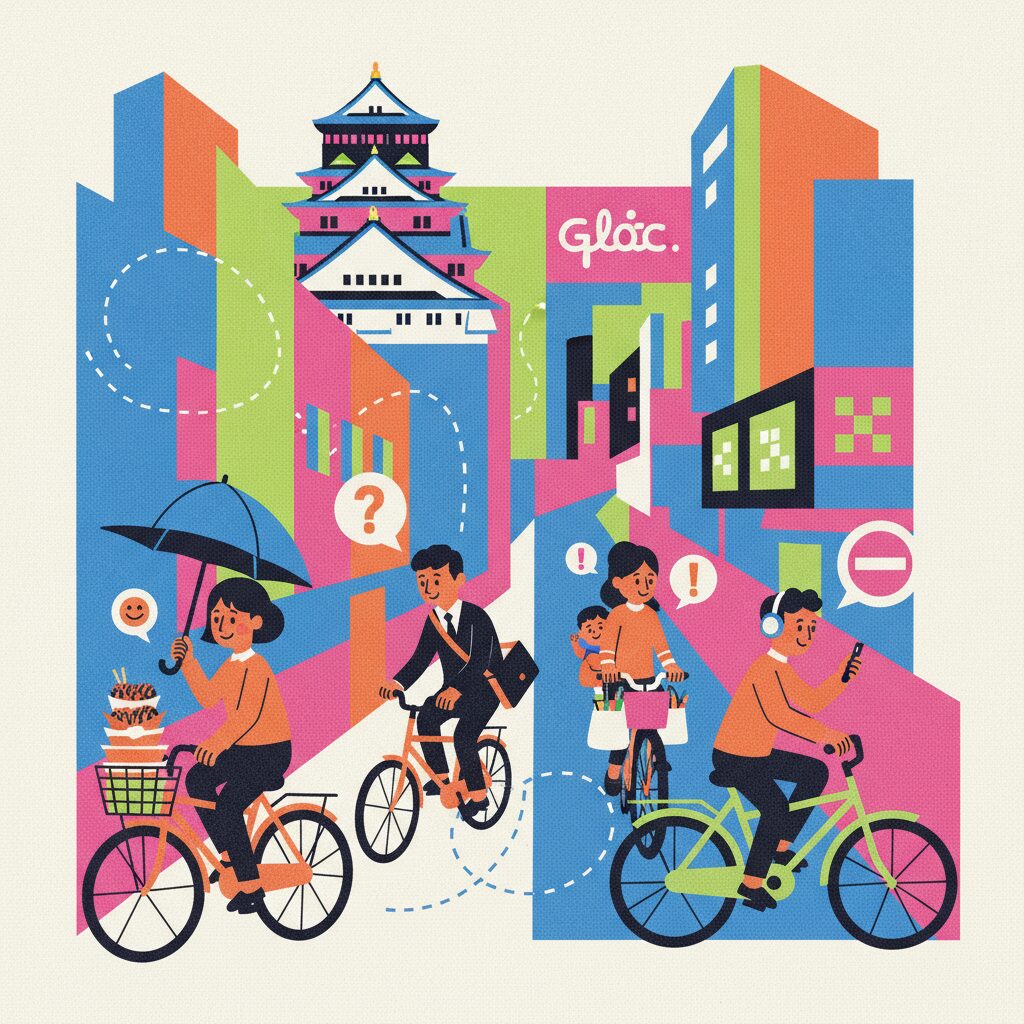
To truly understand Osaka, you must understand the ‘mamachari’. The term literally means ‘mom bicycle,’ but this nickname barely captures its cultural ubiquity. The mamachari is Japan’s minivan—designed entirely for practicality rather than speed or style. It boasts a step-through frame, a large front basket, sturdy kickstands, and often rear racks made to carry child seats or extra cargo.
In Osaka, everyone rides a mamachari. You’ll spot suited businessmen dashing to morning meetings with their briefcases thrown casually into the basket. You’ll see high school students pedaling hard, laughing loudly as they weave through traffic. Elderly shopkeepers cruise the streets with cigarettes dangling from their lips. Riding a practical bike carries no stigma here; in fact, arriving at the local supermarket on a sleek, expensive carbon-fiber road bike might earn you a few puzzled looks.
The local biking pace is fiercely efficient. Osaka residents are known throughout Japan for their impatience. They walk fast, talk fast, and bike even faster. There’s a distinct, rhythmic flow to how they navigate tight spaces. They rarely slow down unless absolutely necessary, instead calculating trajectories with mathematician-like precision, squeezing through gaps in the crowd that seem impossibly narrow. Mastering this pace takes time: at first, you’ll feel clumsy and slow, but eventually, you’ll learn to trust the flow and match the speed of the grandmothers beside you.
Osaka vs. Tokyo: Differences in Biking Vibes
If you spend enough time in both cities, the differences between Tokyo and Osaka’s biking cultures become strikingly clear. Tokyo is a city of rules. Its infrastructure is generally more rigid, with high levels of compliance. Cyclists in Tokyo tend to stay within designated road boundaries, and there is a growing culture of costly road bikes and e-bikes favored by affluent urbanites as a lifestyle choice. The atmosphere feels more structured, heavily policed, and somewhat sterile.
Osaka, in contrast, operates like organized chaos. The city’s mercantile history shapes its culture, rooted in merchants who prioritized results over perfect appearances. This mentality directly influences the cycling scene. Osaka’s streets are narrower, urban planning more convoluted, and the atmosphere overwhelmingly pragmatic. If an Osaka resident faces a red pedestrian light at a major intersection but the car lane is clear, they might simply merge into traffic, power through, and hop back onto the curb.
It’s not a matter of disrespecting the law; rather, it’s reliance on common sense and situational awareness over blind obedience to signs. This can be startling to foreigners, whether arriving from abroad or from Tokyo. Here, you must stay hyper-aware. The energy is vibrant, sometimes aggressive, but entirely honest. People aren’t being rude—they’re just trying to get home in time for dinner.
Official Japanese Cycling Laws You Must Know in 2026
Ride on the Left Side of the Road
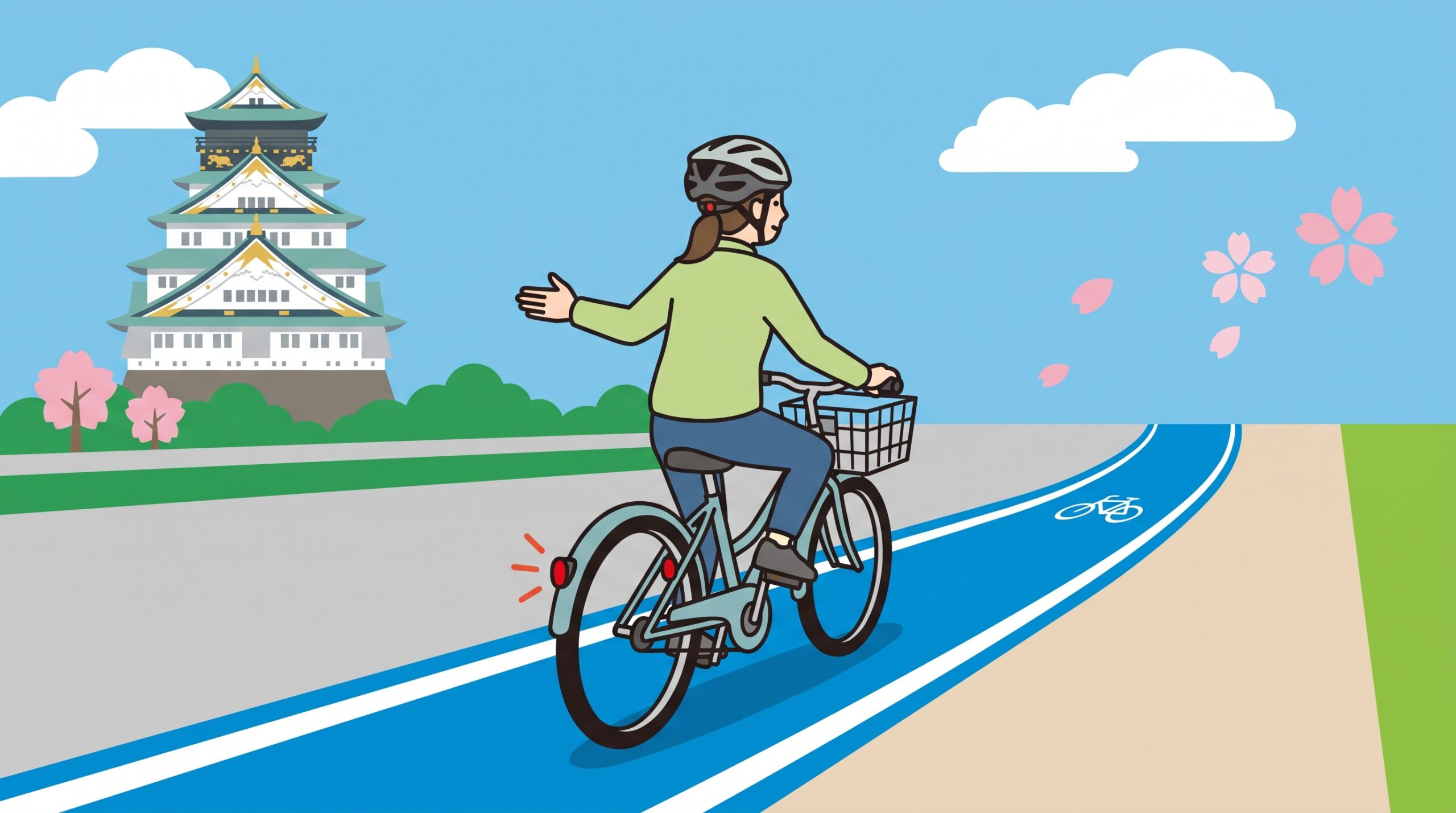
Although Osaka locals might bend some unwritten rules, national traffic laws remain very strict, and police enforcement has significantly increased. The fundamental rule of cycling in Japan is that bicycles are classified as light vehicles. Therefore, you must ride on the left side of the road, following the same direction as automobile traffic.
Riding against traffic on the right side is not only illegal but also extremely dangerous. Osaka’s streets are full of blind corners, aggressively driven delivery trucks, and fast-moving taxis. If you ride on the wrong side, drivers turning from side streets may not see you. Local police officers on their own white bicycles often set up discreet checkpoints near major intersections to stop foreign residents and tourists who casually cycle against traffic. The fines are costly, and the warnings are always strict. Always stick to the left.
The Sidewalk Exception: When Can You Ride on Pavements?
This is where the large gap between national law and Osaka’s reality becomes clear. Legally, bicycles belong on the street. However, there are exceptions. You may ride on the sidewalk if there is a specific blue sign showing a pedestrian and a bicycle. You can also ride there if the road is considered too dangerous due to heavy traffic or lack of shoulder space, or if the rider is under thirteen or over seventy years old.
In practice, because Osaka’s streets are so narrow and drivers often drive fast, almost everyone rides on the sidewalk whenever possible. This creates a tense environment where pedestrians and cyclists share tight concrete spaces. If you ride on the sidewalk, the law clearly states that pedestrians have absolute right of way. You must ride slowly on the side closest to the road. If your path is blocked by pedestrians, you must stop, wait, or dismount. You cannot force pedestrians to move. This crucial rule often trips up newcomers who treat sidewalks like their personal expressways.
Strict Penalties for Smartphones, Umbrellas, and Alcohol
If you take away one thing from this guide, let it be this. By 2026, Japan has enforced harsh crackdowns on dangerous cycling behaviors. The days of riding with a beer in hand are over. Cycling under the influence of alcohol carries severe, life-changing penalties. You could face up to three years in prison or a hefty fine of five hundred thousand yen. For foreign residents, such a conviction can result in visa revocation and deportation. If you’ve been drinking at an izakaya in Fukushima, don’t bike home. Walk or take a taxi. There is zero tolerance.
Similarly strict are the new rules regarding smartphone use. Riding while looking at or texting on a screen can lead to up to a year in prison or a large fine. Even holding a phone while riding is a serious offense.
There is also the issue of umbrellas. Osaka is known for the ‘sasubee,’ a clamp attached to handlebars to hold an umbrella hands-free, keeping the rider dry. While popular among local grandmothers, using a wide umbrella in tight spaces is highly restricted and illegal in many traffic situations because it increases your size and blocks your view. If caught holding an umbrella with one hand while steering with the other, police will stop you immediately. Buy a quality rain poncho instead. It may not be stylish, but it’s the legal and practical option.
Helmet Regulations and Recommendations
Recently, the Japanese government introduced updated laws encouraging all cyclists to wear helmets. Currently, this is an effort-based requirement rather than an offense with an immediate fine for adults. However, the cultural shift is underway.
In the past, it was rare to see an adult wearing a helmet on a mamachari. Now, especially among expats and long-term residents commuting across the city, helmet use is becoming more common. Given Osaka’s chaotic traffic, aggressive taxi drivers in the Minami district, and the volume of cyclists, protecting your head is simply sensible. While local police may not fine you for not wearing a helmet on a quick grocery trip, insurance companies pay close attention to whether helmets were worn if a collision occurs.
Unwritten Etiquette for Riding in Osaka
Navigating Pedestrians: The Bell vs. Saying Sumimasen
This is the most essential cultural etiquette you need to learn. Every bicycle comes with a bell, but under Japanese national traffic law, that bell is only to be used in absolute emergencies to avoid collisions. Technically, it is illegal to ring your bell simply to tell pedestrians to move aside on a sidewalk.
Nonetheless, you may occasionally hear an older Osaka resident aggressively ringing their bell through a crowd. Do not follow their example. For foreigners or younger residents, persistently ringing your bell at pedestrians is seen as extremely rude, impatient, and arrogant. It implies that your time is worth more than their safety.
The correct, unwritten etiquette is to slow down, approach cautiously, and either wait for them to notice the squeak of your brakes or softly say “Sumimasen,” which means excuse me. Often, the sound of your tires quietly approaching is enough to encourage people to step aside. If the crowd is too dense, dismount and push your bike gracefully. Humility is highly valued on the sidewalks in this city.
Dealing with Crowded Shotengai Shopping Arcades
Osaka is unrivaled when it comes to shotengai, the covered shopping arcades. Tenjinbashisuji is Japan’s longest, featuring a vibrant, multi-kilometer stretch of restaurants, butchers, tea shops, and clothing vendors. Kuromon Market is a famous hotspot for street food. These arcades serve as vital arteries of local commerce.
Because they are covered and paved, they seem like tempting shortcuts for cyclists. However, nearly all major shotengai have strict regulations forbidding riding during business hours. Signs clearly instruct that you must dismount and push your bicycle. Ignoring these rules is a serious cultural mistake. If you try to ride through a busy arcade, you will face hostile glares, angry shouts from shopkeepers, and possibly a stern reprimand from neighborhood patrol volunteers. These arcades are spaces for commerce, conversation, and pedestrian movement. Respect the area, dismount, and enjoy the stroll past the takoyaki vendors.
Eye Contact and Non-Verbal Cues at Intersections
In residential wards like Nakazakinishi or Taisho, you will find numerous small, unmarked intersections. There are no stoplights or clear right-of-way signs. High walls and tightly packed houses create blind corners everywhere. Navigating these requires mastering what locals call the Osaka stare.
When approaching an unmarked crossing, locals often don’t come to a complete stop if they don’t hear cars. Instead, they slow down gradually, leaning forward to peer around concrete walls. If another cyclist appears, the right of way is settled entirely through eye contact and subtle body language. A slight nod, breaking eye contact, or a small shift in handlebar angle communicates who goes first. It is a smooth, silent negotiation. As a newcomer, the safest approach is to stop completely, look both ways, and yield. With time, you’ll learn to interpret the tiny cues that keep this chaotic dance flowing safely.
Bicycle Parking Churinjo Rules in Osaka
Why You Cannot Park in No-Parking Zones
One of the biggest misconceptions about Osaka is that because bicycles are everywhere, you can park your bike anywhere. This misconception traps many foreigners. You cannot simply leave your bike outside a cafe, chain it to a guardrail, or lean it against a convenience store window for hours.
Major areas such as Umeda, Namba, and Tennoji are designated strict no-parking zones. These places are heavily monitored by city workers, known affectionately and fearfully by locals as the green men due to their uniforms. Parking illegally in these zones not only blocks pedestrian paths, emergency exits, and tactile paving for the visually impaired but also guarantees your bike will be removed. The convenience of cycling disappears when you spend forty minutes searching for a legal parking spot.
How to Find and Pay for Official Bicycle Parking
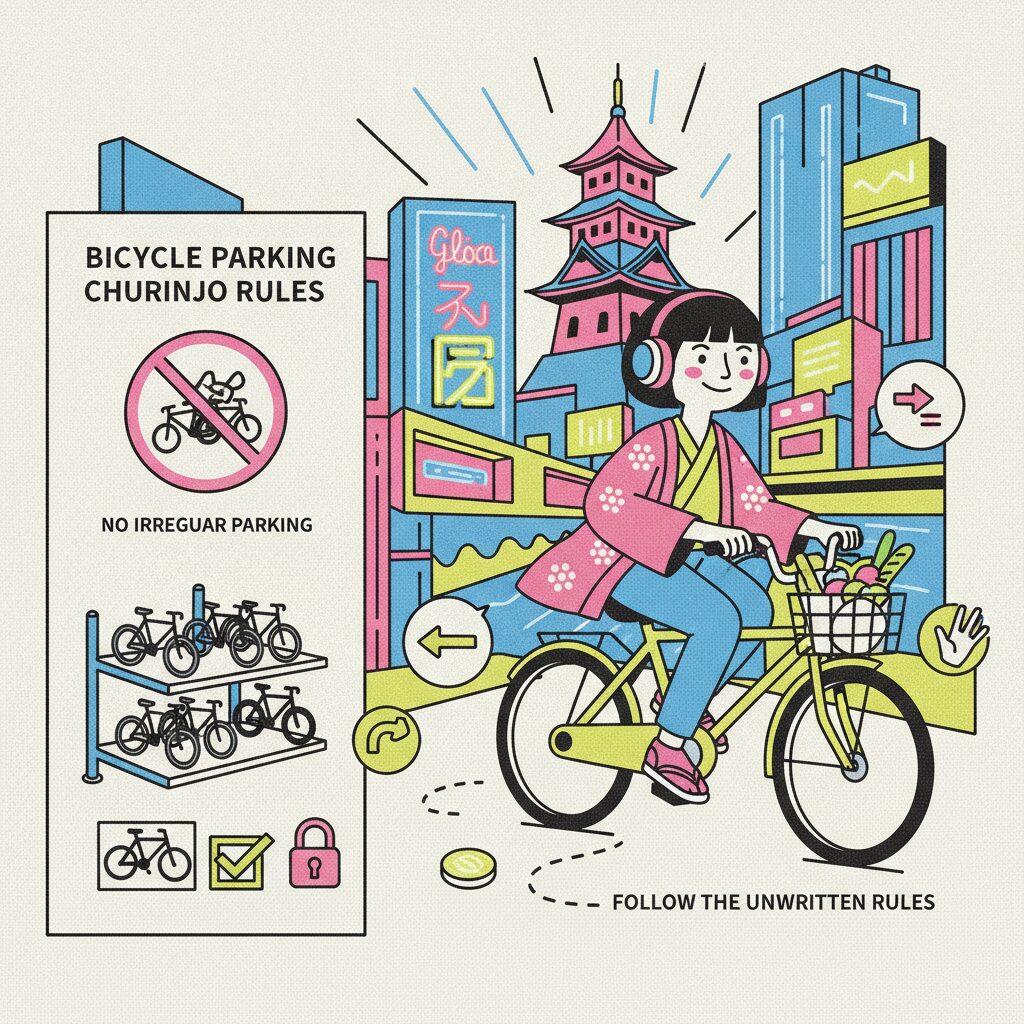
The answer lies with the ‘churinjo,’ the official bicycle parking lots scattered throughout the city. Finding one can sometimes feel like a treasure hunt. They are often hidden in narrow alleys, beneath elevated train tracks, or in vast underground facilities near major stations.
When you discover an outdoor automated churinjo, you’ll notice rows of metal tracks on the ground. You roll your bike into an empty slot, with the front wheel sliding into a metal bracket. After a few seconds, a heavy locking mechanism clamps down on your tire. Remember the number painted next to your slot.
When it’s time to leave, head to the central payment machine, which resembles an old-fashioned parking meter. Enter your slot number, press the confirmation button, and the screen will show your fee—usually between one hundred and two hundred yen for several hours. Insert coins or tap your transit IC card, and the machine will make a loud clunk. You then have a short window, typically three minutes, to return to your bike and remove it before the lock re-engages. This clever, self-service system makes you feel like a true local once mastered.
What Happens if Your Bike Is Impounded
If you ignore the warnings and park illegally, eventually you will face the dreaded ‘tetsuko’ bicycle removal. First, you might find a bright yellow warning tag wrapped around your handlebars—this is your final notice. If you see this, move your bike immediately.
If you don’t act in time, you will return to find your bike gone. Your heart sinks. It has been loaded onto a flatbed truck and taken to a municipal impound lot, often located far on the outskirts of the city or beneath a deserted highway overpass.
Recovering your bike becomes a frustrating ordeal. You must find a small notice posted on a nearby utility pole indicating where bikes from that area have been taken. Then, you take a train and walk to the distant impound lot. You’ll need to show personal ID, bring your bike lock key, and pay a hefty retrieval fee in cash—usually between two thousand five hundred and four thousand yen. The bureaucratic embarrassment is real. The staff will ask you to sign a ledger, silently judging your parking decisions. Always use the churinjo; the one hundred yen fee is far better than the impound lot hassle.
Tips for Navigating Major Osaka Districts by Bike
Umeda and Kita Area High Traffic and Pedestrian Density
Anchored by the expansive Umeda station complex, the Kita district is the commercial center of northern Osaka. It’s a maze of glass skyscrapers, upscale department stores, and an extensive underground mall network. Because much of the pedestrian flow is directed below ground, the surface streets are dominated by wide multi-lane avenues, aggressive taxi drivers racing toward the station, and loud delivery trucks.
Cycling in Umeda demands nerves of steel and constant vigilance. Major boulevards like Midosuji Avenue have dedicated bike lanes, but these are frequently obstructed by parked cars with their hazard lights on. You’ll find yourself repeatedly merging into heavy traffic to get around these blockages. Additionally, locating surface bicycle parking near the large department stores is incredibly challenging. Often, you must navigate into massive underground bike parking facilities, pushing your bike down long concrete ramps. Umeda is not a place for a leisurely ride; it’s a place to commute through with focus and caution.
Namba Dotonbori and Minami Area Navigating Crowds
If Umeda represents the polished commercial center, Minami pulses as Osaka’s neon-lit entertainment core. Centered around Namba and the famous Dotonbori canal, this area is characterized by its dense crowds. Tourists from across the globe gather here to snap photos of the Glico running man and enjoy street food.
Attempting to ride a bicycle through the main corridors of Dotonbori or Shinsaibashi in the afternoon or evening is an exercise in frustration and futility. The crowds are so thick that cycling is nearly impossible. Instead, you’ll find yourself pushing your bike through seas of people who frequently stop for selfies.
A smart local strategy for getting around Minami is to use the parallel backstreets. Avoid the main thoroughfares entirely. Slip into the narrow alleys a few blocks to the east or west of the main shopping districts. Here, you’ll share the road with delivery motorbikes and restaurant staff carrying supplies. It’s gritty, authentic, and moves at a quicker pace. But keep your hands close to the brakes—intoxicated revelers and wandering tourists can emerge suddenly from around corners.
Osaka Castle Park and Surrounding Bike Paths
When you need a break from the urban chaos, head toward Osaka Castle Park. Situated on the eastern side of the central loop, this expansive area of greenery, moats, and historic stone walls is a true haven for cyclists.
Unlike the cramped sidewalks of the commercial districts, the paths through the park and along the nearby Oigawa riverbanks are wide, paved, and exceptionally scenic. This is one of the rare spots in central Osaka where you can truly release the brakes, feel the breeze on your face, and ride purely for enjoyment.
In spring, cycling under tunnels of blooming cherry blossoms creates a breathtaking scene. In the crisp autumn air, the changing leaves reflect off the moat water. The park is heavily frequented by local runners, dog walkers, and families teaching children to ride. The atmosphere is relaxed, communal, and peaceful, offering a vital contrast to the relentless city pace and reminding you why having a bicycle in Osaka is such a wonderful privilege.
Conclusion: Enjoying Osaka Safely on Two Wheels
Embracing the charinko lifestyle is the quickest way to shift from feeling like a visitor to truly becoming a resident of Osaka. It creates a deeply personal connection with the city. You sense the contours of the neighborhoods through your legs. You discover shortcuts through alleys tucked behind temples. You uncover tiny, off-the-map bakeries and local cafes that you would never find on foot.
Osaka is a city that values street smarts, practical wisdom, and a bit of resilience. By respecting the strict legal rules around safety, alcohol, and parking, and by learning the subtle, unwritten etiquette of sharing space with millions of impatient yet warm-hearted locals, you earn your place in the daily rhythm. So grab a sturdy mamachari, master the art of crossing streets with a nod, keep a pocket full of hundred-yen coins for the churinjo, and immerse yourself in the lively, chaotic pulse of daily life in Japan’s most vibrant city.