The roar of the crimson-striped Midosuji Line train echoes through the cavernous tunnels of Umeda Station, a sound that serves as the daily heartbeat for millions of Kansai residents. As the doors slide open, a tightly packed wave of humanity spills out onto the platform, moving with a synchronized precision that can seem almost intimidating to the uninitiated observer. If you are new to the city, or contemplating making the move to Japan’s vibrant kitchen, understanding the subterranean world of Osaka is your first true test of integration. You might have heard the persistent rumors that Osaka is a relaxed, boisterous, and rule-breaking paradise compared to the stiff formality of Tokyo. While it is true that the people here possess a legendary warmth, a sharp wit, and an unparalleled love for street food banter, the moment you descend into the transit system, you enter a different psychological realm. The subway is where the city gets down to business. As someone who spends half the week dissecting anime storyboards in quiet Nakazaki-cho cafes before plunging into the evening chaos of Nipponbashi to hunt down rare art books, I navigate this subterranean labyrinth daily. I have learned the hard way that blending in requires more than just buying a transit pass. It demands a keen awareness of spatial dynamics, an understanding of silent social contracts, and a deep respect for the unspoken rules that keep this massive urban machine running smoothly. Let us decode the commuter culture of Osaka, peeling back the layers of etiquette that transform a bewildered expatriate into a savvy local traveler.
Why Public Transportation Etiquette Matters in Osaka
To comprehend the immense scale of the situation, you must first recognize the intense physical density of Osaka. This city is compressed between the mountains and the bay, an urban sprawl where space is the most precious commodity. The transit networks, especially key arteries like the Midosuji Line and the JR Osaka Loop Line, handle a staggering volume of commuter traffic every day. We’re talking about millions of people traveling to corporate offices in Yodoyabashi, busy retail jobs in Shinsaibashi, and vast entertainment complexes in Tennoji.
When so many people are packed into enclosed steel tubes speeding through underground tunnels, chaos is always just a breath away. The only thing preventing complete pandemonium is a highly refined, collectively upheld code of conduct. Public transportation etiquette in Osaka is far more than empty politeness or outdated tradition. It is an essential mechanism for urban survival. Every guideline, from where you stand on the escalator to how you hold your umbrella, is intended to maximize efficiency and reduce friction. When foreigners break these unspoken rules, locals seldom show open anger or vocal criticism. Instead, you’ll encounter a subtle shift in posture, collective avoidance of eye contact, or the dreaded silent sigh of resigned patience. Mastering these customs signals to the locals that you respect their shared environment, showing you are not just a transient tourist treating their daily commute as a gimmick, but a thoughtful resident who understands the delicate equilibrium of life in Kansai.
Osaka’s Unique Local Rules: How It Differs from Tokyo
The intense rivalry between the Kanto region, centered on Tokyo, and the Kansai region, centered on Osaka, goes well beyond differences in dialect, food preferences, and comedy styles. It is physically evident in how people move through public spaces. Many foreign residents make the crucial mistake of thinking that mastering Tokyo’s transit etiquette means they are prepared for traveling throughout Japan. This misconception quickly leads to awkward moments on the platforms of Umeda and Namba. Osaka follows a slightly different rhythm, preserving unique historical customs while gradually adapting to modern safety regulations.
Escalator Etiquette: Stand on the Right, but Do Not Walk
One piece of trivia that every newly arrived expatriate learns within their first forty-eight hours in Japan is the great escalator divide. In Tokyo, people stand on the left, leaving the right side open for those in a hurry. In Osaka, the custom is reversed: stand on the right and leave the left side open. Urban legends abound trying to explain this difference. The most popular theory is that Tokyo’s custom originates from the Edo period, when samurai walked on the left side of the road to avoid bumping swords worn on their left hips. Osaka, historically a merchant city rather than a warrior stronghold, had no such martial rules. The right-hand standing rule in Osaka was reportedly cemented during the 1970 World Expo, when the city adopted international standards to accommodate a surge of foreign visitors.
However, knowing this historical background is no longer sufficient for navigating modern Osaka commutes safely. In recent years, Japanese transit authorities have initiated sweeping changes. Due to a rise in severe accidents, slips, and falls, railway companies nationwide, alongside several municipal governments, have launched strict campaigns prohibiting walking on escalators altogether. The new rule is clear: stand still in two rows, side by side. Eye-catching posters featuring cartoon characters urging passengers to hold the handrail and remain stationary are plastered throughout major transit hubs like Shin-Osaka and Tennoji. Automated announcements in multiple languages repeat the message endlessly, instructing riders not to walk or run on moving stairs.
This situation creates an intriguing—and often confusing—social dynamic. Despite widespread public campaigns and updated safety rules, ingrained habits are hard to break. During the hectic morning rush, you’ll still see long lines of salarymen standing obediently on the right, while determined commuters rush down the left, ignoring safety warnings. For foreign residents, the best approach is flexible adaptation. When the station is moderately busy and people ahead of you form a single line on the right, follow their lead and stand on the right. But if you are traveling with a companion or if the station is packed, with crowds filling both sides of the escalator to maximize capacity, confidently stand on the left without walking. Don’t be deterred by impatient sighs from behind; standing still is officially the railway’s rule. Just be sure to hold the handrail firmly and keep your luggage secure in front of you.
Women-Only Cars in the Kansai Region
Another key operational difference between Kanto and Kansai lies in the use of women-only train cars. These designated cars were introduced to address the persistent problem of chikan, or groping, during crowded rush hours. In Tokyo, women-only cars are generally enforced only during peak morning commute times and usually revert to general use afterward.
Osaka, however, adopts a far more extensive and protective policy. On major subway lines such as the Midosuji Line, as well as busy private railways like the Hankyu and Keihan lines, women-only cars often operate all day, from the first train in the morning until the last train at night. This all-day enforcement often surprises newly arrived foreign men. The designated cars are usually located either at the very front or the very end of the train, though their exact placement varies by railway company.
Platforms feature clear, vibrant pink signs—often with floral designs or bold Japanese and English lettering—indicating where the women-only car doors will open. Inside the car, bright pink stickers on windows and hanging hand straps mark the space. While young boys of elementary school age and individuals needing mobility assistance are allowed to ride regardless of gender, adult men who mistakenly enter these cars will immediately face the disapproving gazes of many passengers. Male expatriates who find themselves in a noticeably empty pink-marked car should remain calm. Simply wait for the train to arrive at the next station, exit onto the platform, and quickly move to the adjacent general-use car before the doors close. It’s an honest mistake but one to avoid by carefully observing platform floor markings before boarding.
Golden Rules for Riding Trains and Subways in Osaka
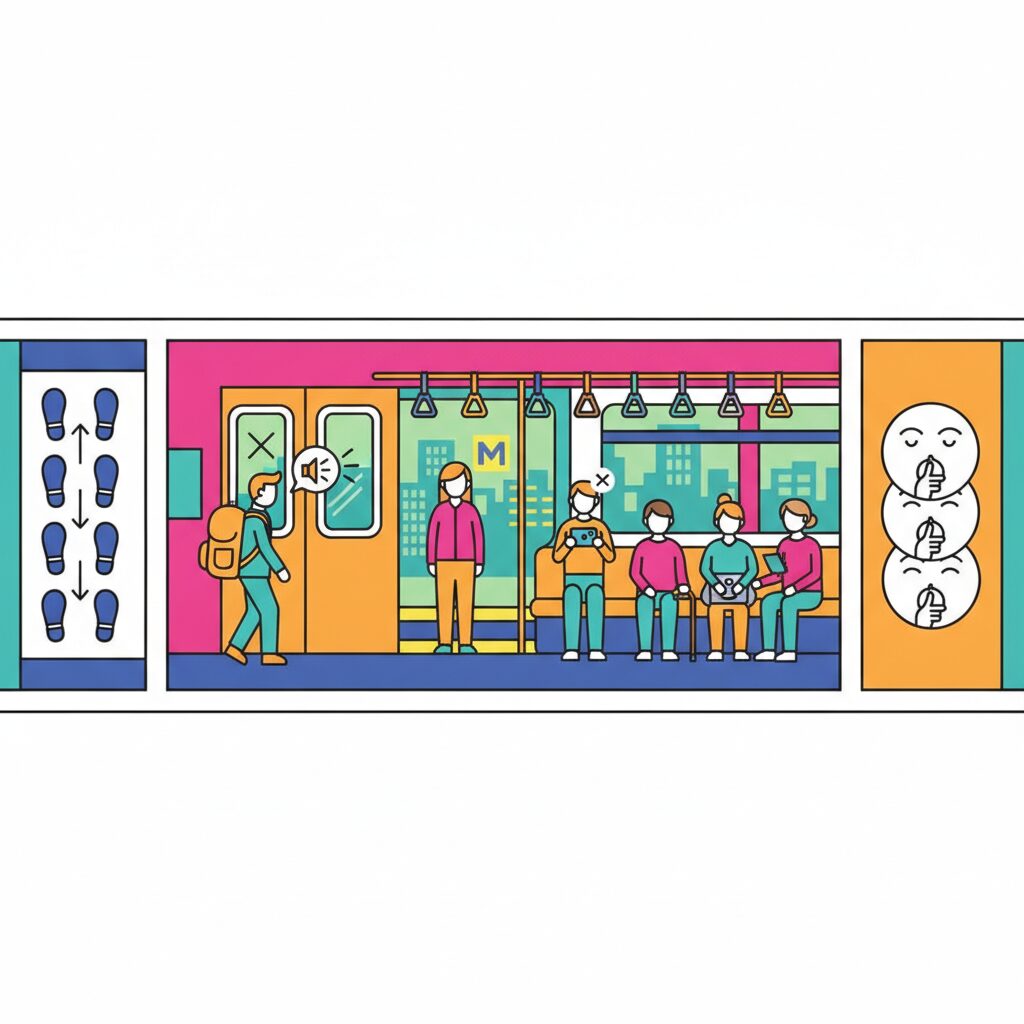
Once you have successfully navigated the platform and boarded the correct carriage, a new set of behavioral expectations comes into effect immediately. The interior of a Japanese train carriage represents a unique social ecosystem—a space where private and public spheres collide intensely, demanding heightened spatial awareness and strict acoustic discipline.
Keep the Noise Down: No Phone Calls
The acoustic environment inside a Japanese commuter train is something of an urban marvel. Imagine a gleaming steel tube speeding underground with incredible velocity, packed shoulder to shoulder with two hundred passengers enduring the August heat, yet the only sounds you hear are the low mechanical hum of the engine and the rhythmic clack of the rails. This profound silence is no accident; it results from a strictly enforced social contract demanding minimal noise pollution. In Osaka, a city globally famous for its vibrant comedy clubs, loud street vendors in Dotonbori, and animated, boisterous conversations over sizzling takoyaki grills, this sudden silence on entering a train can feel startling to newcomers.
However, respecting and understanding this quiet is your first crucial step toward genuine integration. The cardinal rule on Japanese railways is an absolute ban on mobile phone conversations. Talking on a call while on the train is seen as a serious breach of public peace, forcing everyone in the confined space to involuntarily engage with your private life. If your phone rings during transit, the expected response is to quickly reject the call or send a brief text explaining you are on the train and will call back later. In an absolute emergency, you should cover your mouth, whisper as softly as possible, explain you will return the call immediately after disembarking, and then hang up.
Texting, browsing the internet, scrolling through social media, and reading digital manga are all acceptable, provided your phone is on silent mode, known in Japan as manner mode. Additionally, be mindful of sound leakage from your headphones. Osaka commutes can be long, and many passengers use the time to grab much-needed rest. Playing heavy metal or an action movie soundtrack loudly enough for a faint, tinny beat to escape your earbuds will attract sharp glares from the exhausted salaryman trying to nap beside you.
Backpacks and Luggage: Be Mindful of Shared Space
The morning rush hour crush is no exaggeration. Boarding the Midosuji Line at Shin-Osaka heading toward Umeda and Hommachi between 7:30 and 9 a.m., you will experience physical compression defying Western notions of personal space. You will be pressed against glass doors, strangers’ shoulders, and corporate briefcases. In this environment, wearing a bulky backpack traditionally over your shoulders becomes a serious hazard. Such a backpack effectively occupies the space of two people and, as the train sways, it can involuntarily batter seated and standing commuters with its nylon shell.
To address this, a distinct commuter ritual unfolds every time an Osaka train arrives at a busy station. You will see entire carriages of students and professionals seamlessly unclip their backpacks, swing them off their shoulders, and hold them tightly against their chests or place them carefully on the floor between their feet. This forward-facing backpack hug is essential. It reduces your physical footprint, allows more passengers to board, and keeps you in full control of your belongings.
This principle extends to large luggage as well. Osaka, as a major international hub, has trains such as the Nankai Airport Express or JR Haruka traveling to and from Kansai International Airport, often crowded with travelers dragging massive suitcases. If you are struggling to manage a heavy rolling suitcase on a local subway line, it is your responsibility to keep it firmly controlled—parked tightly against your legs without blocking the narrow central aisle. When the train accelerates or brakes suddenly, unattended rolling bags can become dangerous projectiles. Always maintain a firm grip on the handle or use the wheel locks if available. Under no circumstances should bags be placed on empty seats; seats are reserved exclusively for people, regardless of how heavy your load may be.
Eating and Drinking: What is Acceptable
Rules around eating and drinking on Japanese trains vary depending on the kind of train you are on. It is vital to distinguish between local commuter lines and long-distance express trains. On Shinkansen bullet trains or special limited express services connecting prefectures, eating is not only allowed but celebrated. Passengers happily purchase elaborate bento boxes called ekiben and enjoy them alongside cold beers while watching the passing countryside.
On local transit systems such as Osaka Metro subways, the JR Loop Line, or the Hankyu and Hanshin commuter lines, eating is highly inappropriate. These carriages are designed for short-distance, high-capacity travel with long bench seats where passengers face each other rather than forward-facing airline-style seats. Eating an onigiri rice ball, unwrapping a noisy convenience store sandwich, or consuming fast food on a local train is social suicide. Food smells quickly permeate the entire carriage, creating an unpleasant environment, and the constant jolting risks spilling crumbs or sauces on upholstery or other passengers’ clothing.
Drinking occupies a more ambiguous space. During the brutal, suffocating humidity of Kansai summer, staying hydrated is vital. Taking a quick, discreet sip of water or cold green tea from a plastic PET bottle or sealed thermos is generally tolerated, provided it is done quietly and swiftly. However, drinking hot coffee from an unsealed paper cup, consuming sticky sugary juices prone to spills, or opening an alcoholic beverage on a commuter subway is entirely unacceptable and immediately brands you as a disrespectful outsider.
Priority Seating: When to Give Up Your Seat
Every train carriage in Osaka has designated priority seats, usually situated at the ends of the car. These seats are reserved explicitly for elderly passengers, individuals with physical disabilities, pregnant women, and travelers with small infants. The upholstery on these seats is typically a different color, and the windows above them display instructional diagrams.
One of the most complex social interactions in Japan is offering a seat. Because the culture heavily emphasizes not being a burden, some elderly passengers may decline a seat offered out of pride or reluctance to inconvenience a younger person who might also be tired after a long day. To navigate this tactfully, avoid making a loud or performative display of generosity. If you’re seated in a priority spot and someone clearly in need boards, simply stand quietly, make brief eye contact, offer a subtle nod or soft hand gesture toward the seat, and move away to another part of the carriage. This allows the person to take the seat gracefully without causing a scene.
Additionally, train yourself to recognize the maternity mark. Many women in the early, vulnerable stages of pregnancy may not yet show any physical signs but still need seating. Japanese municipalities provide a small, circular pink and blue badge depicting a mother and child. Women wear this badge on handbags or backpacks. If you see a woman with this mark standing nearby, it is your duty to offer your seat immediately, whether you are in the priority or general seating area.
How to Navigate Stations Smoothly
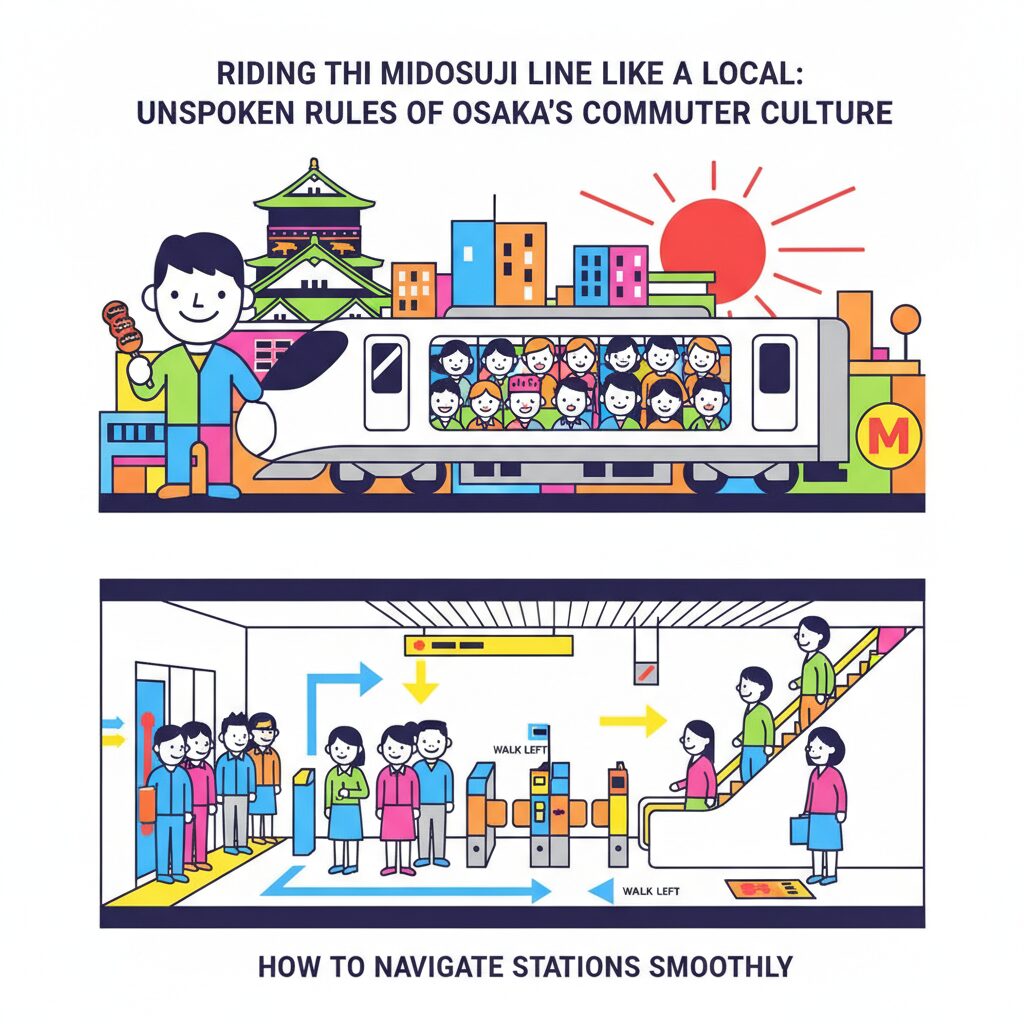
The journey neither starts the moment you board the train nor ends the instant you step off. The station itself functions as a meticulously organized ecosystem where thousands of people intersect without collisions. Moving through ticket gates and platform lines with ease is just as essential as your conduct inside the train carriage.
Boarding and Alighting: Allow Passengers to Exit First
Platforms at major transit hubs like Umeda or Namba are designed with precise mathematical planning. You will notice colored lines, arrows, and numbers painted on the platform floor, clearly marking where each train door will open. Upon arriving, you are expected to find the end of the existing queue and line up properly—usually two by two—behind these markings. Cutting in line is absolutely forbidden, and chaotic crowd behavior is not tolerated.
The most crucial moment comes when the train arrives and its doors open with a hiss. Unlike the hectic rush seen in many Western cities, where boarding and alighting passengers jostle each other, Osaka follows a strict protocol. The boarding line immediately splits in half, parting like the Red Sea to create a wide, clear path in the center for exiting passengers. You must patiently wait until every departing passenger is fully on the platform. Only after the flow of exiting passengers has completely stopped can the boarding line advance onto the train. Trying to force your way on before the train is clear will result not only in being physically pushed back by the exiting crowd but also in stern vocal reprimands from station staff and nearby commuters.
IC Card Etiquette at the Ticket Gates
The rhythm of Osaka’s ticket gates is a swift, relentless mechanical pulse: beep-beep, tap, step; beep-beep, tap, step. During rush hour, foot traffic flowing through the automated turnstiles is immense. To maintain this flow, you must come prepared. Whether using a physical ICOCA or Suica card or a digital transit card on your smartphone wallet, ensure your payment method is in hand well before reaching the gate.
The biggest rookie error—and a sure way to trigger a chaotic pileup—is stopping suddenly at the gate to search your pockets or backpack for your transit card. This abrupt halt disrupts the rapid flow behind you, triggering a domino effect of collisions and frantic apologies. Have your card ready, tap it firmly against the glowing blue reader without slowing down, and pass smoothly through the gates. If the gate flashes red and shuts, indicating a low balance or read error, immediately step back and move aside to avoid blocking others, then proceed to the nearby fare adjustment machine to resolve the issue.
Bus Etiquette in Osaka: A Quick Guide
While the subway and train networks are undeniably the dominant modes of transit in Osaka, the city bus system plays a vital role as the connective tissue reaching into deeper residential neighborhoods and specific local areas that rail lines cannot access. Riding the bus follows a slightly different set of operational rules compared to the train, and the boarding process often confuses first-time riders.
Unlike many Western transit systems where passengers enter at the front and pay the driver immediately, the standard Osaka City Bus employs a rear-entry, front-exit system. When the bus arrives at the stop, you must board through the door located in the middle or rear of the vehicle. You do not pay the fare at this time; instead, you simply find a seat or securely hold onto a hanging strap. Buses in Osaka navigate extremely narrow neighborhood streets, making sharp turns and sudden stops, so it is essential to hold on tightly at all times while standing. Additionally, drivers are very strict about passenger safety—if you try to stand up and walk toward the exit while the bus is still moving, the driver will issue a stern warning over the intercom, ordering you to remain seated until the bus has come to a complete stop.
As your stop approaches, press one of the many stop buttons located along the walls and handrails inside the bus. Only after the bus has stopped and the doors have opened should you proceed to the front to get off. The fare machine is positioned right next to the driver. You simply tap your ICOCA card on the reader or drop the exact coin fare into the designated slot. If you don’t have exact change, don’t worry—the fare machine includes a built-in change maker that can break down thousand-yen bills and larger coins into smaller denominations. However, keep in mind that you must first use the change maker to break your bill, then insert the correct fare into the payment slot; the machine does not automatically deduct the fare and return change in one step.
Embracing the Commute Like a True Osaka Local
Absorbing all these rules, ordinances, and unspoken expectations can feel overwhelming for a new resident. It’s easy to perceive Japan’s meticulously structured transit system as rigid, inflexible, and lacking in personal freedom. However, living in Osaka demands a shift in how you perceive public space. The strict observance of these transportation manners isn’t about suppressing individuality; it’s a profound expression of civic empathy.
The millions of people who ride the Midosuji Line daily are fatigued. They endure long work hours, navigate intense corporate pressures, and cope with the relentless stress of urban life. The silence on the train, the careful handling of luggage, and the orderly queues on the platform are collective gifts that the people of Osaka offer one another. It’s an unspoken understanding that, while the world outside may be chaotic, demanding, and fiercely competitive, our shared journey home will remain as peaceful and frictionless as possible.
When you master the rhythm of the ticket gates, reflexively swing your backpack to your chest as the doors open, and instinctively stand perfectly still on the correct side of the escalator, you stop being an outsider looking at the city from afar. You become an active, respected participant in the daily life of Kansai. You’re no longer merely passing through Osaka; you’re moving in sync with its deepest, most essential rhythms. So the next time you descend the concrete stairs into the humid, echoing depths of Umeda station, stand tall, keep your phone on silent, and ride the crimson rails like a true local.