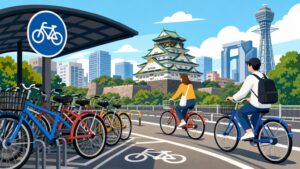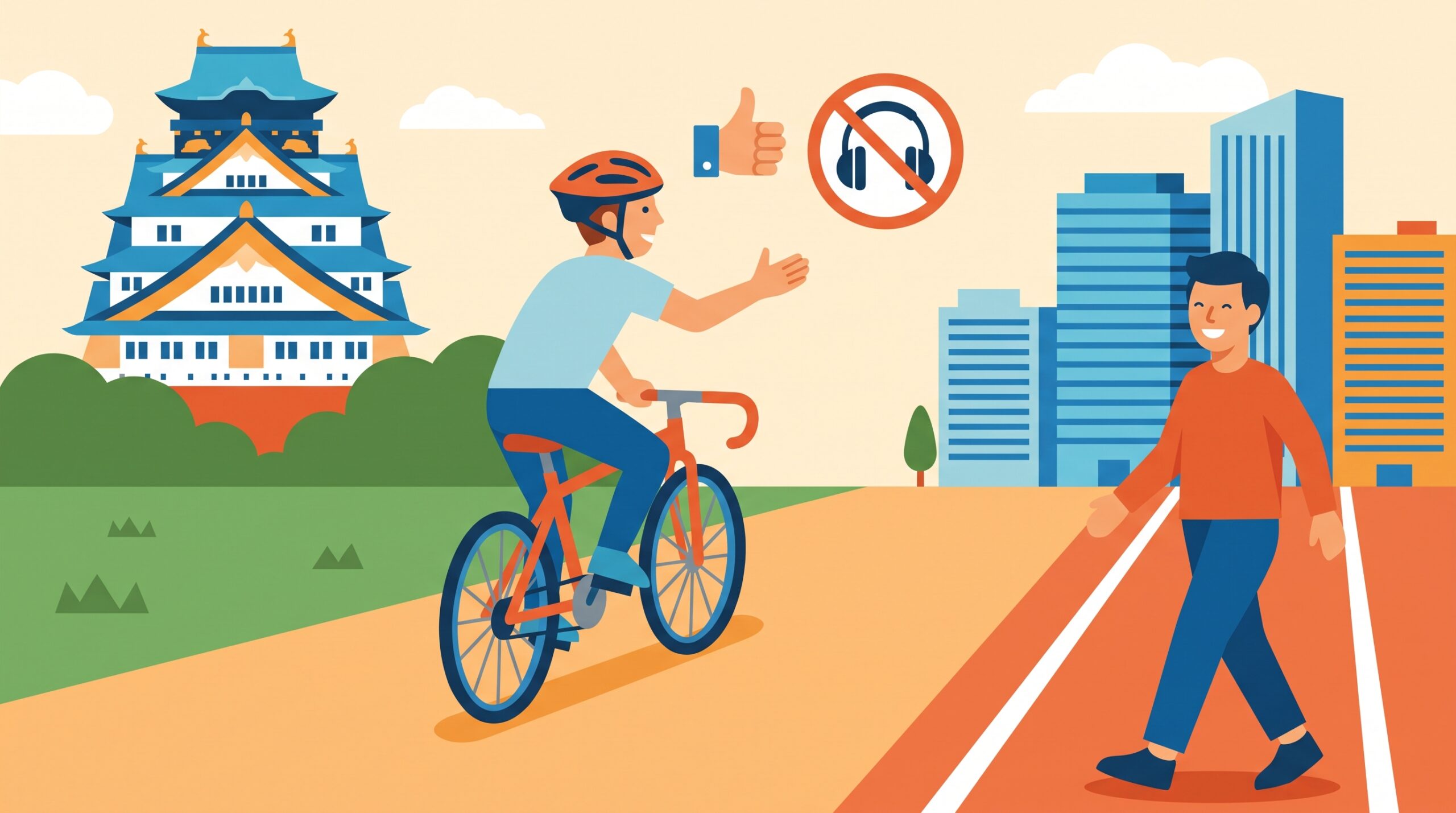
Osaka moves differently than any other city in Japan. While Tokyo marches to the metronomic, bureaucratic beat of a capital city obsessed with order, Osaka swings to the syncopated, pragmatic rhythm of a merchant town. Here, efficiency trumps formality. Speed often overrides rigid protocol. And nowhere is this cultural divergence more vividly expressed than on the streets, specifically in the saddle of a bicycle. To understand Osaka is to understand how its people move through it. The bicycle, or the ubiquitous mamachari as the heavy, utilitarian city bikes are affectionately known, is not merely a mode of transport in this metropolis. It is the lifeblood of the city, an extension of the Osakan spirit, and a primary vehicle through which you can observe the raw, unfiltered mindset of its residents. When you step out onto the pavement in neighborhoods like Umeda, Namba, or Tennoji, you immediately sense a chaotic yet remarkably functional ballet of pedestrians, automobiles, and a seemingly infinite stream of cyclists weaving through the gaps. For a newcomer, an expatriate settling into their new life, or a long-term visitor trying to decipher the local customs, this flow can appear completely lawless. Yet, beneath the surface of this apparent anarchy lies a deeply ingrained, highly complex system of unspoken rules, mutual understandings, and historical habits that dictate every pedal stroke.
As a researcher who spends his days tracing the historical narratives that connect Japan’s deeply structured past with its hyper-modern present, I have spent countless hours observing the streets of Osaka. I look at the city not just as a collection of buildings, but as a living, breathing organism shaped by centuries of commerce. Osaka was historically the kitchen of Japan, a city built by merchants, for merchants. In a merchant city, time is money. Getting from point A to point B quickly, without the friction of excessive bureaucratic hurdles, has always been the priority. This historical pragmatism trickles down to how people ride their bicycles today. Unlike the samurai-bureaucratic origins of Edo, which became modern Tokyo, where top-down rules were strictly enforced and blindly followed, Osaka has always operated on a more horizontal, consensus-based reality. The people follow the rules that make sense and collectively bend the ones that do not. This creates a unique friction point for foreigners moving to Osaka. You read the official rulebook, you study the national traffic laws, and then you step outside and see grandmothers blatantly ignoring those very laws to navigate a crowded sidewalk with a basket full of groceries. The confusion is immediate and profound.
My goal here is to bridge that gap. I want to explain not just what the rules are, but how they are actually applied, ignored, or modified by the people who live here. If you want to survive the streets of Osaka, avoid hefty fines, and most importantly, integrate smoothly into the local fabric without becoming a nuisance, you must understand both the rigid legal framework and the fluid cultural reality. You need to know why someone might aggressively ring a bell at you, why your bicycle might vanish from in front of a convenience store, and why the recent crackdowns on cycling behavior are changing the landscape of the city. By exploring these habits, we are really exploring the sociology of Osaka itself. We are looking at a society that prizes harmony but demands practicality, a city that welcomes outsiders but expects them to catch the underlying rhythm. Let us delve into the unspoken rules of the road and unpack the unique bicycle etiquette of this vibrant, relentless city.
Why Cycling is the Best Way to Explore Osaka
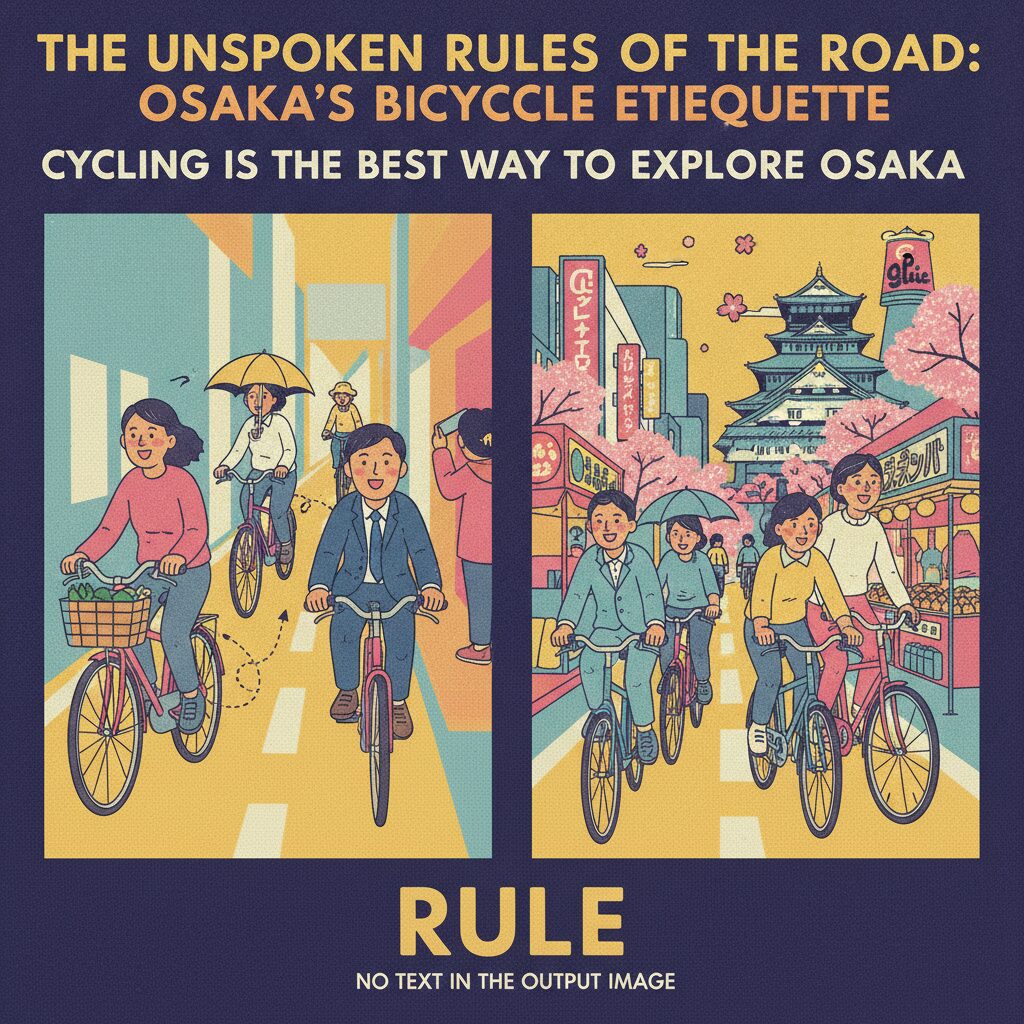
To fully understand why the bicycle dominates in Osaka, you first need to grasp the city’s physical and historical geography. Unlike Kyoto, nestled in a basin surrounded by steep mountains that restrict urban expansion and shape movement, or Tokyo, known for its undulating terrain with steep hills dividing its wards, central Osaka is largely flat. Built on an extensive delta, the city was historically interlaced with a vast network of canals and rivers, earning it the nickname the Water Metropolis. When Toyotomi Hideyoshi established Osaka Castle in the late sixteenth century, he launched a major urban engineering project that laid out merchant quarters in a logical, grid-like pattern. This flat and predictable terrain minimizes physical effort. You can pedal from Umeda, the northern commercial center, all the way to Namba, the southern entertainment district, with barely any change in elevation.
This geographic advantage aligned perfectly with the post-war economic boom. As the city quickly rebuilt and expanded, the working and merchant classes needed an inexpensive, reliable, and space-efficient method to navigate the dense, narrow streets that were inaccessible to cars. The mamachari bicycle became the ideal solution, evolving into the ultimate utility tool. Even now, despite having a highly efficient and extensive subway system, the bicycle remains the favored mode for the final mile. For residents, taking the subway often means going deep underground, navigating complex station corridors, and following train schedules. A bicycle offers total freedom—a door-to-door journey without waiting.
For foreigners settling in the city, buying a bicycle or joining a bike-sharing service marks the moment they truly shift from visitor to resident. It transforms their mental map of the city. Neighborhoods that once seemed disconnected due to required subway transfers become just a ten-minute ride apart. They begin to uncover Osaka’s hidden links—the quiet residential backstreets, tiny local shrines tucked between apartment buildings, and neighborhood takoyaki stands absent from any guidebook. They realize Osaka is not just a series of major hubs but a continuous, vibrant tapestry of local communities. Yet this freedom carries significant responsibility. Because bicycles are so integral to daily life, they are heavily regulated both by the government and the unspoken social norms. Stepping into this flow demands awareness, respect, and a willingness to learn the local rhythm.
Basic Japanese Cycling Laws Every Rider Must Know
Before we can truly understand the subtle, unwritten customs of Osaka, we first need to establish the foundation of national law. Japan boasts some of the most thorough and strictly defined traffic regulations worldwide, with bicycles legally categorized as light vehicles. This classification means that, in the eyes of the law, cyclists must comply with many of the same rules as motorists. For many years, there was a significant gap between what the law prescribed and what police actually enforced. Cyclists operated in a legal gray area, tolerated as a nuisance by drivers and feared by pedestrians, but largely overlooked by law enforcement unless involved in an accident. However, as we enter 2026, this enforcement landscape has dramatically changed. The era of lenient policing has ended, replaced by stringent national directives aimed at reducing traffic accidents and restoring order. You need to know these foundational rules, as ignorance—especially as a foreigner—will no longer protect you from harsh financial penalties.
Keep to the Left Side of the Road
This is the most fundamental traffic rule in Japan, yet it is frequently ignored by casual cyclists. According to Japanese traffic law, bicycles must be ridden on the left side of the road, moving in the same direction as motor vehicles. Riding on the right side, facing oncoming traffic, is not only extremely dangerous but also illegal. Staying on the left makes your movements predictable to drivers turning from side streets and pedestrians stepping off curbs.
The tradition of keeping left in Japan dates back to the Edo period, when samurai walked on the left to avoid their sword scabbards clashing, as these were worn on the left hip. When modern traffic laws were introduced, this custom was codified. In today’s Osaka, adhering to the left is essential because many streets are narrow and lack dedicated shoulders. Riding against traffic forces cars to swerve unpredictably, disrupting the delicate balance of street traffic. Despite the law, you will still see local Osakans biking against traffic, cutting corners to save time—a display of merchant pragmatism prioritizing risk versus efficiency. As a foreign resident, you should never follow this example. Locals might receive leniency from police, but you represent the international community. Strictly following the left-side rule is your first step in showing respect for the local culture.
Strict Bans on Smartphones, Umbrellas, and Alcohol
The image of an Osakan cyclist juggling an umbrella in one hand and a smartphone in the other once summed up a common, though alarming, stereotype. Osaka even invented the sasubey, a mechanical clamp attached to handlebars designed to hold an open umbrella, keeping riders dry or shaded while freeing both hands for steering. For years, the sasubey symbolized Osaka’s inventive spirit.
However, the national government has taken a hard stance against any form of distracted or impaired cycling. Using a smartphone while riding—whether calling, texting, or checking maps—is completely banned and carries heavy fines. Holding an umbrella while cycling is also illegal because it hampers your ability to brake quickly and reduces peripheral vision. Even the sasubey occupies a legal gray zone: while the clamp itself is not unlawful, if the attached umbrella exceeds certain size limits or obstructs traffic, riders can be cited for reckless driving.
Most importantly, the laws concerning cycling under the influence of alcohol are absolute and unforgiving. Japan’s legal blood alcohol limit for driving is effectively zero, and this applies equally to bicycles. If you drink at an izakaya in Namba and try to cycle home, you are committing a serious criminal offense. Penalties include enormous fines and possible imprisonment. For foreign residents, a drunk-cycling conviction can result in immediate visa revocation and deportation. The risk is simply not worth it. While Osaka’s drinking culture is lively and social, a strict boundary is maintained between the tavern and the road. You must either walk your bike home or park it legally overnight and take a taxi.
The “Blue Ticket” System: Fines for Cyclists
The most significant recent change in Japanese cycling culture is the introduction of the Blue Ticket traffic violation system, which fully took effect in 2026. For decades, police had only two options when dealing with misbehaving cyclists: issue a meaningless verbal warning or arrest the cyclist and initiate criminal charges through the cumbersome red ticket system. Because criminal procedures were too taxing for minor violations, enforcement was rare, fostering a culture of impunity.
The Blue Ticket system has transformed this dynamic. It functions similarly to a standard traffic citation for cars. Police can now issue immediate administrative fines for a wide range of common cycling infractions without pursuing criminal charges. These include running red lights, ignoring stop signs, riding on the wrong side of the road, using a smartphone while cycling, and riding without a working headlight at night.
In Osaka, the impact of the Blue Ticket system has been profound. Intersections that were once chaotic with rolling stops and weaving bicycles are now heavily patrolled, particularly during morning and evening rush hours. You’ll often see officers stationed under overpasses in Umeda or along major roads, stopping dozens of cyclists every hour. As a foreign resident, understanding the Blue Ticket system is crucial. It signals the end of the legal gray area. The authorities demand order, and the fines for violations are steep. It is no longer sufficient to follow the crowd—if that crowd runs a red light in front of a watchful officer, tickets will be issued without exception.
Osaka-Specific Bicycle Etiquette and Unwritten Rules
While national laws provide the rigid framework for traffic behavior, Osaka’s local etiquette adds the flesh and blood. To live comfortably here, you must read the room. You need to understand the city’s specific environmental challenges and the social contracts that govern how people share extremely limited public space. Osaka is densely populated, intensely commercial, and deeply communal. Navigating it requires a constant negotiation between your desire for speed and your obligation to preserve the community’s harmony.
Navigating Shotengai (Covered Shopping Arcades)
One of Osaka’s defining architectural and cultural features is the shotengai, the covered shopping arcade. These extensive networks of glass and steel canopies stretch for kilometers, sheltering hundreds of small businesses, butchers, grocers, cafés, and pachinko parlors from rain and sun. The most famous is Tenjinbashisuji, Japan’s longest shopping street, extending over two kilometers. These arcades serve as vibrant arteries of local commerce, bustling with pedestrian traffic, the calls of shopkeepers offering discounts, and the aromas of grilled seafood and fresh produce.
The unwritten, often explicitly posted, rule for shotengai is clear: you must dismount and push your bicycle. These spaces are designed for walking, browsing, and lingering. When a cyclist attempts to ride through a crowded shotengai, they pose a significant hazard in a relaxed environment. The tension arises immediately. Pedestrians have to dodge, the street’s rhythm is disrupted, and the risk of collision in a confined space increases drastically.
Yet, because this is Osaka, you will often see locals slowly pedaling their bicycles through crowds, softly ringing their bells, or weaving assertively. This is the local merchant mentality clashing with communal etiquette. Locals riding through the shotengai often feel a sense of ownership over the space, having probably lived in the neighborhood all their lives, and feel entitled to bend the rule for convenience. However, for expatriates or visitors, this behavior is considered highly disrespectful. It signals ignorance of local customs and a disregard for the safety of elderly shoppers and young children who frequent these arcades. When you enter a shotengai, do as the most respectful citizens do: step off your bike, walk alongside it, and soak in the sensory experience of the market at a human pace.
Using the Midosuji Avenue Bike Lanes
Midosuji Avenue is Osaka’s grand boulevard. Lined with majestic ginkgo trees that turn a brilliant gold in autumn, it cuts straight through the city’s heart, connecting the northern commercial hub of Umeda with the southern entertainment and retail district of Namba. Historically, Midosuji was a heavily congested, multi-lane road dominated by cars. Recently, the city government initiated an aggressive urban renewal project to transform Midosuji into a more human-centered space, significantly reducing car lanes and installing wide, dedicated bike lanes on both sides.
These bike lanes are a marvel of modern urban planning, offering a fast, safe, and scenic route through the city’s core. However, they come with specific behavioral expectations. As a primary commuter artery, the bicycle lanes operate at high speeds during morning and evening rush hours. Commuters on sleek road bikes and electric mamacharis move with intense purpose.
Etiquette here resembles highway driving. You must maintain a steady pace, keep as far left within the bike lane as possible to allow faster riders to pass, and crucially, communicate your intentions. Sudden stops to check your phone or erratic swerving to photograph the ginkgo trees will provoke angry shouts and increase collision risks. Midosuji embodies Osakans’ desire for efficiency. It is a beautiful ride, but demands full attention and respect for the fast-moving commuter flow. Don’t treat the Midosuji bike lanes as a leisurely tourist path during peak hours; respect them as vital to the city’s economic lifeblood.
Sidewalk Riding and the “Bell Dilemma”
The most confusing aspect of cycling in Japan for any foreigner is the sidewalk paradox. National traffic law clearly states that bicycles are vehicles and must be ridden on the street. Sidewalks are strictly for pedestrians. Exceptions exist for children, the elderly, or those facing genuinely dangerous road conditions, but the baseline rule is: stay on the street.
However, Osaka’s urban layout contradicts this law. Many side streets are incredibly narrow, barely wide enough for two cars, much less a bicycle and a delivery truck. As a result, many Osaka cyclists routinely ride on sidewalks. Over decades, this has become an accepted, though legally questionable, cultural norm. The city even designates mixed-use zones on wider sidewalks, implicitly acknowledging bicycle presence.
This shared space creates what I call the Bell Dilemma. Legally, a bicycle bell should only be used in emergencies to prevent imminent collisions, not as a horn to clear pedestrians. Yet, spend ten minutes on an Osaka sidewalk and you’ll hear a cacophony of bells. Local riders, especially older ones, ring their bells aggressively at pedestrians who walk in the middle of the sidewalk, essentially demanding right of way.
This behavior reveals a unique aspect of Osaka culture: asserting spatial dominance through noise. But it’s a trap for foreign residents. While an elderly Osakan woman ringing her bell at a group of businessmen might be tolerated, a foreigner doing the same is viewed as rude, arrogant, and aggressive. The unspoken rule for outsiders and polite locals alike is that pedestrians always have absolute priority on sidewalks. If pedestrians block your way, do not ring your bell. Instead, slow to walking speed, gently apply brakes so they squeak softly, or patiently wait for a gap. If needed, offer a soft polite greeting to signal your presence. Yielding to pedestrians, even at the expense of your speed, is the ultimate sign of cultural fluency. It shows you acknowledge that you are a guest in their dedicated space.
Parking Your Bicycle in Osaka: Avoid the Impound Lot
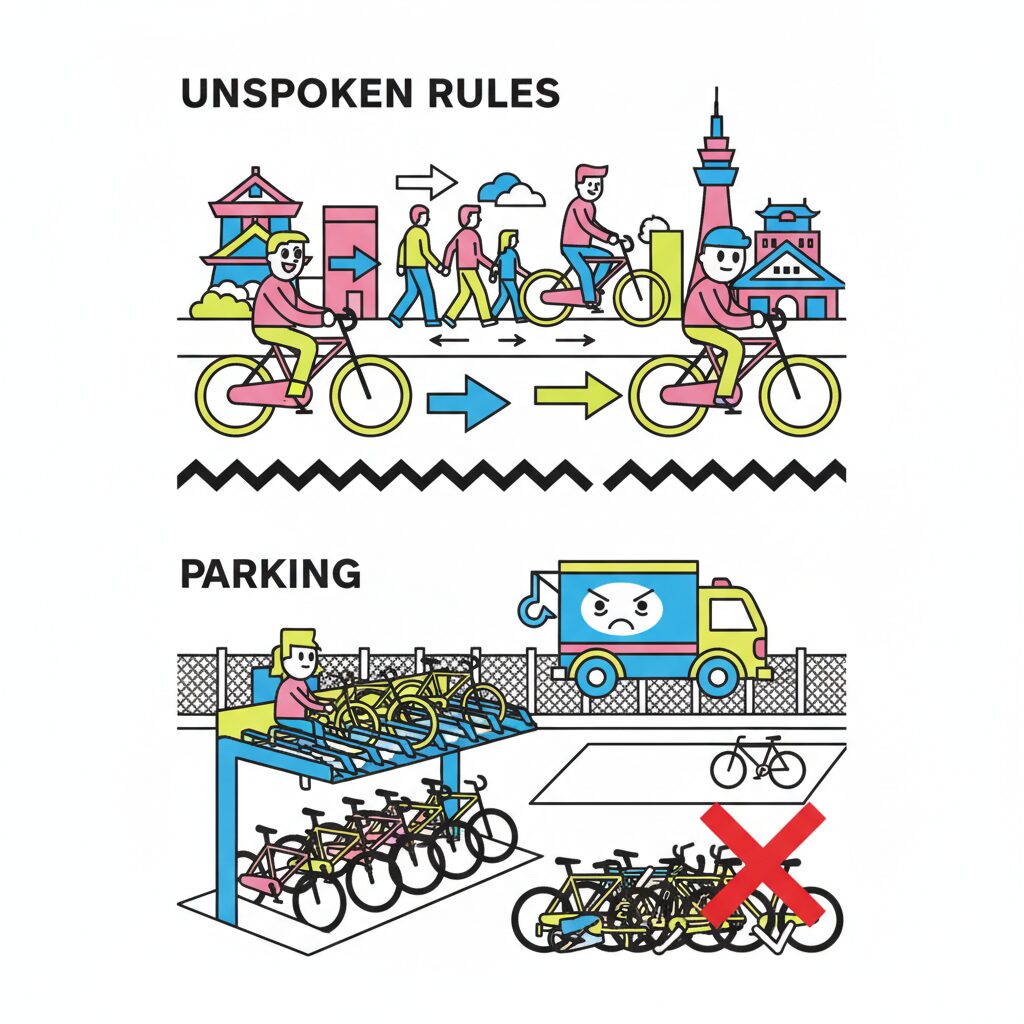
Perhaps the harshest lesson for newcomers to Osaka is learning just how strictly bicycle parking is enforced. In many Western countries, locking a bike to a street sign or fence outside a café is perfectly normal and legal. However, in central Osaka, doing so guarantees frustration, financial loss, and a ruined day. Space is an incredibly scarce and valuable resource here. Every square meter of pavement is carefully managed, and leaving a bicycle on the sidewalk—even for just ten minutes while you pop into a convenience store—is seen as a significant public nuisance that blocks pedestrian traffic and poses dangers to the visually impaired.
Designated Parking Zones (Churinjo)
To handle the millions of bicycles in the city, Osaka depends on an extensive system of designated parking areas called churinjo. These range from simple marked spaces overseen by a parking attendant to large, multi-level underground garages with robotic conveyors that transport your bike into secure vaults below ground.
When visiting major hubs like Umeda, Namba, or Tennoji, your top priority isn’t immediately reaching your destination but locating a legal churinjo. Most train stations and large department stores have nearby dedicated parking. These facilities are generally affordable, often costing just a few hundred yen for a full day, with many offering the first hour or two free. Using these spaces is not optional—it’s mandatory.
The process is usually simple. For ground-level automated lots, you place your front wheel into a locking mechanism. Upon return, you enter the slot number on a payment kiosk, pay the fee, and the lock releases. For larger underground facilities, an attendant may direct you to a spot or provide a ticket. Mastering the churinjo system greatly reduces daily stress by keeping your bicycle safe from theft and, more importantly, shielded from the city’s relentless impound teams.
What Happens if Your Bike is Towed?
Disregarding Osaka’s parking rules leads to a swift and unforgiving penalty: impoundment. Enforcement teams patrol major commercial areas continuously in small flatbed trucks. When they spot a bike parked illegally outside a designated zone, their procedures are prompt and efficient.
First, they attach a brightly colored warning tag—often yellow or red—to the handlebars, indicating the bike is parked illegally and scheduled for removal. If you return while the tag is still there, you can typically reclaim your bicycle and leave quickly, albeit shaken. But these teams move fast; often just minutes after placing the tag, they load the bike onto the truck and drive off.
Finding the spot where you parked empty is a common experience for locals but a highly stressful one. When your bike is towed, the enforcement team usually leaves a chalk message on the pavement with details of the impound lot where your bike was taken. Retrieving it requires a frustrating trek, as these lots are usually located in remote, industrial parts of the city and often involve a long train ride and a considerable walk.
Once at the impound lot, the hassle begins. You must present identification, prove ownership—typically via the national bicycle registration system, which you should complete when purchasing a bike—and pay a substantial retrieval fee that can total several thousand yen. The entire process consumes a significant portion of your day and drains your wallet. The lesson is clear and unwavering: never, under any circumstances, park your bicycle illegally in central Osaka. The convenience of parking right in front of your destination is never worth the agony of dealing with the impound procedure.
Etiquette for Using Share Bikes (Docomo, HUBchari, LUUP)
In recent years, Osaka’s streets have been significantly transformed by the rapid growth of the share-bike economy. For tourists, short-term residents, and even locals who prefer to avoid the responsibilities of ownership, these services have been a game changer. The red electric-assist bicycles from the Docomo bike share network, often operating locally under the HUBchari brand, along with the ubiquitous turquoise LUUP electric scooters and compact bicycles, have become permanent fixtures of the urban landscape.
These share systems are excellent because they perfectly complement Osaka’s flat terrain, enabling users to cover large distances with minimal effort. However, the arrival of share bikes has also brought about new expectations regarding proper etiquette. Since the vehicles are not personally owned, there can be a psychological tendency to treat them carelessly—a temptation that must be consciously resisted.
The most important rule in the share-bike economy is to return the vehicle correctly. Unlike some disorganized dockless systems in other cities where bikes end up abandoned in trees or rivers, Osaka’s systems rely on designated parking hubs. You must start and end your rental at these hubs. Leaving a HUBchari or LUUP scooter on a random street corner at your destination is prohibited. Doing so will not only continue to charge your credit card but also deeply offends the local community by cluttering narrow sidewalks and creating a significant nuisance.
When returning a LUUP scooter or a Docomo bike, make sure to park it neatly within the painted boundaries of the hub. Avoid blocking access for other users and do not park so carelessly that the vehicle might topple into pedestrian pathways. Additionally, take a moment to report any mechanical problems via the app. The share-bike system relies on mutual trust and collective upkeep. By treating the rented vehicle with the same care and respect as you would your personal belongings, you help sustain the system and show a strong commitment to Japanese communal responsibility.
Final Tips for a Safe and Respectful Ride
Living in Osaka offers a deeply fulfilling experience. The city welcomes you with a warmth and straightforward energy rarely found elsewhere in Japan. However, this welcome comes with the expectation that you will engage in the social contract. Cycling here isn’t merely a mode of transportation; it is a daily practice of civic responsibility.
As you hold the handlebars and join the flow of traffic, remember that you are part of a vast, coordinated system. Watch the locals, but discern which behaviors to follow and which to avoid. Adhere to national laws, especially the strict prohibitions on smartphones, alcohol, and the new Blue Ticket regulations. Always yield to pedestrians courteously, resisting the urge to ring your bell aggressively in crowded areas. Park your bicycle only in designated spots, acknowledging that public space is a shared and limited resource.
Osaka rewards those who pay attention. If you ride with empathy, spatial awareness, and respect for the unspoken rules of the road, the city will reveal itself to you in unexpected ways. You will stop feeling like a confused outsider dodging traffic and instead become part of the rhythm, gliding effortlessly through the neon-lit nights and bustling daytime markets of Japan’s greatest merchant city.