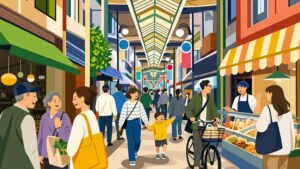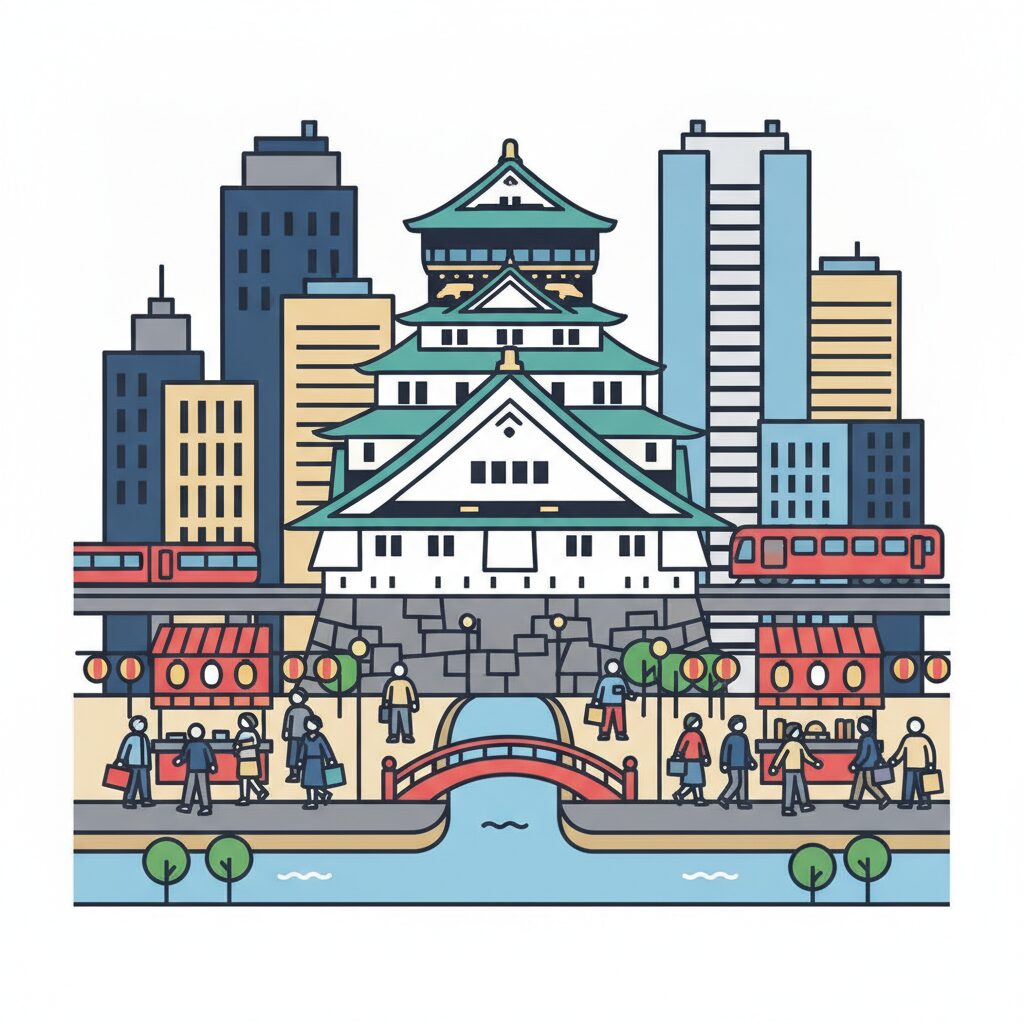
Your first few months in Osaka are a sensory recalibration. It’s not just the neon glare of Dotonbori or the smell of takoyaki hanging thick in the air. It’s the sound. It’s the cadence of conversations that hit you on the street, in the supermarket, on the train. You hear a loud, almost aggressive exchange between two friends, braced for a fight that never comes, only to see it dissolve into roaring laughter. A shopkeeper you’ve never met comments on your shoes, your grocery choices, the weather, all in one breathless sentence. You make a small, self-deprecating joke, and instead of a polite chuckle, you get a sharp, witty retort that feels, for a terrifying second, like an insult. You start to wonder, is this friendliness? Is it rudeness? Is everyone here a part-time comedian?
Welcome to the wonderful, baffling world of Osaka communication. For anyone coming from the more reserved, coded politeness of Tokyo, or from a Western culture with different boundaries, decoding the local dialect of interaction can feel like learning a new language within a language. What you’re encountering isn’t random noise; it’s a deeply ingrained cultural code, a performance art perfected over centuries in the merchant stalls and back alleys of Japan’s kitchen. This isn’t the Japan of quiet temples and unspoken understandings. This is the Japan of the punchline, the direct question, and the unsolicited opinion offered with a warm, mischievous grin. Forget everything you learned about `tatemae` (public face) and `honne` (true feelings) as separate, guarded entities. In Osaka, the line is blurred, redrawn in neon, and often shouted from across the room. To survive and thrive here, you have to learn the rhythm, embrace the banter, and understand that beneath the sometimes-abrasive surface is a city with a huge, beating, and surprisingly accessible heart.
Amid the lively backdrop of Osaka’s spirited banter, experiencing the humble bicycle culture offers an intimate glimpse into the city’s authentic heartbeat.
The Sound of Osaka: More Volume, Less Filter
One of the first things that hits you about daily life in Osaka is the sheer loudness. It’s not only the announcements in the shotengai, the covered shopping arcades buzzing with constant jingles and sales pitches. It’s also the people. Conversations often begin at a volume that, in Tokyo, might suggest a serious argument. This auditory intensity can be overwhelming, causing many newcomers to think the city is always angry.
Why So Loud?
In truth, volume in Osaka often signals engagement rather than hostility. It shows passion, being fully present and invested in the interaction. Quiet, mumbled speech might be seen as disinterest or boredom. Speaking loudly demonstrates you care and have energy for the person you’re engaging with. Imagine this: you’re on the crowded Midosuji subway during rush hour. Two women near the door chat loudly, their voices rising above the train’s rumble and the taps on many smartphones. Their gestures are lively, their tone forceful. A foreigner might instinctively back away, thinking they’re in a heated dispute. But if you listen closely, you’ll catch peaks of excitement and bursts of laughter. They’re not arguing over betrayal; they’re passionately analyzing last night’s TV drama with the intensity of world leaders at a summit. This is connection, Osaka-style.
This energy also characterizes commercial exchanges. The booming “Irasshaimase!” (Welcome!) heard in Tokyo often sounds rehearsed and robotic. In an Osaka market, it’s a genuinely projected shout from the shop owner, personally acknowledging your presence. It’s a vocal handshake, saying, “I see you. Come on in. Let’s do business.” The volume cuts through the busy city noise to create an immediate, human-to-human link.
The Disappearing Filter: Unsolicited Advice as a Welcome Mat
Beyond the volume is the content itself. Osakans are famously direct, often skipping the layers of polite ambiguity common in other parts of Japan. This leads to one of the most surprising experiences for newcomers: unsolicited public comments. You might be standing in a Life supermarket, unsure between two brands of soy sauce. Suddenly, an `obachan` (a local term for an older, often feisty woman) might appear beside you, tap one bottle, and say, “Kocchi no hou ga oishii de.” (This one’s tastier.) She doesn’t work there. She doesn’t know you. But she has an opinion, and in Osaka, sharing it is seen not only as acceptable but as helpful.
In Tokyo, this would feel like a rare and intrusive breach of personal space. In Osaka, it’s just a normal Tuesday. This isn’t about nosiness or intrusion; it comes from a deeply communal, almost village-like mindset that thrives even in the sprawling metropolis. The message is, “We’re all in this together, so let me help.” Strangers might comment on your shopping basket (“Buying a lot today, planning a party?”), your outfit (“Aren’t you cold in that?”), or your struggles reading a map (“Where are you going? Shinsaibashi is that way!”). It’s a shortcut to connection, bypassing formal introductions to tap directly into shared human experience. A simple “Arigatou!” and a smile are all it takes to complete the exchange, leaving both people feeling a little more connected to the city around them.
The Punchline Is the Point: Humor as a Social Currency
If directness drives Osaka conversation, humor is its fuel. This city is the undisputed birthplace of Japanese stand-up comedy, known as `manzai`, and its essential principles extend beyond the stage. They form the lifeblood of everyday interactions. Conversations often mirror a comedy sketch, featuring a setup and a punchline. The aim is not just to share information but to entertain, evoke laughter, and transform ordinary moments into shared bursts of joy.
Are You the Fool or the Straight Man? Understanding `Boke` and `Tsukkomi`
At the heart of this comedic conversational style lie the roles of the `boke` and the `tsukkomi`. The `boke` is the funny character, the fool, who says or does something absurd, illogical, or silly. The `tsukkomi` is the straight man, who quickly highlights the absurdity with a sharp, witty comeback, often paired with a light, playful tap on the head or shoulder. This dynamic plays out constantly like a dance in Osaka.
Picture yourself at the office, accidentally trying to unlock the door with your train pass. A Tokyo colleague might politely ignore it or gently say, “I think that’s the wrong card.” An Osaka colleague, however, is likely to exclaim with theatrical disbelief, “Anata, densha de kaeru ki ka?!” (What, are you planning to go home by train through the door?!). This is a classic `tsukkomi`. Your role isn’t to feel embarrassed but to join in. You might respond with a sheepish laugh and say, “Oops, my brain is on vacation,” taking on the `boke` role.
This interaction is both a social test and an invitation. When someone delivers a `tsukkomi`, they’re assessing your ability to roll with the punches and play along on their terms. It signals they feel comfortable enough with you to break formal boundaries. Successfully managing these moments—either by making a `tsukkomi` yourself or graciously accepting the `boke` role—is a significant step toward social integration. The highest praise is when someone says you have good “nori,” meaning you have good rhythm and know how to respond in these playful exchanges.
The Art of the Tease: “Meccha Ijirareru”
This comedic interplay also gives rise to `ijiri`, or playful teasing. In Osaka, being teased often signifies affection and acceptance into the group. People pick up on your quirks, habits, or funny accent in Japanese and turn them into ongoing jokes. A friend might repeatedly bring up the time you mispronounced `byouin` (hospital) as `biyouin` (beauty salon), creating a hilarious and slightly startling mental image.
For foreigners, this can be tricky. In many cultures, such direct and personal teasing from anyone other than a close friend might be seen as rude or even bullying. But in Osaka, it’s a love language. The key is understanding the intent. The teasing usually focuses on light, superficial topics and isn’t meant to be hurtful or touch on real insecurities. It’s a way of saying, “I see you, I know you, and your little quirks are part of why I like you.” The right response is to laugh at yourself, exaggerate the flaw for comedic effect, or better yet, respond with a clever tease of your own. Getting defensive or offended can shut down the interaction, signaling that you’re unwilling to engage in the playful exchange and creating social distance. When you hear someone say you’re “meccha ijirareru” (teased a lot), it’s often a backhanded compliment meaning you’re popular and well-liked.
The Merchant’s DNA: Practicality, Negotiation, and “Chau Nen”
To grasp why Osaka is the way it is, you need to explore its history. For centuries, it served as Japan’s commercial center, a city of merchants (`akindo`) where fortunes were won and lost through sharp deals and quick wit. This merchant spirit remains deeply ingrained in the local mentality and language, fostering a culture of practicality, efficiency, and a healthy dose of skepticism.
“So, How Much Is It?” The Culture of Haggling
Although Japan is mostly a fixed-price culture, Osaka keeps alive a flicker of the art of negotiation. In the city’s bustling `shotengai` like Tenjinbashisuji, or within the electronics maze of Den Den Town, a little bargaining is not only accepted; it’s sometimes expected. This isn’t the aggressive haggling seen in other parts of the world, but rather a polite, almost ritualistic exchange.
The classic phrase is “Chotto makete kureru?” (Can you give me a little discount?). This isn’t a demand but an opening move in a dialogue. The shopkeeper might laugh, mention their slim margins, then knock a hundred yen off the price or toss in a small extra item (`omake`). The goal isn’t just to save a small amount of money, but to engage in the interaction itself. It’s a performance that honors the merchant-customer relationship—a moment of human connection over a simple transaction. In Tokyo, attempting to haggle in most stores would be met with confusion or a firm, polite refusal. In Osaka, it can mark the beginning of a warm, if fleeting, friendship.
The Power of “Chau Nen”: The Gentle Disagreement
Even with their straightforwardness, Osakans possess a unique linguistic tool to soften disagreements. It’s the magic phrase `Chau nen`, which literally means “It’s different,” but contextually translates to something like, “Well, actually…” or “That’s not quite it.” It acts as a conversational balm, allowing someone to correct you or offer an opposing view without sounding confrontational.
If you say, “This ramen seems really spicy,” a Tokyoite might politely agree even if they don’t think so. An Osakan is more likely to respond with, “Ah, `chau nen`,” before explaining: “It looks spicy because of the red oil, but that’s actually shrimp flavoring, so it’s more savory than hot.” The phrase signals a forthcoming correction but frames it as a helpful clarification rather than a blunt contradiction. It’s the merchant’s style of communication: clear, direct, but mindful of maintaining good relations. Mastering the use of `chau nen` lets you join debates and express your opinions with local flair, demonstrating an understanding of the subtle art of being direct without causing offense.
Navigating the Code: A Foreigner’s Survival Guide
So how do you combine all of this and navigate daily life without experiencing constant cultural whiplash? It takes a mental adjustment and a few practical strategies. It’s about understanding the intent behind the words, not just the words themselves.
Don’t Confuse Directness with Dislike
This is the golden rule. When someone asks a question that feels too personal (“Are you married? Why not?” “How much is your rent?”), or makes a blunt comment (“You look tired today”), try to hold back your initial defensive reaction. More often than not, this is simply the most efficient way to express interest and start a conversation. It comes from curiosity, not judgment. View it as an effort to quickly find common ground. Respond honestly and without embarrassment, and you’ll see the conversation move on swiftly to the next topic.
Learn to Laugh at Yourself (and Others)
Having thick skin helps, but a good sense of humor is essential. If you become the focus of some good-natured `ijiri`, take it as a compliment. You’ve been noticed. You’re part of the group. Laughing along with the joke is the best response. It shows confidence, approachability, and that you don’t take yourself too seriously—all traits highly valued in Osaka. And don’t hesitate to gently tease back. If a coworker jokes about your flashy sneakers, feel free to comment on their equally questionable anime-themed tie. This fosters a balanced, playful dynamic that Osakans appreciate.
When in Doubt, Use a `Nande Ya Nen!`
You don’t need to be fluent in Osaka-ben, the local dialect, but learning a couple of key `tsukkomi` phrases can make a big difference. The most famous is `Nande ya nen!`, which roughly means “Why?!” or “What the heck?!” and is the classic reaction to any `boke` remark. If a friend says something silly, a well-timed (or even poorly timed) `Nande ya nen!` will almost always get a laugh. It shows you’re not just a passive observer of the culture but actively trying to engage. They’ll appreciate the effort, and it will instantly endear you to them, even if your accent is far from perfect.
Beyond the Punchline: The Warmth Beneath the Banter
It’s easy to get caught up in the mechanics of the `boke` and `tsukkomi`, the volume, and the directness, mistaking Osaka’s communication style for mere performance. But that misses the point. These elements are simply the tools the city uses to achieve its true aim: swift, genuine human connection.
The constant banter, teasing, and shared laughter all work to peel away the layers of formal politeness that can create distance elsewhere in Japan. In Osaka, you quickly learn where you stand with people. Friendships feel more immediate and solid. The same `obachan` who criticized your daikon choice one moment might, the next, press a free orange into your hand and remind you to take care of yourself.
I once found myself hopelessly lost in the winding, covered streets of Kuromon Ichiba Market. I asked a fishmonger, a man with a weathered face and a gravelly voice, for directions. After looking at my map and then at me, he bellowed, “You’re completely backwards! Are you trying to walk to Kobe?!” It was a perfect, sharp `tsukkomi`. Yet without missing a beat, he wiped his hands on his apron, left his stall, and guided me three blocks through the bustling market, teasing me all the while about my terrible sense of direction. When he reached my destination, he gave me a playful slap on the back and vanished into the crowd before I could properly thank him.
That’s the Osaka code: a sharp jab followed by a warm embrace. It’s a city that will tease you, challenge you, and talk your ear off—but will also walk you down the street when you’re lost. Cracking the code isn’t about memorizing rules or phrases; it’s about opening yourself to a more direct, humorous, and ultimately vulnerable way of connecting with those around you. In Osaka, a good laugh is simply another way of saying, “Welcome home.”