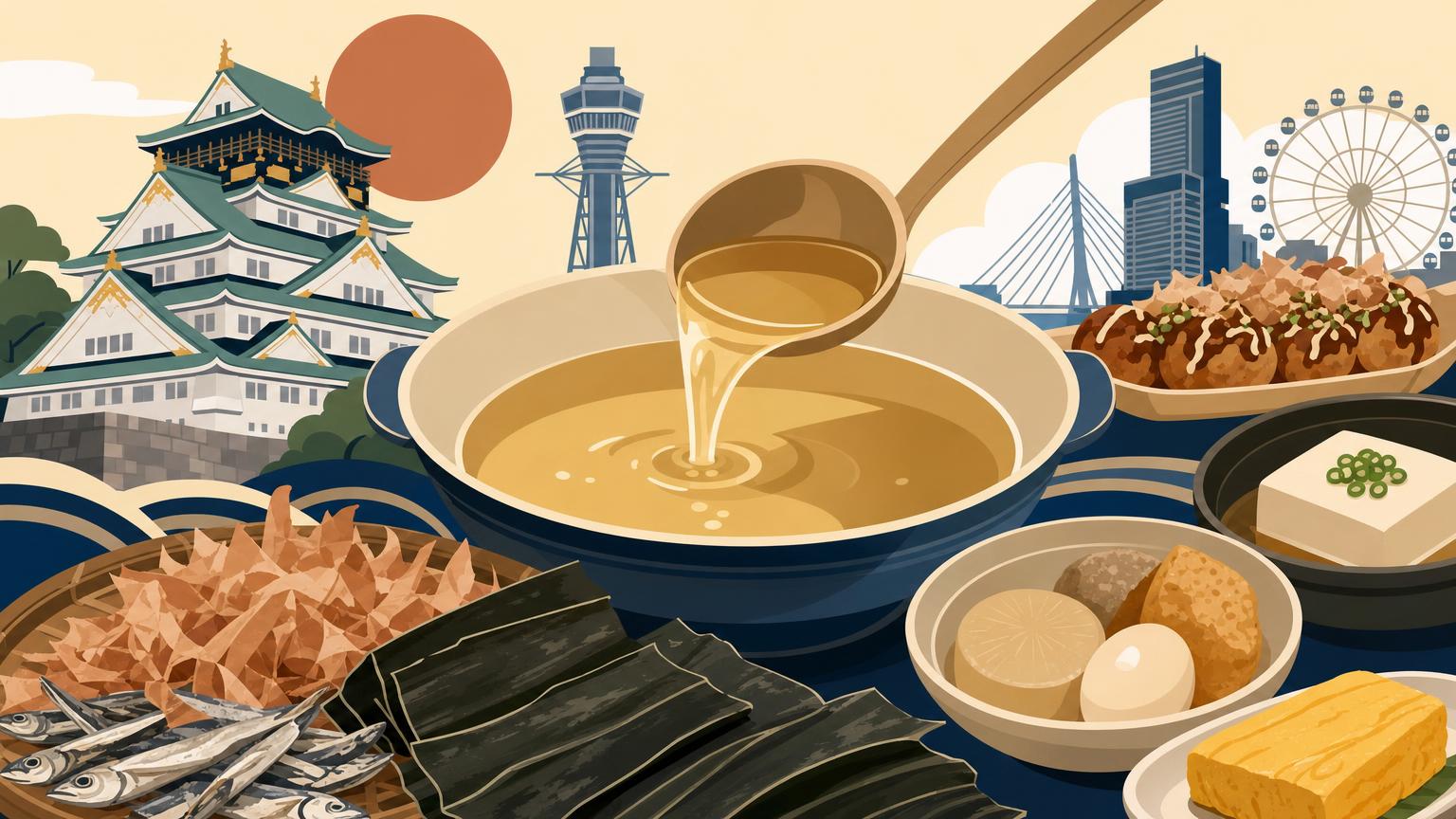
To understand Osaka, you must first understand the invisible current that flows beneath its bustling streets, beneath its neon-drenched commercial facades, and beneath the boisterous laughter of its pragmatic people. That current is not water. It is dashi. When foreigners arrive in this sprawling metropolis, they are immediately confronted with a sensory assault of heavy, aggressive flavors. The guidebooks, the travel blogs, and the enthusiastic social media influencers all point toward the visceral thrill of takoyaki smothered in thick brown sauce, or the dense, savory pancake known as okonomiyaki, slathered with mayonnaise and dancing with bonito flakes. These dishes are loud. They are unapologetic. They reflect the extroverted, mercantile spirit that the rest of Japan so often attributes to the people of Kansai. Yet, to live in Osaka, to walk its neighborhoods in the quiet hours of the morning, and to truly comprehend the mindset of its residents, you must look past the heavy sauces. You must look past the fried street food. You must look into the bottom of a bowl of golden, translucent broth.
The truth of daily life in Osaka lies in the subtle, profound, and deeply historical art of dashi. Dashi is the foundational soup stock of Japanese cuisine, but in Osaka, it is elevated to an almost spiritual necessity. If Tokyo is a city defined by the dark, sharp, definitive bite of soy sauce, Osaka is a city defined by the pale, mild, endlessly complex umami of dashi. Tokyo tells you exactly what it is upon the first taste. Osaka invites you to slow down, to breathe in the steam, and to discover what it is over time. This dichotomy is not merely culinary. It is profoundly cultural. It reflects the fundamental differences in how the people of these two great cities approach life, business, and human interaction. In Tokyo, the samurai capital, rules are rigid, boundaries are clear, and the culture is built on a foundation of explicit hierarchy. The dark soy sauce of the Kanto region mirrors this explicit nature. In Osaka, the historical merchant capital, life is fluid, transactions require negotiation, and the culture thrives on reading between the lines. The clear dashi of the Kansai region mirrors this unspoken complexity.
For the newly arrived expatriate, this realization changes everything. You begin to notice the scent of kelp and flying fish drifting from the open doors of tiny neighborhood udon shops before the sun has fully risen. You begin to see how local grandmothers carefully inspect packets of dried fish in the basement levels of department stores, treating the procurement of soup stock with the gravity of a major financial investment. You realize that the supposedly loud, brash people of Osaka possess a palate so refined, so delicately tuned to the microscopic variations in umami, that it completely upends the common stereotype of the city. To understand dashi is to unlock the unspoken rules of Osaka. It is to move past the superficial image of the city as a noisy kitchen, and to enter the quiet, reverent dining room where the true soul of the culture resides.
Why Dashi is the Heart of Osaka’s Food Culture
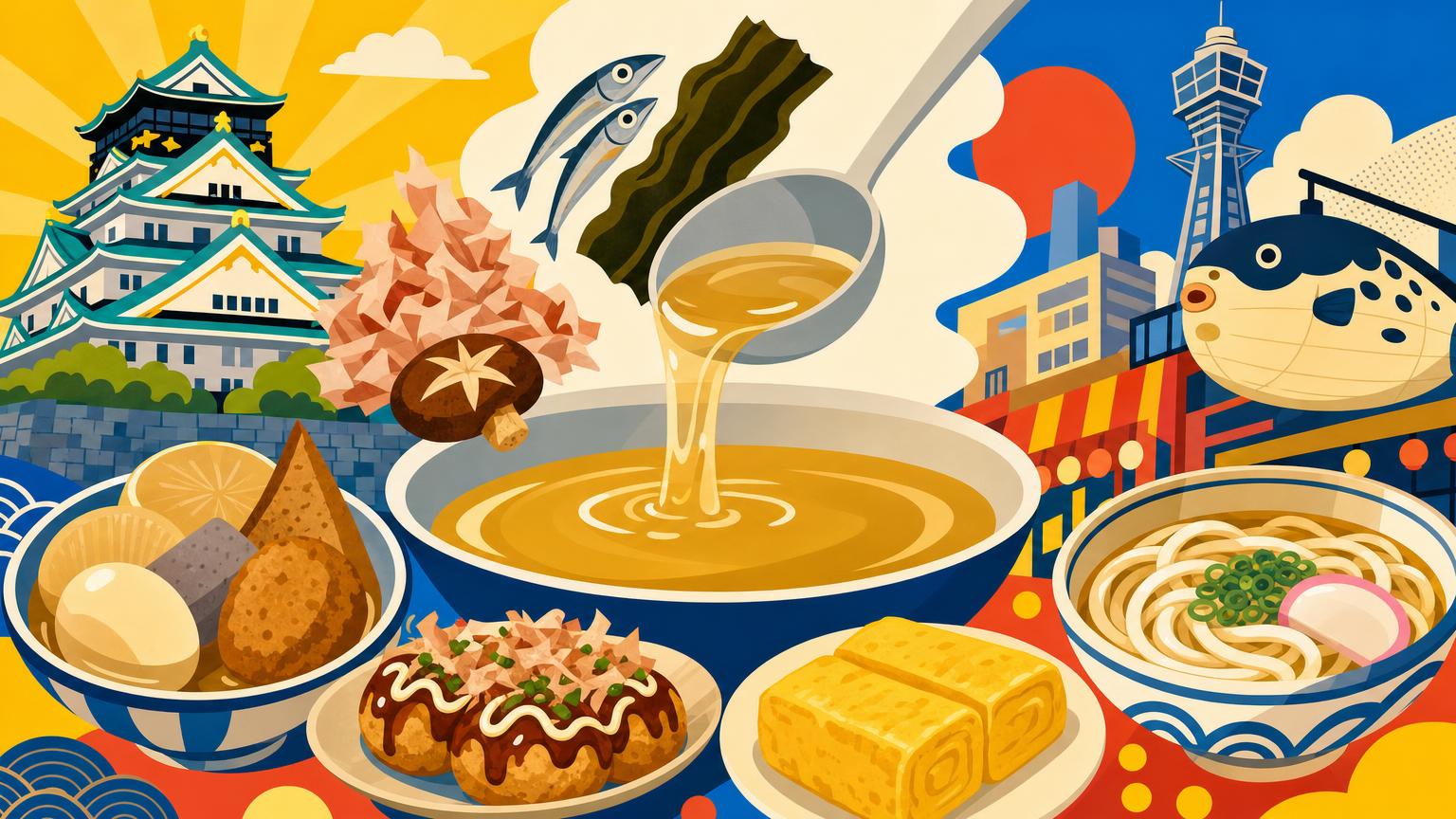
The expatriate experience in Japan is often characterized by a series of gradual realizations. Initially, everything feels overwhelmingly new—a haze of unfamiliar customs and landscapes. But as months turn into years, this haze comes into clearer focus. You begin to grasp not just what people do, but why they do it. In Osaka, the realization of dashi’s importance marks perhaps the most pivotal cultural milestone. The people of Osaka are renowned for their practicality. They are associated with the phrase “Kuidaore,” which roughly translates to “eat until you drop,” or more precisely, “eat until you go bankrupt.” While this might suggest a culture of excess, it is a serious misinterpretation. Kuidaore actually reflects an uncompromising demand for quality. An Osaka native will never pay good money for poor food. They will tolerate a rundown interior, endure abrupt service, and even wait in a freezing alley if the meal is exceptional. But if the foundational flavor is flawed, they will not return. And in Osaka, that foundational flavor is always, unequivocally, dashi.
This emphasis on broth rather than sauce reveals a deep-seated cultural preference for foundational integrity over superficial embellishments. In Western culinary practice, sauces often mask or drastically alter the flavor of the main ingredient. In the Kansai region, dashi serves to enhance and support the natural tastes of the seasonal ingredients. It is the unseen partner in the meal. When you share a bowl of simple kitsune udon with an Osaka local, you will notice they do not reach for condiments immediately. They lift the bowl with both hands, bring it close to their face, close their eyes, and inhale the steam. They take a small sip of the broth before even tasting the noodles or fried tofu. They are assessing the foundation and evaluating the kitchen’s skill. If the dashi is weak or lacks depth, the entire meal is deemed a failure, no matter how attractive its presentation.
“The Kitchen of Japan” and the History of Kelp (Kombu)
To understand why Osaka relies so heavily on the delicate flavors of dashi, we must look back into Japanese history, specifically to the Edo period. During Tokugawa shogunate rule, Japan was divided not only geographically but by strict class structures and tightly controlled trade routes. While Tokyo, then called Edo, was the nation’s political center, Osaka was its vital economic powerhouse. It was known as the “Tenka no Daidokoro,” or the Kitchen of the Nation. Wealthy merchants gathered the finest products from across the archipelago, turning the city into a fiercely competitive market where fortunes were made or lost on the quality of rice harvests or salt shipments.
Yet, the most crucial shipment coming to Osaka was not rice. It was kelp. High-grade kombu from the nutrient-rich, freezing waters of Hokkaido in the far north was transported down the Sea of Japan by wooden cargo vessels called Kitamaebune, or Northern Bound Ships. This treacherous journey took months, during which the kombu aged gradually in the ships’ hulls. The intense saltiness softened, and the deep, savory compounds intensified. By the time the ships reached Osaka, the kelp was perfectly cured, with an umami profile of exceptional depth.
Tokyo, in contrast, depended on maritime routes bringing dried bonito, or katsuobushi, along the Pacific coast. Bonito generates a sharp, smoky, highly aromatic broth that complemented the bold, dark soy sauce favored by the samurai, who required substantial sodium to recover after physical exertion. Osaka’s merchants, working in parlors and ledger rooms, preferred the elegant, restorative, and subtle umami of kombu. Moreover, the Kansai region’s softer water, which lacks heavy minerals, is uniquely suited to extracting the delicate glutamic acids from kombu without clouding or bitterness. Tokyo’s harder water required the aggressive flavor of bonito to cut through mineral content. Thus, geography, economics, and water chemistry combined to create Japan’s great culinary divide. When you sip dashi in Osaka today, you are tasting not just soup but the legacy of the Kitamaebune ships, Edo-period merchant wealth, and Kansai’s unique geological waters.
What is Dashi Made Of? Natural Ingredients vs. MSG
When foreigners try cooking Japanese dishes in their small apartments, one common question often arises, whispered with dietary caution: “Is dashi just MSG?” It’s a fair question, born from genuine confusion about the intense, nearly addictive savoriness of Japanese cuisine. To answer honestly, we must explore the science of umami, a journey that starts with the very kelp Osaka values so highly.
In 1908, Japanese chemist Kikunae Ikeda aimed to understand why his wife’s kombu dashi tasted so richly savory. Through careful experimentation, he isolated the main flavor compound in kelp: glutamic acid. He named this distinct taste “umami,” and shortly after, succeeded in synthesizing it into a stable salt form—monosodium glutamate, or MSG. Chemically speaking, dashi’s magic and MSG share the same root. MSG is essentially isolated, crystallized kombu essence.
However, telling an Osaka chef that their painstakingly crafted dashi is identical to a spoonful of synthetic MSG is deeply insulting and scientifically misleading. Authentic dashi is a complex symphony of flavors. A proper Osaka dashi does not rely solely on kombu; it is a carefully balanced blend. The process begins with soft water and aged Hokkaido kelp, soaked for hours to gently extract glutamic acid. Just before boiling, the kelp is removed to avoid bitterness from tannins. Then, shaved bonito flakes or dried sardines are briefly added. These fish add inosinic acid, which, when combined with kelp’s glutamic acid, creates umami synergy. This combination doesn’t just double the flavor—it produces a profound, lingering taste that satisfies deeply.
Synthetic MSG delivers a flat, one-dimensional glutamate punch. It is effective and widely used in inexpensive eateries worldwide but lacks the aromatic complexity of wood-smoked bonito, the subtle brininess of kelp, and the rich golden color from slow extraction. In Osaka, where palates are trained to detect such nuances from birth, using synthetic powders in a respected restaurant is an unforgivable offense. For those living in Osaka, while they might enjoy MSG in a late-night snack, the broth sought for comfort on a rainy day must be authentic—the real, complex, synergistic extraction. It’s the difference between a photograph of a fire and the genuine warmth of a hearth.
Best Places to Taste Authentic Dashi in Osaka
For the newly arrived Osaka resident, the question quickly evolves from “What is dashi?” to “Where can I genuinely experience it?” The city is expansive, an endless concrete grid extending outward from the twin hubs of Umeda in the north and Namba in the south. It’s easy to fall prey to tourist traps—brightly lit venues with plastic food displays designed to lure transient visitors. But to dine like a local, you need to grasp the city’s rhythm. Osaka is a city of motion, a city of commuters, where high finance intersects with blue-collar grit. The best spots to savor authentic dashi reflect this reality. They aren’t always secluded, Michelin-starred temples of cuisine; rather, they often blend seamlessly into the everyday flow of commercial life, hidden in plain sight within train stations and department stores.
Dashi Kobayashi (Eki Marche Osaka)
Consider the morning rush at Osaka Station, a sprawling, multi-level maze of steel, glass, and humanity. Hundreds of thousands pass through the ticket gates daily. Amid this chaotic dance of office workers, students, and shoppers sits Eki Marche, a commercial dining area directly connected to the station. Here, you’ll find Dashi Kobayashi. To the uninitiated, it may seem like just another quick-service counter, but to locals, it’s a crucial refueling stop.
Dashi Kobayashi symbolizes the modernization of traditional soup stock. They treat dashi with the same reverence that specialty coffee roasters give to single-origin beans. The experience here goes beyond just dining; it’s about savoring broth in its purest form. When you order a cup of hand-drip dashi, you witness a deliberate, almost meditative process amid the rush hour frenzy. They offer distinct blends, letting you choose between the deep, robust flavor of dried flying fish or the delicate, mellow notes of pure kelp. Standing at the counter, sipping a steaming cup of broth while commuter trains rumble beneath your feet, is a quintessential modern Osaka experience. It perfectly illustrates how the city preserves its culinary heritage even under time pressures. It’s high-art convenience, proving that in Kansai, fast food doesn’t have to mean flavorless food.
Dashi Chazuke En (LUCUA Osaka)
Moving up into the towering commercial complex of LUCUA, still within Osaka Station’s orbit, you encounter a different dashi experience at Dashi Chazuke En. Chazuke is the ultimate Japanese comfort food. Traditionally, it involves pouring hot green tea or simple broth over leftover rice, often topped with pickled vegetables or salted salmon. It’s what mothers prepare for sick children and what salarymen eat after long nights out to soothe their stomachs.
Dashi Chazuke En elevates this humble home dish into an elegant dining experience without losing its essence. The space often fills with solo diners, especially women taking a break from shopping or work. The unspoken rule here is quiet appreciation. Bowls arrive beautifully arranged, adorned with fresh sashimi, seared chicken, or seasonal vegetables. But the true highlight is the small iron kettle served alongside, containing fiercely hot, expertly crafted dashi. Pouring the golden liquid over the rice partially cooks the raw toppings, releasing their aromas into the rising steam. The broth is typically a sophisticated blend, heavily relying on kombu and dried sardines to create a deeply restorative umami. Dining here as an expat offers insight into Japan’s concept of healing food—it isn’t heavy stews or rich casseroles but hot, savory liquid that breathes life into simple grains of rice.
Traditional Kansai Udon: Dotonbori Imai
To grasp the historical depth of Osaka’s food culture, you must eventually venture south to the neon spectacle of Dotonbori. This area is the chaotic, pulsating heart of Osaka nightlife—a sensory overload of giant mechanized crab signs, blaring pop music, and crowds of revelers. It’s the last place you’d expect a sanctuary of subtle refinement, yet in the midst of this frenzy sits Dotonbori Imai.
Approaching Imai feels like stepping through a portal to another era. The traditional wooden facade, the hanging willow tree, and the entrance’s quiet dignity sharply contrast with the flashing LED screens around it. Imai has served udon since 1946, with roots as a tea house going back even further. Inside, the street noise fades away, replaced by the hushed voices of respectful diners and the faint, intoxicating scent of superior kelp.
Here, you encounter the pinnacle of Kansai-style udon. The broth is a pale, translucent gold—not aggressively salty but gradually enveloping the palate. It’s made using top-grade natural Hokkaido kombu and carefully selected varieties of dried mackerel and round herring, with precise temperature control to extract full flavor without bitterness. The noodles are softer than the chewy Sanuki style from other regions, designed specifically to absorb the delicate broth. The signature dish, Kitsune Udon, features sweet, deep-fried tofu that soaks up and releases bursts of exquisite dashi with each bite. Dining at Dotonbori Imai is to understand Osaka’s spirit: a city that builds dazzling, chaotic futures while fiercely protecting the quiet, golden traditions of its past.
Where to Buy Dashi Powder in Osaka (Perfect Souvenirs)
As you become more immersed in life in Osaka, dining out every day quickly becomes impractical. You start cooking in your own kitchen, weaving through narrow market aisles and trying to recreate the flavors that have gradually reshaped your palate. At the same time, you inevitably face the question of what to bring back home. Friends and family expect souvenirs. While they might imagine samurai swords or geisha dolls, as an informed local, you know better. The best gift you can offer them—the purest essence of the city you now call home—is high-quality dashi. Luckily, Osaka provides a wide range of choices for purchasing this liquid gold in convenient powdered or packet forms, from luxurious boutique brands to everyday supermarket staples.
Kayanoya Dashi: The Most Popular Choice
To grasp the modern premium gifting culture in Japan, you must be familiar with Kayanoya. Although originally from Fukuoka, Kayanoya has become the definitive standard for premium, natural dashi nationwide, with their Osaka boutiques acting as pilgrimage spots for locals and discerning expatriates alike. When tourists and residents seek the finest dashi to take home, “Kayanoya original dashi stock powder” is the most sought-after product.
Their primary counters are found in major commercial centers like the Grand Front Osaka complex in Umeda or the Daimaru department store in Shinsaibashi. Visiting a Kayanoya counter feels like entering a high-end cosmetics store. The packaging is minimalist, elegant, and deeply traditional. They offer an impressive variety of blends, with their signature original dashi, made from roasted flying fish (ago), standing out. Kayanoya’s distinction—and what justifies its premium price—is an unwavering commitment to natural ingredients. There are no chemical preservatives, synthetic MSG, or artificial flavorings. Instead, it consists solely of finely ground, top-quality ingredients enclosed in unbleached paper tea bags. Drop a bag into boiling water, simmer for a few minutes, and you have a broth rivaling that of the finest city restaurants. Bringing a beautifully wrapped box of Kayanoya dashi home isn’t merely gifting food; it’s sharing a masterclass in umami.
Department Store Food Halls (Depachika)
To truly observe Osaka’s consumers in their element, you must explore the subterranean culinary theaters called Depachika. The basement floors of massive department stores like Hankyu in Umeda or Takashimaya in Namba are dazzling spectacles of gastronomy. Rows upon rows of pristine glass counters display everything from imported French cheeses to perfectly spherical melons costing hundreds of dollars. Yet, for our purposes, the focus is the dry goods section, the sanctuary of serious home cooks.
Navigating the dashi aisle in a high-end Depachika demands concentration. You’ll find dedicated stalls run by historical kombu merchants, some tracing their trade back to the Edo period. They sell thick, leathery slabs of aged rishiri or ma-kombu for those eager to make broth from scratch. They also offer exceptionally high-quality instant powders and liquid concentrates (shiro-dashi). The atmosphere is one of serious commerce. You’ll see older Osaka women—unquestioned matriarchs of the local food scene—questioning clerks about the origin of bonito flakes or the specific aging process of the kelp. Buying dashi here connects you to the city’s historic merchant heritage and requires engaging in the commercial exchanges that built Osaka.
Local Supermarkets for Everyday Dashi
While Kayanoya and Depachika are splendid for gifts and special occasions, they don’t capture the reality of a typical Tuesday night for most Osaka residents. For daily use, expatriates must learn to navigate local supermarkets: the ubiquitous, brightly lit aisles of chains like Life, Kohyo, or the famously inexpensive and vibrantly neon Tamade.
The variety of dashi options on these shelves can be overwhelming. Entire sections are devoted to granules, powders, and liquids. The reigning king of everyday market dashi is Ajinomoto’s “Hondashi.” Available in a glass jar with a red lid or in small paper sachets, it’s the workhorse of modern Japanese kitchens. It’s affordable, potent, and yes, contains MSG alongside natural extracts. It’s the secret ingredient in countless home-cooked dishes nationwide.
However, astute Kansai residents notice regional differences even in supermarket offerings. While Kanto stores emphasize bonito-heavy blends, Osaka shelves prominently feature kombu-based dashi granules. When reading labels, you learn to identify the characters for kombu (昆布) versus katsuo (かつお, bonito). The everyday cooking reality in Osaka means keeping a box of inexpensive, reliable kombu granules by the stove for quick miso soup, while reserving pricey Kayanoya packets for weekend hot pots where the broth takes center stage. Mastering this stock hierarchy is a rite of passage for foreign residents.
How to Use Dashi Powder at Home
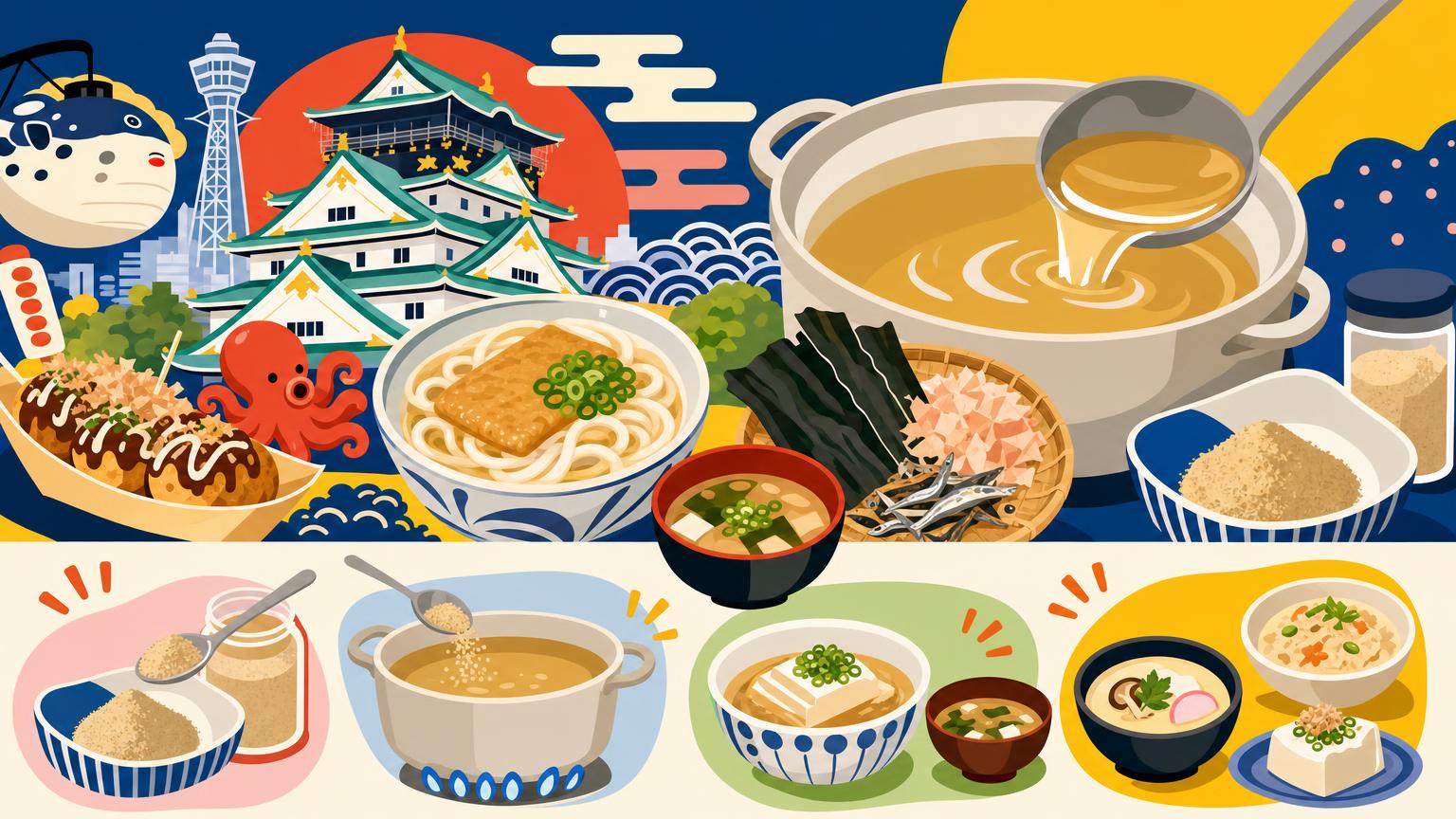
The integration of a foreign resident into Japanese society is reflected in subtle changes to everyday habits. You naturally stop wearing shoes indoors. You learn to separate your garbage into a bewildering variety of combustible and non-combustible categories. And, most importantly, you discover how to use dashi powder in your daily cooking. The charm of these high-quality powders and tea-bag style packets lies in their ability to democratize the rich flavors of Osaka’s kitchens, making them accessible to anyone who can boil water.
However, the true revelation for an expat is realizing that dashi is not limited to Japanese cuisine. At its core, it is a concentrated umami bomb, a fundamental flavor enhancer capable of elevating nearly any savory dish. Living in Osaka, you may find yourself craving the heavy, creamy pastas or hearty meat stews of your homeland. The unspoken secret among expats who enjoy cooking is blending Western recipes with Japanese ingredients.
Using tea-bag style dashi (such as Kayanoya) is remarkably straightforward. You bring a pot of water to a boil, drop in the bag, lower the heat, and let it simmer for three to five minutes. Remove the bag, and you have a clear, golden broth. This stock can serve as the base for a splendid miso soup, requiring only the addition of tofu, wakame seaweed, and a spoonful of fermented soybean paste. It can be used to poach chicken, imparting a subtle oceanic depth to the meat. It can also be combined with soy sauce and mirin to create the classic dipping sauce for cold somen noodles during Osaka’s brutally humid summers.
But if you open the packet and use the raw powder inside, a new world of culinary fusion opens up. A pinch of premium dashi powder stirred into a pan of aglio e olio pasta binds the garlic and olive oil with an unexpected savory richness. Sprinkled on roasted potatoes or mixed into meatball batter, it acts as a quiet flavor amplifier, enhancing the natural taste of the primary ingredients. The everyday routine of an integrated expat in Osaka involves keeping a container of this powder close to the stove, using it instinctively to bridge the culinary divide between their past life and their current existence in the Kitchen of Japan.
Frequently Asked Questions About Dashi
What exactly is dashi made of?
At its essence, authentic Japanese dashi is a broth made by extracting water, premium kelp (kombu), and cured, dried fish (most commonly bonito flakes called katsuobushi, though dried sardines or flying fish are also used). The method involves soaking and gently warming these ingredients to release their natural amino acids—specifically glutamic acid from the kelp and inosinic acid from the fish. This unique combination produces the synergistic, deeply savory taste known as umami. Unlike Western stocks, which simmer bones and vegetables for hours, dashi is delicate and quick to prepare, often taking just minutes once the ingredients are ready, embodying a philosophy of capturing fleeting, pure flavors.
What is Osaka’s most famous dish using dashi?
Although tourists come to Osaka for takoyaki and okonomiyaki, the dish that truly represents the city’s connection with dashi is Kansai-style udon, especially Kitsune Udon. The hallmark of this dish is the broth, which is noticeably lighter and milder compared to the dark, soy-heavy udon broths typical of Tokyo. Osaka’s broth emphasizes the rich yet gentle umami of top-quality Hokkaido kombu and light soy sauce, allowing delicate flavors to stand out. The “kitsune”—sweet, deep-fried tofu pouches that soak up the golden broth—offer a perfect balance of sweet, savory, and comforting textures cherished by locals for generations.
What is the most popular dashi in Japan?
When it comes to everyday, mass-market convenience, Ajinomoto’s “Hondashi” is undeniably the most widespread brand, found in nearly every household and supermarket nationwide. However, if the question concerns the most prized, premium dashi favored for gifts and upscale home cooking, “Kayanoya” is the leader. Their original dashi stock powder, made with roasted flying fish (ago) and free from synthetic chemical additives, has become a national sensation. It represents the height of accessible luxury in Japanese cuisine, blending professional restaurant quality with home convenience.
Is dashi just MSG?
No. While the savory compound glutamic acid found in kelp is the same compound chemically isolated to produce the synthetic seasoning monosodium glutamate (MSG), authentic dashi is far more intricate. Natural dashi includes a complex mix of minerals, subtle wood-smoked fish aromas, and a blend of various amino acids that synthetic MSG cannot imitate. Whereas MSG delivers a flat, one-dimensional savory hit, a well-made kombu and bonito dashi provides a rich, resonant, and layered flavor that unfolds on the palate. Honoring this natural complexity is a key element of Osaka’s culinary tradition.