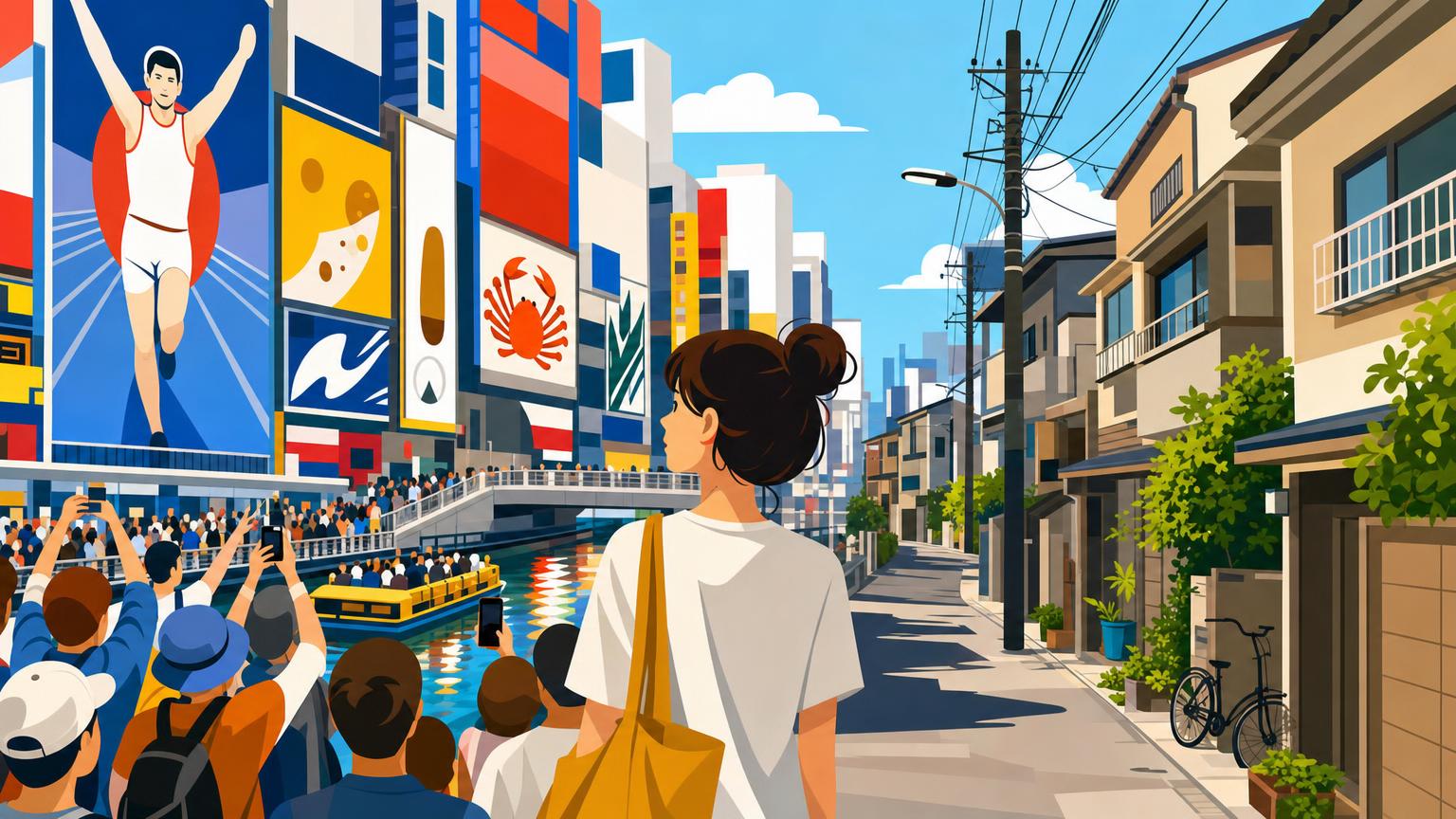
The city does not sleep. It barely even blinks. You step out of your apartment building and the smell of fried batter hits you instantly. It is Tuesday night. It is midnight. The streets are alive. This is Minami. This is the beating, chaotic, beautiful heart of Osaka. For a visitor, this energy is a thrill. For a resident, this energy is a lifestyle. It demands adaptation. It requires a certain kind of urban grit. Tourists see the glowing running man sign. They see the giant mechanical crab waving its arms above the street. Locals see something entirely different. They see the maze of bicycle parking. They see the local ward tax office. They see the late-night cheap supermarkets hidden behind neon facades.
Living in or staying near Dotonbori and Shinsaibashi is not for the faint of heart. It is the ultimate test of your urban endurance. If Tokyo is a city of rules, Osaka is a city of guidelines. You see this the moment you arrive, but you do not truly feel it until you try to navigate these streets every single day. People jaywalk. Bicycles weave through foot traffic with terrifying precision. If you hesitate at a crosswalk, you will be left behind. But there is a warmth beneath the chaos. The Tokyo mindset prioritizes harmony through invisibility. You do not bother others by pretending you are not there. The Osaka mindset prioritizes harmony through direct interaction. You bump into someone here, they might crack a joke.
This area is the commercial center of western Japan. It is a hub for nightlife, youth culture, and endless consumerism. But beneath the flash, real people live here. They pay rent. They take out the trash. They buy milk. This guide is a reality check. It strips away the tourist gloss and explains exactly what it takes to navigate daily life in the loudest, brightest, and most unapologetic neighborhoods in Osaka. Whether you are a digital nomad booking a monthly rental, an expat signing a lease, or a traveler wanting to understand the culture, this is your blueprint for the Minami district.
Why Stay or Live Near Dotonbori and Shinsaibashi?
The appeal is undeniable. You are at the heart of the universe—or at least, the center of the Kansai region. Choosing to reside in the midst of this urban sprawl is a deliberate trade-off. You exchange peace and quiet for absolute, unfiltered convenience. You don’t move to Dotonbori to read a book in silence; you come here to soak up the city’s kinetic energy.
Unmatched Access to Food, Shopping, and Nightlife
The concentration of commercial activity here is astonishing. You are never more than a three-minute walk from a convenience store, nor more than five minutes from a steaming bowl of pork broth ramen. The streets are packed with standing bars, upscale boutiques, and expansive discount stores. For short-term residents, daily routines become effortless. There’s no need to cook or plan meals—the city nourishes you effortlessly.
However, living locally shifts your perspective on this abundance. The famous restaurants with two-hour lines fade into the background, replaced by cherished neighborhood spots. You find basement grocery stores where bentos are discounted by fifty percent at eight in the evening. You learn the alleys that help you avoid crowds dragging roller bags. Shopping arcades evolve from tourist hotspots into transit routes you navigate with purpose, dodging dawdlers with the practiced skill of a true Osaka native.
Outstanding Transport Connections for Exploring Osaka and Kansai
From a logistical standpoint, there’s no better base. The Midosuji subway line is Osaka’s main artery, ferrying millions of commuters north and south. Shinsaibashi and Namba stations are massive transit hubs. Shin-Osaka Station, for bullet train access, is just fifteen minutes away. A ride on the Kintetsu line brings you face to face with wild deer in Nara in under an hour. The Nankai line offers direct service to Kansai International Airport without transfers.
This connectivity is the main draw for digital nomads and long-term business travelers. Time is money, and living in Minami saves both. You don’t waste hours commuting from the quiet suburbs—you’re already at your destination. When your evening ends, there’s no need to rush for the last train home—you are already home.
Considerations: Noise, Crowds, and the Nighttime Hustle
The price of convenience is your personal space. Noise becomes a constant presence. Delivery trucks start rumbling at dawn. Garbage collection in a commercial district is loud and relentless. Nightlife brings drunk salarymen and boisterous university students echoing through concrete canyons well into the early morning. If your apartment faces a busy street, double-paned windows aren’t a luxury—they’re vital for your well-being.
Crowd fatigue is real. Imagine stepping outside to buy eggs and having to push through a sea of international tourists snapping selfies every single day. The sheer volume of humanity can be draining. Locals cope by developing mental blinders, walking with heads down and eyes fixed on their destinations. They don’t stop to admire the neon glow—they’ve seen it a thousand times. To live here, you must learn to tune out the spectacle and carve out your own quiet routines amid the chaos.
Living vs. Visiting: Is It a Good Base for Long-Term Stays?
Spending a weekend in a hotel is entirely different from renting an apartment for three months. A hotel shields you from the daily grind, while an apartment exposes you to it. The Minami district caters heavily to short-term stays and presents distinct challenges for long-term residents.
Short-Term Travelers: Ultimate Convenience
For visitors staying a week or less, the Shinsaibashi and Dotonbori area arguably offers the best base in the city. You make the most of your time by stepping out of your hotel lobby straight into the heart of the culture. The language barrier here is lower than anywhere else in Osaka. Menus are often translated into English, and staff are accustomed to foreign requests. It’s a frictionless environment designed to part you from your money as smoothly as possible.
However, this seamless experience can give you a misleading impression of Osaka. You might leave thinking the city is all takoyaki stands and duty-free shops. The true culture of Osaka requires deeper exploration—chatting with bartenders at tiny standing bars or observing the interactions between shop owners and delivery drivers.
Digital Nomads and Expats: Managing Apartments and Everyday Life
For stays of a month or longer, the situation changes. Finding daily necessities in a tourist-heavy area can be surprisingly difficult. Large drugstores on main streets stock face masks and matcha-flavored candy, but not laundry detergent or toilet paper. Locating a proper supermarket demands local knowledge.
Most long-term foreign residents soon discover the Life supermarket near Namba Station or Aeon Food Style in Yotsubashi. They learn the detailed schedules for trash collection—an intricate civic duty in Japan. Combustibles go out on Tuesdays and Fridays, plastics on Thursdays. Living in a dense commercial area means these rules are strictly enforced by building managers to prevent rats and crows from turning alleys into battlegrounds.
Supermarkets here offer fascinating social insights. Super Tamade, with its bright yellow and red neon signs, looks like a cheap casino from the outside. Inside, it’s a hardcore discount grocery store where you can buy a single banana wrapped in plastic or a three-dollar bento box. It’s a local institution. Watching the diverse crowd at Tamade at two in the morning is surreal—you’ll see sharply dressed host club workers buying energy drinks behind elderly women purchasing discounted fish. This strange mix of vibrant nightlife and raw reality captures the essence of living in Minami.
Social isolation is another challenge in this transient neighborhood. Because it’s dominated by tourists and short-term visitors, building a local community requires effort. You won’t find quiet parks where locals walk their dogs but rather concrete plazas where street performers attract large crowds. Expats who succeed here are those who embrace the area’s transient nature—they become regulars at hidden local bars and form connections with owners who recognize them among the endless stream of tourists.
Best Micro-Neighborhoods Around the Area
Minami is far from uniform. The character of the neighborhood shifts completely depending on which side of the street you walk along. Grasping these micro-neighborhoods is essential to finding a livable spot in the city center.
Right in Dotonbori: The Heart of the Action
Living right on the Dotonbori canal is nearly impossible since the real estate there is entirely commercial. However, just one or two streets away—especially heading east toward the Sakaisuji subway line—there are residential buildings. This area is raw and gritty, heavily occupied by nightlife workers, host club employees, and late-night restaurant staff.
The atmosphere here is persistently nocturnal. Mornings are quiet, almost lifeless, with streets sticky from spilled beer and the remnants of the previous night. But as night falls, the area comes alive. Living here requires accepting the grime and dealing with the constant stream of taxis and delivery trucks. It offers authentic, unfiltered urban living, though it’s far from comfortable.
Shinsaibashi-Suji and Amerikamura (Amemura): Trendy and Youthful
Moving slightly north and west brings you to Amerikamura, or Amemura, the undisputed hub of youth culture in Osaka. It’s a maze of vintage clothing stores, record shops, and underground music venues. The streets center around Triangle Park, a small concrete plaza where teenagers gather to eat ice cream and flaunt their streetwear.
Renting an apartment near Amemura means immersing yourself in a cultural phenomenon. It’s vibrant, artistic, and loud. On weekends, the bass from nearby clubs will shake your windows. You’ll spot fashion trends here months before they hit the mainstream. Yet, it can also be draining. The sidewalks are narrow and perpetually crowded with shoppers. It’s a fantastic place to be twenty-two and energetic but might try your patience if you need quiet to work remotely.
Yotsubashi and Horie: Quieter, Stylish Alternatives Nearby
For the savvy expat or seasoned digital nomad, this is the golden ticket. Just a few blocks west of Amemura, crossing the expansive Yotsubashi-suji avenue transforms the vibe entirely. Neon signs disappear, crowds thin, and the loud hawkers give way to silent, tree-lined streets. Welcome to Horie.
Horie is Osaka’s equivalent of Brooklyn—a home for the successful creative class. The neighborhood is marked by third-wave coffee shops, upscale furniture boutiques, and sleek designer apartments. Locals stroll by with French bulldogs in designer strollers. The architecture is modern, and the atmosphere is both sophisticated and relaxed.
Living in Horie or near Yotsubashi Station offers the ultimate life hack: you’re just a ten-minute walk from the chaotic energy of Dotonbori, yet you can rest in complete silence. You have access to better, standard supermarkets and quiet cafés where you can work on your laptop undisturbed for hours. It strikes the perfect balance between Minami’s wild energy and the practical realities of daily life.
Getting Around: Shinsaibashi to Dotonbori Distance
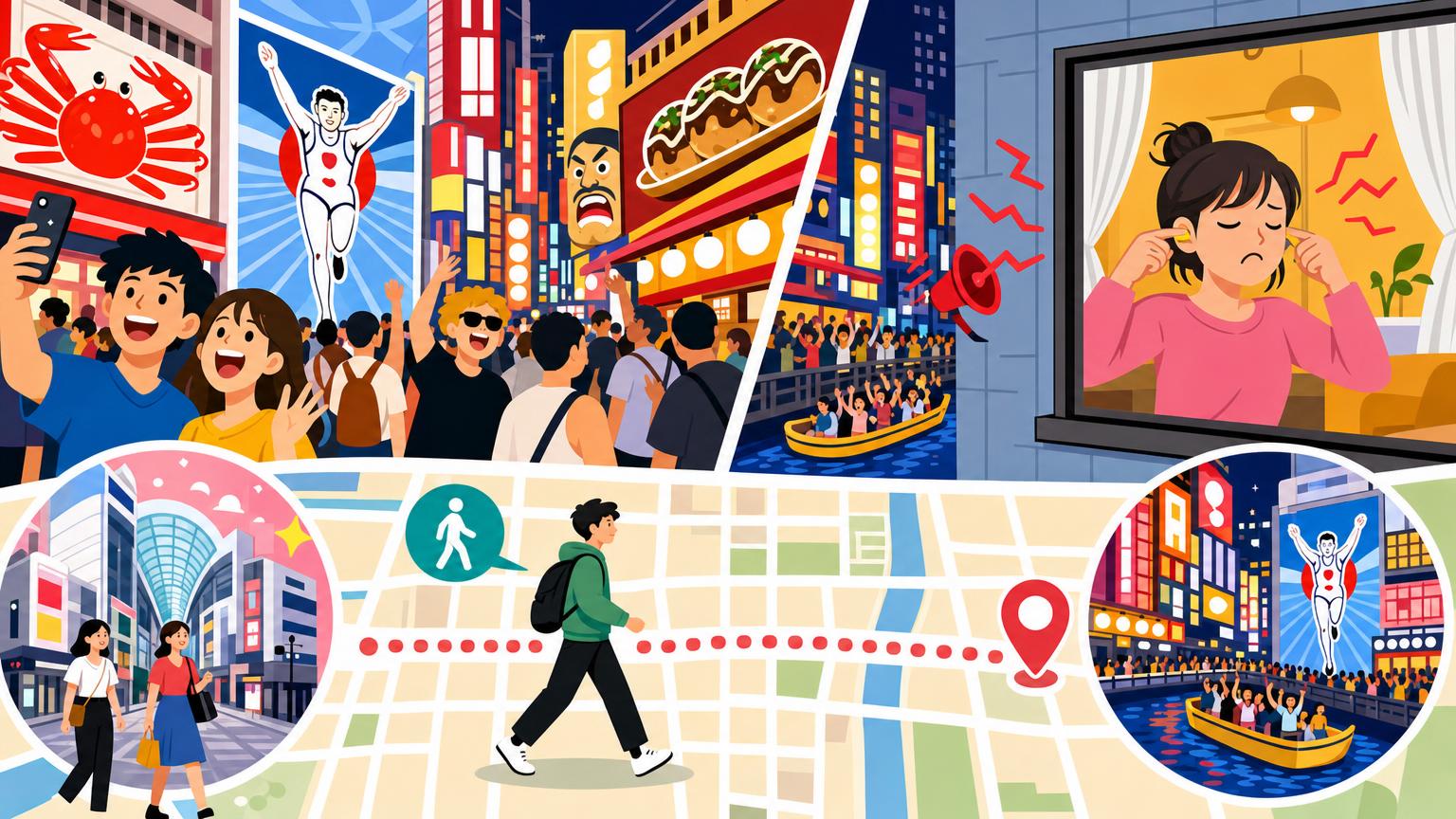
A common source of confusion for newcomers is the spatial relationship between Shinsaibashi and Dotonbori. They are often mentioned together, leading many to assume they are a single location. In fact, they are two separate areas connected by a large pedestrian corridor.
Walking the Covered Shopping Streets
The distance between Shinsaibashi Station and the Ebisu Bashi bridge in Dotonbori is about one kilometer. On an empty street, it takes a brisk ten-minute walk. However, the Shinsaibashi-suji shopping arcade is never empty. It is a covered, brightly lit passageway that serves as a river of people.
Walking through this arcade during peak hours is a cultural experience in its own right. You don’t really walk—you shuffle, you float along with the tide of thousands of other pedestrians. For tourists, it’s an overwhelming sensory overload of retail therapy. For local residents commuting home, it’s an obstacle to navigate. Locals avoid walking down the center of the arcade. Instead, they use parallel side streets and weave through narrow back alleys. When the weather is bad, they head underground to the Crystal Nagahori subterranean mall, bypassing the surface-level crowds altogether. Learning these alternate routes is the first sign you’re transitioning from a visitor to a local.
Navigating Shinsaibashi and Namba Stations
Osaka’s underground infrastructure is just as complex as the surface. Shinsaibashi Station and Namba Station are vast, sprawling labyrinths. They are linked by an extensive network of underground shopping malls, allowing you to theoretically walk from Shinsaibashi to beyond Namba without ever seeing the sky.
Navigating these stations requires an understanding of Osaka’s mindset, characterized by aggressive pragmatism. Tokyo stations like Shinjuku can be confusing due to their sheer size, but the signage is meticulous. Everyone follows the arrows and stays in their lane. Osaka stations are confusing because everyone is looking for shortcuts. The flow of foot traffic is unpredictable. People cut corners and walk on the wrong side of stairs if it saves them a few seconds. You have to walk with purpose. If you stop in the middle of a corridor to check your phone, you’ll disrupt the flow and likely hear a sharp click of a tongue behind you. Move aside. Keep the rhythm.
The Osaka Mindset: How Locals Interact With the Chaos
To truly grasp what it’s like to live in this district, you must understand its people. Osaka has a rich history as a merchant city, built on trade, commerce, and communication. This legacy still permeates the modern social fabric. The culture here is transactional yet deeply warm.
Navigating the Crowds the Osaka Way
In Tokyo, a crowded street operates like a silent machine. People avoid physical contact at all costs, and eye contact is scarce. In Osaka, the crowd feels like a living, breathing organism, where physical closeness is simply part of everyday life. People will bump into you and brush past your shoulder. But unlike Tokyo, where a collision triggers silent discomfort, an Osaka bump often comes with a murmured apology, a nod, or even a joke.
There is an unspoken rule of mutual recognition in Minami. You are here. I am here. We’re both trying to snag the last discounted bento box at the supermarket. Let’s navigate this together. This straightforwardness is often misunderstood by foreigners who mistake the loudness for aggression and the directness for rudeness. It is neither. It’s a culture that prioritizes efficiency and human connection over rigid, formal protocols.
Bicycles in Osaka are not viewed as a leisure activity but rather as a primary mode of aggressive transportation. Mothers with two children strapped to electric-assist bikes will race down narrow sidewalks at full speed. You must stay alert. When you hear a bicycle bell ring behind you, it’s not a polite signal—it’s a warning. In Tokyo, cyclists typically stick to the road or navigate pedestrians with extreme care. In Osaka, sidewalks are a shared battleground. If you live near Shinsaibashi, you quickly develop an almost instinctive sense for approaching bicycles. You learn to step aside without looking, creating a subconscious rhythm to your daily commute.
Tokyo Politeness Versus Osaka Pragmatism
The concept of meiwaku, or causing trouble for others, is fundamental in Japanese society. In Tokyo, meiwaku means making noise—such as taking a phone call on a train or speaking loudly in a cafe. The aim is to remain unseen and maintain complete silence.
In Osaka, however, meiwaku is defined differently. Bothering others means wasting their time or being unnecessarily inflexible. If you’re fumbling with coins at the register while a line forms behind you, that’s meiwaku. If you block escalator traffic because you don’t know which side to stand on, that’s meiwaku too. In Osaka, people stand on the right side of escalators and walk on the left, whereas in Tokyo, it’s the opposite. This single difference perfectly symbolizes the divide between the two cities—Osaka operates on its own wavelength.
Osaka dialect is far more than a regional accent; it embodies the city’s entire personality. The standard Japanese taught in schools is polite, indirect, and conflict-averse. The local dialect, by contrast, is rhythmic, punchy, and highly expressive—the language of comedians. When a shopkeeper gives you your change and thanks you in the local dialect, they’re not just being polite—they’re inviting you into the local groove. Learning a few words of the dialect will open doors faster than perfect standard Japanese ever could. It shows respect for their unique cultural identity. Foreigners who flourish in Osaka learn to let down their guard and speak up. If you look lost in Tokyo, people might politely ignore you to spare your embarrassment. But in Dotonbori, an elderly woman may grab your arm and pull you toward your destination, speaking rapid-fire local dialect as she goes. You don’t need to understand every word—just appreciate the intention.
Frequently Asked Questions
Is Shinsaibashi a good area to stay in Osaka?
It largely depends on how much sensory stimulation you can handle. Shinsaibashi is an amazing area if you want to step outside your door and immediately access the best food, shopping, and lively nightlife in western Japan. It is especially convenient for first-time visitors who want everything within walking distance. However, if you are a light sleeper, easily overwhelmed by crowds, or seeking a calm, traditional Japanese atmosphere, this area will likely disappoint you. It’s a concrete jungle illuminated by neon lights and filled with noise.
Is it too noisy to sleep near Dotonbori?
If your window faces the main street or the canal, definitely yes. The noise continues until dawn, with sirens, late-night partygoers, and early-morning garbage trucks easily heard through standard residential windows. If you’re renting, check the window construction carefully—look for double-paned glass. Even better, seek apartments facing inner courtyards or back alleys. A mere fifty meters can be the difference between sleepless nights and peaceful quiet. Always prioritize locations slightly off the main commercial areas. That way, you can enjoy the advantages of the central district without sacrificing your mental well-being to the city’s ambient noise.
Where do most foreigners live in Osaka?
The expat community in Osaka generally splits into two groups based on lifestyle and profession. Corporate expats, English teachers with families, and those in traditional office roles tend to prefer the northern parts of the city. Neighborhoods like Umeda, Fukushima, and North Osaka’s suburbs offer larger apartments, international schools, and a quieter, family-oriented environment.
Conversely, digital nomads, young creatives, and solo entrepreneurs mostly flock to the central and southern districts. Areas such as Horie, Namba, and the residential pockets around Shinsaibashi are major hubs for the international creative class. These individuals choose this area for the quintessential, densely packed Japanese urban experience. It provides immediate access to networking opportunities, entertainment, and the raw, unfiltered culture of the city. They come for the neon lights but stay for the gritty, practical, and deeply human spirit of the Osaka locals.