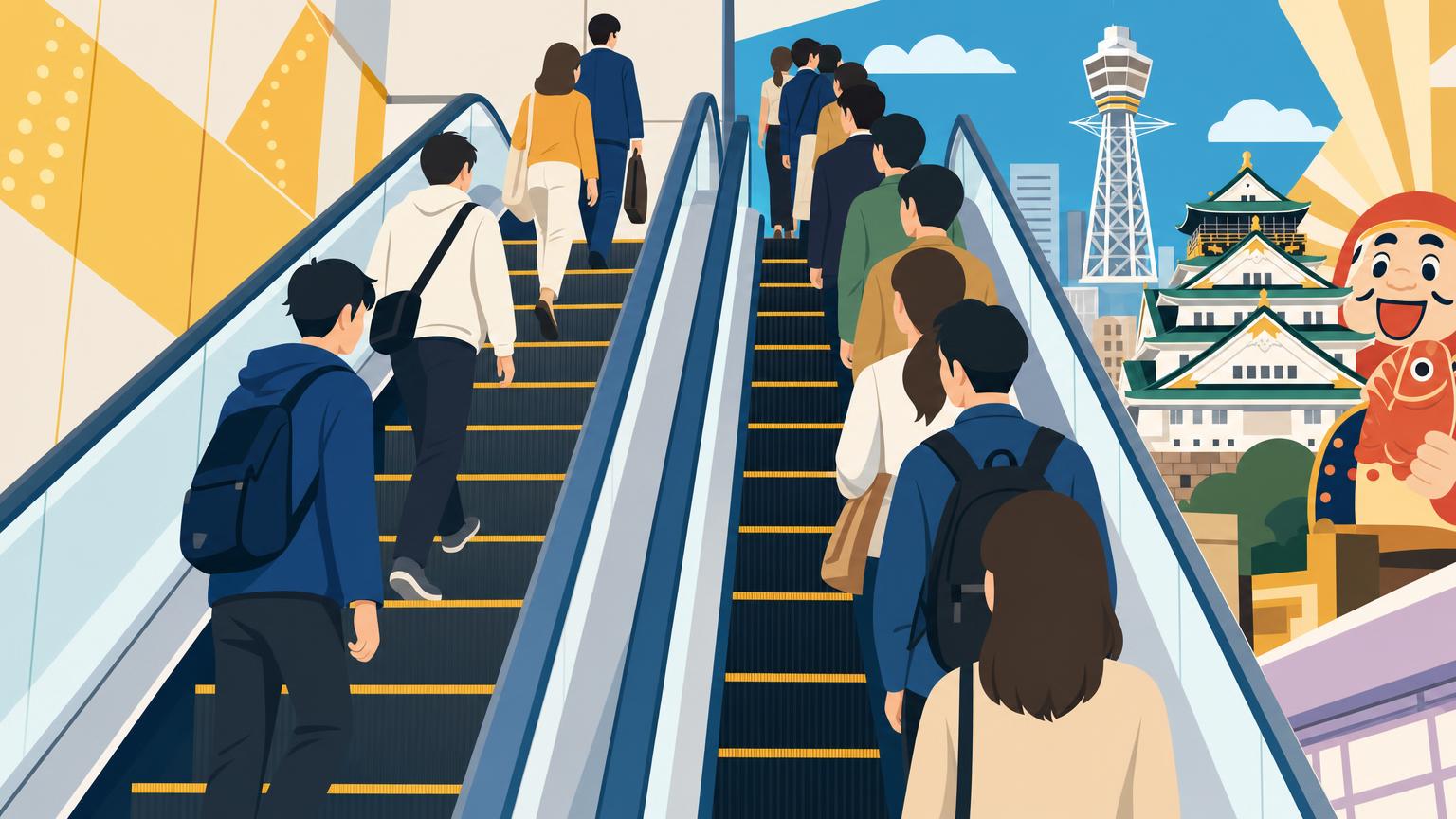
Living in Japan brings a unique rhythm to your daily life. A steady pulse. A predictable hum. You learn the unwritten rules quickly. You wait for the pedestrian light to turn green, even when the street is empty. You quiet your voice on the train. You stand politely on the left side of the escalator. It becomes second nature. It feels like the universal law of the land. But then, you move to Osaka.
Suddenly, the rhythm shifts. The melody changes. The crowd stands on the right.
Why? What does this mean? For many expats and international residents, this sudden flip in behavior is the first jarring sign that they have entered a different world. It is not just a quirky local habit. It is a profound statement of identity. Osaka operates on its own frequency. It always has. The city is fiercely proud. It is intensely practical. It is beautifully chaotic. Today, we dive deep into the everyday reality of this magnificent city. We will explore what makes Osakans tick. We will look beyond the bright lights of Dotonbori. We will decode the mindset, the behavior, and the unwritten laws of Kansai. Let us begin with the escalators. Let us uncover what a simple step to the right reveals about the soul of Osaka.
Escalator Etiquette in Japan: Tokyo vs. Osaka
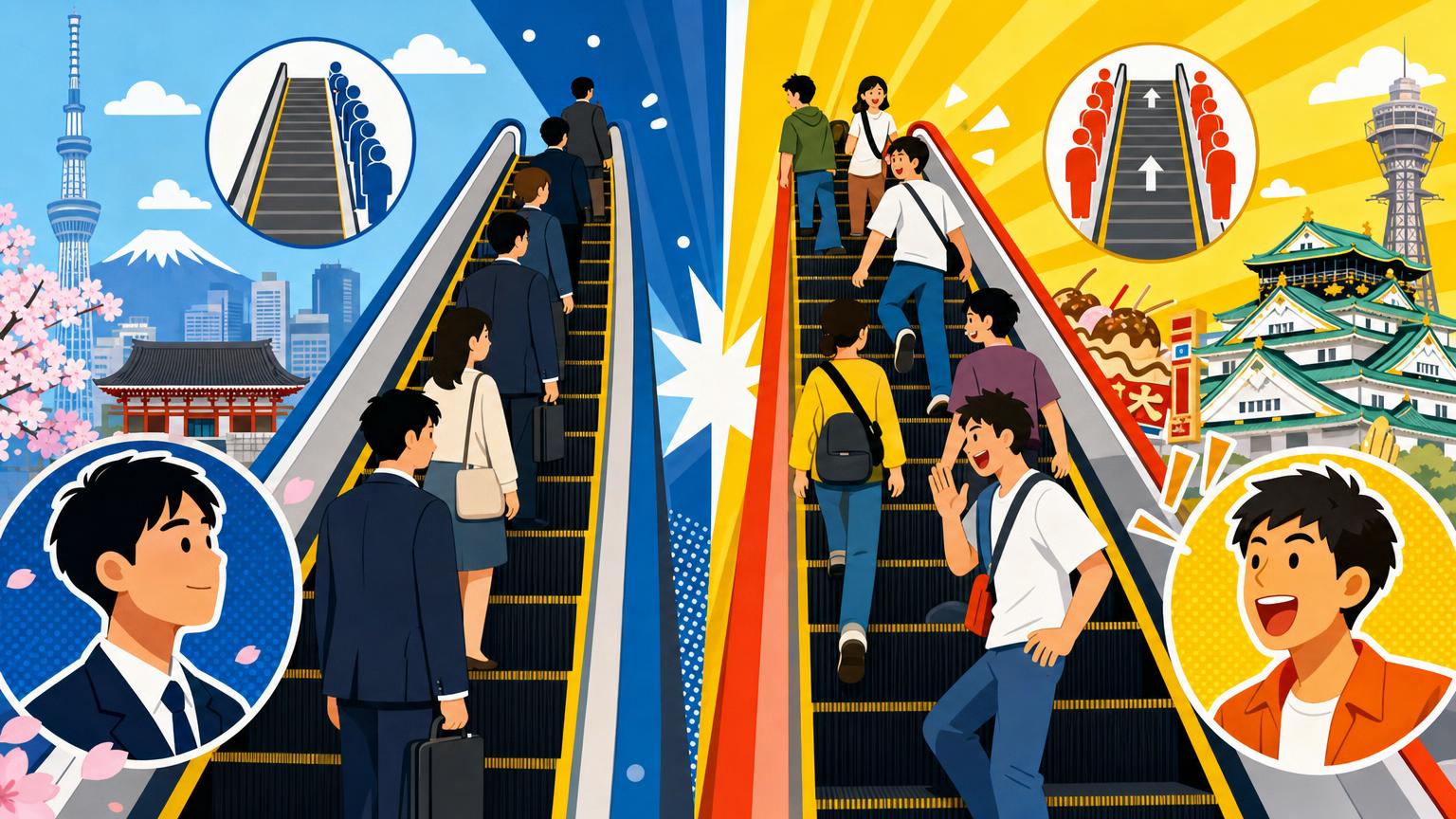
In Tokyo, order is paramount. The vast metropolis functions with clockwork precision. People stand on the left and walk on the right. This unspoken rule governs the Kanto region. Upon arriving in Tokyo, you quickly absorb this norm. It feels universal and distinctly Japanese. The left-side stance matches the side of the road cars drive on, making logical sense.
Then you take the bullet train to Shin-Osaka Station. You step onto the platform, head for the stairs, and onto the escalator. Suddenly, everything reverses.
In Osaka, people stand on the right and keep the left side clear for walkers. For newcomers, this can be very confusing. You might instinctively stand on the left and find yourself blocking a hurried salaryman, earning a sharp click of the tongue. This simple geographical change is often the first cultural shock foreign residents experience when moving from Tokyo to Kansai.
It feels like crossing an invisible national border, revealing a fundamental truth about life in Japan. The country is not a monolith. Regional cultures run deep, influencing daily routines and shaping public interactions. Understanding this divide is the first step to truly grasping Osaka.
Why Do People in Osaka Stand on the Right Side?
The question demands an answer. Why does Osaka choose to stand apart? Why deviate from the pattern set by the nation’s capital? The explanation is more than simple rebellion. It is rooted in a compelling blend of international ambition and corporate influence. Two key historical factors shaped the right-standing culture of Osaka.
The 1970 Osaka World Expo Influence
Let’s rewind the clock to 1970. The world’s attention turns to Osaka. The Japan World Exposition, widely known as Expo ’70, takes place in the city. It is a landmark event for Japan, symbolizing the country’s rapid economic growth. Millions of international visitors flood the area. Osaka eagerly aims to be a welcoming global hub. It wants to demonstrate that it is a modern, international metropolis.
At the time, standing on the right side of the escalator was considered the global norm. London did it. New York did it. Paris did it. To accommodate these foreign visitors and make them feel at home, Osaka’s transit authorities actively promoted standing on the right. They wanted the city to align with international standards. They broadcast announcements. They displayed signage. The message was clear: Welcome the world. Stand on the right.
This outward-looking, international mindset endured. Long after the futuristic pavilions of Expo ’70 were taken down, the habit remained deeply ingrained in local culture. It became a source of civic pride. It served as a lasting reminder that Osaka was a city designed for the world stage.
The Hankyu Railway Theory
But there is another part of the story—one that is purely local and thoroughly practical. It involves one of the most powerful and respected institutions in the Kansai region: the Hankyu Railway.
Even before the Expo began, Hankyu Umeda Station was undergoing a vast, ambitious renovation in the late 1960s. Umeda is the vibrant heart of northern Osaka, a maze of commerce, transit, and daily activity. Hankyu installed extraordinarily long, sweeping escalators to manage the continuous flow of commuters. To maintain order on these massive machines, they required a system. They needed a rule.
They looked to the right-hand traffic rules used for vehicles. They began broadcasting announcements instructing passengers: Stand on the right. Keep the left side clear for those in a hurry. Hankyu passengers are known for their quiet loyalty to the brand. They followed the instructions precisely. The rule rapidly spread from the polished halls of Umeda Station to the rest of the vast city. Together, the international aspirations of the Expo and the practical logistics of Hankyu Railway forged a lasting local convention.
Where Does the Rule Change? Kanto vs. Kansai
So, where exactly is the border? At what point does the Tokyo-left turn into the Osaka-right? It’s not a sharp, straight line marked on a map—it’s a cultural gradient.
This shift typically occurs around the Sekigahara area in Gifu Prefecture, a place historically known for dividing eastern and western Japan. However, the reality on the ground is much more complex. Traveling west from Tokyo, the strict adherence to left-side rules gradually lessens. By the time you reach the core of the Kansai region, the right-side rule predominates.
What About Kyoto and Other Kansai Cities?
That said, Kansai itself is not entirely homogenous. This is where living in the region becomes especially intriguing.
Take Kyoto as an example. It’s just a short train ride from Osaka, yet its escalator etiquette is a delightful, perplexing mix. Kyoto is a city deeply influenced by tradition alongside large numbers of domestic and international tourists. At Kyoto Station, you’ll see people standing on the left, others standing on the right, and some looking completely confused in between. Locals in Kyoto often simply adapt on the spot—they read the situation and follow the person directly ahead.
Kobe, meanwhile, mostly follows Osaka’s pattern, with the right-side stance as the standard. Cross over to neighboring Shiga or Nara, and you might notice a return to the Kanto left-side norm. This geographic patchwork highlights an important point for anyone moving to the area: Osaka is the vibrant, driving heart of Kansai culture, and its influence is strong, but its customs don’t perfectly govern every adjacent town.
The New Escalator Rule in Japan: Stand Still on Both Sides
Now, we must discuss the present and the future. If you are moving to Osaka today, you should know that the ground beneath your feet is shifting. The old rules are confronting a significant modern challenge.
Throughout Japan, a powerful new movement is emerging. Safety is taking precedence over speed. For decades, the culture of walking on one side of an escalator was accepted everywhere, seen as essential for busy commuters. However, it is inherently dangerous. Slips happen. Collisions occur. For the elderly, people with physical disabilities, and travelers managing heavy luggage, a rushing commuter brushing past them on a narrow metal staircase poses a serious risk.
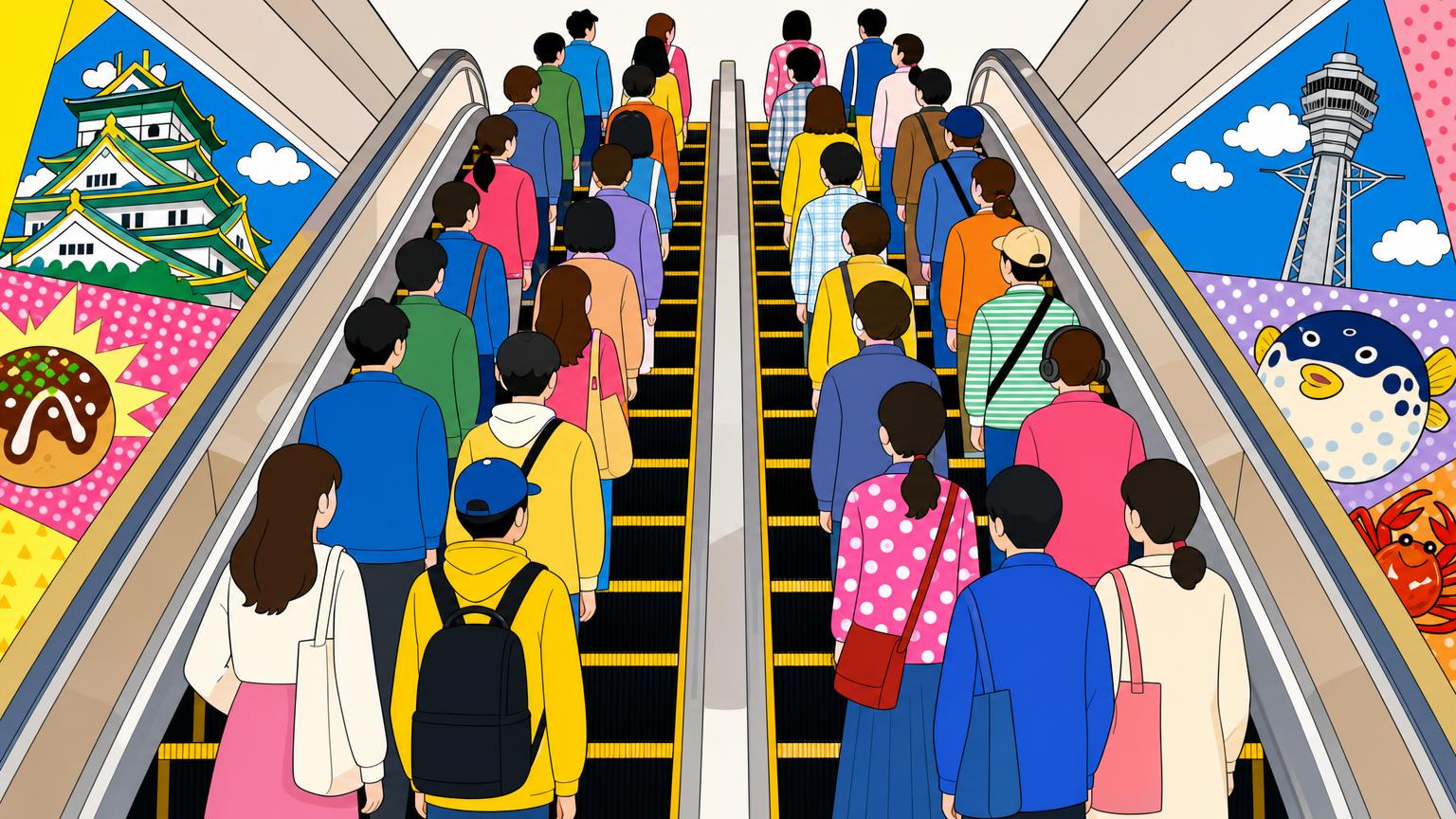
Transit authorities are now appealing to the public: Stand still. Hold the handrail. Do not walk on escalators at all. Keep both sides stationary.
This is no longer just a polite request. Local governments are intervening. Saitama Prefecture has passed a landmark ordinance requiring people to stand still on escalators by law. Nagoya soon followed with its own strict regulations.
Osaka is currently grappling with this cultural shift. Posters now cover the walls of major hubs like Umeda, Namba, and Tennoji, featuring cute, colorful mascots standing side by side. The message flashes across digital screens: Walking is dangerous. Stand still on both sides.
Still, human habits die hard. Osaka’s merchant spirit prizes efficiency. The urge to rush, to move quickly, and to get things done fast is deeply embedded in local DNA. Ride the subway during the morning rush hour today, and you’ll witness a fascinating clash. You will see safety posters, hear automated announcements urging you not to walk, yet still find a line of people standing firmly on the right while impatient commuters march swiftly up the left.
Living in Osaka today means witnessing this transition unfold in real time— a tug-of-war between a deeply ingrained local identity and essential modern safety standards.
The Osaka Mindset: Practicality Over Perfection
To understand why Osakans adhere to their escalator rules and behave the way they do in everyday life, you need to grasp their history. Osaka is not a city of samurai and strict lords; it is a city of merchants, historically known as the Kitchen of Japan.
In a merchant city, time is money. Practicality takes precedence above all else. Perfection and strict observance of formal etiquette are secondary to completing the task at hand. This mentality influences every part of daily life, which is why Osaka feels so fundamentally different from Tokyo.
Tokyo values Tatemae, the concept of a polite facade. It represents social harmony achieved by hiding true feelings, maintaining public order, and avoiding causing inconvenience to others. This makes Tokyo extremely peaceful but can also make it feel cold and isolating to a foreigner.
Osaka values Honne, which is the honest, raw truth. Osakans are direct and expressive; they will tell you what they really think. If you drop your wallet, someone will shout to alert you. If you are blocking the way, they will ask you to move. This bluntness can be surprising at first, but once you understand it, it is incredibly refreshing as it removes any guesswork from daily interactions.
This practical mindset perfectly explains the escalator habit. Hankyu Railway decided to have people stand on the right to keep traffic flowing smoothly. The merchants of Osaka adopted this rule because it made sense, and it worked. Why change it just because Tokyo does things differently?
Communication and Connection in the Kansai Capital
Living in Osaka means embracing a new emotional language. The city’s physical closeness encourages a distinctive type of social interaction. Boundaries here are noticeably thinner than in other regions of Japan. Conversations ignite far more easily between strangers.
If you appear completely lost while staring at a map in the vast maze of Shinjuku Station in Tokyo, most people will politely walk past you. They assume you desire privacy and do not want to intrude.
If you seem lost in Namba Station in Osaka, don’t be surprised if an older woman approaches you directly. She might grab your arm, firmly point you in the right direction, or even press a piece of wrapped hard candy into your hand before disappearing into the endless crowd.
This is the legendary Osaka Obachan—the friendly, leopard-print-wearing, candy-carrying auntie of Kansai. Though she’s a stereotype, she’s deeply rooted in reality. Foreigners often summarize this phenomenon with the cliché phrase “Osaka is friendly.” But it goes far beyond mere friendliness. It arises from the city’s deep merchant culture. In a place built on trade, communication is currency, and connection means survival. Ignoring a confused person is simply bad business.
The local dialect, Kansai-ben, greatly contributes to this atmosphere. It is melodic, bouncy, and inherently humorous. The standard Japanese taught in textbooks can sometimes sound stiff and overly formal, whereas Kansai-ben feels warm and grounded. Learning a few phrases like Ookini (thank you) or Nandeyanen (you’ve got to be kidding me) will instantly win you the locals’ affection and show respect for their unique cultural identity.
Decoding the Everyday Commute in Osaka
Let’s discuss the daily reality of getting around this city. The commute is where you genuinely feel the heartbeat of Osaka.
The Midosuji Line serves as the city’s main artery. It runs straight through the center, linking key hubs like Shin-Osaka, Umeda, Shinsaibashi, Namba, and Tennoji. Riding the Midosuji Line during rush hour offers an intense sensory experience.
The cars are packed tightly. However, the atmosphere feels somewhat more relaxed compared to a Tokyo commute. In Tokyo, a crowded train is eerily silent. Everyone focuses intently on their phones or closes their eyes. The silence is almost palpable.
In Osaka, trains are certainly quiet by international standards, but you’ll still hear whispers. You’ll catch quiet chuckles. You’ll notice friends gently nudging each other. The tension is lighter. People are noticeably more at ease with close physical proximity.
Navigating the sprawling stations requires a unique set of skills. Umeda Station is famously complicated. Locals fondly call it the Umeda Dungeon. It’s an expansive underground maze of intersecting rail lines, endless shopping centers, and shifting levels. Here, the right-hand escalator rule is your essential guide. You blend into the flow of foot traffic, follow the current, avoid stopping abruptly in hallways, and keep moving. The city is built for continuous, fluid motion.
Practical Tips for Residents Riding Escalators in Osaka
If you are planning to live in Osaka or have just arrived, how do you navigate this environment? How do you fit in and honor the local pace? Here are practical, everyday guidelines for mastering the transit system.
- Continuously observe your surroundings. The cardinal rule of living in Japan is to watch what those around you are doing. If everyone lines up on the right side of the escalator, you do the same. Don’t overthink it.
- Heed the safety campaign messages. Traditionally, people stand on the right and walk on the left, but keep in mind the recent nationwide initiative. When the escalator is crowded or particularly steep, do not walk—stand still and hold the handrail.
- Keep your luggage secure. Osaka is a major tourist hub, so you’ll often be carrying suitcases. Keep your luggage directly in front of you or close by on the step, ensuring it doesn’t block the open side for others passing by.
- Go with the flow. Avoid stopping right at the top or bottom of the escalator to check your phone. Step off, continue walking a few steps, then pull over to the side. People behind you are moving quickly.
- Leave your Tokyo habits on the Shinkansen. Expats who lived in Tokyo may feel confident about the left-side rule, but let that go. You’re in Kansai now—respect the local customs.
Embracing the Local Identity
Understanding Osaka’s escalator habit is about far more than just knowing where to place your feet. It’s about grasping the essence of the city.
Osaka is a city that refuses to simply blend in. It honors its merchant heritage. It prioritizes practical solutions over strict traditions. It embraces international influences while fiercely safeguarding its local character. When you stand on the right side of the escalator in Umeda, you are engaging with a living history. You are aligning yourself with the legacy of the 1970 Expo. You are moving to the rhythm of the Hankyu Railway.
For a foreigner living here, this is the true joy of Osaka. It’s a city that demands your involvement. It doesn’t want you to merely watch quietly from the sidelines. It wants you to participate. It wants you to communicate openly. It wants you to laugh, to eat heartily, and to move with intention.
So, when you finally take the step, take a deep breath. Step off the train. Observe the chaotic, beautiful, vibrant flow of people. Step confidently onto the right side of the escalator. Let the fast walkers pass on your left. Smile at the subtle differences that make this city so uniquely special. You are not just a tourist anymore. You are learning its rhythm. You are becoming part of Osaka.