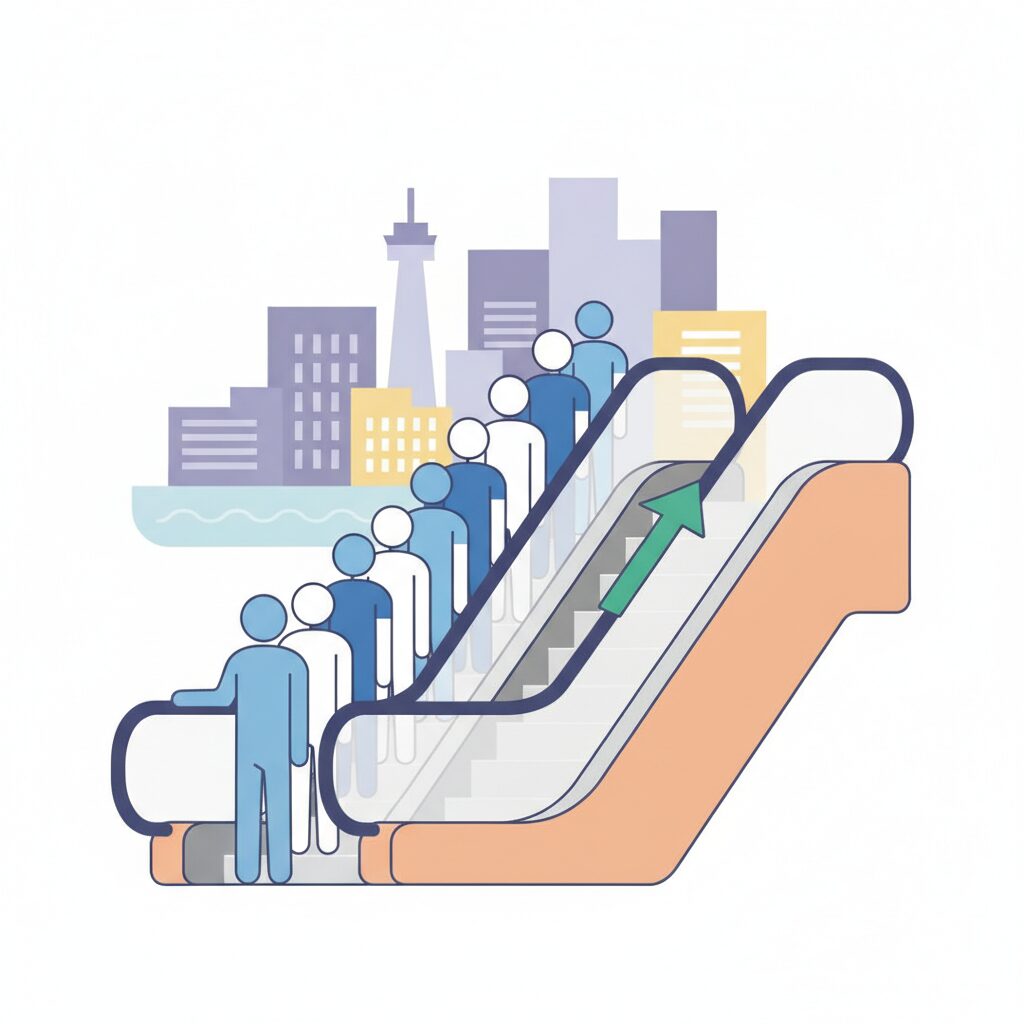
Your first week in Osaka, you’ll feel it. Not the humidity, not the language barrier, but the escalator. You step on, drift to the left like you’ve done your whole life, and suddenly you’re a rock in a river. A salaryman in a slightly-too-shiny suit gives you a polite but firm “sumimasen.” A woman with a leopard-print tote bag sighs audibly. You’ve committed the cardinal sin of Osaka transit: you’ve blocked the fast lane. Here, in this vibrant, chaotic, and relentlessly practical city, you stand on the right. You walk on the left. This isn’t just a quirky local custom; it’s a key. It’s the first piece of code you need to decipher the city’s entire operating system. Forget guidebooks. Your real introduction to the Osakan mindset happens on the moving stairs of Umeda Station, a concrete and steel heart pumping a million people a day through its arteries. This simple, unspoken rule is a daily referendum on Osaka’s identity—a declaration of independence from the quiet conformity of Tokyo and a testament to a culture built on speed, efficiency, and a healthy dose of rebellious pragmatism.
This unspoken rule on Osaka’s moving stairs is just one facet of a culture where exploring the city’s quirky humor and unfiltered honesty offers a deeper look into its vibrant character.
The Great Escalator Divide: Osaka vs. The World (and Tokyo)
A Rule Set in Motion
In most parts of the world, and importantly, in most of Japan, the escalator is a place for left-side alignment. You step on, keep close to the left rail, and let the ambitious, the latecomers, and the perpetually impatient pass by on the right. It’s a straightforward, global rhythm. Then you arrive in Osaka, and this pattern flips. The right side becomes a stationary wall of commuters, shoppers, and families, quietly ascending. The left lane turns into a fast-moving channel for those who count their day in seconds saved. This isn’t a mere suggestion; it’s an unbreakable rule of urban physics. For anyone relocating to Osaka from elsewhere in Japan, especially Tokyo, this is the first and most striking cultural shock. It’s more immediate than the local dialect, more tangible than the flavor of dashi. It’s a physical expression of a psychological reality: you are now in a different domain, one governed by its own rules. The neat, orderly procession of Tokyo is replaced by a system that feels more aggressive, more dynamic, and designed above all for one purpose: constant forward momentum. Blocking the left lane isn’t just a nuisance; it feels like you’re actively resisting the city’s natural rhythm.
Where Did It Come From? Unpacking the Theories
Ask ten Osakans why they stand on the right, and you may receive ten different answers, each accompanied by a shrug that suggests the reason matters less than the fact itself. The most common explanation, one you’ll hear in bars and from talkative taxi drivers, points to the 1970 World Expo. Osaka welcomed the world, and to accommodate the influx of international visitors used to right-side traffic, the city’s railways reportedly launched a “stand on the right” campaign. This was meant to ease things for guests—a classic example of Osakan hospitality grounded in practical problem-solving. Another, perhaps more convincing, theory credits the powerful Hankyu Railway, the private line dominating the city’s northern corridor. Legend has it that at their vast Umeda terminus, announcements urged passengers to leave the left side clear for those rushing through. The logic was straightforward: Umeda is a hub of transfer and transit, a place with purpose. People needed to move quickly. Hankyu, a company built on efficiency, devised a simple solution. Unlike a government mandate, this was a practice that emerged organically from the needs of the people and the businesses serving them. It endured because it worked. It became the default standard because it made sense in a city that has always prioritized commercial logic over strict tradition. Whether fact or folklore, this origin story perfectly embodies the Osakan spirit: if a system is more efficient, adopt it, regardless of what the rest of the country does.
More Than Just a Rule: It’s the ‘Seiri-teki’ Mindset
The Gospel of ‘Hayo Hayo’ (Hurry, Hurry)
To fully grasp the right-side rule, you need to understand the concept of “hayo hayo.” It’s Osaka-ben for “hurry up, hurry up,” and it serves as the city’s unofficial motto. You’ll hear it whispered by shopkeepers, by parents urging their children, and by coworkers racing against a deadline. It’s a philosophy of constant movement. Time isn’t an abstract idea; it’s a valuable commodity, a resource not to be wasted. The escalator’s left lane is the physical embodiment of “hayo hayo.” During the morning rush at Namba or Yodoyabashi, it’s no mere walking lane; it’s a sprinting lane. You see people taking two steps at a time, briefcases swinging, faces set with focused determination. There’s an unspoken, mutual understanding that everyone has places to be, and your dawdling shouldn’t slow them down. This sharply contrasts with the more patient, nearly serene flow of pedestrians you might observe in Tokyo. In Osaka, there is a subtle but constant hum of urgency. The city was founded by merchants, and the spirit of the marketplace—where a moment’s delay can mean a lost sale—infuses everything. Politeness here isn’t about waiting calmly; it’s about collectively agreeing to a system that helps everyone reach their destination faster.
Practicality Over Politeness? Not Quite.
Outsiders might mistake this perpetual rush for rudeness. It can seem brusque, impatient, even aggressive. But that misses what politeness means in Osaka. Here, consideration is shown through efficiency. The kindest thing you can do for the person behind you is to get out of their way. It’s a social contract based on logic, or what the Japanese call “seiri-teki”—rational, systematic thinking. The system aims for maximum efficiency. By following the stand-on-the-right rule, you support the smooth functioning of the whole. True rudeness, the ultimate social faux pas, is to disrupt this well-oiled machine. Standing on the left marks you as a glitch in the system, a wrench in the gears. Disapproving looks and sharp “sumimasen” aren’t personal criticisms; they’re system error alerts. This reflects the Osakan mindset: a profound belief in functional harmony over performative politeness. No need to bow or fawn; just follow the logical rule so everyone can get on with their day. It’s a straightforward, no-nonsense way to coexist in a crowded city, and it works remarkably well.
The Escalator as a Microcosm of Osaka Life
A Challenge to Central Authority
On a deeper level, the escalator rule represents a quiet, daily form of rebellion. For centuries, Osaka has stood as the commercial counterbalance to Edo (now Tokyo), the center of political power. While Tokyo set the laws and customs for the nation, Osaka created its own world grounded in trade, money, and a strong sense of local pride. This longstanding rivalry nurtures a healthy skepticism toward anything originating from the capital. For some Osakans, the fact that Tokyo and much of the country keep to the left is reason enough to stand on the right. It’s a small but meaningful way of asserting, “We do things our way.” This independent spirit is woven into the city’s very fabric. You hear it in the distinctive, melodic rhythms of Osaka-ben, a dialect spoken proudly. You see it in the city’s lively and irreverent manzai comedy, often mocking the rigid formalities of Tokyo. You feel it in the passionate loyalty to local sports teams like the Hanshin Tigers. Standing on the right is more than a habit; it’s a cultural symbol, a quiet affirmation of a unique identity shaped in opposition to the nation’s center of gravity.
Navigating the Human Flow in the Nation’s Kitchen
This principle of efficient movement goes far beyond subway stations. Osaka is famously known as “Tenka no Daidokoro,” or the Nation’s Kitchen, a nickname earned through its history as the central hub for rice and food distribution. The city itself is laid out like a vast, bustling marketplace. Consider the covered shopping arcades, the “shotengai,” such as the impossibly long Tenjinbashisuji or the crowded Shinsaibashi-suji. These are not leisurely strolls; they are human rivers where survival depends on navigating the current. You learn to anticipate others’ movements, find gaps, and weave and bob without losing momentum. The escalator rule is simply the most formalized expression of this unwritten urban choreography. It reflects a city shaped for commerce and consumption, where any interruption in flow spells trouble for business. The merchant’s DNA runs deep in the city’s bones, insisting that everything—people, goods, money—must keep moving. To live here is to adopt this rhythm, becoming part of the city’s relentless, dynamic, and highly efficient pulse.
What This Means for You, the Resident
The Unspoken Onboarding Process
So, what does this mean for you, the newly minted resident of Osaka? It’s simple: your assimilation begins on the escalator. In your first few days, just observe. Notice how everyone, without a word, keeps to the right. Follow their lead. It’s your initial and easiest lesson in local etiquette. Standing on the right will make you invisible in the best way possible; it will help you blend into the flow. Standing on the left, with your luggage and your puzzled expression, will instantly mark you as an outsider. Mastering this simple act is a small victory, a silent sign that you’re starting to understand. It’s the moment you stop being a tourist and start becoming a local. You might even catch yourself hesitating on a day trip to Kyoto or Kobe, where this rule is less consistent. You’ll pause at the base of an escalator, checking which side is the static lane—a brief moment of “escalator code-switching.” That’s when you realize the Osaka way has truly embedded itself into your awareness. It’s a subtle, almost subconscious rite of passage into life in this wonderfully unique city.
Beyond the Escalator: Applying the Osaka Mindset
Ultimately, the stand-on-the-right rule is a metaphor for a broader cultural mindset. The pragmatism, directness, and focus on efficiency you see on the escalator are principles that shape much of daily life here. Don’t be surprised if business meetings in Osaka get straight to the point much faster than those in Tokyo. The elaborate dance of formal pleasantries is often shortened in favor of cutting to the chase. When you’re in line at the supermarket, have your money or IC card ready. The person behind you expects your transaction to be quick and smooth. Socially, people tend to be more direct. They’ll ask blunt questions, share their opinions openly, and engage in a kind of friendly banter that can feel surprisingly intimate to newcomers. This isn’t meant to be intrusive; it’s a style of communication that values honesty and connection over veiled ambiguity. It’s the “hayo hayo” spirit applied to human interaction. Everything comes back to the same core idea: respect people’s time, be logical, and don’t obstruct the flow. From escalators to marketplaces, this is the philosophy that keeps Osaka moving. And grasping it is the first real step toward making this fast-paced, straightforward, and brilliantly efficient city your home.