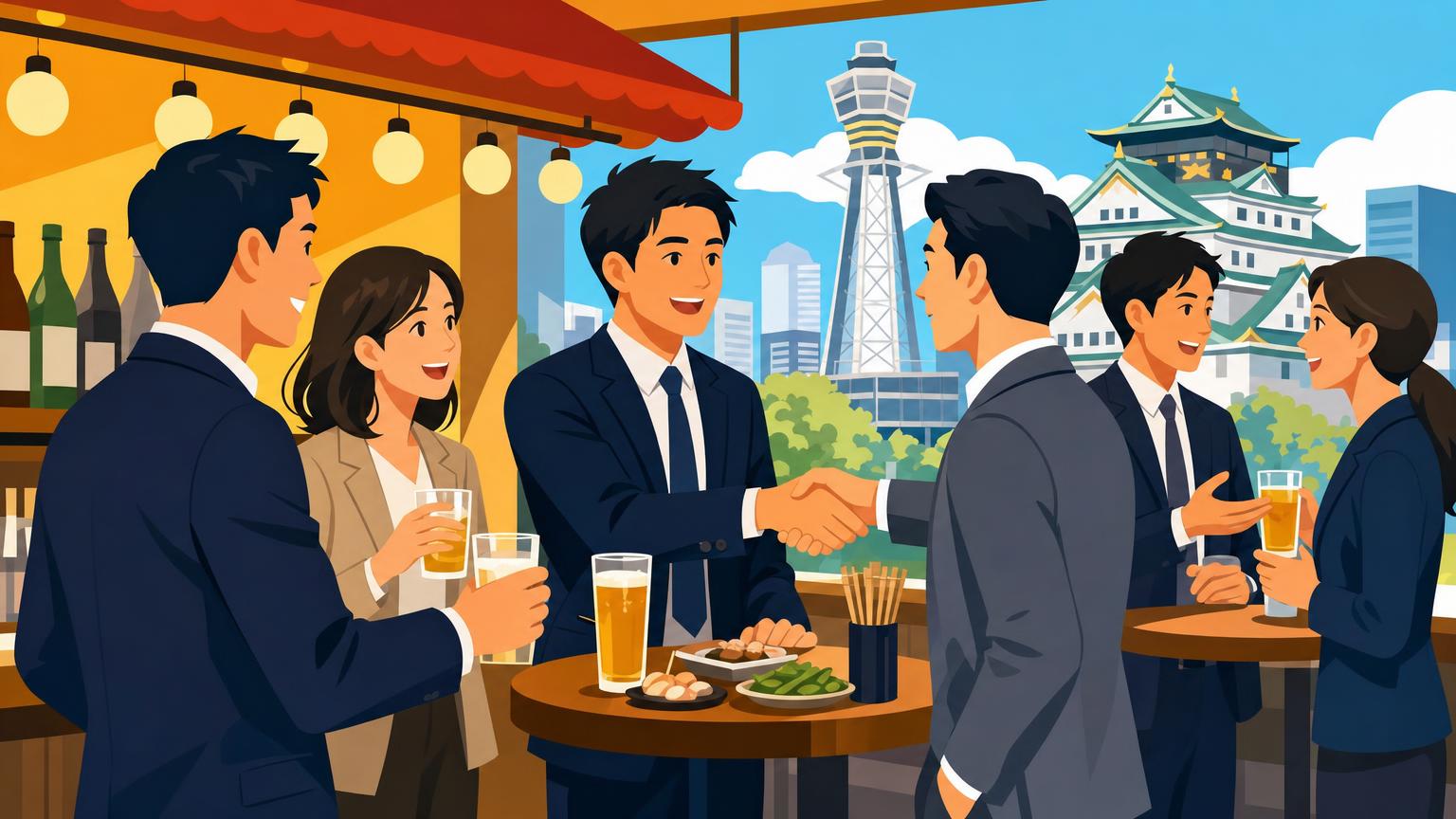
You step out of the corporate office. The sun dips below the concrete skyline of Umeda. The neon signs flicker to life, casting red and blue shadows across the bustling pavement. You are a professional living in Osaka. You want to build your network. You want to connect with local entrepreneurs, creative freelancers, and industry veterans. If you bring your standard Western business sensibilities to this Kansai metropolis, you might start searching for a quiet, high-end hotel lounge. You might look for a ticketed corporate networking event in a sterile, heavily air-conditioned convention room. You might print out a thick stack of pristine business cards, practice your firm handshake, and prepare a highly polished elevator pitch. But if you do that, you are entirely missing the heartbeat of the city. You are completely overlooking the true professional underbelly of Osaka.
In this sprawling, energetic city, the most valuable networking does not happen on professional social media platforms. It does not happen in quiet boardrooms lined with heavy leather chairs. It happens on your feet. It happens in the narrow, smoke-draped, fiercely loud alleys located beneath the elevated train tracks. It happens in the Tachinomi. The standing bar. I spend the vast majority of my time away from this urban neon glow. As an outdoor specialist in my early twenties, my true passion lies on the rugged dirt trails of Mount Rokko or the dense, forested ridges of the Kongo Range. I hike. I navigate. I read the shifting weather patterns and the steep terrain. But when I come down from the mountains and enter the concrete valleys of Osaka, I apply those exact same outdoor survival skills to the local nightlife. Navigating a crowded standing bar requires an intense level of spatial awareness. You have to read the social environment. You have to understand the natural, chaotic flow of the local ecosystem.
Foreigners who move to Japan to do business often bring deeply ingrained expectations of formal, rigid Japanese corporate culture. They anticipate sit-down dinners with strict seating arrangements. They expect to interact in highly structured environments where everyone guards their true opinions. When they realize that authentic Osaka networking happens in a tiny, grease-stained standing bar where personal space does not exist, they are usually shocked. But the standing bars of Osaka are an ecosystem of their own. They are the great social equalizers of the Kansai region. They are the unique places where the rigid walls of traditional Japanese corporate hierarchy melt away into the steam of simmering beef stews and the rhythmic clinking of cheap, heavy glass beer mugs.
Why Tachinomi is Osaka’s Ultimate Secret Networking Hub
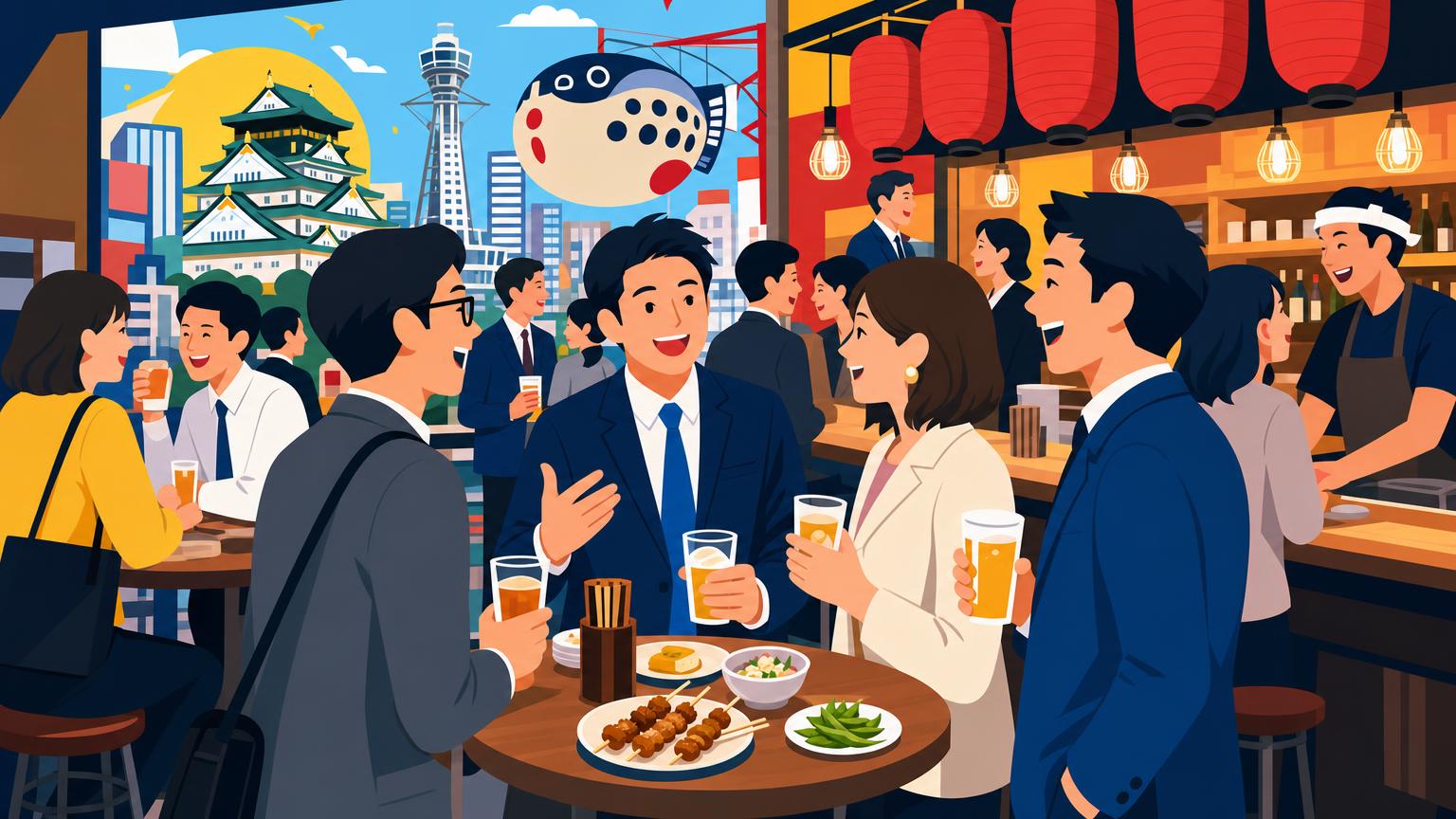
To fully integrate into the professional fabric of this city, you must first grasp the underlying psychology of the standing bar. It is more than just a place to drink alcohol cheaply; it is a highly developed social structure specifically designed for rapid, informal human connection.
The Democratic Nature of Standing Bars
The democratic nature of standing bars represents a significant urban phenomenon. The design of a Tachinomi is intentionally minimalistic. Removing the chairs eliminates the physical anchor, allowing people to become completely fluid. In a traditional sit-down restaurant, you are physically confined to your assigned table, typically interacting only with those directly across from you, with your social interactions limited by the wooden legs of your chair. However, in a standing bar, movement is essential. You shift your weight, step aside to let a waiter pass, or lean against the counter. This continuous, fluid motion fosters an environment where bumping elbows with strangers is not only expected but is the fundamental spark for conversation.
When a local business owner stands at the counter, he sheds his corporate armor. Without a leather chair or an imposing mahogany desk symbolizing his authority, he becomes just another person holding a cold glass of beer. The physical equality of standing side-by-side completely removes the intimidating professional barriers that typically prevent junior employees or foreign newcomers from approaching seasoned executives. You don’t need to schedule a meeting to speak with the person next to you; you simply turn your head, make a casual comment about the baseball game playing on the small corner television, and the networking process naturally begins.
Osaka vs. Tokyo: The Culture of Talking to Strangers
To understand why the standing bar is so essential to professional life in Osaka, you must contrast it with Tokyo’s corporate culture. Tokyo’s corporate structure is a towering, impenetrable monolith rooted in centuries of samurai tradition, where rank is absolute, order is strictly maintained, and emotional restraint is valued. When Tokyo professionals attend a Nomikai, an after-work drinking party, the strict hierarchy carries over into the bar. Junior staff sit nervously near the door while senior executives occupy seats of honor far from the entrance. Junior employees spend the evening pouring drinks, nodding respectfully, and ensuring the boss is constantly entertained. Networking in Tokyo resembles a strategic, calculated game of chess—you don’t simply approach a stranger in a Tokyo bar to pitch a collaborative idea. You would be met with cold stares and regarded as a disruptive, uncultured anomaly.
Osaka operates on a completely different wavelength. As the nation’s historic kitchen, Osaka is a loud, vibrant city built by merchants, independent traders, and hustlers. In a merchant city, rigid social hierarchies are seen as frustrating obstacles to profit. Merchants need to communicate quickly, assess potential partners instantly, and determine if they are trustworthy, quick-witted, and genuinely enjoyable company. This historical merchant spirit is deeply ingrained in the modern Tachinomi. When an Osaka professional stands at a bar, they don’t care about the font on your business card; they care about your character. They want to know what makes you laugh, your true opinions about the world, and whether you have the social stamina to keep up with the fast-paced Kansai banter.
Unspoken Rules for Socializing at a Standing Bar
While the Tachinomi is delightfully chaotic, it is not entirely without rules. Navigating this environment requires a nuanced understanding of unspoken Japanese social etiquette. Just as I must honor the unwritten guidelines of the mountain trail to ensure a safe hike, you must respect the unspoken rules of the standing bar to guarantee a successful evening of networking.
Reading the Room and Finding Your Space
First, you need to master the concept of reading the room. In Japanese culture, this is referred to as Kuuki wo Yomu, which literally means reading the air. In a Tachinomi, the air is extraordinarily dense. It is heavy with the aroma of fried pork skewers, spilled draft beer, and cheap tobacco smoke. But it is also dense with subtle social signals. Since there are no chairs and the floor space is entirely flexible, you don’t simply walk in and claim a large territory for yourself assertively. You must carefully edge your way in. You survey the counter. You find a tiny, seemingly impossible sliver of empty space. You offer a slight, apologetic nod to the men and women standing closely packed on either side. You don’t demand physical space; you politely negotiate it.
You also need to master the physical art of the Osaka pivot. As the night wears on, the bar will exceed its architectural capacity many times over. People will constantly brush past your back to reach the tiny restroom in the rear. The bartender will weave through the tight crowd carrying towering, precarious stacks of empty glasses. You cannot remain perfectly rigid like a stone statue. You must maintain a loose, athletic stance. When someone needs to pass, you instinctively pivot your shoulders. You pull your elbows tightly toward your ribs. You perform a smooth, synchronized physical dance of accommodation with the strangers around you. When you inevitably bump shoulders with a local, you don’t scowl. You turn, make immediate eye contact, smile warmly, and offer a quick apology. In a Tachinomi, that accidental physical contact often sparks a thirty-minute, deeply meaningful conversation about your career and your life in Japan.
The Art of Sharing Food as an Ice Breaker
Once you have claimed your physical space, you must grasp the culinary dynamics of the bar. The art of sharing food is the ultimate ice breaker in Osaka. To understand this, you need to know the concept of Senbero. The word Senbero is a cultural portmanteau. It combines the Japanese word sen, meaning one thousand, and bero-bero, meaning wildly drunk. In a genuine working-class Tachinomi, you can reach a state of complete satisfaction, both in terms of alcohol and food, for roughly one thousand yen. This extreme affordability transforms the social dynamics of the room completely.
In an upscale, high-end establishment, you naturally protect your financial resources and focus solely on your private group. But in a Senbero standing bar, generosity flows freely and continually. Because the financial barrier to entry is so incredibly low, the cost of buying a round of drinks for a complete stranger becomes negligible. If you strike up a conversation with the tired salaryman standing to your left, you can easily offer to buy his next glass of shochu without damaging your weekly budget. You can point to the grease-stained paper menu plastered on the wall, order a fresh plate of crispy, deep-fried meat skewers known as Kushikatsu, and physically push the small ceramic plate toward your new friend. This simple, physical gesture of sharing food breaks down all remaining cultural and linguistic barriers. It is the universal, unspoken language of Osaka hospitality.
Best Neighborhoods in Osaka for Organic Connections
Osaka is a vast, intricate concrete jungle. Not every neighborhood provides the same networking atmosphere. Depending on your industry and personal social stamina, you need to choose your starting point with great care.
Tenma: The Bustling and Chaotic Social Labyrinth
Tenma is more than just a residential area. It is an expansive, vibrantly chaotic social labyrinth. A dense network of narrow, twisting alleys, glowing red paper lanterns, and overlapping, lively conversations. Stepping out of Japan Railways Tenma Station, you are instantly immersed in a powerful sensory flood. Tenma’s physical design is deliberately crafted to foster organic human connections. The alleyways are so narrow that the standing bars practically spill into the street.
There are no heavy wooden doors separating patrons from the outside world. Instead, flimsy plastic curtains sway in the evening breeze. The line between public street and private bar is completely blurred. You can stroll slowly down a lantern-lit alley, peer directly into a bright Tachinomi, and make eye contact with a local business owner before entering. Tenma draws a remarkably diverse crowd, where older local merchants mingle easily with energetic university students. For a fast-paced, high-energy introduction to Osaka networking, Tenma should be your first stop.
Kyobashi: The Genuine Salaryman Networking Hub
If Tenma is a lively, inviting social maze, Kyobashi is the real, battle-tested networking ground. Kyobashi is raw and unapologetically gritty, the historic, undisputed domain of the Japanese corporate salaryman. The men and women drinking beneath the Kyobashi train tracks have endured ten intense hours battling through spreadsheets, endless meetings, and demanding clients. Once they exit the Keihan rail line and enter Kyobashi’s alleys, their corporate armor drops entirely.
Neckties are dramatically loosened. Tailored suit jackets are casually tossed over battered, upside-down plastic beer crates used as impromptu tables. This is the place to network with Osaka’s true, unfiltered, resilient workforce. Conversations here focus less on creative startups and more on raw business endurance, market realities, and the relentless daily grind of commerce. Forming bonds in a Kyobashi Tachinomi proves to locals you have what it takes to thrive in the traditional Japanese business world.
Fukushima: Trendy Venues for Digital Nomads and Creatives
Fukushima has a completely different vibe. Just one train stop from the towering skyscrapers of Umeda’s business district, Fukushima has rapidly changed. What was once a quiet, old industrial area has become a vibrant, trendy hotspot for digital nomads, independent creatives, and young tech entrepreneurs. The Tachinomi culture here stays true to the standing tradition but with a distinct aesthetic twist.
The standing bars in Fukushima are noticeably cleaner, with sharper, more intentional ambient lighting. Menus might include organic natural wines or locally crafted gins alongside the classic whiskey highballs. Yet the core social philosophy remains unchanged. The absence of chairs still compels physical interaction. If you’re a foreign resident working in software engineering, graphic design, or freelance media consulting, Fukushima’s winding streets are your prime professional playground. You’ll easily spot young tech founders leaning against sleek wooden counters, animatedly debating startup funding and digital marketing over plates of artisanal potato salad and smoked fish.
Top Sociable Tachinomi Bars to Expand Your Network
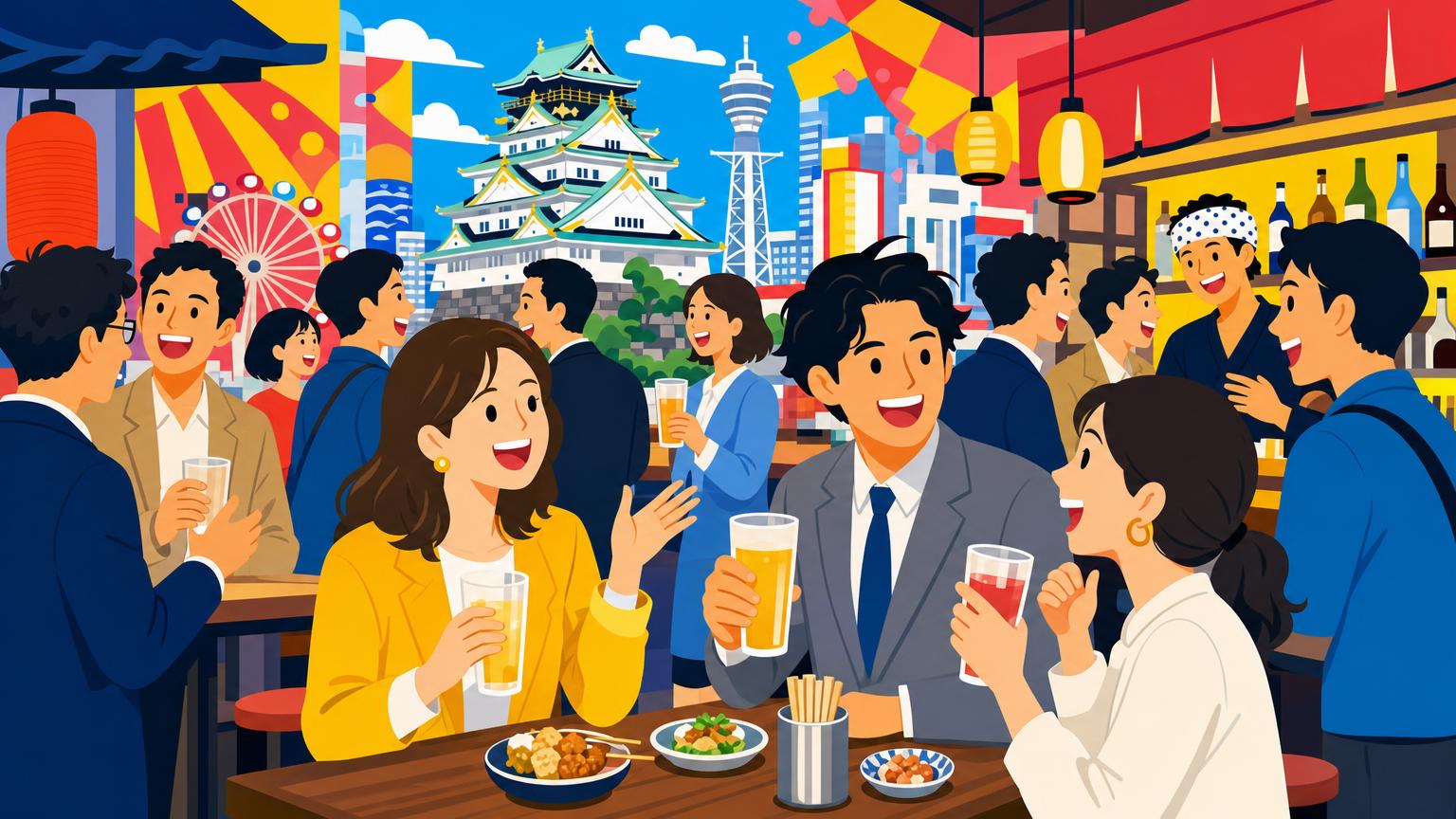
Knowing the right neighborhood is only half the challenge. You also need to know which exact doors to step through. Certain bars serve as natural social accelerators, actively encouraging patrons to engage with one another.
Izakaya Toyo (Kyobashi)
It’s impossible to discuss the Osaka standing bar scene without immediately showing immense respect to Izakaya Toyo in Kyobashi. This place is more than just a bar. It’s a raw, highly theatrical display of culinary artistry and social mastery. The eccentric owner operates entirely outdoors, right beside a quiet local cemetery, standing confidently behind a simple aluminum table. He takes massive, thick slabs of raw tuna cheek and sears them with a roaring, industrial-grade blowtorch.
He does so with his bare hands. Bright orange flames shoot dramatically into the dark night sky. The intense heat washes over the tightly packed crowd. This bold, unapologetically dangerous spectacle acts as the ultimate social catalyst for the patrons. You find yourself squeezed next to complete strangers, watching an older man taming fire with joy. You have no choice but to turn to the person beside you, widen your eyes, and share your amazement. That spontaneous moment of shared awe is your golden entry point. That’s exactly how the network begins.
Stand Sono Da (Tanimachi)
In the quieter, historically rich Tanimachi neighborhood, you will discover Stand Sono Da. This wildly popular spot embodies a perfect fusion of Showa-era working-class nostalgia and vibrant modern creative energy. The atmosphere mirrors the gritty visuals of a mid-century Japanese diner but pulses with the electric vibe of a contemporary cultural hub. The signature drink here is the Vice sour, a vivid, shockingly pink cocktail that looks like liquid neon in a glass.
The crowd at Stand Sono Da is distinct. It leans younger and artistically inclined. You’ll find yourself standing shoulder-to-shoulder with independent fashion designers, local magazine editors, and foreign residents who have successfully integrated into the Kansai arts scene. The background music is always carefully chosen—loud enough to create energy but soft enough to allow deep, ongoing conversation. To tap into the creative heart of modern Osaka, you stand at Sono Da’s counter.
Ginza-ya (Osaka Station Area)
For an unfiltered lesson in physical proximity and budget networking, you must venture into the sprawling underground depths of the Osaka Station area to find Ginza-ya. This space is unapologetically cheap, loudly chaotic, and fiercely loved by the local working class. It’s buried deep within the maze-like basement levels, completely hidden from the pristine, high-end luxury malls towering directly above.
Ginza-ya’s interior is astonishingly cramped. The iconic red star labels of large Sapporo beer bottles cover nearly every available flat surface. Due to the tight quarters, your personal cultural bubble shatters the moment you step through the sliding doorway. High-ranking corporate executives stand elbow-to-elbow with exhausted construction workers in muddy boots. Foreign English teachers mingle comfortably with seasoned, gray-haired stockbrokers. The shared pursuit of cheap beer and delicious potato salad naturally dissolves every social hierarchy in the room.
Essential Japanese Phrases to Spark a Conversation
You need the right linguistic tools in your survival kit. Just as I carefully pack specific carabiners and ropes for a challenging winter hike, you need particular conversational phrases for a Tachinomi outing. You can’t rely on stiff, formal, textbook Japanese. Speaking like a recorded language tape makes you sound like a distant corporate robot. Instead, you must speak the language of the merchants—you need Kansai dialect. You need phrases that quickly break down defensive walls and warmly invite humor and connection.
Start with a simple observation. When you see the person next to you drinking something brightly colored or visually interesting, lean in slightly, casually point at their thick glass, and say, Nani nonde-man-nen. This roughly means, what on earth are you drinking? The rhythmic cadence of this Kansai phrase is naturally funny. It instantly shows that you’ve taken the time to learn the local street language, signaling that you don’t take yourself too seriously and that you respect the regional culture.
When they inevitably ask about your life or how your business is going in Japan, respond with sincere humility. Avoid bragging about major corporate successes. Instead, use the ultimate classic Kansai merchant reply. Smile slightly, nod your head, and say, Bochi bochi denna. This means, I’m getting by or things are going so-so. It’s a deeply humble phrase that strongly suggests you’re working hard and enduring the daily grind, just like they are. It instantly creates a solid bridge of mutual respect. Finally, when it’s time to leave the bar, never just walk away silently into the night. Turn back to your new acquaintances, raise your hand in a casual salute, and say, Ookini. This traditional, deeply historic Osaka word for thank you carries much more emotional warmth and local affection than a standard polite arigatou. It leaves a lasting positive impression, ensuring you’ll be warmly welcomed back next time.
Step Out of Your Comfort Zone and Say Kanpai
When leading a group of novice hikers up the incredibly steep, punishing slopes of Mount Kongo in the depths of winter, the most physically demanding moments always prove to be the most socially rewarding. The extreme physical effort naturally compels the group to bond. The intense shared struggle fosters a deep, unbreakable sense of camaraderie. Standing in a crowded, smoky, and intensely loud Tachinomi for four continuous hours demands its own unique kind of physical and mental stamina.
Your legs will eventually tire. Your lower back may start to ache from leaning awkwardly against a tiny wooden ledge. Your expensive business attire will inevitably carry the heavy scents of rich charcoal smoke, fried pork fat, and spilled beer. But this deep physical commitment is the essential price of entry to the most authentic, powerful professional network in all of Japan. It shows the locals that you are completely willing to get your hands dirty. It proves you’re not just a passing, superficial tourist or a detached, elite corporate drone. It demonstrates that you are fully prepared to engage with the real, unvarnished, beating heart of the city.
Networking the Osaka way demands considerable courage. It calls for a genuine willingness to relinquish your preconceived, Western ideas of formal professional behavior. It pushes you to step boldly off the polished, brightly lit corporate pathways and forge your own path through the smoky, noisy, and incredibly vibrant urban wilderness of the standing bar. But if you have the endurance to stay on your feet, the humility to share a cramped, sticky counter, and the humor to warmly embrace the surrounding chaos, you will discover a professional network unlike any other in the world. You will not merely exchange glossy business cards with nervousness. You will eagerly exchange real stories. You will build genuine, lasting trust. Step fully out of your safe comfort zone. Spot a glowing red paper lantern swaying in the breeze. Push aside the heavy hanging fabric curtains. Order a towering, ice-cold draft beer. Turn confidently to the stranger beside you, raise your glass high, and say Kanpai.