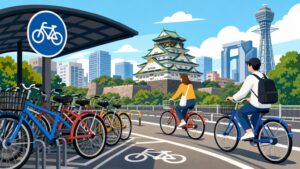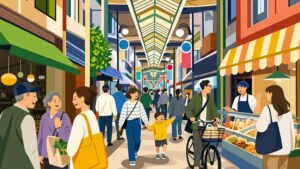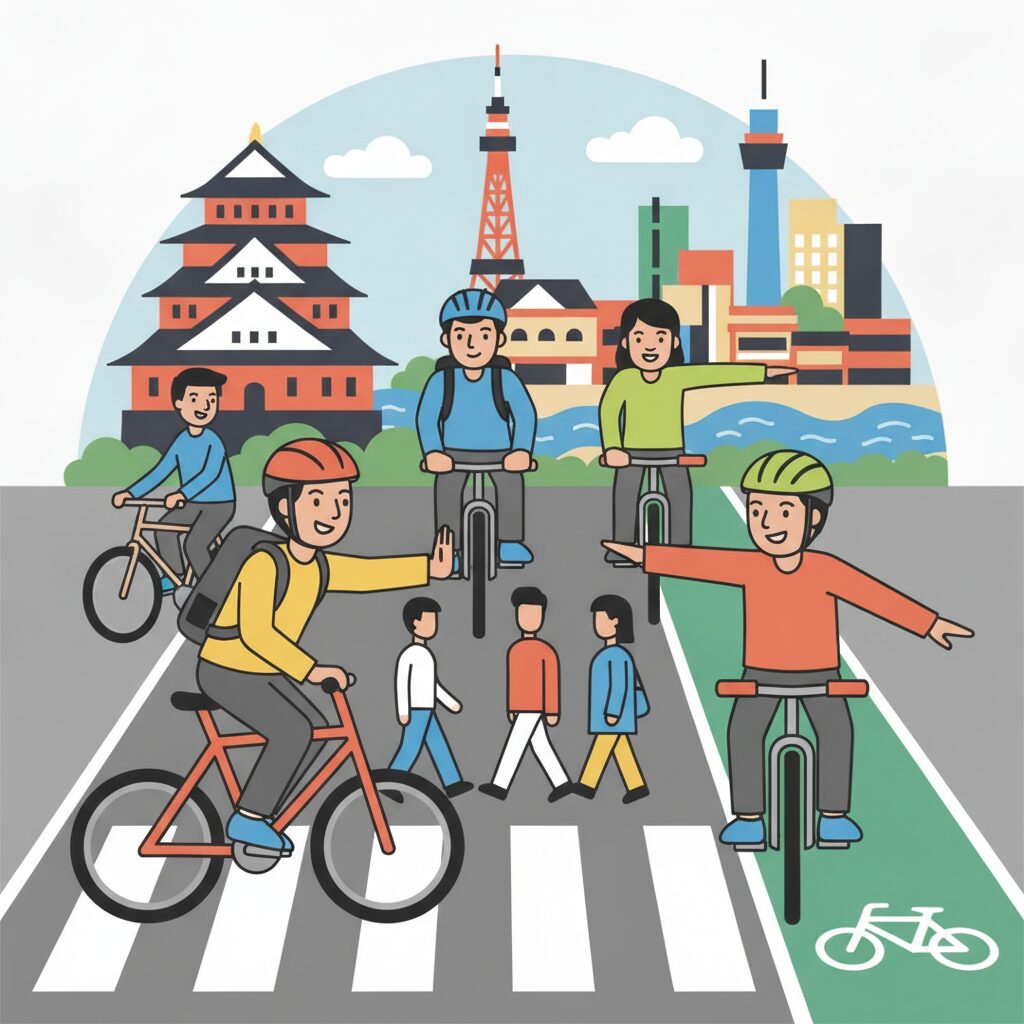
So, you’ve seen it. You’re standing in Shinsaibashi or navigating the backstreets of Tenma, and a cyclist glides past. They’re steering with one hand, holding a dripping umbrella in the other, a basket full of groceries rattling up front, all while weaving through a sea of pedestrians like a fish swimming upstream. They ring a sharp, insistent bell—chirin-chirin!—not as a request, but as a statement of fact: “I am coming through.” You might have thought, “Is that even legal? Is that safe? Is this just… normal?” Welcome to Osaka. The answer to all three questions is a complicated, shrug-of-the-shoulders “yes.” Cycling here isn’t just a mode of transport; it’s a cultural phenomenon, a masterclass in organized chaos that tells you more about the soul of this city than any guidebook ever could. Forget the pristine, orderly lines you might imagine when you think of Japan. This isn’t Tokyo, where rules are often followed with quiet precision. This is Osaka, a city built on pragmatism, efficiency, and a healthy disregard for any rule that gets in the way of getting things done. To understand how to navigate these streets on two wheels is to understand the city’s heartbeat. It’s a rhythm of calculated risks, unspoken agreements, and a shared understanding that the most important rule is to simply keep moving. This guide is your key to decoding that rhythm, to moving beyond the tourist pamphlets and into the real, rolling, wonderfully chaotic world of daily life in Osaka.
For a deeper exploration of how Osaka’s raw humor and vibrant soul shape its chaotic charm, consider delving into Osaka’s direct cultural code.
The “Mamachari” Mindset: Utility Over Sport
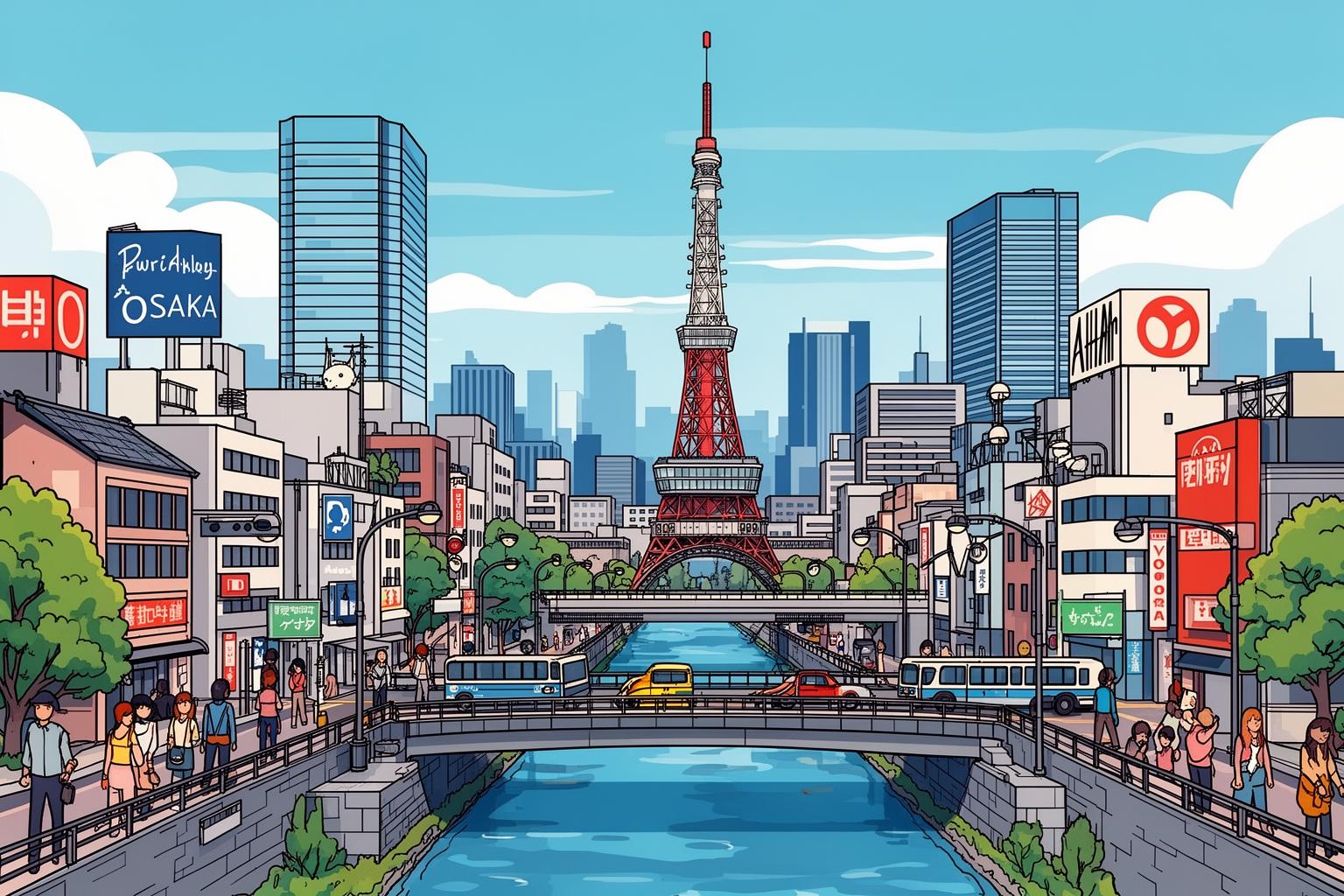
Before understanding the rules, you first need to understand the vehicle. In Osaka, the bicycle isn’t the sleek, carbon-fiber racing machine seen in the Tour de France. It’s neither a fashion statement nor a fitness tool. It is, overwhelmingly, the mamachari. Literally meaning “mom’s chariot,” this is the city’s workhorse. Imagine a heavy, single-speed bike with a low, step-through frame, a wide, comfortable seat, a built-in lock, a dynamo light that hums as you pedal, and, most importantly, a large basket on the front. It often comes equipped with a child seat on the back, a kickstand sturdy enough to support its full weight, and a bell that has seen better days. The mamachari is the urban equivalent of a pickup truck, designed for one purpose: utility. It’s used to haul groceries from the local shotengai shopping arcade, drop kids off at daycare, make a quick run to the post office, or reach the nearest train station without breaking a sweat. This fundamentally shapes the mindset of the Osaka cyclist. The goal isn’t speed; it’s efficiency. The attitude isn’t athletic; it’s logistical. That’s why you see people riding in suits, dresses, and sandals. The bike is an extension of their daily errands, a tool to navigate the dense urban landscape. In Tokyo, while mamacharis exist, a greater sense of separation prevails. People might choose a nicer, lighter bike for their commute, and with the train system being so comprehensively dominant, it often feels like the default choice even for short trips. In Osaka, the flat terrain and compact city layout make the mamachari the undisputed king of short-distance travel. The city’s entire rhythm seems calibrated to its steady, pragmatic pace. This explains the seemingly reckless behavior: it’s not driven by a desire for thrills but by a deep-rooted, practical need to save two minutes on a trip to the supermarket.
Sidewalks, Streets, and the Gray Zone
Here it is—the million-yen question for every newcomer: where exactly are you supposed to ride your bike? The answer is the first and most vital lesson in Osaka’s unwritten rulebook. The law is more of a suggestion; the reality is a fluid dance of context and consensus. This gray area is where the true nature of the city’s cyclists comes to light.
The Sidewalk is the Default… Usually
Technically, Japanese law classifies bicycles as vehicles that belong on the road, except where sidewalks are specifically marked with a bicycle sign. But take that as “interesting trivia,” because it barely impacts your everyday life in Osaka. In reality, most mamachari riders use the sidewalk as their main route. On major streets like Midosuji or Sakaisuji, where cars race by at high speeds, riding in the road is viewed as impractical—and frankly, a bit suicidal. So, the sidewalk becomes the default. This turns pedestrian walkways into complex shared spaces. Pedestrians officially have the right of way, but it’s not a one-sided relationship. Pedestrians are expected to stay aware and avoid sudden, unpredictable moves. Cyclists, in turn, navigate around them with reasonable care. What forms is a subtle, unspoken choreography. You’ll see cyclists weaving smoothly, anticipating when a cluster of high schoolers will part, slowing gently behind an elderly woman, then speeding through an open gap. It’s a system based on mutual, if sometimes grudging, awareness. You don’t stop; you flow. This is a sharp contrast to many Western cities where sidewalk cycling is a major taboo, or even to Tokyo, where sidewalk cycling often feels more timid and apologetic.
The Art of the Bell Ring
The bicycle bell is the main communication tool in this sidewalk ecosystem. But its use here is culturally distinct. A soft chirin from afar is a polite heads-up, a way of saying, “Just so you know, I’m coming from behind.” It’s a subtle request for a sliver of space. But a rapid, sharp chirin-chirin-chirin! isn’t a request; it’s a demand. It’s directed at someone engrossed in their phone, oblivious to their surroundings, blocking the path. It means: “I’m here. I’m moving at a steady pace. I’m not stopping. Please move.” Though it may seem aggressive to outsiders, locally it’s clear, efficient communication. It’s less about anger and more about maintaining momentum—the ultimate goal of Osaka’s cyclists. Silence isn’t golden; it’s inefficient. You assert your presence not out of malice, but from a shared understanding that everyone’s trying to get somewhere, and clear signals help the whole system run smoothly.
When to Hit the Road
Do cyclists ever use the road? Absolutely. Like everything else, the choice is pragmatic. Cyclists move onto the road in certain situations. On narrow backstreets where the sidewalk barely fits one person, the road is the only option. In quiet residential neighborhoods, where car traffic is slow and sparse, the road is often smoother and faster. And if a cyclist is on a sportier bike aiming to build speed, they’ll use the road to avoid the pedestrian slalom on the sidewalk. But this comes with risks. Bike lanes are still rare in much of the city, and drivers aren’t always generous with space. Drivers expect cyclists on the sidewalk, so a bike suddenly in their lane can be a surprise. It’s a calculated trade-off: you give up the pedestrian obstacle course for the higher stakes of vehicle traffic.
The Unwritten Laws of Motion and Parking
Once you’ve determined where to ride, the next step is to learn how to ride like an Osakan. This means mastering the physics of continuous motion and realizing that designated spaces often serve merely as starting points for negotiation. It’s a world of gentle stops, flexible one-way rules, and inventive parking solutions.
The “Osaka Slide”: Intersections and Crossings
Watch a cyclist approaching a red light at a pedestrian crossing. A strict law-abider would come to a full stop and wait for the light to change. An Osaka cyclist, on the other hand, will often execute what I call the “Osaka Slide.” They slow, gauge the cross-traffic flow, and if there’s an opening, they glide through the crossing without ever putting a foot down. They might weave behind the last car or cut the corner early. This isn’t viewed as reckless jaywalking; rather, it’s seen as smart use of a brief pause in traffic. The philosophy is that the light is meant for cars. For a bicycle, which is smaller and more agile, the real rule is “don’t get hit and don’t hit anyone.” This results-driven mindset is quintessentially Osaka. Why wait 30 seconds if there’s a safe path? The aim is to keep momentum going. Stopping means losing efficiency. Of course, police occasionally issue tickets for this, especially during safety campaigns, but on a daily basis, the slide is an essential part of the city’s traffic rhythm.
Riding Against Traffic: The One-Way Street Anomaly
In Osaka, one-way streets are often more of a one-way suggestion for cyclists. It’s quite common to see people calmly pedaling against traffic. They stay close to the edge of the road, yielding to cars, but see no reason to take a long, indirect route when their destination is just a short distance ahead. Again, the logic is practical. The sign is intended for cars, which are wide and fast. A bicycle is narrow and slow. As long as you’re cautious and yield to oncoming vehicles, you’re not causing an issue. This behavior can be surprising for foreigners used to strict traffic laws, but it perfectly illustrates how Osakans bend formal rules to suit everyday needs. The system works due to an unspoken mutual understanding: cyclists won’t be a nuisance, and drivers won’t react with anger. It’s a delicate, functional anarchy.
The Parking Predicament: Anywhere and Everywhere
Finding a spot to park your bike is the ultimate challenge of cycling in Osaka. In theory, cyclists should use designated bicycle parking lots, often located near train stations and major commercial areas. In practice, these lots frequently fill up, are sometimes inconveniently placed, or require a small fee. The result is an extravagant proliferation of impromptu bicycle parking. Bikes line up against storefronts, lock to guardrails, and cluster in dense groups on sidewalks near stations. This creates a constantly shifting maze of metal and rubber for pedestrians to navigate. It’s an ongoing struggle between public convenience and the city’s efforts to maintain order. This is where the real risk emerges: the impound truck. In busy areas, especially around hubs like Umeda, Namba, or Tennoji, the city regularly carries out sweeps, removing illegally parked bicycles. A small warning sticker might be the only sign. If your bike disappears, you’ll face the dreaded trip to the municipal impound lot, often in a remote, inconvenient part of town. You’ll pay a fine, fill out paperwork, and reclaim your bike, having learned a hard lesson. Nearly every long-term resident has an impound story; it’s a rite of passage.
The Gear and the Attitude: What Everyone Else is Doing
Beyond the bike itself, a few essential accessories and behaviors complete the image of the Osaka cyclist. These small details, when combined, reveal the city’s priorities: convenience, multitasking, and a strong belief that a little rain shouldn’t spoil your day.
The Umbrella Technique: A Masterclass in Balance
It’s a rainy day. In most cities, this means fewer cyclists. In Osaka, however, it brings out a remarkable local skill: the one-handed umbrella ride. Businesspeople, students, and grandparents alike glide through the drizzle, one hand on the handlebar, the other holding a full-sized umbrella high. It’s an impressive display of balance and ease. This practice, called kasa-sashi unten, is technically illegal and undeniably risky. It impairs steering, braking, and signaling ability. Yet, it is incredibly common. Why? Because a poncho is inconvenient—hot, cumbersome, and something you have to carry around. An umbrella is simpler. This preference for an easy, if somewhat dangerous, solution is distinctly Osaka. It reflects a can-do spirit and a high tolerance for minor risk in pursuit of comfort and convenience.
The Smartphone Scroll
Another illegal but all-too-familiar sight is cyclists riding while focused on their smartphones. Sometimes the phone is held in one hand; other times it’s mounted on the handlebars. People are texting, checking maps, or scrolling through social media while moving. This isn’t unique to Osaka, but the dense mix of cyclists and pedestrians makes it especially hazardous here. It highlights a modern culture of hyper-connectivity and multitasking, where even a brief bike ride is a chance to stay digitally engaged. It serves as a reminder that while unspoken road rules matter, they depend on mutual awareness—a foundation quickly weakened by digital distraction.
A Note on Helmets
In recent years, a law was revised to make wearing a helmet a doryoku gimu, or “effort-based obligation,” for all cyclists. This is a typically Japanese legal concept meaning “you should really try to do it, but there’s no penalty if you don’t.” The result? Almost no adults on mamacharis wear helmets. They’re seen mainly on children, serious road cyclists with expensive gear, and Uber Eats delivery riders. For the average person running errands, a helmet is viewed as an unnecessary hassle. It messes up your hair, adds something else to carry, and feels excessive for a slow ride. This cultural resistance underscores the gap between official safety regulations and the everyday reality of utility cycling. The mamachari is part of an outfit and routine, and a helmet simply doesn’t fit the aesthetic or practical needs of daily life.
Why It Works (and When It Doesn’t)
Observing this mix of bent rules and risky behaviors, you might wonder how the city avoids descending into complete gridlock and constant accidents. The secret is that this seeming chaos is actually a highly effective, self-regulating system. It functions because it isn’t truly random; it is guided by a deep, shared intuition. Osakans grow up immersed in this environment. They learn to interpret subtle body language cues, anticipate other cyclists’ paths, and gauge the speed of approaching pedestrians. It’s a skill refined over a lifetime of navigating crowded spaces. The system depends on everyone’s participation. The low average speed of the mamachari also provides an essential safety buffer, keeping most interactions low-risk. This is the city’s renowned ability to read the kuuki, or “read the air,” applied to traffic. You don’t merely follow the traffic light; you sense the atmosphere of the intersection. You detect the hesitation of the pedestrian ahead. The system falters when someone stops engaging in this social contract. Often, this is a foreigner who suddenly stops in the middle of the sidewalk, used to pedestrians having absolute, unyielding right of way. Or it’s the person so absorbed in their smartphone that they break the chain of mutual awareness. When accidents occur, it’s usually not because the system is flawed, but because an individual has ceased to follow its unwritten rules.
Your Survival Guide: How to Adapt
So, how do you navigate this ecosystem without becoming a hazard or a victim? It’s about striking a balance between respecting local customs and ensuring your personal safety. You don’t need to ride with an umbrella during a typhoon, but you do need to understand the flow.
Be Predictable, But Expect the Unpredictable
Your main objective should be to make your actions easy for others to anticipate. Ride in a fairly straight line. Avoid sudden stops or sharp turns. At the same time, assume that others won’t be predictable. Expect a door to open, a child to dart into your path, or a cyclist to emerge from a blind alley. Ride defensively. Use your bell as a communication tool, not as a weapon. A quick, friendly ring is usually enough. Make eye contact with pedestrians and drivers at intersections; it’s the most effective way to ensure they’ve seen you.
Choose Your Path Wisely
When you’re just starting out, there’s no need to dive into the busiest areas. Stick to wider sidewalks or find routes through quieter backstreets. Get a sense of the rhythm before tackling the main roads during rush hour. Also, take parking seriously. Spend a few minutes locating official paid bicycle parking near your local station. The hundred yen you spend will spare you the big headache and the three thousand yen fine of retrieving your bike from the impound lot. Think of it as an inexpensive insurance policy.
Embrace the Flow
The most important thing is to adjust your mindset. You have to let go of the rigid, rule-based traffic systems common in many other countries and learn to move with the fluid, intuitive dynamics of Osaka. It’s less about strict right and wrong, and more about what is safe, efficient, and considerate in the moment. Stay alert, be courteous but assertive, and keep moving. Mastering cycling in Osaka is more than just learning how to get from point A to point B. It’s a crash course in the city’s true character: a bit rebellious, fiercely practical, surprisingly efficient, and all woven together by an invisible network of unspoken social rules. Once you catch that rhythm, you’re no longer just a visitor; you become part of the flow.