Another Tuesday, another blur of Slack notifications and video calls. Your apartment, once a sanctuary, now feels like a softly lit office you can never leave. You’re plugged into the global grid, connected to colleagues thousands of miles away, but the person you see most often is the overworked Uber Eats driver dropping off your dinner. You moved to Osaka, this city legendary for its boisterous, in-your-face friendliness, yet you feel a strange sense of isolation. You hear the laughter from izakayas as you walk home, you see the crowds in Shinsaibashi, but you’re on the outside looking in. Where is that famous Osaka connection everyone talks about? How do you break through the screen and find a real, tangible community in this sprawling metropolis?
This is the modern paradox of city living, amplified for any foreigner trying to plant roots. We’ve built digital bridges across oceans but have let the footpaths to our neighbors crumble. The question isn’t just how to survive in Osaka; it’s how to thrive. How to find your people. The answer, surprisingly, isn’t in a language exchange cafe or a networking event. It’s behind a steamy, unassuming curtain, a noren, hanging in your local neighborhood. It’s in the sentō, the public bathhouse. Forget everything you think you know about sentō as a quaint tourist attraction or a relic of a bygone era. Here in Osaka, the sentō is not dead. It’s the city’s buzzing, analog social network, its communal living room, and the most effective digital detox you’ll ever experience. It’s where you’ll understand the soul of this city, one scalding hot bath at a time.
Discover how embracing Osaka’s tameshi-ni spirit can further connect you to the authentic pulse of the city beyond the sentō experience.
More Than Just a Bath: The Sentō as Osaka’s Living Room
In Tokyo, where I’m from, the sentō often feels like a quiet sanctuary. It’s a place for peaceful reflection, a personal ritual. You enter, you bathe, you leave. The interactions are minimal, polite, and transactional—simply a service. But in Osaka, it’s a completely different experience. The moment you slide open the door, you’re not merely a customer; you’re stepping onto a stage. The sentō there is a theater of everyday life—loud and unapologetic. It serves as the city’s great equalizer, where the unspoken rule is to leave your ego, your job title, and your smartphone in the locker.
The Unspoken Social Contract
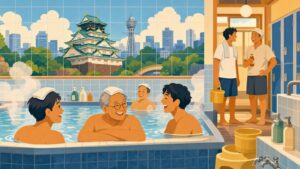
There’s a concept in Japan called hadaka no tsukiai, meaning “naked communication.” The idea is that by shedding clothes, you also shed the social hierarchies and pretenses that shape life outside. In Osaka, this isn’t just philosophical; it’s a loud, steaming, everyday reality. You’ll see a construction worker and a small business owner soaking side-by-side, passionately debating the Hanshin Tigers’ latest game. Nearby, a group of obachan (middle-aged and older women) trade neighborhood gossip at the speed and intensity of stock traders. Their voices bounce off the tiled walls, creating a symphony of Osaka-ben that’s both confusing and welcoming.
What a foreigner might mistake for noisy chaos is actually the sound of a vibrant community. Silence is suspicious here. If you sit in the tub, stone-faced and quiet, people might assume you’re upset or arrogant. But if you release a sigh of relief as you sink into the hot water—an “aaaaah”—you’ll likely receive a knowing chuckle or comment from a nearby regular. “Feels good, eh?” That’s your invitation, your opening. It’s a social space built on shared physical experience rather than curated digital profiles. No one cares about your job or where you’re from. What matters is if the Tigers are winning and if you can handle the heat of the main tub.
“Maido!” – The Sound of Belonging
At the heart of this ecosystem is the bandai, the raised platform at the entrance where the owner or manager sits, collecting money and overseeing operations. In a Tokyo sentō, this might be a simple exchange of cash for a ticket. In Osaka, the bandai-san is the neighborhood’s memory keeper and social conductor. They greet regulars with a hearty “Maido!” which means more than “Welcome.” It signals recognition: “You, again! Good to see you. You belong here.”
They know who’s been sick, whose child just started school, and who recently got a new job. I once witnessed a bandai-san scold a regular for not coming for a week, then immediately follow with a concerned, “Were you okay? We were worried.” This is not mere customer service; it’s genuine care. They hold the community’s rhythm, keeping forgotten umbrellas for weeks, giving kids free ice cream bars on hot days, and listening to the ramblings of elderly patrons who might not speak to anyone else all day. For a foreign resident struggling to find belonging, this simple, consistent recognition can be profoundly grounding. It’s the feeling of being a “regular” somewhere—a rare comfort in the transient anonymity of a large city.
Decoding the Osaka Sentō: An Insider’s Guide to Not Sticking Out
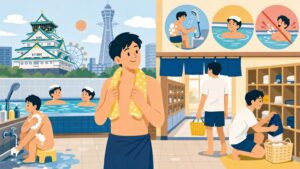
Walking into a sentō for the first time can feel intimidating. The rules are unspoken, the etiquette invisible, and, well, you’re naked. But understanding the process is the key to unlocking the experience. It’s a ritual in three parts: the prep, the soak, and the cool-down. Each phase serves a purpose and offers insight into the Osaka mindset.
The Pre-Bath Ritual: More Than Just Getting Clean
After you pay and receive your key, you enter the changing room (datsuijo). The first thing you’ll notice is a row of small, colorful plastic baskets. These hold the personal bath kits of regular visitors, filled with their preferred shampoo, a well-used scrubbing towel, and a razor. These baskets quietly signal membership. Leaving your gear at the sentō is an act of trust and a promise to return. It says, “This is my spot.” A small detail, but one that speaks volumes about the difference between a visitor and a member of the community.
Before you even think about stepping into the hot water of the main tubs, you must wash thoroughly. You grab a small stool and a bucket, find a spot along the rows of faucets, and scrub down. This is the most important sentō rule—an essential act of respect for the shared water and other bathers. In Osaka, you might receive a gentle but firm reminder if you forget. A simple “Aniki, saki ni arai ya” (“Brother, wash first”) isn’t an insult; it’s a practical, direct correction typical of Osaka’s communication style. They’re not trying to embarrass you; they’re efficiently maintaining communal order. They’d rather tell you directly than give a cold stare and gossip about the clueless foreigner later. For many non-Japanese, this straightforwardness can be jarring, but it’s ultimately a more honest and effective way of coexisting in a close-knit space.
Navigating the Tubs: Hot, Cold, and Electric
Once you’re clean, the tubs await—and they’re not all the same. There’s usually a main tub, hot but manageable. Then the atsuyu, the scalding hot bath, often occupied by seasoned old-timers who seem impervious to heat. Dipping a toe in might feel like stepping into lava, but for them, it’s a therapeutic necessity. Don’t try to be a hero on your first visit.
Then there are the more unusual options. The jet bath, or jetto-buro, which drenches your back with powerful high-pressure streams. And the well-known denki-buro, the electric bath. Two plates on opposite sides of a small tub emit a low-voltage current that makes your muscles tingle and contract. It feels strange, slightly alarming, but strangely addictive. Watching Osakans sit casually in the denki-buro as if it were a regular jacuzzi reveals their love for intense, peculiar experiences. It’s part challenge, part amusement, and totally unforgettable.
The key is to observe. Watch how people move between the hot tub and the mizuburo (the ice-cold plunge pool). This hot-cold cycle is central to the sentō experience. Listen to the conversations. Notice who has a designated spot. Don’t bring your towel into the water. Don’t swim. The rules are simple, and following them shows respect for the space. In return, you’ll be welcomed into the rhythm of the place.
The Post-Bath Cool-Down: Where True Connections Form
The magic of the sentō doesn’t end when you leave the water. In fact, for building community, the most important part comes next. The changing room doubles as the lounge. You’ll see people, fresh from their bath, wearing a simple yukata or just a towel, sitting in front of fans or on massage chairs. This is the liminal space where the digital detox solidifies and genuine conversations begin.
Here, you’ll see a dad teaching his son how to properly tie a towel around his head. You’ll see old men gathered around the TV, shouting at a baseball game as if they were in the stadium. People grab a classic post-bath drink from the vintage vending machine—either a small glass bottle of fruit milk (furutsu gyunyu) or a cold beer. Phones are strictly forbidden in the bathing area and generally frowned upon in the changing room. The result is a space where people are fully present. Their attention isn’t on Instagram or email. They are there, in the moment, with those around them. For a remote worker craving unstructured, face-to-face interaction, this is a revelation. A simple comment about the weather or the TV program can blossom into a full conversation. This is where you might make a friend. It’s low-stakes, organic, and worlds away from the forced networking of a business event.
The Sentō Economy: A Microcosm of Osaka’s Pragmatism
A common question foreigners ask is, “Why would I pay 500 yen to visit a sentō when I have a perfectly good shower at home?” This question itself shows a misunderstanding of what the sentō truly offers. The answer reveals the core of the Osaka mindset: pragmatism and an obsession with value, or kosupa (cost performance).
Why Pay for a Bath When You Can Bathe at Home?
For an Osakan, the 500 yen isn’t just a fee for a bath. It’s seen as an incredibly efficient, high-value exchange. For the price of a fancy coffee, you gain access to large tubs of hot water you don’t need to heat yourself, a high-temperature sauna, a cold plunge pool, a massage chair, a social club, and a therapy session all in one. It’s an investment in physical and mental well-being that offers unbeatable returns. This appreciation for a good deal is quintessentially Osaka. It’s the same mindset that leads people to line up for the cheapest, most delicious takoyaki. It’s not about being cheap; it’s about being smart with your resources and recognizing genuine value.
The home bath is for maintenance; the sentō is for restoration. It’s meant to melt away the week’s stress, sweat out a hangover, and soothe sore muscles after a long day. It’s a practical tool for better living. And in a city where apartments can be small and isolating, the sentō offers a sense of expansive, shared luxury. It’s a palace for the people, and that’s a deal any Osakan can support.
The Fading Tradition? Not Quite.
Throughout Japan, traditional sentō are closing rapidly as the population ages and modern homes all have baths. But in Osaka, there is a stubborn resilience. While some have shut down, others are fighting back with classic Osaka entrepreneurial spirit. They are evolving to survive, refusing to let this community cornerstone disappear.
You’ll find “designer sentō” renovated with modern, stylish interiors that attract a younger crowd. Some have introduced craft beer taps in their lounges, turning the post-bath drink into a trendy social event. Others have added small libraries, co-working spaces, or even live music. They innovate without losing the essence of what makes a sentō special: the water and the people. This spirit of adaptation is pure Osaka. It’s a city that respects tradition but isn’t bound by it. If the old way isn’t working, you don’t give up; you adjust the business model, try something new, and hustle. The survival and evolution of the Osaka sentō stand as a testament to the city’s practical, forward-thinking creativity.
Finding Your Sentō, Finding Your Osaka
The charm of Osaka’s sentō landscape lies in its diversity. Each bathhouse acts as a mirror, reflecting the distinct character of its neighborhood. Exploring them offers one of the best ways to grasp the city’s complex and varied personality, far removed from the tourist crowds of Dotonbori.
Your Neighborhood Mirror
A sentō in the working-class Nishinari district will exude a completely different vibe than one in the trendy, artistic Kita-horie neighborhood. In Nishinari, you might share the bath with day laborers, their bodies adorned with striking traditional tattoos (irezumi, often accepted in older neighborhood sentō, unlike many modern spas or gyms). Their conversations are raw, humorous, and full of the city’s grit and resilience. In Kita-horie, you could find yourself soaking alongside young designers, musicians, and café owners, their chats buzzing with fresh ideas and creative projects. By visiting various sentō, you’re not just cleaning yourself; you’re engaging in a form of grassroots urban anthropology. You’re learning about the city from the inside out, witnessing its many faces in their most candid moments.
The First Step Through the Noren
If this all feels overwhelming, start small. The barrier to entry is lower than you might expect. Choose a weekday afternoon when it’s quieter. Bring a small towel for drying, another tiny one for washing (and modesty while moving around), and about 1,000 yen in cash to cover the fee, a rental towel if needed, and a post-bath drink. The key phrase to know is “Sumimasen” (Excuse me), but truly, a smile and nod go a long way.
Upon entering, simply observe what others do. The ritual is easy to pick up. Be respectful, watchful, and open. Don’t hide in the corner. Make eye contact. Offer a small bow. Osakans, more than people in any other Japanese city, are often genuinely curious about foreigners who make an effort to join local life. Your presence might stand out, but it will be a welcomed one. They’ll appreciate that you chose their neighborhood spot over a generic tourist spa. The shared vulnerability of being naked together serves as a powerful social lubricant. In the steam of the sentō, you’re not a foreigner, you’re not a remote worker, you’re not an outsider. You’re simply another person trying to wash away the day’s grime. And in that simple, shared act, you may just discover the community you’ve been seeking.