
Tokyo asks for your silence. Osaka demands your voice. If you have just moved to Japan, or if you are contemplating a life here, you might have a very specific image in your head. You probably picture silent subway cars, impeccably polite clerks bowing at forty-five-degree angles, and a society that operates on the quiet friction of unspoken rules. Growing up in Tokyo, that was my reality. My background is in planning large-scale traditional festivals, events where chaos is strictly scheduled and contained. But when I began spending significant time in Osaka, I realized that the entire city operates like a daily, unending festival. The epicenter of this daily festival is the shoutengai, the covered local shopping arcade.
A shoutengai is not a mall. It is a living, breathing organism. It is a long, narrow street shielded from the rain by a high glass or plastic roof, flanked on both sides by mom-and-pop shops, butchers, tea merchants, hardware stores, and tiny standing bars. For a foreigner navigating daily life in Osaka, the shoutengai is the ultimate testing ground. It is where you stop being a mere spectator and start becoming a resident. But it requires a completely different communication toolkit than the rest of Japan. You cannot rely on the sterile, textbook Japanese you learned in a quiet classroom. You have to learn the art of the banter. You have to learn how to catch the rhythm of the street, how to hold eye contact with a sharp-tongued vendor, and how to embrace the beautifully chaotic social contract of the Kansai region. This is your guide to understanding the people of Osaka, not through sightseeing, but through the everyday magic of buying a daikon radish.
The Heartbeat of Osaka: Why Shotengai Are Built on Communication
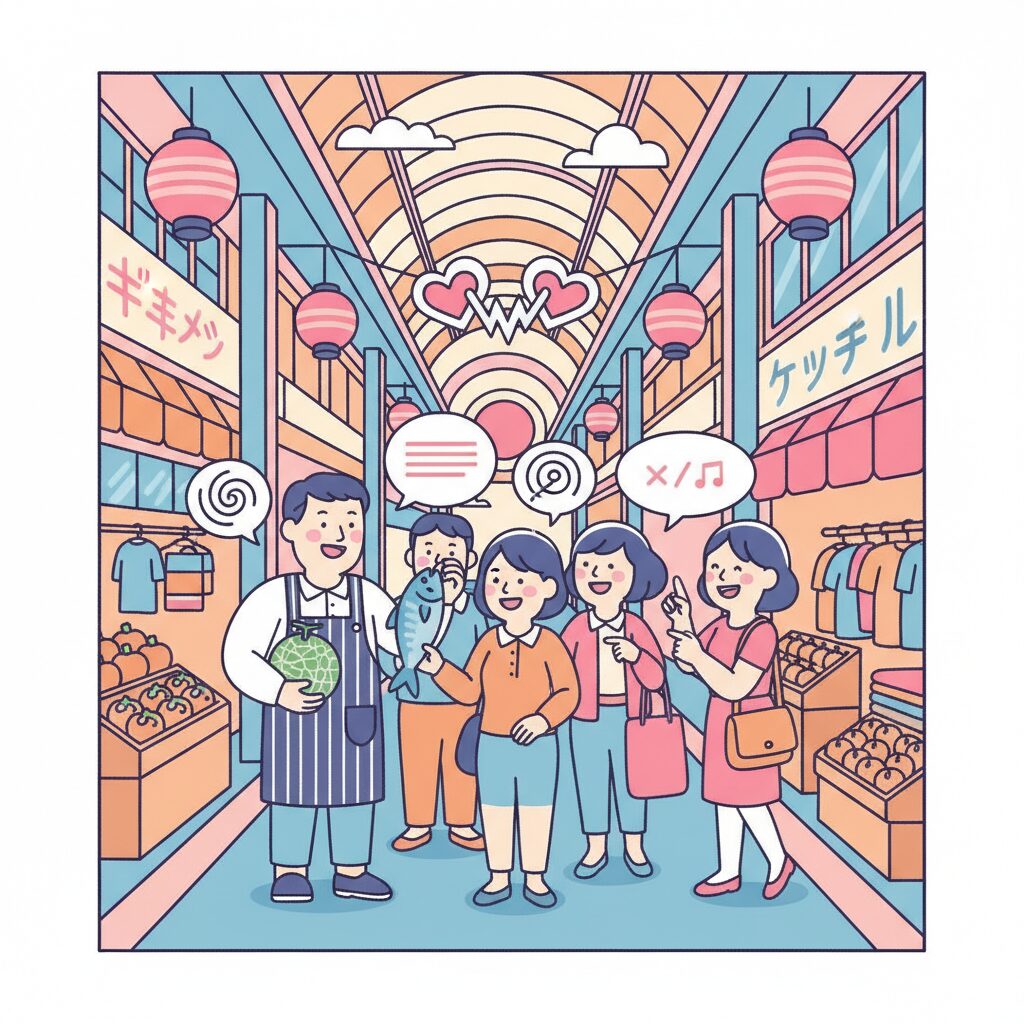
To understand how to behave in an Osaka shopping street, you first need to grasp why the people here behave the way they do. The atmosphere is not accidental, nor is it just a regional peculiarity. It is the outcome of centuries of deeply rooted cultural philosophy. Foreigners often hear the cliché that “Osaka people are friendly,” but this phrase is far too simplistic. They are not just friendly; they are vigorously communal. They are as invested in the social exchange as they are in the financial one.
The Merchant Spirit (Akindo) and Osaka’s Friendly Culture
Historically, while Tokyo was the political capital ruled by samurai and rigid class structures, Osaka was the commercial capital. It was known as the nation’s kitchen. Power here belonged not to warriors wielding swords but to merchants armed with abacuses. In the local dialect, this merchant spirit is called the way of the Akindo. For an Akindo, business is not a cold transaction of currency for goods; business is a relationship.
When a shopkeeper in a shoutengai talks to you, they are continuing this ancient tradition. They want to get to know you. They want to make you laugh because a laughing customer will return tomorrow. There is a deep egalitarianism in this mindset. To an Osaka merchant, everyone’s money is the same color. Whether you are a local grandmother, a foreign student, or a corporate executive, you are welcomed with the same exuberant energy. This friendliness is a sophisticated social lubricant designed to build trust, foster community, and ensure mutual survival. Once you realize their chatter is actually a form of respect and an invitation to connect, the loud atmosphere of the shoutengai suddenly feels less intimidating and more like a warm embrace.
How Osaka Differs from Tokyo in Local Interactions
Coming from Tokyo, the difference in everyday commercial interactions was a severe culture shock for me. In Tokyo, excellent customer service is defined by invisibility and seamless transactions. A clerk at a Tokyo supermarket will scan your items, recite a highly formalized script of polite keigo (honorific Japanese), and never make eye contact. The aim is to let you pay and leave without disturbing your personal peace.
In an Osaka shoutengai, invisibility is impossible. If you linger too long looking at a box of strawberries, the vendor will shout across the aisle to tell you exactly which farm they came from and why you should buy them right now. They will ask where you’re from. They will comment on the weather, your jacket, or that you look tired. Tokyo interactions are based on maintaining a polite, respectful distance to avoid burdening the other person. Osaka interactions are built on quickly closing that distance. If a shopkeeper in Osaka playfully teases you, it means you have been welcomed into their space. For a foreigner trying to adapt to daily life, learning to abandon the quiet convenience of Tokyo and embrace the lively friction of Osaka is the vital first step to feeling at home.
Breaking the Ice: Practical Tips for Foreign Residents and Newcomers
Many foreign residents freeze up when they visit a local shoutengai for the first time. You might have learned Japanese from a textbook, memorized the correct polite conjugations, and practiced your pronunciation. But when a fishmonger brandishes a knife at a tuna and shouts something rapidly in Kansai dialect that sounds like a completely different language, all that studying disappears. The good news is you don’t need perfect Japanese to thrive here—you need the right attitude.
Overcoming the Language Barrier with Gestures and Smiles
Osaka is a deeply physical city. Since its culture is built on comedy, timing, and loud expression, non-verbal communication holds great importance. If you don’t understand what a shopkeeper is saying, don’t look down at your shoes and mumble an apology. That kills the street’s energy. Instead, meet their gaze, smile broadly, and use your hands.
The people of Osaka value effort and enthusiasm far more than grammatical precision. If you want two of something, hold up two fingers confidently. If you try a free sample and it tastes amazing, widen your eyes, nod emphatically, and give a big thumbs-up. Vendors are experts at reading body language—they interact with thousands of people daily. If you bring bright, open energy to the encounter, they will respond in kind. They might mimic a joke back to you or toss in an extra tangerine simply because they liked your reaction. In Osaka, communication is a contact sport, and your smile is your greatest asset.
The Art of Pointing and Using Translation Apps Respectfully
Technology is fantastic, but it can create an artificial barrier in a highly social setting. When newcomers use translation apps in a busy shoutengai, they often make the mistake of staring at their screens, typing a long sentence, then shoving the phone in the face of an impatient merchant. This is a guaranteed way to kill the mood.
If you need to use your phone to translate a specific ingredient or ask a complex question, start by establishing a human connection. Catch their eye first. Give a slight bow and say a loud, cheerful excuse me to get their attention. Only after making eye contact should you gesture to your phone. Even better, rely on the universal language of pointing. Simply pointing at an item, looking at the vendor with a questioning expression, and tilting your head is much faster and feels more natural than waiting for a digital voice to speak for you. Use technology as a last resort—not your first line of defense.
Essential Kansai Dialect Phrases for Shopping Streets
If you want to quickly win over any local shopkeeper, you need to speak their language. The Kansai dialect, or Kansai-ben, is more than just a regional accent; it carries a distinctly different emotional tone compared to standard Japanese. It is rounder, warmer, and naturally more humorous. Using a well-timed Kansai phrase shows that you’re not merely a passing tourist but someone who respects and embraces the local culture.
“Maido!” (The Ultimate Osaka Greeting)
If there is one word that perfectly captures the spirit of Osaka commerce, it is “Maido.” Literally translated, it means something like “every time,” but its actual use is incredibly versatile. It’s a shortened form of a longer phrase expressing gratitude for continuous patronage. When you pass by a vegetable stand, the vendor will shout, “Maido!”
It serves as hello, welcome, thank you, and goodbye all in one lively, energetic word. As a customer, you can definitely respond with it. When you approach a counter, a cheerful “Maido!” instantly lets the shopkeeper know you’re in tune with the local vibe. It removes the stiffness of standard Japanese greetings and creates an immediate, friendly equality between buyer and seller.
“Kore Nambo?” (Asking for the Price Like a Local)
In Tokyo, if you want to ask the price of an untagged item, you politely say, “Ikura desu ka?” In an Osaka shoutengai, this marks you as an outsider. To sound like a local, point to the item and ask, “Kore nambo?”
“Nambo” is the Kansai equivalent of “how much.” It’s shorter, snappier, and instantly softens the financial aspect of the interaction. When a foreigner uses “Kore nambo?” with a friendly tone, it almost always brings a smile, a chuckle, and an enthusiastic response from the vendor. It quickly breaks the ice and often leads the shopkeeper to ask how long you’ve lived in Osaka and where you picked up such good local slang.
“Makete!” (The Playful Art of Bargaining)
Foreigners often wonder if bargaining is acceptable in Japan. In modern department stores or chain supermarkets, definitely not. But in a traditional Osaka shoutengai, negotiating is a well-established cultural game. It must be done properly. The phrase to use is “Makete,” which basically means “cut the price” or “give me a discount.”
Here’s the unspoken rule: don’t use it aggressively, and don’t ask for discounts on cheap single items. You won’t get a deal on a hundred-yen croquette. But if you’re buying large quantities of fruit, an expensive ceramic bowl, or multiple pieces of clothing from a local boutique, you can flash a big smile and say, “Mou chotto makete ya!” (Can you make it a little cheaper?). Even if they won’t lower the price, the vendor will laugh. Often, instead of a discount, the “makete” results in an omake, a freebie. They might toss an extra apple into your bag or round down the tax. It’s not about saving a few coins; it’s a playful nod to the Akindo spirit.
“Oishii wa!” (Praising the Food)
Osaka is famously known as the city of kuidaore, meaning to eat until you drop. Food here is more than sustenance; it’s a religion. The people who make and sell food in the local arcades take great pride in their craft, whether grilling wagyu beef or frying cheap dough balls.
If you buy something to eat on the spot, like piping hot takoyaki or freshly fried menchi katsu, don’t wait until you walk away to eat it. Take a bite right there at the stall. Let the heat burn your tongue a little, widen your eyes, look directly at the cook, and say, “Oishii wa!” (This is delicious!). Adding “wa” softens the phrase and makes it sound more natural and conversational. Immediate, vocal praise is the highest form of respect you can give a vendor. It acknowledges their hard work, and you’ll often be rewarded with a booming laugh and a proud thank you.
“Ookini!” (Saying Thank You the Osaka Way)
When the transaction is done, you could say “Arigatou gozaimasu.” It’s perfectly polite. But if you want to leave a lasting impression, say “Ookini!”
Ookini originally means “a great deal” or “very much,” but it has evolved into the quintessential Kansai expression of gratitude. It’s a warm, lingering word. When an Osaka shopkeeper hands you your change and says, “Ookini,” they usually stretch out the final syllable, letting it echo down the street. Returning the favor with your own heartfelt “Ookini!” as you walk away is the perfect way to close the social bond of the shoutengai. It leaves both you and the vendor feeling like you’ve shared a joyful secret.
Top Osaka Shotengai for Authentic Local Interactions
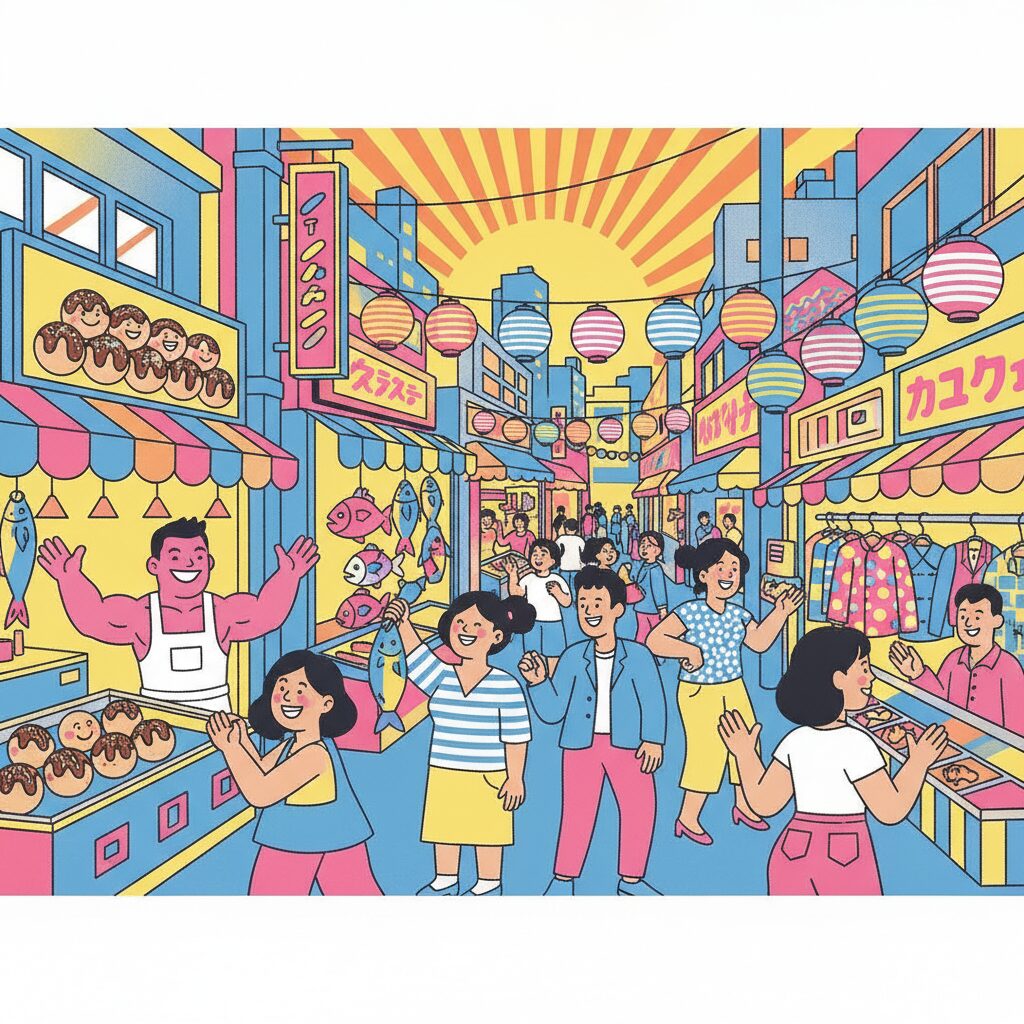
While nearly every local train station in Osaka features its own small arcade, a few standout ones truly highlight the immense scale and vibrant energy of the city’s merchant culture. These arcades are not merely shopping destinations; they serve as windows into the authentic pulse of the city.
Tenjinbashisuji: The Never-Ending Street of Local Conversations
Tenjinbashisuji reigns supreme as Japan’s premier shopping arcade. Stretching over two and a half kilometers and covering six subway stations, it holds the title of the longest continuous covered shopping street in Japan. For someone like me, an event planner, walking this street is like experiencing a masterclass in crowd behavior and community interaction.
This is where the true spirit of Osaka thrives. You’ll encounter grandmothers meticulously inspecting loose-leaf tea, businessmen slurping udon at tiny standing bars, and knife vendors chatting with professional chefs. The street echoes with a cacophony of recorded jingles, bicycle bells, and booming vendor calls. If you want to hone your banter skills, this is the perfect place to start. With so many shops, you can spend hours wandering, practicing your “Maido” at a different stall every five minutes. It’s chaotic, intensely colorful, and the absolute best spot to grasp the city’s everyday rhythm.
Kuromon Ichiba: Immersing in the Passion of Food Vendors
Kuromon Ichiba is often referred to as Osaka’s kitchen. Historically, it was the go-to market where professional chefs from the Minami entertainment district bought their premium seafood and produce. Although it has recently drawn many tourists, altering the atmosphere somewhat, the original merchant spirit still beats strongly beneath the surface.
To experience Kuromon truly, you need to look beyond the flashy signs and connect with the vendors who have been there for decades. Pickle sellers with their wooden barrels of fermented vegetables and tea roasters carefully sorting leaves remain committed to the old Akindo traditions. Show sincere interest in their products, ask how they are made, and use a bit of Kansai dialect, and they’ll warmly open up, offering samples and sharing stories about the market’s history. It’s an excellent way to bridge the gap between sightseeing and genuine local interaction.
Local Neighborhood Arcades: Discovering the True Community Spirit
To witness the unfiltered daily life of Osaka residents, venture beyond the city center to the deeply residential arcades. Neighborhoods like Senbayashi Shotengai in Asahi Ward or Karahori Shotengai in Chuo Ward form the real heartbeat of their communities.
Senbayashi, in particular, is famous for its endlessly catchy theme song that loops throughout the arcade. These local streets aren’t designed for tourists but for neighborhood mothers buying ingredients for dinner and retirees enjoying a cheap cup of coffee and a long chat. The pace is slower, the interactions more intimate, and incredibly sincere. Shopkeepers will recognize you after just a few visits. For anyone moving to Osaka, living near one of these hyper-local shotengai will help you integrate into the community faster than any other approach.
Unspoken Rules and Etiquette When Interacting
While Osaka is much more relaxed and informal than Tokyo, it is not a free-for-all. There is a deeply ingrained rhythm to the streets, and unspoken rules that guide these social interactions. The banter is meant to be enjoyable, but it remains fundamentally connected to the day’s business.
Reading the Room During Busy Hours
People in Osaka are known for their impatience. There is a local term, “ikkachi,” which refers to their quick-tempered, fast-paced nature. They walk fast, speak fast, and expect their transactions to be swift. The banter in a shoutengai is meant to be quick and sharp, like a game of linguistic table tennis.
As a foreigner eager to practice your Japanese, the biggest mistake you can make is holding up the line. If there’s a queue of hungry office workers waiting to buy bentos, or three grandmothers tapping their feet behind you at the butcher’s, that is not the time to ask the vendor about their family history. The art of banter depends entirely on reading the room. You chat when the shop is quiet, or slip in a quick, witty comment while the money is changing hands. You must never interrupt the flow of commerce. The interaction happens in the margins of the transaction, never at its expense.
Respecting Boundaries While Enjoying the Banter
Because shopkeepers are so openly friendly, some expats and tourists mistakenly treat them like free local entertainment. They’ll linger at a stall for twenty minutes, taking photos, asking a million questions, practicing their Japanese, and then walk away without buying anything. This is a serious breach of the Akindo social contract.
The vendors work incredibly hard on very thin profit margins. Their friendliness is genuine, but it is also their livelihood. You have to participate in the ecosystem. If you want to enjoy the banter, you must buy the ticket. Purchasing a simple hundred-yen bag of roasted sweet potatoes gives you the right to stand and chat for a few minutes. Buying a cup of green tea provides an authentic local interaction. Treat the merchants with the deep respect they deserve, and understand that buying their goods is the truest way to honor their time and culture.
Conclusion: Taking Home More Than Just Goods
Living in Osaka demands a change in perspective. You must release the desire for perfect, silent order and embrace the messy, loud, and profoundly human chaos of the city. The shoutengai perfectly embodies this philosophy. It is a place where you are not merely a passive consumer but an active participant in a daily community celebration.
By stepping beyond your comfort zone, setting aside your textbook Japanese, and immersing yourself in the playful rhythm of the Kansai merchant spirit, you discover a side of Japan that few foreigners genuinely experience. You realize that the true essence of Osaka is not found in the neon lights of Dotonbori or the towering views of Umeda. It lives beneath the plastic roof of a local arcade, in the shared laughter over a slightly bruised discount apple, and in the joyful echo of a heartfelt “Ookini!” as you walk away. When you master the art of banter, you stop merely living in Osaka and truly become a part of it.