I am an outdoor specialist. I spend my weekends hauling a heavy backpack up the steep inclines of Mount Kongo or navigating the quiet, forested ridges of the Minoh mountain range. I like the silence of the outdoors. I like the predictability of a map, a compass, and a clear dirt trail. But when Monday morning rolls around, I descend from the peaceful peaks and plunge straight back into the concrete basin of Osaka. Down here, the compass spins wildly. There are no trail markers in the neon canyons of this city. You navigate by smell. You navigate by the sheer density of the crowds. Coming off a mountain and stepping onto the pavement of Osaka is a massive shock to the senses. But it is a shock that makes you feel instantly alive.
People constantly ask me what it is really like to live here. Foreign residents arriving from Tokyo or abroad want to know if the loud, brash stereotypes about Osaka people hold any water. They want the truth about daily life in Japan’s second-largest metropolitan area. I always give them the same honest advice. If you want to understand how this city breathes, how its people think, and how you will spend your days here, you have to look at the food. Osaka is a city built entirely on the stomach. Tokyo is built on status and relentless efficiency. Kyoto is built on rigid tradition and historical preservation. Osaka is built on the sheer, unadulterated joy of eating. This is not just a tired talking point from a glossy travel brochure. This is the structural foundation of our daily routine. You do not just eat to live in this city. You live to eat. This foundational concept is known as “Kuidaore.” As a new resident, you will feel the gravitational pull of this philosophy immediately. Your wallet might empty faster than you expected, but your soul will be incredibly full. Let me explain exactly how this mindset dictates everything from morning commutes to late-night business deals, and how you can navigate the glorious chaos of Osaka’s dining culture.
What Does “Kuidaore” Mean? Osaka’s Food Philosophy Explained
To understand your new neighbors, you first need to grasp the vocabulary that shapes their lives. The term “Kuidaore” is a linguistic fusion of two powerful ideas. “Kui” means to eat, while “Daore” means to collapse, go bankrupt, or fall into ruin. Combined, it forms a philosophy that roughly translates to eating until you drop, or spending so much on extraordinary food that you financially ruin yourself.
This is not seen as a negative quality here. On the contrary, it is a badge of honor—a testament to your priorities. To fully appreciate the significance of this word, you must compare it to those of our neighbors. An old saying in the Kansai region highlights the sharp cultural contrasts between the major cities: Kyoto people experience “Kidaore,” meaning they bankrupt themselves on expensive kimonos and fine clothing; Tokyo people experience “Hakidaore,” meaning they ruin themselves buying costly shoes to walk their endless busy streets; but Osaka people experience “Kuidaore.” We don’t care if our jacket is ten years old or our shoes are scuffed. What matters is that the broth in our udon is brewed with the finest quality kelp, and we are willing to spend our last yen to savor it.
When you move to Osaka, this philosophy immediately changes your daily routine. Many foreign residents arrive with strict budgets, planning to buy groceries, cook at home, and save money for future travel. This plan usually falls apart within the first month. The aromas wafting from the neighborhood alleys irresistibly pull you out of your apartment. Additionally, social pressure heavily revolves around food. In Tokyo, coworkers might nod politely at day’s end and head home silently. In Osaka, saying no to a spontaneous Tuesday night invite for grilled skewers is considered a minor social tragedy. Your boss wants to eat out. Your neighbor wants to hand you a warm bag of octopus dumplings over the fence. The city demands your appetite. Soon, you’ll find your mental map of the city is no longer defined by subway stations or parks, but rather by where the best standing bars are, which street serves the crispiest fried pork, and which vendor stays open past midnight.
Meet Kuidaore Taro: The Drumming Icon of Dotonbori
If the Kuidaore philosophy is Osaka’s religion, then the Dotonbori district serves as its central cathedral. Standing right in the heart of that cathedral is its patron saint: Kuidaore Taro. If you’ve wandered through the neon-lit streets of the Minami entertainment district, you have almost certainly seen him. He is a life-sized mechanical clown dressed in a red and white striped suit, a matching pointed hat, and thick round glasses. He continuously beats a small drum while swiveling his head back and forth. To a newcomer, he might appear somewhat eerie. But to locals, he is a cherished symbol representing the city’s straightforward, humorous, and deeply resilient spirit.
The History Behind the Famous Mascot
Kuidaore Taro was created in the mid-twentieth century, shortly after the devastation of World War II. The city was rebuilding, people were hungry, and morale needed a significant lift. A local restaurant owner wanted something loud, eye-catching, and entirely unique to attract families to his eatery. Thus, Taro was born.
The mascot endured decades marked by economic booms, bursting bubbles, and shifting cultural trends. When the original restaurant that housed him finally closed in the late 2000s, a genuine public outcry followed. People across Japan worried about his fate. He was eventually saved and permanently relocated, becoming a street fixture rather than just a symbol of a single business. Osaka residents love mascots, but not in the polished, corporate way Tokyo does. They prefer mascots that feel approachable, slightly goofy, and free from any high-culture pretensions. Taro embodies the “boke,” or funny-man role, in traditional Osaka comedy. He stands there drumming away, reminding everyone not to take life too seriously and to enjoy a good meal.
Where to Find Kuidaore Taro Souvenirs
You’ll quickly notice Kuidaore Taro’s face emblazoned on almost every item imaginable in local shops. You can find his striped suit on socks, his face shaped into sweet butter cookies, and his drum attached to heavy metal keychains. Although these might seem like mere tourist traps, understanding how locals use these items reveals much about Osaka’s social culture.
When an Osaka resident travels to another prefecture for business or family visits, they rarely bring elegant, understated gifts. Instead, they bring Kuidaore Taro cookies. Why? Because it’s an immediate icebreaker. Giving a Tokyo executive a brightly colored box featuring a drumming clown quickly cuts through formal tension. It’s a way of saying, “I’m from Osaka, we love to laugh, and we love to eat.” As a foreign resident, adopting this habit is a clever social strategy. Bringing a box of these loud, unpretentious sweets to your new workplace or offering them to your landlord instantly earns goodwill. It shows you understand the local spirit and embrace the self-deprecating humor of the Kansai region.
Nakaza Kuidaore Building: The Epicenter of Osaka’s Food Culture
To truly embrace the daily life of an Osaka resident, you must visit the physical landmarks dedicated to this lifestyle. The most prominent of these is the Nakaza Kuidaore Building. Situated right in the vibrant heart of Dotonbori, this extensive complex has long been the go-to spot for anyone determined to eat until they can’t eat anymore. It’s a multi-level maze filled with sizzling grills, overflowing beer mugs, and lively conversations.
Exploring the Spring 2025 Reopening
Cities are living entities. They breathe, age, and must adapt to survive. For decades, the Nakaza Kuidaore Building was a cherished yet unmistakably worn fixture of the street. However, in the Spring of 2025, the building reopened its doors after extensive, comprehensive renovations. This update is essential for anyone living in the city today.
For the casual tourist, the Spring 2025 reopening meant brighter neon lights, improved photo lighting, and cleaner restrooms. But for those of us who call Osaka home, this reopening held much deeper significance. Many locals worried modernization might erase the building’s chaotic, greasy character. We feared it would turn into just another sterile shopping mall.
Fortunately, the architects got it right. The newly reopened building is a brilliant example of controlled chaos. They enhanced safety protocols and ventilation but preserved its soul completely. The narrow corridors still reverberate with the calls of hawkers. The air remains thick with the tempting aromas of roasted soy sauce and frying pork fat. It continues to embody the Kuidaore spirit vertically. When locals visit the Nakaza Kuidaore Building on a Friday night, it’s not just a casual visit. We plan our night strategically. We approach it like an endurance challenge. I tackle a night out there like a steep mountain climb. You have to pace yourself. You don’t stuff your stomach with heavy carbs on the first floor. Instead, you start with a quick drink and a light skewer downstairs, gradually making your way up to the upper floors in search of the boldest flavors and the most affordable highballs.
How to Experience “Kuidaore”: A Dotonbori Street Food Guide
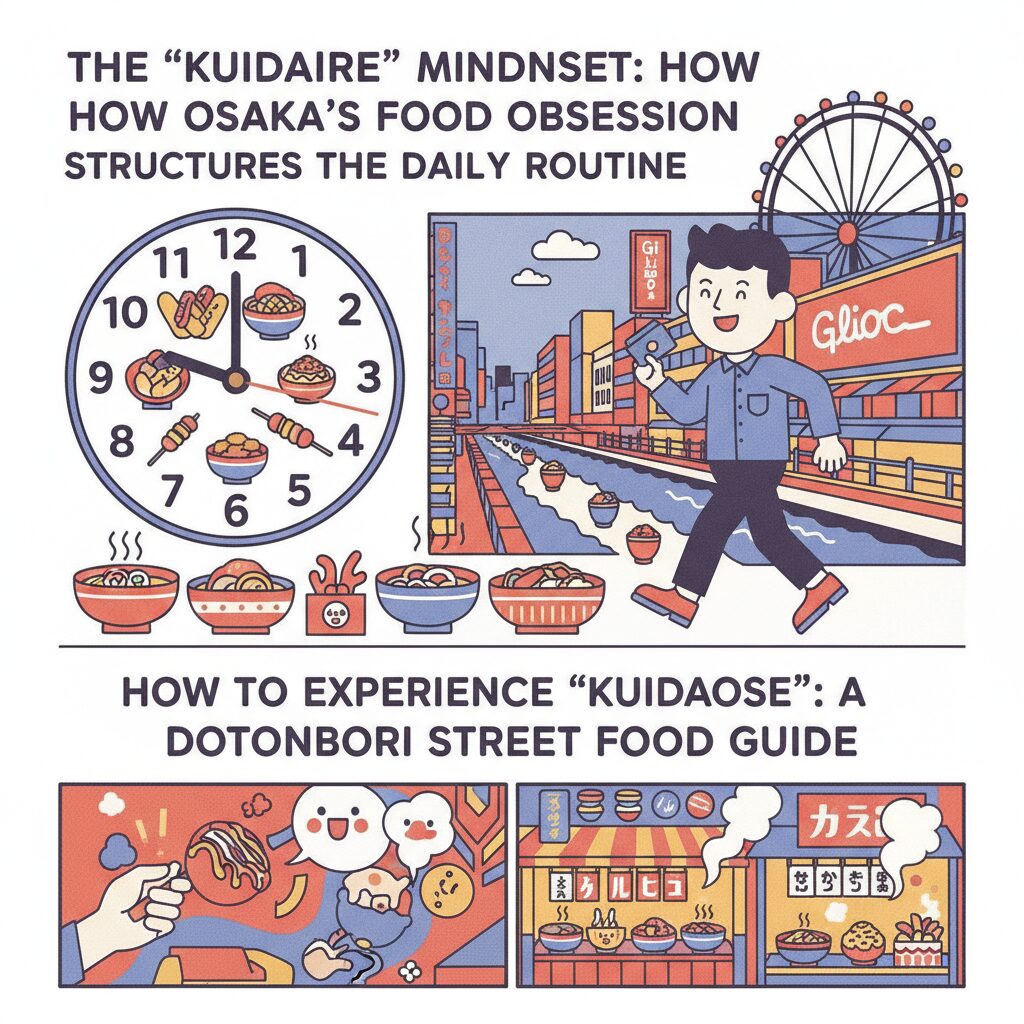
Understanding the philosophy and knowing the history are important. But in Osaka, theory is meaningless without practice. You must actually participate in the act of eating. The daily lives of residents here are punctuated by specific, deeply comforting local dishes. This isn’t haute cuisine. This is what we call “B-kyu gurume,” or B-grade gourmet. It is inexpensive, incredibly quick, and overwhelmingly delicious. Status holds no weight when it comes to Osaka food. Only taste matters. If you want to truly live like a local, these are the foods that will shape your week.
Takoyaki: The Ultimate Octopus Dumplings
Takoyaki is the undisputed king of Osaka street food. It is the city’s original fast food, and every neighborhood has its own local stand. Usually run by a quick-witted older woman who knows all the local gossip, the takoyaki stand is the spot to stop on your walk home from the train station.
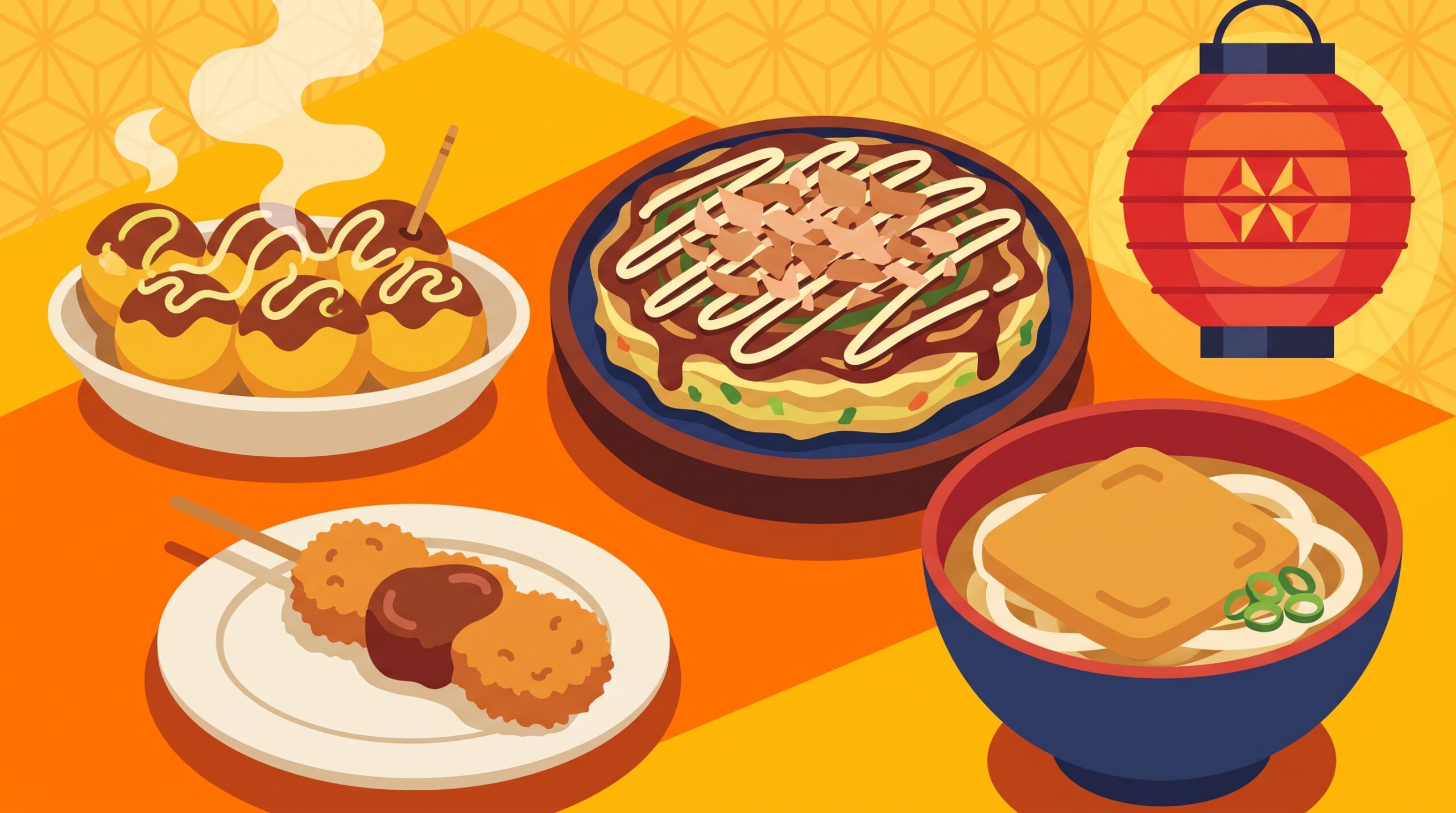
Watching a skilled chef prepare takoyaki is captivating. It is a masterclass in rhythm and wrist control. They pour a thin, dashi-infused batter into a specially molded cast-iron pan filled with half-sphere indentations. They drop a single, tender piece of boiled octopus into each well, scatter tempura scraps and green onions on top, then use thin metal picks to rapidly flip the batter as it cooks. The resulting dumpling features a study in contrasting textures. The exterior must be crisped to a golden brown, offering a delicate resistance when bitten. The interior, however, remains molten. It is a savory lava that constantly threatens to burn the roof of your mouth. Burning your tongue on a fresh takoyaki is a genuine rite of passage for any new resident. Covered in a thick, sweet and savory dark sauce, heavily drizzled with rich mayonnaise, dusted with powdered seaweed, and topped with oceanic bonito flakes that dance in the rising heat, takoyaki is more than a snack. It is a social lubricant. You buy a boat of eight pieces, stand on the street corner with your friends, and share them.
Okonomiyaki: Savory Cabbage Pancakes
If takoyaki is the street snack, okonomiyaki is the meal you sit down to share with others. The name roughly translates to “grilled as you like it.” It is a heavy, savory pancake made from a batter mixed with heaps of shredded cabbage, eggs, and various proteins like thick slices of pork belly, shrimp, or squid.
Okonomiyaki began as a working-class dish. It was an inexpensive way to use leftovers and fill an empty stomach. Today, it remains deeply embedded in the city’s daily life. When you visit an okonomiyaki restaurant in Osaka, you usually find a heavy iron griddle built right into the center of your table. There is a unique intimacy in sitting around the hot plate with coworkers or family, watching the thick batter sizzle and rise. The dish’s geometry is striking. Once cooked, the chef or customer spreads a dark, rich sauce over the top, then precisely drizzles mayonnaise in thin, parallel lines before slicing through them with a metal spatula to form a dramatic web pattern.
A crucial tip for any foreign resident: Never, under any circumstances, confuse Osaka-style okonomiyaki with Hiroshima-style okonomiyaki. Hiroshima style layers the ingredients and includes noodles, while Osaka style mixes everything together into one dense, cohesive pancake. Mixing them up in conversation is the quickest way to annoy your new Osaka neighbors. Defend the Osaka style fiercely, and you will be welcomed immediately.
Kushikatsu: Golden Deep-Fried Skewers
When the workday finally ends, the people of Osaka crave cold beer and hot oil. Kushikatsu is the answer. Originally born in the gritty, retro Shinsekai neighborhood just south of Dotonbori, kushikatsu consists of various meats, vegetables, and seafood skewered on bamboo sticks, coated in a fine panko breadcrumb batter, and deep-fried to perfect golden crispiness.
The charm of kushikatsu lies in its simplicity. You can order a skewer of premium beef or a simple quail egg, a slice of lotus root, or a wedge of pumpkin. The fine batter creates a crust that is incredibly crispy yet lighter than traditional tempura.
However, eating kushikatsu comes with the strictest, most unbreakable rule in all of Osaka’s dining culture: No double-dipping. At the counter, you will find a large stainless steel tray filled with a thin, sweet and tangy black sauce. This tray is shared by all customers seated there throughout the night. For hygiene reasons, you are only allowed to dip your freshly fried skewer into the communal sauce once before taking a bite. If you want more sauce, you don’t dip your half-eaten food back in. Instead, you take a crisp piece of raw cabbage provided at the table, use it to scoop more sauce, and drizzle it onto your skewer. Violating the no double-dipping rule is a serious breach of the social contract. Follow the rule, savor the sharp snap of the panko crust, wash it down with a draft beer, and you’ll understand why the city operates the way it does.
Practical Tips for Eating Your Way Through Osaka
Living in Osaka demands that you recalibrate your behavioral compass. The unspoken rules governing dining and everyday interactions here differ greatly from the rest of Japan. Tokyo is polite, formal, and often reserved, while Osaka is warm, energetic, and boldly friendly.
First, you need to embrace the tachinomi, or standing bar. Many of the finest and most authentic meals you’ll enjoy in this city will take place without a seat. Standing bars maintain a high turnover, keep prices remarkably low, and create an electric atmosphere. You’ll frequently find yourself standing shoulder to shoulder with both wealthy business executives and broke university students. In these bars, Japan’s social hierarchy melts away through the shared experience of excellent food.
Second, mastering the use of your voice is essential. In a quiet Tokyo restaurant, you might raise your hand slightly and wait for the server to catch your eye. In a bustling Dotonbori eatery, waiting for eye contact could mean going hungry. You must learn to project your voice from your diaphragm. A loud, confident shout of “Sumimasen!” (Excuse me!) here is not seen as rude but as efficient.
Lastly, recognize that conversations with shop owners and chefs form a vital part of the experience. In Osaka, the chef isn’t just a silent craftsman preparing your meal behind a glass screen—they are a performer. They’ll joke with you, complain about the weather, and address you as “ni-chan” (brother) or “nee-chan” (sister), no matter where you’re from. You’re expected to engage. While tipping with cash is uncommon in Japan, in Osaka, you tip with your energy—by laughing at the chef’s jokes, complimenting the crispness of the pork belly, and finishing your plate completely.
When you finally stagger out of a Dotonbori alleyway at midnight, your clothes smelling of smoke and frying oil, your wallet noticeably lighter, and your stomach fully satisfied, you’ll realize that you’re no longer merely a spectator in this city. You have taken part in the daily ritual, embraced the Kuidaore mindset, and found a home.