The first time it happened, I was utterly lost. I was standing in a FamilyMart near Tennoji, holding a single onigiri, when the cashier, a woman who looked like she could be my auntie, scanned it and looked me dead in the eye. With a perfectly straight face, she asked, “Sore dake? Kyou wa shussoshoku ya na.” Only that? What a frugal meal today. My Japanese was decent, but my cultural fluency was zero. Was she criticizing my lunch choice? Was she concerned for my financial well-being? I stammered something about not being very hungry, paid, and fled, my cheeks burning with confusion. It wasn’t until weeks later, after recounting the story to a local friend, that I understood. He burst out laughing. “She wasn’t judging you,” he explained. “She was setting you up. She was waiting for you to come back with a zinger, a punchline. You were supposed to say something like, ‘Yeah, I’m saving up for a private jet!’ or ‘This is just the appetizer!’” I had been given an opening for a joke, a boke, and I had completely missed my cue. I let the comedic ball drop, and in Osaka, that’s almost worse than dropping your wallet.
This city runs on a different kind of social energy. While much of Japan operates on a principle of reserved politeness and subtle cues, Osaka’s operating system is coded with the fast-paced, interactive rhythm of a comedy routine. Here, humor isn’t just for entertainment; it’s the primary tool for communication, connection, and social navigation. It’s how you break the ice with a stranger, how you show affection to a friend, and how you smooth over awkward situations. To live here, to truly understand the pulse of this city, you have to learn the language of laughter. This isn’t about memorizing jokes. It’s about understanding that in Osaka, many conversations are a performance, and you’re expected to play a part. Forgetting your lines isn’t a disaster, but learning them makes life here infinitely richer and more fun. It’s the key to deciphering why this place feels so fundamentally different from the rest of Japan.
Osaka’s infectious energy not only challenges you to master its playful banter but also mirrors its evolving urban landscape, as seen in the Kansai luxury hotel boom that is reshaping travel and local experiences.
The Unspoken Rules of the Osaka Comedy Routine
To someone unfamiliar, conversations in Osaka can feel like stepping into a linguistic pinball machine. The topic quickly bounces from serious to absurd, driven by interjections, playful insults, and a rhythm slightly off from standard Japanese. This isn’t chaos; it’s a highly structured, though unwritten, system of interaction rooted in manzai, a traditional Japanese stand-up comedy style featuring a duo. These two roles, the boke and the tsukkomi, extend beyond the stage in Osaka—they are the essential foundation of everyday conversation.
Boke and Tsukkomi: The Pulse of Conversation
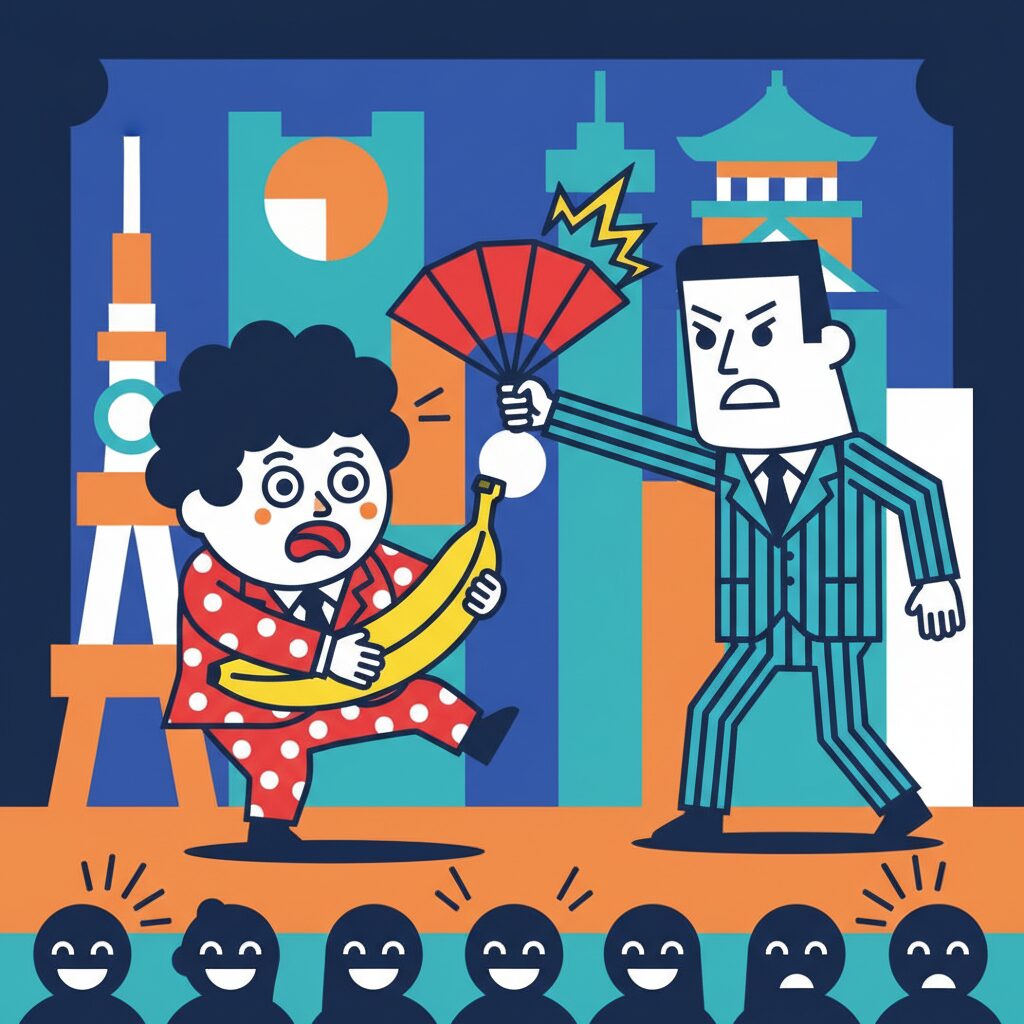
The boke (ボケ) is the funny one, the fool, the person who says something absurd, incorrect, or silly. The term comes from bokeru, meaning to be senile or air-headed. But in conversation, playing the boke is a deliberate, creative kind of silliness. It’s a purposeful offering, a verbal softball tossed up for someone else to hit. It’s your friend pointing to the magnificent Osaka Castle and seriously saying, “Wow, Tokyo Tower looks great from this angle.” It’s your neighbor, seeing you struggle with a heavy grocery bag, asking, “Training for the Olympics?” The boke introduces a small, temporary break in reality, a pocket of absurdity that demands a response.
That response is the tsukkomi (ツッコミ). The tsukkomi is the straight man, the one who corrects the boke. The word means to “thrust in” or “poke,” reflecting the role perfectly. A good tsukkomi is sharp and quick, restoring order to the conversation in a way funnier than the initial absurdity. When your friend misidentifies Osaka Castle, the right tsukkomi is not a flat correction like “That’s Osaka Castle.” It’s an exasperated, almost theatrical, “Nande ya nen!?” which roughly means “Why the heck!?” or “What are you talking about!?” Often accompanied by a gentle tap on the arm or shoulder, this physical gesture punctuates the verbal correction. The tsukkomi grounds the conversation back in reality, but with an energy that completes and validates the joke.
This dynamic fuels social life in Osaka. A boke without a tsukkomi is just an odd comment left hanging, creating awkward silence. It’s like telling half of a knock-knock joke and getting no reply. In Osaka, failing to provide the tsukkomi can come across as cold, distant, or inattentive. The entire exchange is a cooperative comedic performance. It’s a dance—one person steps out of line, and the other playfully pulls them back. This rapid back-and-forth of absurdity and correction creates instant rapport. It signals, “We are on the same wavelength. We’re sharing the joke.”
‘Ochi’ – Every Story Needs a Punchline
Beyond the moment-to-moment banter of boke and tsukkomi, there’s a wider narrative expectation in Osaka: every story needs an ochi (オチ), a punchline, or a final twist. This contrasts sharply with the conversational style typical of Tokyo, where stories often serve just an informational purpose. A Tokyoite might tell you about a terrible commute simply to explain a train delay and being late. An Osakan will take that same story and turn it into a dramatic narrative with a beginning, middle, and a crucial, often self-deprecating, punchline at the end.
The story builds with exaggerated sighs and gestures. They’ll describe the crowded train, slow progress, and rising frustration. You’re on edge, expecting a tale of workplace hardship. Then comes the ochi: “…and after all that, I finally get to the office, storm into the meeting an hour late, and realize it’s Saturday.” The ochi transforms the narrative from a complaint into entertainment. The story’s purpose wasn’t to relay the delay; it was to share a laugh at the storyteller’s expense.
For locals, this means an unspoken pressure to be a skilled storyteller. You learn to spot the humorous, ironic, or absurd angle in everyday life. Mundane events are constantly mined for comedic value. This shapes the city’s social fabric into a lively tapestry of shared stories. When you ask someone in Osaka, “How was your day?” you rarely get a simple “Fine.” Instead, you’re likely to hear a two-minute tale with a killer punchline. It’s a culture that prizes entertaining over merely transmitting facts.
Where Comedy Lives: From the Stage to the Supermarket
This profound intertwining of humor with the city’s identity isn’t coincidental. It stems from a rich and extensive history with professional comedy, a legacy that has so deeply infused the culture that the boundary between performer and audience is delightfully and chaotically blurred. The show isn’t confined to the theaters of Namba; it plays out in every taxi cab, each takoyaki stand, and every doctor’s waiting room throughout the city.
The Yoshimoto Kogyo Effect
Discussing Osaka comedy inevitably leads to Yoshimoto Kogyo. Established in Osaka over a century ago, this entertainment giant reigns as the undisputed leader of Japanese comedy. For generations, its headquarters in the Namba district has served as the heart of owarai (Japanese comedy), producing the nation’s most celebrated comedians. Watching Yoshimoto Shinkigeki, a slapstick comedy troupe with nationwide broadcasts every weekend, is a cultural staple for many Japanese families; in Osaka, it borders on a religious experience.
Yoshimoto’s long-standing dominance of the airwaves meant that generations of Osakans grew up absorbing the distinctive rhythms, stereotypical characters, and reactive humor of manzai. The interplay of boke and tsukkomi wasn’t just entertainment on TV; it was the principal model for funny interactions learned in childhood. This immersion created a shared comedic language almost everyone speaks. The jokes and catchphrases from well-known Yoshimoto comedians become woven into the local vernacular, serving as cultural shortcuts in everyday conversation. This mutual understanding allows for quicker, more nuanced communication where a single phrase can evoke an entire comedic scenario.
Humor as a Social Lubricant
This deeply rooted comedy culture is most obvious in daily commercial and social engagements. Humor functions as the go-to method for breaking down barriers and fostering a sense of warmth and closeness—even with complete strangers. This is the basis for the stereotype that “Osaka is friendly,” but it’s a distinct, performative kind of friendliness that may initially surprise newcomers.
Visit Kuromon Ichiba Market, and you’ll see this in practice. A pickle vendor might call out, “Hey miss, you’re too pretty to be wandering around without trying my delicious daikon!” This is a line, a small performance, and an invitation to respond. Rather than blushing and walking away, the expected reaction is to play along, retorting with a tsukkomi like, “Flattery will get you everywhere… but will it get me a discount?” This playful back-and-forth is the real transaction. The exchange of money takes a backseat to the exchange of wit. The vendor isn’t just making a sale; they’re fostering a memorable and human interaction.
This dynamic permeates nearly every facet of life. A taxi driver might joke about the terrible traffic. An elderly woman sitting beside you on the train could offer a playful comment on your brightly colored shoes. These aren’t intrusions; they’re acts of social outreach. In a culture that can sometimes feel formal and hierarchical, Osaka’s humor serves as a great equalizer. It’s a way of saying, “For this brief moment, let’s set aside formalities and simply share a laugh.” This mindset cultivates a palpable sense of community, transforming the city from an anonymous urban environment into a collective of individuals who are all potential scene partners in the grand, ongoing comedy of everyday life.
Navigating the Osaka Joke-scape: A Foreigner’s Guide
For a non-Japanese resident, this environment can be both exciting and daunting. On one hand, it’s a quick way to feel connected; on the other, the fear of missing the joke or saying something wrong is very real. The key is to remember that perfection isn’t expected. Participation, even if clumsy, is what matters. It shows you’re making an effort to speak the local language—and that language is humor.
The ‘Nande Ya Nen!’ Moment: When to Tsukkomi
Recognizing a boke is the first and most important skill. It’s that moment when a statement doesn’t quite match reality. When your colleague says they’re so tired they could sleep for a year, or the ramen shop owner claims his secret ingredient is love and a dash of poison (he’s kidding… probably). In these moments, you have a choice. You can nod politely, as you might in Tokyo, or you can step up and deliver a tsukkomi.
You don’t need perfect mastery of the Kansai dialect. Even a simple, well-timed response in basic Japanese can work wonders. “Honma ka?” (“Really?”) said with a skeptical laugh is a great all-purpose tsukkomi. “Muri muri muri!” (“No way, impossible!”) also fits. And if you’re feeling confident, you can pull out the king of all tsukkomi: “Nande ya nen!” Don’t worry about perfect pronunciation. The mere attempt often brings delighted laughter. By playing your part, you’re acknowledging the unspoken rules. You’re showing that you get it. You’re moving from a passive observer to an active participant in Osaka’s social ecosystem. People will appreciate the effort far more than they will judge the execution.
The Misunderstanding of Rudeness
One of the biggest culture shocks for foreigners—and even for Japanese people from other regions—is how direct and personal the humor can be. An Osakan might playfully comment on your new haircut, your choice of clothes, or your terrible singing at karaoke. From the perspective of a culture that values indirectness, this can feel extremely rude or intrusive. It’s easy to mistake this teasing for a genuine insult.
However, in Osaka’s context, this kind of personal teasing is often a sign of affection and inclusion. It’s the opposite of the polite but impenetrable wall of tatemae (public face) that can characterize interactions elsewhere in Japan. If someone teases you, it usually means they feel comfortable enough with you to drop formalities. They treat you like a local, like one of their own. The jokes are a shortcut to familiarity. While it takes some getting used to, learning to take these jokes lightly—and even better, to throw one back—is a crucial step in forming genuine friendships. The humor bridges the cultural gap, but it requires your willingness to both give and receive the banter.
A Note on ‘Aho’ vs. ‘Baka’
Nowhere is this cultural difference clearer than in one word: aho (アホ). In most of Japan, especially in the Kanto region around Tokyo, the common word for “idiot” is baka (バカ). Depending on tone and context, baka can be a lighthearted tease or a deeply cutting insult. In Osaka, however, baka is almost always taken as the latter—harsh, foreign, and genuinely mean.
The preferred word in Osaka is aho. Paradoxically, aho is often a term of endearment. When a friend messes up and you laugh, saying, “You’re such an aho,” it’s the equivalent of calling someone a “silly goose” or “goofball.” It’s a core part of the boke/tsukkomi dynamic. The boke acts foolishly, and the tsukkomi calls them aho with a warm, exasperated tone. It’s a verbal hug disguised as an insult. For a foreigner, mastering this distinction is essential. Calling an Osakan friend baka can create an awkward moment, while calling them aho in the right context strengthens your bond. It’s a small but powerful linguistic sign that you understand the local emotional landscape.
The Flip Side of the Comedy Coin
Certainly, no cultural trait is entirely positive, and Osaka’s pervasive comedy culture comes with its own set of challenges. While it creates a lively and open atmosphere, it can also impose social pressures and expectations that may be difficult to manage, especially for those who aren’t naturally extroverted or quick-witted.
When the Joke Doesn’t Land
There is an unmistakable pressure to always be “on” in Osaka. You are constantly just one beat away from being drawn into a comedic exchange. For introverts, or anyone lacking social energy on a given day, this can be draining. Sometimes, you simply want to buy your train ticket without having to engage in witty banter with the station agent. The expectation to perform, to always have a clever retort at the ready, can feel like a heavy weight.
Moreover, the boundary between friendly teasing and genuine intrusion can sometimes become unclear. While generally good-natured, the humor can occasionally cross into areas that feel too personal or even stereotypical by international standards. Navigating this social contract requires a thick skin and the ability to laugh things off, yet there are times when the jokes fail to land, causing discomfort rather than connection. Learning to handle those moments—knowing when to play along and when to gently express your unease—is a subtle skill that takes time to master.
Is It All an Act? Authenticity in Osaka
A common question from outsiders is whether this constant performance is authentic. Is the friendliness genuine, or just a façade? The truth is it’s not an either/or situation. In Osaka, the performance is the means by which genuine connection is expressed. Authenticity exists within the shared act of creating humor together.
Think of it as a different kind of social intimacy. In many cultures, warmth is shown through quiet empathy, reserved sincerity, and deep, serious conversation. In Osaka, warmth is conveyed through shared laughter. The comedy is not a mask hiding true feelings; it is the primary way in which camaraderie and affection are communicated. Building a bond through a successful boke/tsukkomi routine is just as valid and genuine as doing so through a heart-to-heart conversation. It’s a more exuberant, more vulnerable, and more collaborative form of connection, requiring you to put yourself out there, risk looking foolish, and trust that the other person will join you in the joke.
Living in Osaka is like enrolling in an immersive course on the art of communication. It teaches you that conversation can be more than just exchanging information; it can be a creative act, a shared game with its own rules and rewards. Understanding the essential role of humor—the ongoing dance between the boke and the tsukkomi—is the key to unlocking the city’s social code. This transforms everyday errands into memorable adventures and strangers into temporary comedy partners. The city is a living stage, and while it may take time to learn your lines, being part of the performance is what makes life here so unpredictable, so challenging, and ultimately, so incredibly rewarding.