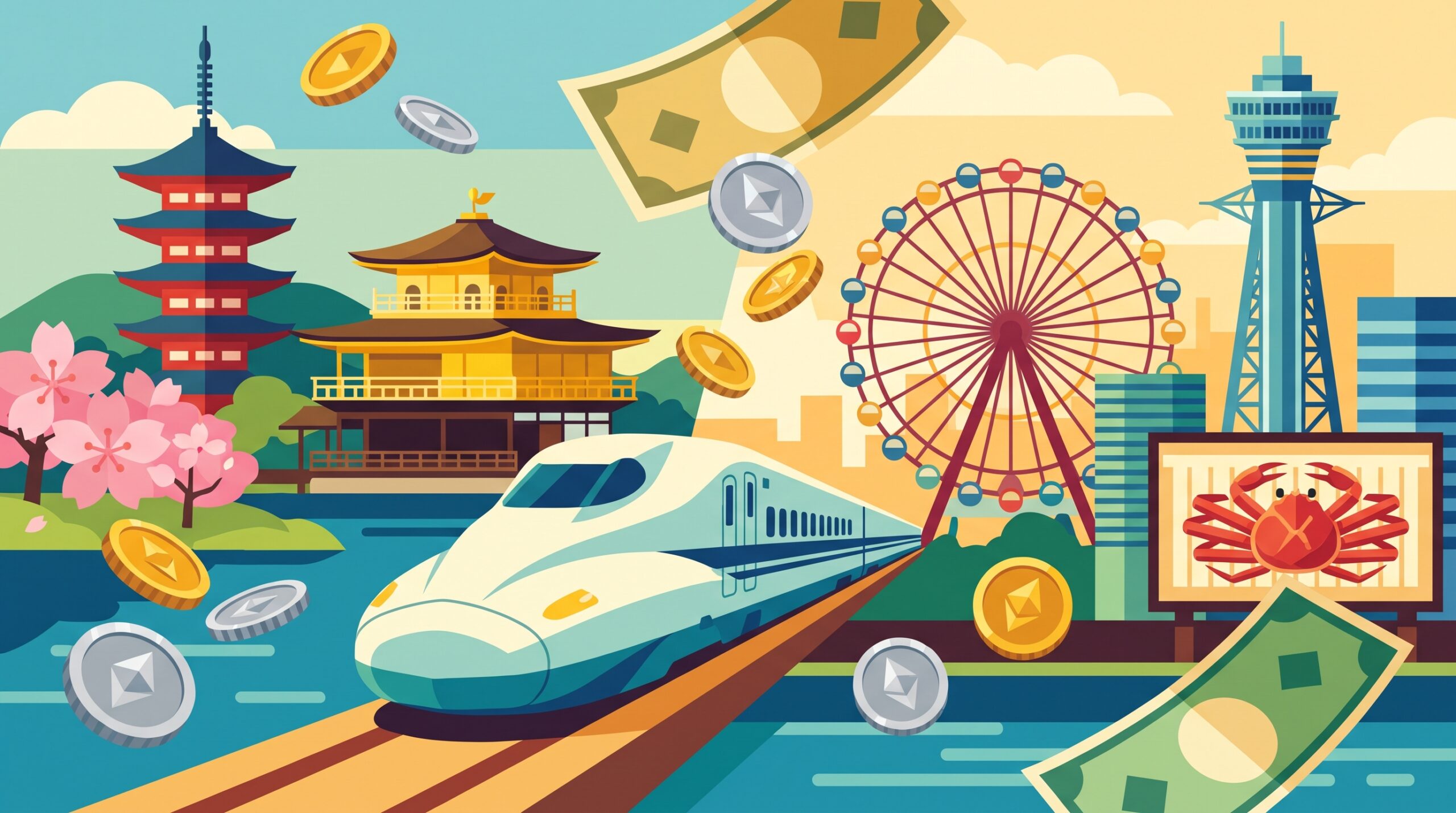
Living in the Kansai region presents a fascinating psychological puzzle. You step off the train in Osaka, and the world feels immediately tangible. Prices are splashed across massive neon signs in bold red and yellow lettering. People talk about money openly, loudly, and with a distinct sense of pride. You take a quick forty-five-minute train ride north to Kyoto, and suddenly, money becomes a ghost. It drives everything, it dictates social standing, yet absolutely nobody mentions it out loud. For foreigners settling into life in Japan, this stark contrast is deeply jarring. You might find yourself wondering why your Osaka neighbors eagerly brag about how little they paid for a secondhand bicycle, while your Kyoto acquaintances subtly dodge any topic remotely related to personal finance or the cost of their perfectly tailored coats.
This is not just a quirky personality difference between two neighboring cities. It is a deep, historical divide. It is the fundamental clash between the pragmatism of the merchant and the refined pride of the aristocrat. We are exploring the complex reality of how two interconnected cities handle their wallets, their reputations, and their daily survival. Navigating the cultural landscape of Kansai requires the same mental preparation as a multi-day trek through the rugged trails of the Suzuka Mountains. As someone who spends weekends assessing trail risks and packing ultralight gear for mountain ascents, I can tell you that surviving the urban jungle requires a similar respect for the local environment. You need to know the terrain, you must assess your resources carefully, and you absolutely must pack the right mindset. Understanding this financial and cultural difference is the master key to surviving, thriving, and spending your money wisely in the region. Whether you are signing a lease for your first apartment near Namba station, trying to figure out where to take visiting friends for dinner, or just trying to decode the unspoken rules of your workplace, you need to read the financial room accurately. Money talks everywhere in the world, but in Kansai, it speaks two entirely different dialects.
Osaka vs Kyoto: A Tale of Two Financial Cultures
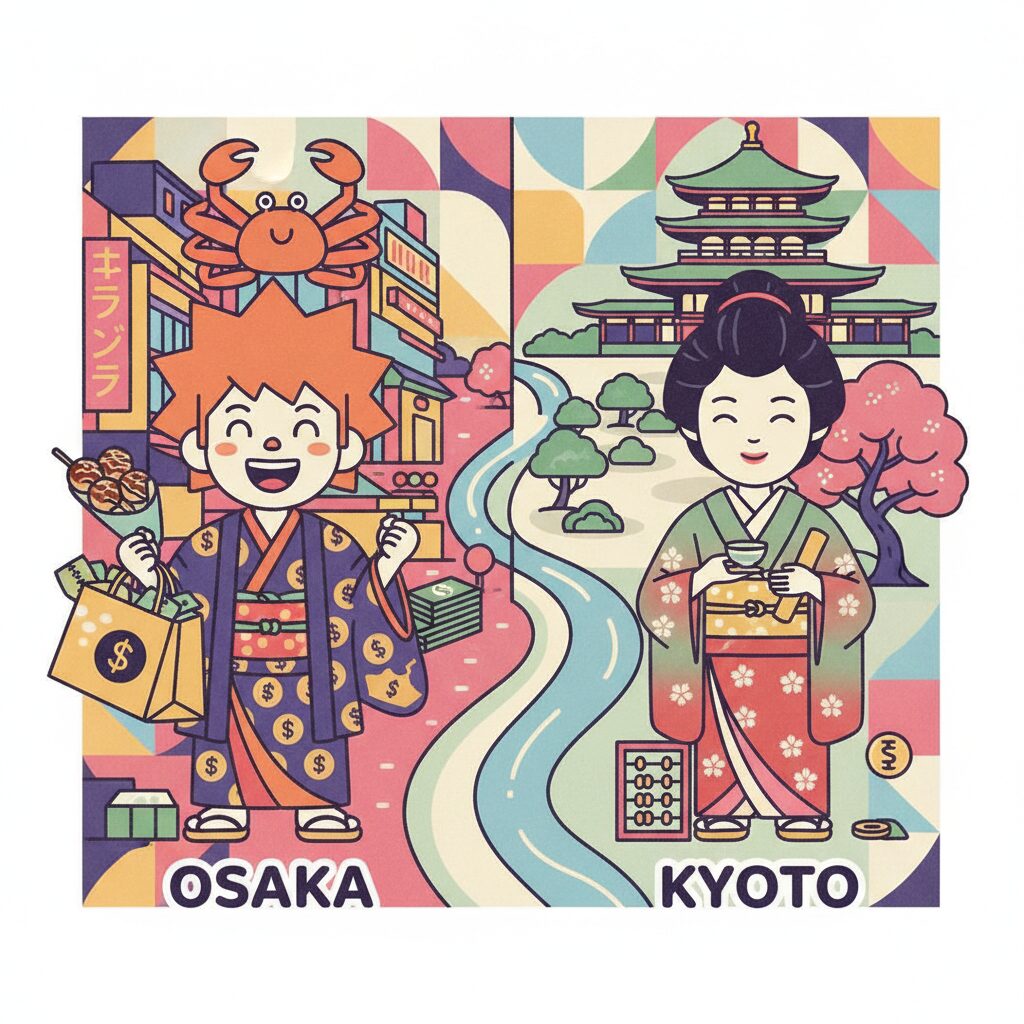
To understand how people in Kansai spend their yen today, you need to look back in time. The behavioral patterns you see in a modern supermarket checkout line are direct descendants of economic systems that have existed for centuries. The local mindset regarding money is deeply embedded in how these cities were built, who held power, and what was regarded as a virtuous way of life.
Osaka’s Merchant Roots and the “Kuidaore” Philosophy
Osaka was historically known as the Kitchen of Japan. During the Edo period, it was the bustling and chaotic hub of national commerce. Rice from all over the country was shipped here to be traded, stored, and sold. The city was shaped by the Shonin, the merchant class. In the rigid social hierarchy of feudal Japan, merchants technically ranked lowest, beneath samurai, farmers, and artisans. They lacked political power and noble lineage but possessed cold, hard cash. This unique position fostered a culture of relentless pragmatism. When you cannot depend on a family crest to navigate life, you rely on your wits, negotiation skills, and an eye for a great deal from afar.
This history gave rise to Osaka’s core philosophy of Kuidaore. Literally, it means to eat oneself into bankruptcy. However, understanding Kuidaore requires looking beyond the literal meaning. It is not about gluttony or financial recklessness. It is a bold declaration of values. People of Osaka believe food is the ultimate, tangible joy in life. It nourishes the body, brings the community together, and provides immediate, measurable satisfaction. An Osaka local will gladly spend a significant portion of their paycheck on a large, lively dinner with friends because the value is clear. The food is hot, the beer is cold, and the laughter is genuine.
Yet, this willingness to splurge on food is balanced by a strong commitment to Shimarisan. Shimarisan is a colloquial concept roughly translating to smart frugality. It is the complete opposite of being cheap. Being cheap means sacrificing quality to save a few pennies. Shimarisan means relentlessly seeking maximum value. A true Osaka resident will spend ten thousand yen on an extraordinary yakiniku dinner without hesitation but will firmly refuse to pay an extra hundred and ten yen for an out-of-network ATM withdrawal fee. They will walk three extra blocks to buy household goods at a cheaper drugstore. When an Osaka person compliments your outfit, the proper cultural response is not simply to say thank you, but to proudly reveal how heavily discounted the item was. Admitting you paid full retail price in Osaka is like admitting defeat. Finding a bargain is a badge of honor, a testament to your street smarts, and a fun conversational icebreaker all at once.
Kyoto’s Aristocratic Legacy and the “Kidaore” Aesthetic
Kyoto represents the opposite end of the cultural spectrum. For over a thousand years, it was Japan’s imperial capital. It was home to the Emperor, court nobles, and the highest-ranking samurai elites. In a city shaped by aristocratic values, money was seen as dirty. The nobility did not concern themselves with the vulgar act of haggling over rice prices; they focused on poetry, tea ceremonies, seasonal aesthetics, and the delicate maintenance of social harmony.
This environment nurtured the philosophy of Kidaore, which means to dress oneself into bankruptcy. Again, the literal translation misses the deeper cultural meaning. Kidaore emphasizes the supreme importance of external presentation and maintaining appearances. In the imperial court, the exact shade of a kimono, the quality of its silk, and one’s bearing determined social standing. Failing in one’s presentation invited social death. Thus, spending lavishly on clothing, home aesthetics, and cultural signaling was not waste; it was a vital investment in social survival.
Today, this appears as Kyoto’s reputed thriftiness, which foreigners often misunderstand. Kyoto locals are not necessarily frugal; they simply spend their money on different, often invisible things. They invest heavily in the unspoken infrastructure of status. They pay a premium to live in specific historic neighborhoods, purchase understated yet incredibly expensive traditional crafts, and spend small fortunes on formal gifts to uphold neighborhood relationships. Importantly, they practice Tatemae, a polite social facade. In Kyoto, discussing money, asking for discounts, or boasting about bargains is highly vulgar. It disrupts the carefully maintained illusion of effortless grace. If you ask a Kyoto local the price of their beautiful ceramics, they might respond with a vague smile and change the subject. The cost is irrelevant to the object’s beauty, and acknowledging the financial transaction diminishes the aesthetic experience.
How Local Money Mindsets Shape Your 2026 Travel and Living Budget
Understanding Shimarisan and Kidaore goes beyond being a mere academic study of cultural history. In 2026, as Japan contends with fluctuating inflation, currency volatility, and the lasting effects of post-pandemic overtourism, these historical philosophies actively influence the tangible, everyday costs of living. The city’s ethos directly impacts the real estate market, grocery prices, and the hospitality sector.
Accommodation Costs: Practical Utility vs. Traditional Luxury
If you plan to sign a long-term lease or book an extended stay, the financial contrast between the two cities becomes striking. Osaka’s real estate market is shaped by merchants’ demand for utility and fair pricing. The city offers a large supply of practical apartments and highly efficient business hotels. Landlords in Osaka recognize that tenants seek value. While the usual Japanese renting challenges remain, upfront costs like Reikin (key money) tend to be lower or more negotiable in Osaka. Osakans strongly dislike paying non-refundable gratitude money just for moving in. Renting here is a straightforward process. The spaces might sometimes lack traditional charm, often featuring standard vinyl flooring and unit baths, but they are functional and priced according to their accessibility to major train lines.
By contrast, Kyoto’s accommodation market is deeply influenced by the Kidaore mindset and the premium placed on heritage. Finding an affordable, modern apartment in central Kyoto is extremely difficult. Strict building height regulations, designed to preserve the historical skyline, limit housing supply. Additionally, cultural expectations to maintain appearances mean traditional Machiya townhouses and high-end Ryokans dominate sought-after areas. Renting in a historically significant neighborhood means paying not just for square footage but a hefty premium for the address, aesthetic, and social prestige. Hidden costs are common. High key money remains standard because living in a beautiful Kyoto property is viewed as an honor granted by the owner. In 2026, with the surge of global tourists flooding Kyoto, this dynamic has grown more intense. The local housing market is tightly squeezed, pushing budget-conscious residents to distant suburbs while the city center becomes an enclave of expensive, aesthetically driven traditional luxury.
Dining Expenses: Street Food Bargains vs. Refined Kaiseki
Your daily food budget will vary widely depending on which side of the Keihan railway you are on. Osaka reigns supreme as the king of affordable, impactful dining. Neighborhoods such as Dotonbori, Tenma, and Shinsekai serve as vibrant tributes to the Kuidaore lifestyle. The streets overflow with vendors selling Takoyaki, Okonomiyaki, and Kushikatsu. The food is fast, hot, and incredibly cheap. The value is extraordinary—you can eat until you are completely full and slightly intoxicated for less than the cost of a single cocktail in Tokyo. Even grocery shopping exemplifies this. Supermarkets like Super Tamade are legendary in Osaka for their blinding neon signs and rock-bottom prices. The store’s appearance is chaotic, loud, and unrefined, but Osaka shoppers prioritize seasonal vegetables at half the price of boutique markets elsewhere.
Dining in Kyoto operates within a completely different financial ecosystem. The pinnacle of Kyoto cuisine is Kaiseki ryori, a traditional multi-course meal that is as much visual art as nourishment. In Kyoto, you never pay just for the calories. You pay for seasonal ingredients, the precise, mathematical carving of a radish, the chef’s historical lineage, and the serene atmosphere of a private dining room overlooking a moss garden. Even casual dining carries a premium. Markets like Nishiki, once functional local grocery strips, have transformed into highly manicured, expensive destinations catering to visitors’ aesthetic expectations. The local Kyoto resident accepts this unwritten rule. They know dining out downtown often entails hidden cover charges (Otoshi) and a general markup for ambiance. While an Osaka resident will relentlessly hunt for the cheapest, most delicious bowl of udon under a noisy train track, a Kyoto resident will quietly pay triple for noodles served in a historically preserved wooden tea house with flawless service.
Shopping and Souvenirs: Finding Deals vs. Funding Heritage
When it comes to buying goods, Osaka’s merchant spirit truly shines. Shopping there feels like a sport. In traditional arcades like Tenjimbashisuji, Japan’s longest shopping street, bargaining remains alive. Although you can’t haggle in modern corporate convenience stores, negotiating prices at local mom-and-pop shops, electronics stalls, and clothing markets is expected and accepted. The phrase “Makarimakka?” (loosely, “Can you make it cheaper?”) is part of daily vocabulary. It’s not a forceful demand but a playful social exchange. The shopkeeper feigns offense, you point out a small flaw, and eventually, a modest discount or free bonus item is offered. The transaction ends with mutual respect.
In Kyoto, trying to haggle is one of the quickest ways to ruin your social standing and offend local sensibilities. The city is built on meticulously preserving traditional crafts. Whether shopping for Kiyomizu pottery, Nishijin textiles, or hand-forged kitchen knives, prices are fixed. These goods embody the Kidaore culture. You aren’t buying simple tools or cloth—you are supporting centuries of inherited heritage. Transactions in these quiet boutiques are respectful and non-negotiable. You don’t ask a fifth-generation artisan to reduce the price of a hand-painted teacup by fifty yen. You either value the aesthetic enough to pay the asking price or quietly bow and leave. The Kyoto shopping experience is about demonstrating cultural refinement by supporting the arts without questioning the cost.
The Ultimate Financial Strategy for the Kansai Region
Living in or exploring Kansai demands a dual-core processor in your mind. You need to switch fluidly between Osaka’s bold pragmatism and Kyoto’s subtle aesthetic sensibility depending on where you are. For foreigners trying to settle here, striking this balance is the key difference between thriving comfortably and rapidly depleting your savings while alienating the locals.
Why Budget-Conscious Travelers and Expats Should Choose Osaka as Their Base
Whether you’re planning a year-long working holiday, pursuing a university degree, or relocating permanently, Osaka is the optimal strategic choice for your home base. Adopting the Shimarisan mindset is incredibly freeing. In Osaka, you don’t have to put on a show. There’s no social pressure about wearing an inexpensive jacket or carrying a non-designer bag. The intense focus on maintaining a flawless aesthetic simply isn’t as strong here as it is in Kyoto or Tokyo. This absence of pretension removes a huge amount of psychological and financial stress from daily life.
By setting yourself up in Osaka, you tap into the real cost-of-living advantages the region offers. You can rent a functional apartment near a major subway line at a fraction of the cost found elsewhere. You learn to shop like locals do, uncovering amazing bargains in the sprawling underground malls of Umeda or the narrow, smoky streets of Kyobashi. You gain the street smarts to spot tourist traps and the confidence to walk away from a bad deal. Living among pragmatists teaches you to use your resources wisely. You save money on everyday essentials—rent, groceries, commuting—so you have extra when you want to indulge. Osaka serves as a dependable, sturdy base camp where you can live comfortably without emptying your wallet to prove your value.
When and Where to Wisely Splurge in Kyoto
Kyoto is not a rip-off, nor a place to be avoided. It is simply a different environment that calls for a distinct spending approach. The benefit of living in Osaka is the financial freedom it grants you to truly savor Kyoto whenever you decide to visit. Taking the Keihan line to the old capital requires leaving your Shimarisan merchant mindset behind. You don’t go to Kyoto looking for deals. You go to experience the pinnacle of Japanese aesthetics, history, and refinement.
This is where you strategically spend the budget you saved in Osaka. In Kyoto, pay the entrance fees for immaculate temple gardens. Book an authentic tea ceremony. Reserve a spot for an exquisite Kaiseki dinner to mark a special occasion. When you spend money in Kyoto, understand that you’re contributing to the Kidaore culture—you’re paying to preserve an atmosphere that can’t be found anywhere else in the world. Realizing that Kyoto’s high costs stem from its dedication to heritage rather than mere profiteering allows you to enjoy the experience without feeling taken advantage of. You learn to balance both mindsets perfectly: using Osaka’s gritty, street-smart practicality for everyday living, while saving your appreciation and your wallet for Kyoto’s unmatched, refined beauty. This truly is the secret to mastering life in Kansai.