

You have just signed the lease on your new apartment or house in Osaka. You are exhausted from hauling boxes, deciphering utility bills, and trying to figure out which colored bag corresponds to which day of the week for trash disposal. Then, you hear a soft knock on your door. You open it to find a smiling older neighbor holding a clipboard and a small pamphlet. They welcome you to the neighborhood, perhaps hand you a box of plastic wrap or a kitchen sponge as a greeting gift, and ask you to fill out a form. You have just encountered the local Jichikai or Chonaikai, the Japanese neighborhood association.
For many foreign residents, this is the first real test of local integration. Do you sign the paper? Do you hand over the monthly fee? Or do you politely bow, pretend your Japanese is worse than it is, and close the door?
Living in Osaka is a fundamentally different experience from navigating the cold, anonymous sprawl of Tokyo. People in Osaka are famously chatty, inherently curious, and culturally predisposed to minding their neighbors business. This warmth is exactly what draws many expats to the Kansai region. It is the city of Kuidaore, of bustling arcades, of standing bars where strangers buy you a drink just for standing next to them. But that same communal spirit manifests in highly structured, deeply traditional local organizations that demand your time, your money, and your physical labor.
Local ward offices and municipal websites will uniformly encourage you to join the Jichikai. They frame it as a civic duty, a necessary pillar of safe, harmonious living. However, they rarely mention the mandatory Sunday morning cleanups, the dreaded rotation of officer duties, or the passive aggressive friction that can arise over the local garbage station. Official city websites are designed to promote enrollment, meaning they completely gloss over the real anxieties of modern residents. They do not tell you what happens if you simply say no.
This guide is designed to strip away the official bureaucracy and look at the real, on the ground reality of neighborhood associations in Osaka. We will explore what you actually get for your money, the heavy responsibilities that come with membership, and the very real consequences of opting out. Whether you are a single professional on a short term assignment, a couple settling down in a quiet suburb, or a student trying to minimize expenses, you need to understand the social mechanics of your neighborhood before you make a decision.
Should You Join the Jichikai in Osaka? Current Trends and Local Realities
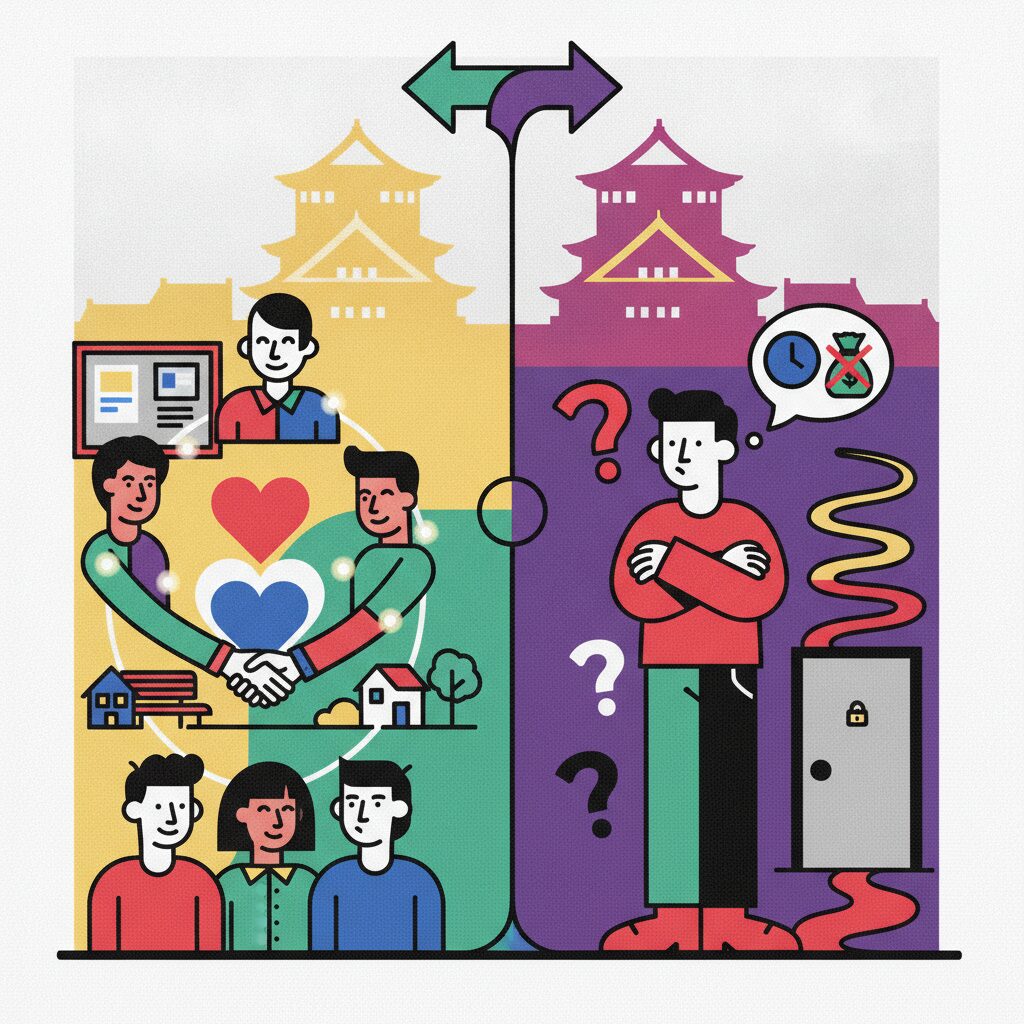
Before exploring the advantages and disadvantages, it is crucial to understand what the Jichikai actually is. Essentially, it is a small, local governing body managed entirely by resident volunteers. Although it works alongside the local city hall, it is not an official government organization. Rather, it is a private mutual aid association. These associations carry significant responsibilities, acting as a bridge between city infrastructure and individual households.
The Declining Yet Persistent Enrollment Rates in Osaka
If you hesitate to join, you are not alone. Throughout Japan, especially in urban centers like Osaka, Jichikai enrollment rates have been steadily declining over the past twenty years. Young professionals, dual-income households, and foreign residents often see the association as a relic of the Showa era. Nowadays, people prioritize their privacy and free time above almost all else.
In Osaka City, overall enrollment is around half the population, though this varies greatly depending on the ward. If you live in a modern high-rise in Kita Ward or Chuo Ward, you might never encounter a Jichikai representative. In these large condominium complexes, a separate management fee typically covers maintenance and garbage collection, making the traditional neighborhood association almost invisible. However, if you live in more traditional, residential areas like Higashinari, Asahi, or in sprawling suburban cities such as Sakai, Higashiosaka, or Yao, the neighborhood association remains very active. In these areas, opting out of the Jichikai is noticed, discussed, and often frowned upon by the older generation who continue to uphold the neighborhood’s social fabric.
Understanding the Difference Between Jichikai, Chonaikai, and Mura
You might hear different terms after moving in. Jichikai and Chonaikai essentially refer to the same organization, with the terminology varying according to historical neighborhood boundaries. Sometimes, these are further divided into Han or Kumi, small groups of about ten to twenty households that represent the organization’s lowest level.
Osaka residents are highly pragmatic. Unlike Tokyo, where maintaining polite distance is paramount, Osaka locals often ask personal questions directly. This means the Jichikai here can feel somewhat intrusive but also much more sincere. When they invite you to join, it’s partly because the city requires them to maintain membership numbers, but also because they genuinely want to know who lives nearby in case of emergencies like fires or earthquakes.
The Tangible Benefits of Joining Your Local Osaka Association
It’s easy to write off the neighborhood association as an outdated club for retirees with too much free time. However, there are significant, practical reasons why these groups persist and why many families actively choose to join. The benefits may not be immediately apparent until a crisis occurs or you try to become deeply involved in the local culture.
Community Coordination for Disaster Preparedness and Crime Prevention
Japan is a nation prone to natural disasters, and Osaka is no exception. The threat of typhoons sweeping through Osaka Bay or a major earthquake is ever-present. When disaster strikes, local authorities simply lack the capacity to check on every resident. This is where the Jichikai demonstrates its critical value.
Neighborhood associations keep updated lists of who lives where. They know which households have elderly residents with mobility issues, which homes have young children, and which apartments house foreigners who might not understand emergency announcements broadcasted over city loudspeakers. Jichikai funds are heavily invested in local disaster supplies, including helmets, emergency food, flashlights, and portable toilets stored in the community center or parks. Additionally, members conduct nighttime patrols; you might hear them walking through the neighborhood during winter, clapping wooden blocks and calling out reminders to turn off space heaters. This grassroots crime and fire prevention effort is a substantial benefit that directly enhances your street’s safety.
The Unspoken Politics of Garbage Collection Areas
This is perhaps the most contentious aspect of neighborhood associations in Japan. Unlike many Western countries where you wheel your plastic bin to the curb in front of your home, Japanese garbage collection is highly communal. Residents carry transparent bags to a designated location, usually a street corner covered by a heavy mesh net designed to keep crows and stray cats away.
What the city doesn’t openly share is that, while municipal trucks collect the trash, the physical space of the garbage station and the net covering it are almost always purchased, managed, and maintained by the Jichikai. When a crow tears into a food waste bag on a hot Tuesday morning in July, it’s the Jichikai members on duty who grab brooms and buckets to clean the area. By paying your dues, you contribute to maintaining this essential shared infrastructure. Being a member grants you the social right to use the station without facing the disapproving glare of neighbors cleaning up around your trash.
Building Genuine Connections Through Neighborhood Events
Living abroad can be incredibly isolating. If you want to escape the expat bubble and experience authentic Japanese community life, the Jichikai is your golden ticket. Throughout the year, the association organizes events that mark the seasons’ rhythms. There are summer Bon Odori festivals when streets close, lanterns are hung, and locals dance in yukata. There are winter mochi-pounding gatherings where children surround wooden mortars.
Osaka residents love their festivals. The atmosphere at these local, non-commercial events is incredibly warm. By participating, you’ll quickly find yourself embraced by neighborhood grandparents who will learn your name, greet you at the supermarket, and keep an eye on your home when you’re away. For families with children, these events are invaluable for integrating kids into the local social network beyond the structured school environment.
The Drawbacks, Duties, and Hidden Burdens of Membership
If the benefits are so significant, why are people leaving the Jichikai system? The reason lies in the substantial demands on time, money, and social obligation. The modern Japanese economy requires long working hours, and the last thing a tired worker wants to do on their only day off is attend a mandatory neighborhood meeting about streetlamp maintenance.
Paying the Monthly Dues and Understanding Average Costs
Joining is not free. Jichikai fees, known as Chokaishi, vary greatly depending on where you live in Osaka. On the lower end, you might pay two hundred to three hundred yen a month. In some wealthy suburban neighborhoods, or areas with large, complex festival floats to maintain, the fee can soar to over a thousand yen monthly. Sometimes, this is collected as a lump sum of six thousand to twelve thousand yen once a year.
For a wealthy family, this is a minor expense. For a university student or a part-time worker, handing over several thousand yen to an association that seemingly does little more than circulate a clipboard can feel like extortion. The lack of transparency about how these funds are used is a common frustration. While a portion goes to the city and the Red Cross, much of it covers local administrative costs, leaving younger residents questioning why they are subsidizing tea and snacks for elder committee meetings.
The Dreaded Rotation of Officers, Group Leaders, and Chores
This is the main reason residents dread the Jichikai. The association is entirely volunteer-run, but volunteering is mandatory if you are a member. The neighborhood is divided into small groups, and the role of the Hancho or Kumicho, the group leader, rotates every year or two.
When your turn comes, you can’t simply say you’re too busy. As group leader, you become the neighborhood tax collector. You have to go door to door, physically asking your neighbors for money. You must attend monthly meetings at the community hall, often scheduled on Sunday mornings and lasting hours as minor grievances are debated endlessly. You have to coordinate local festival duties, which might include standing in the sweltering heat directing traffic. You are also assigned to the garbage cleanup roster. For a foreigner working full time and who may not be fully fluent in reading complex Japanese administrative documents, becoming Hancho is a source of great stress.
Navigating Neighborhood Relationships and Social Pressures
The warmth of an Osaka neighborhood can quickly feel suffocating. The Jichikai relies on a system of consensus and intense social harmony. If you speak out against a tradition or suggest that a meeting could simply be an email, you will face a wall of polite but firm resistance. Gossip is the currency of local neighborhoods. If you fail to sweep the garbage station properly on your assigned day, or if you refuse to pay your dues after joining, everyone will know by the next afternoon.
There is heavy psychological pressure from being constantly observed. The need to conform, to apologize for minor infractions, and to engage in lengthy, superficial pleasantries with people you may not actually like can be exhausting. For those who view their home merely as a place to sleep between work shifts, this enforced socialization is the ultimate disadvantage.
What Happens If You Do Not Join? Myths, Troubles, and Realities
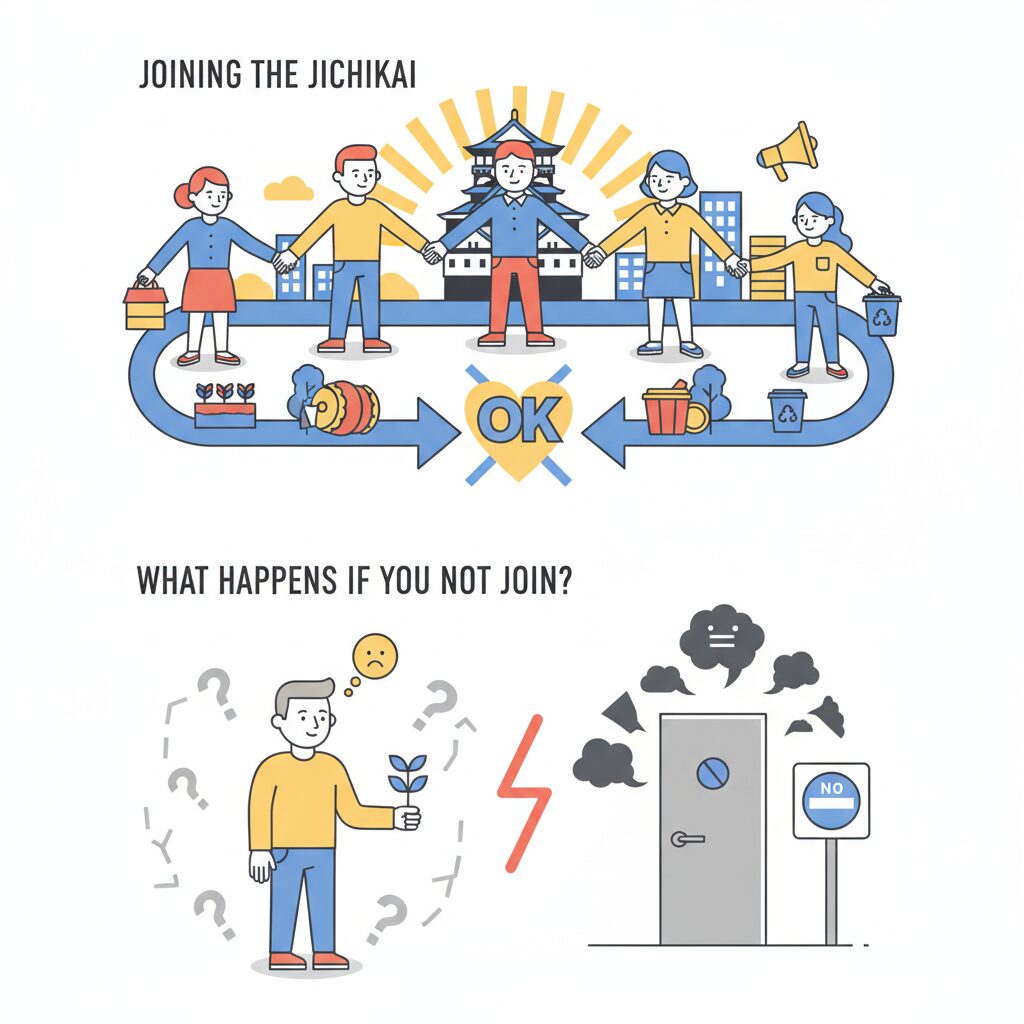
Given the heavy obligations, many newcomers simply decide to opt out. The local city hall will tell you it is voluntary, which is legally accurate. The Constitution of Japan guarantees freedom of association, meaning no one can compel you to join the Jichikai. However, the situation on the ground is far more complex, and opting out comes with unspoken consequences.
Will You Really Be Barred from Using the Local Garbage Station?
This is the most frightening rumor for new residents, and it is entirely based on reality. Because the Jichikai often owns the mesh net and manages the cleaning schedule for the garbage station, some aggressive associations explicitly inform non-members that they cannot dispose of their trash there. They argue, with some logic, that it is unfair for non-members to use a facility maintained by the time and money of dues-paying members.
Legally, the city is responsible for collecting your garbage. If a Jichikai forbids you from using the local station, you should contact your local ward office immediately. The city will usually step in, but it rarely compels the Jichikai to accept you. Instead, the city often instructs you to leave your garbage directly in front of your property for individual pickup. This may seem convenient until you realize you now have to buy your own heavy-duty crow net and store the smelly garbage on your small doorstep rather than down the street. This creates immediate, visible tension with your neighbors, clearly marking you as the outsider who refused to cooperate.
Missing Out on the Kairanban Circulars and City News
One of the main functions of the Jichikai is distributing the Kairanban. This is a physical clipboard passed from house to house. It contains flyers about upcoming road construction, changes in garbage collection schedules during holidays, local health checkups, and neighborhood festival information. You read it, stamp your personal seal on the routing slip to confirm you saw it, and physically carry it over to your next-door neighbors’ house.
If you do not join the association, the clipboard skips your house. You are effectively cut off from the extremely local information network. In the digital era, this is becoming less problematic, as major city announcements are available on the municipal website or via LINE. However, very specific local news, such as a spike in bicycle thefts on your street, will not reach you.
Emergency Support and Treatment at Evacuation Shelters
There is a persistent, dark rumor that if you are not in the Jichikai, you will be denied entry to evacuation shelters during an earthquake. Let me be perfectly clear: this is false. Public shelters, usually local elementary schools, are run by the city and are open to absolutely everyone, regardless of nationality or neighborhood association membership.
However, the reality of surviving a disaster depends heavily on local support. In the chaotic hours immediately following an earthquake, before the military or city officials arrive, the Jichikai takes roll call. They check on the damaged houses of the people they know. If you are not on their roster and they do not recognize your face, no one will come searching through the rubble for you. They prioritize their members. Furthermore, when the Jichikai distributes its privately stockpiled supplies, such as emergency tarps or extra water, they naturally allocate them to the paying members first. You will not be denied basic municipal aid, but you will miss out on the crucial first layer of community support.
How to Join the Jichikai and Navigate the Paperwork
If you have considered the advantages and disadvantages and concluded that joining is the best way to ensure your peace of mind and become part of your Osaka community, the process is generally simple, though quite analog.
Approaching Your Local Block Leader or Landlord
Don’t expect to register online. The Jichikai is highly localized and paper-based. If you live in a rented apartment, the easiest initial step is to ask your landlord or the real estate management company. In many newer buildings, the landlord serves as the Jichikai liaison and may even include the monthly fee in your communal building charge.
If you live in a standalone house or an older apartment building, take a stroll down your street. Look for a house with a small wooden or plastic plaque beside the front door labeled Chonaikai-cho or Hancho. Knock on their door, introduce yourself, and express your interest in joining. They’ll be delighted. You will receive a simple paper form asking for your name, address, phone number, and the names of those living with you. You’ll also be informed of the monthly fee and the payment method, which often involves paying cash directly to the group leader.
Consulting the Ward Office When You Are Completely Lost
If you can’t determine who is in charge and your neighbors aren’t helpful, visit your local ward office. Every ward office in Osaka, from Naniwa to Yodogawa, has a community promotion desk. Provide the clerk with your address, and they will identify the specific Jichikai boundary you belong to. They will then give you the contact details for the association president. The city government actively encourages your participation, so they are very helpful in arranging these connections.
How to Politely Decline Membership Without Making Enemies
Perhaps you are a student staying in Osaka for only one year, or maybe you work night shifts and sleep throughout the day, making Sunday morning cleanups completely impossible. If you decide that the Jichikai is not for you, it is important to decline with care. A blunt or harsh refusal will label you as a troublemaker and provoke hostility.
Osaka culture values straightforwardness, but it remains within the framework of Japanese politeness. The secret to a successful refusal is a sincere apology paired with a solid excuse. Avoid complaining about the fees or saying you find the association pointless. Instead, attribute your decision to your personal circumstances.
When a representative visits your door, bow politely. Accept any small gift they offer, but firmly refuse the paperwork. You can explain that your work schedule is highly irregular, that you are temporarily assigned here by your company, or that you often travel for extended periods and therefore cannot fulfill the required duties. Apologize sincerely for any inconvenience and express regret that you cannot join the community efforts.
If they insist, maintain a steady stream of polite apologies without showing frustration. Simply say you cannot commit the necessary time and do not want to cause problems for the group by failing to contribute. By framing your refusal as an effort to protect the group from your own unreliability, you significantly ease the rejection. Eventually, they will give up; while you might become the subject of some gossip, you will have set your boundaries without igniting neighborhood conflict.
Your Lifestyle Dictates Your Decision
There is no single definitive answer to the Jichikai dilemma; it requires balancing the desire for community support with the need for personal freedom.
If you are moving to a quiet Osaka suburb to raise a family, buy a house, and settle down for the next thirty years, joining is almost essential for your social survival. The minor inconveniences of paying dues and attending meetings are far outweighed by the strong, protective connections you will build with your neighbors. Your children will have safe local festivals to enjoy, and you will have a network of allies when a typhoon causes a power outage.
On the other hand, if you are single, working long hours, and renting a small apartment in a busy ward like Minami or Umeda, the Jichikai offers little practical benefit. The fees may seem like a burden, and the responsibilities will be difficult to meet. In these highly transient neighborhoods, anonymity is the norm, and skipping the association will hardly be noticed, as long as you properly manage your garbage disposal through the city.
Living in Osaka means finding your rhythm amidst its chaotic, vibrant streets. The people here are exceptionally loud, incredibly funny, and deeply loyal to their own. The neighborhood association is simply a formal expression of that loyalty. Understand what is expected of you, consider what you are willing to contribute, and make the decision that lets you enjoy this incredible city on your own terms.








