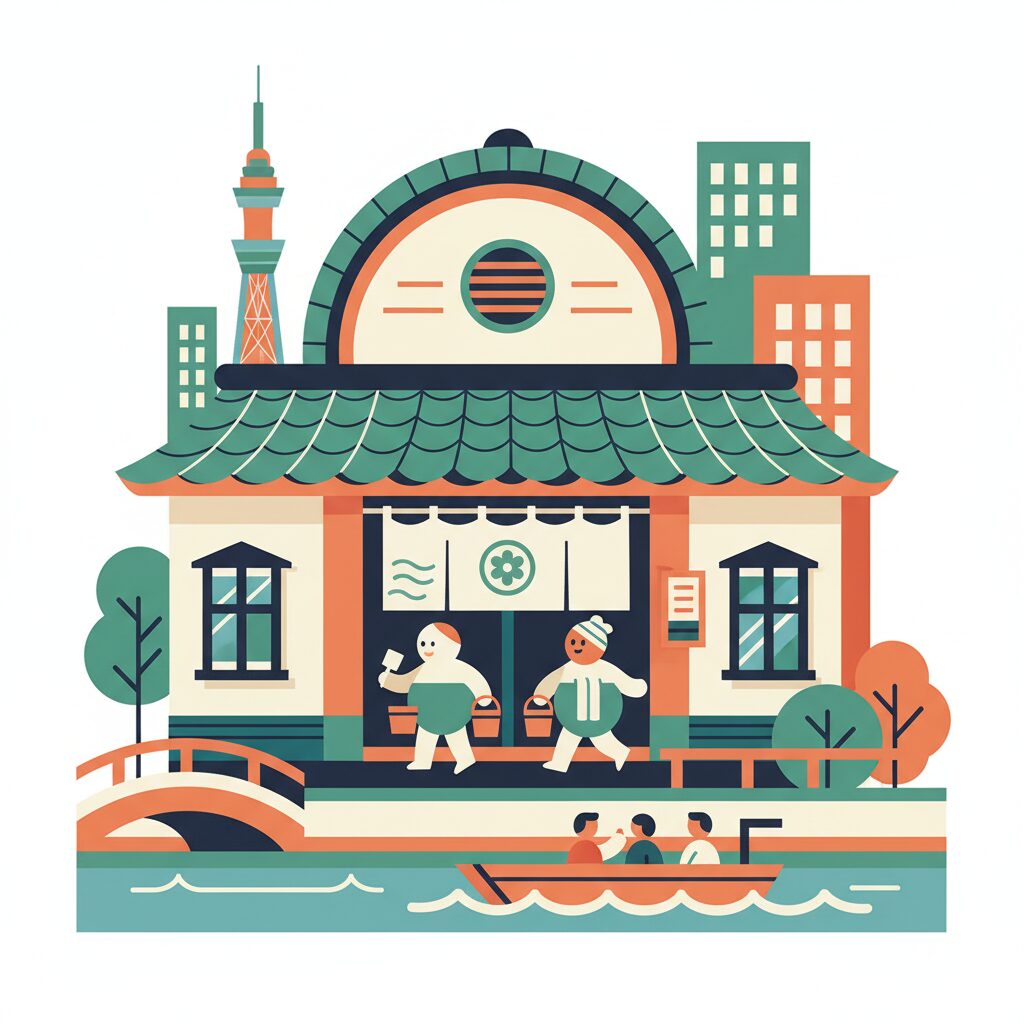
You see them tucked away on quiet side streets, nestled between apartment buildings and family-owned restaurants. A plume of steam escaping from a tall chimney, a soft light glowing behind a sliding door, and the distinctive split curtain, or noren, swaying gently in the evening breeze. This is the neighborhood sentō, the public bathhouse, and for many foreigners, it remains a charming but enigmatic part of the urban landscape. It’s easy to walk past and dismiss it as a relic, a holdover from a time before every home had its own shower and bath. You might wonder, who actually goes there anymore? And why?
The answer is, a lot of people. And the reason why cuts to the very heart of what daily life in Osaka is all about. This isn’t a tourist attraction. This isn’t a luxury spa. The sentō is the city’s unofficial living room, a place of social connection and mental reset that a private bathroom could never replace. It’s where the unspoken rules of Osaka society play out in real-time, where hierarchies dissolve in the steam, and where the city’s true character—loud, practical, and deeply communal—is on full display. Forget what you think you know about quiet, meditative Japanese bathing. The Osaka sentō is a different beast entirely. It’s a place to scrub away the grime of the day, sure, but more importantly, it’s where the neighborhood comes to talk, to laugh, to complain about the Hanshin Tigers, and to simply be together. It’s a ritual that’s less about hygiene and more about humanity. To understand the sentō is to understand a fundamental rhythm of this city, a daily unwinding that keeps the community gears turning.
To truly grasp this communal rhythm, one must also explore other local institutions like the vibrant Komagawa Nakano Shotengai.
More Than Just a Bath: The Sentō as a Social Hub
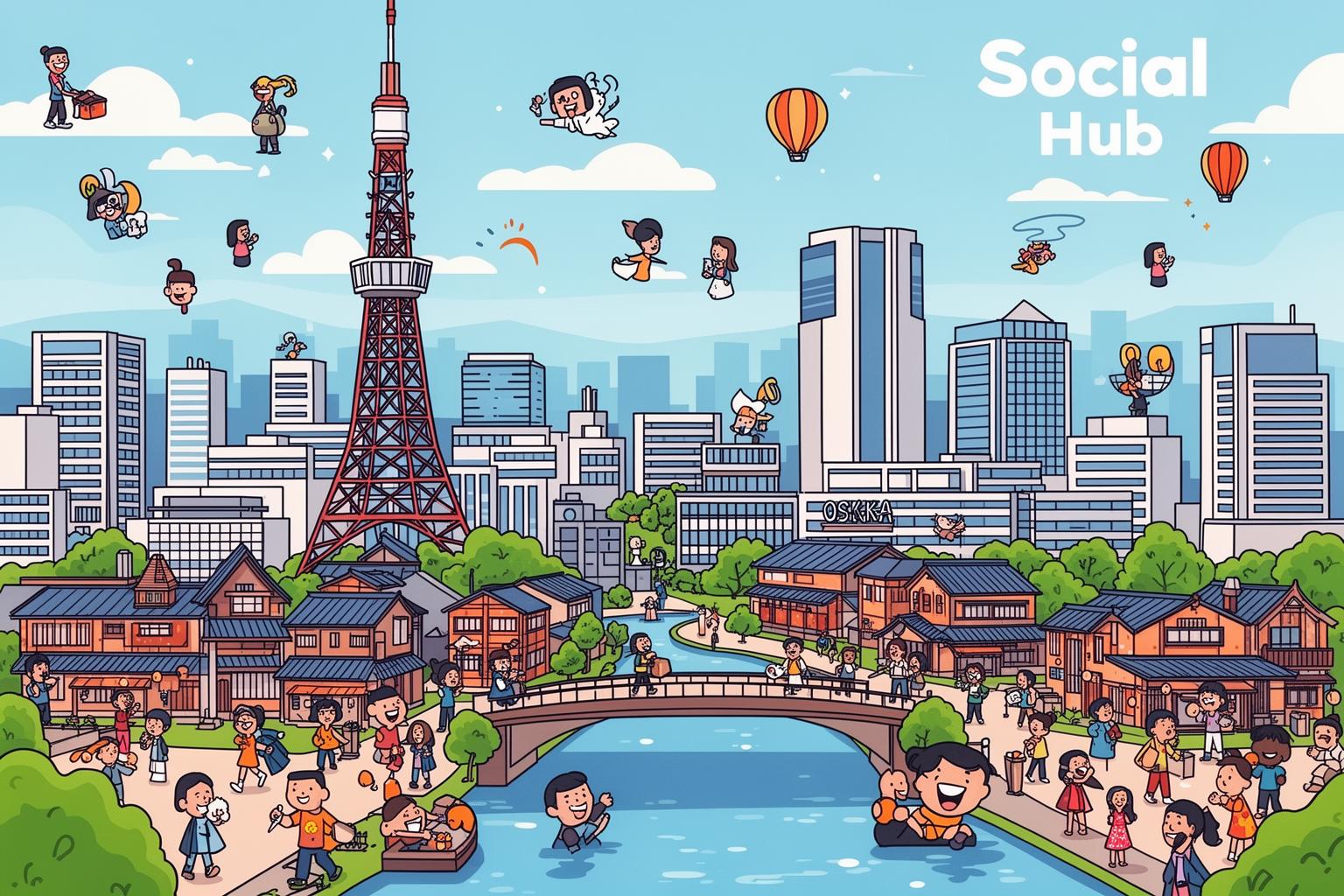
To understand the role of the sentō in Osaka, you must let go of the Western notion of a bath as a private, solitary activity. Here, it’s a communal performance. It’s a space designed for social interaction, where the boundaries between public and private dissolve in the most profound way. The steam doesn’t just warm the room; it melts away the social barriers we carry throughout the day.
The “Third Place” Before It Was a Concept
Sociologists describe the “third place” as a location that is neither home (the first place) nor work (the second place), where people can gather, connect, and foster community. Think of cafes, pubs, or public parks. In Osaka, the sentō has filled this role for centuries, long before the term ever emerged. It’s the original social network, a living, breathing forum for the neighborhood.
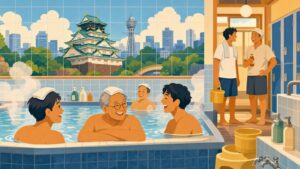
Step into the changing room on any evening, and you’ll see a cross-section of local life revealed, both literally and figuratively. You’ll spot a tattoo-covered craftsman chatting with a salaryman about the rising cost of gas. You’ll hear a group of elderly women, the obachan who are the real matriarchs of these spaces, debating the best place to buy daikon radish. You’ll observe fathers patiently teaching their young sons the right way to wash before entering the bath. This is where information flows, gossip is exchanged, and bonds are strengthened. It’s a place dense with social interaction. While sentō culture exists in Tokyo, it often has a quieter, more reverent atmosphere. People share a soak, but the interactions tend to be more subdued and reserved. In Osaka, however, the energy is turned up. Conversations are louder, laughter more boisterous, and engagement far more direct. People aren’t just sharing the water; they are actively participating in a collective social experience.
The Unwritten Language of the Wash Basin
The entire ritual is guided by a set of unwritten rules, a choreography everyone seems to know instinctively. Watch how people move, and you’ll gain insight into the Osaka mindset. It begins with the iconic small yellow plastic washbasin, the kerorin oke. It’s more than just a bucket; it marks your personal space within a communal setting.
You claim an empty washing station, a low plastic stool in front of a faucet and showerhead. The dance commences. You arrange your soap, shampoo, and towel. You take care to control the spray from your shower to avoid hitting the person next to you. When finished, you meticulously rinse your stool and surrounding area, leaving it spotless for the next user. This isn’t simply politeness; it’s about preserving the collective kibun, or mood. It’s a display of mutual respect and shared responsibility. It reflects how Osaka society operates: a delicate balance between asserting individual needs and being acutely aware of how you affect others. There’s an efficiency and pragmatism to it all. No wasted motion, no unnecessary fuss. Just a shared understanding of how to keep the system running smoothly. It’s a silent conversation that says, “I’m here, you’re here, let’s make this work.” This is the heart of the city’s practical, community-minded spirit.
Decoding the Osaka Sentō Experience: A Step-by-Step Breakdown
For a newcomer, the sentō can seem intimidating. The absence of clear instructions, the unspoken etiquette, and the whole being-naked-with-strangers aspect can be daunting. But once you grasp the rhythm, it becomes a deeply comforting and straightforward ritual. Breaking it down reveals not only how to bathe, but also how to navigate the social currents of the city.
The Entrance: Noren, Getabako, and the Bandai
Your journey starts the moment you go through the noren, the fabric curtain marking the entrance. Usually, it’s blue or navy for men (男) and red or pink for women (女), a clear and simple distinction. Passing through the curtain is a symbolic step, leaving the outside world and its worries behind.
Crossing the Threshold
Inside, the first thing you’ll see is the getabako, a wall of small lockers for your shoes. You slide your shoes inside and take the wooden key, often a chunky, well-worn piece with a number carved into it. This is the initial act of trust that defines the sentō experience. You entrust your shoes to the establishment, and in return, you join a system based on mutual respect. There is no attendant overseeing the shoe lockers; the system works because everyone agrees to uphold it. The clatter of the wooden key in your hand is the opening note of the sentō symphony.
The Transaction: It’s Not a Spa, It’s a Utility
Next, you approach the reception. In older sentō, this might be a traditional bandai, an elevated platform where the owner sits, overseeing both the men’s and women’s changing rooms. More commonly now, there’s a simple front desk. Here, you pay the bathing fee. It’s a standardized, government-regulated price, typically under 500 yen. This price is crucial, cementing the sentō’s role not as a luxury or special indulgence, but as an essential public utility, as vital and accessible as a bus ride. The person behind the counter, often an elderly owner who has witnessed generations of families come and go, is the gatekeeper of the establishment. The exchange is rarely silent or anonymous. They might comment on the humidity, ask about your work, or simply say a warm “okini” (thank you in Osaka dialect). This is the moment you’re welcomed into the neighborhood’s inner sanctum. If you’ve forgotten your supplies, this is where you can buy a small bar of soap, a single-use shampoo packet, or rent a towel. But take note: the regulars—the true locals—always bring their own. A small plastic or woven basket holding their personal soap, shampoo, razor, and a tenugui towel is the quiet badge of a seasoned sentō-goer.
The Changing Room (Datsuijo): The Great Equalizer
After paying, you enter the datsuijo, the changing room. This is where the social dynamics of the sentō truly come alive. It’s a space of shared vulnerability and surprising comfort. The air is warm and humid, carrying the scent of soap and the sound of a television, which is almost always on.
Your Basket, Your Kingdom
You’ll find a wall of lockers, some old-fashioned wicker baskets on shelves, others simple metal lockers with keys. This is where you shed your clothes along with your social status. The president of a company and a part-time convenience store worker become equals here. There is a profound democracy in the datsuijo. It’s a space where pretense is impossible. People move with a casual lack of self-consciousness that can be jarring for newcomers but is ultimately liberating. They chat openly, stretch, weigh themselves on large, old-fashioned analog scales that have been there for decades, and catch up on the day’s news from the TV in the corner. The television is a key focal point, a shared reference whether it’s a Hanshin Tigers game, slapstick comedy, or the evening news.
The Pre-Bath Rituals
Before entering the bathing area, observe the locals. Many perform a crucial pre-bath ritual: hydration. They pull a cold drink from one of the vintage refrigerators or modern vending machines lining one wall. The selection is classic: glass bottles of milk (plain, coffee, or fruit-flavored), yogurt drinks like Yakult, or sports drinks. This isn’t just casual refreshment; it’s practical wisdom, preparing the body for the heat of the baths and sauna. It’s a small, smart step marking the difference between a novice and a veteran.
The Main Bathing Area: Rules, Rhythm, and Relaxation
Pushing through the next door, you enter the main event: the bathing area. The immediate sensation is overwhelming—a blast of hot, humid air, the echo of running water, and bright, sterile light reflecting off endless tile. This is the heart of the sentō, a space with its own sacred choreography.
The Kakeyu and the First Wash
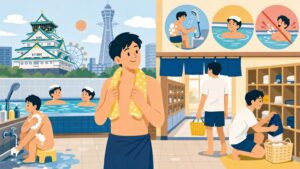
Just inside the door, you’ll see a large basin of hot water with ladles for kakeyu. You scoop some water and pour it over your body, starting with your feet and moving upward. This serves two purposes: it helps your body acclimate to the tubs’ temperature, and acts as a preliminary rinse, a gesture of respect for the shared water. After the kakeyu, you move to the washing stations. Here is the most important, non-negotiable rule of the sentō: you must wash your entire body thoroughly with soap before even thinking about entering the tubs. This cardinal rule, when broken, immediately marks someone as an outsider. You sit on the low plastic stool, turn on the faucet, and scrub. The etiquette is subtle but important. You keep suds and splashes confined. When finished, you rinse your stool and bucket, turn off the water, and leave the station ready for the next person. It’s a seamless, efficient process built on decades of shared practice.
Navigating the Tubs: A Tour of Heat
Now clean, you enter the tubs. A typical Osaka sentō offers a variety, each with a different experience. There’s usually a main tub of very hot water, the atsu-yu, heated to a scalding 42-44 degrees Celsius. There might be a slightly cooler tub, the nuru-yu, for those preferring a longer, gentler soak. Then come speciality baths. You’ll often find a jetto-basu, a jet bath with powerful water streams to massage your back and legs. And then there is the infamous denki-buro, the electric bath. Two metal plates on opposite sides of a small tub pass a low-voltage electric current through the water. The sensation is strange—a tingling, vibrating, muscle-contracting buzz that is both shocking and, for some, deeply relaxing. Trying the denki-buro is a rite of passage. It feels like a perfect metaphor for Osaka itself: intense, slightly shocking, not for the faint of heart, but with a weird, undeniable charm.
The Sauna: The Silent Sweat Lodge
Many sentō also feature a small dry sauna. Here, the etiquette shifts. While the main bathing area can be social and chatty, the sauna is often a place of quiet endurance. A small TV is usually mounted inside, with its sound muted or very low, and occupants sweat in shared silence. You typically grab a small mat to sit on from a stack by the door and place it in a designated bin for used mats when you leave. Outside the sauna, there is always the mizu-buro, the cold plunge pool. For many, the ultimate ritual is the cycle of sauna heat, intense sweating, followed by a bracing, gasp-inducing plunge into icy water, then a moment to rest before repeating. It’s a powerful physical reset that leaves you feeling light, clear-headed, and utterly refreshed.
The Post-Bath Cool Down: The Second Social Act
The ritual doesn’t end when you get out of the water. The post-bath period is equally important—a time for the body to cool down and for social bonds to deepen.
The Rehydration Station
Back in the changing room, the first order is rehydration. This is where the vending machine and refrigerator really shine. The undisputed post-sentō drink king is coffee milk, kōhī gyūnyū, served in a classic glass bottle. There’s a specific, almost ceremonial way to drink it: stand with feet apart, one hand on your hip, and down the bottle in a few quick gulps. It’s a picture-perfect cliché because it’s so universally practiced. The cold, sweet drink after the intense bath heat is a sublime experience, the perfect punctuation to the entire ritual.
Lingering in the Datsuijo
The changing room now shifts from a place of transition to one of relaxation. People don’t just dress and leave. They linger. They sit on the vinyl-covered benches, in front of large, powerful fans, letting cool air dry their skin. They may read a sports newspaper, finish watching TV, or continue the conversation started in the bath. This is the final act of unwinding. The body is clean, the mind calm, and now it’s time to gradually re-enter the world. It’s in these quiet, lingering moments that the true community of the sentō is felt—the shared experience has created a temporary bond, a sense of collective well-being carried by everyone as they don their street clothes and step back into the night.
The Osaka Flavor: What Makes a Sentō an Osaka Sentō?
While public baths can be found throughout Japan, the experience in Osaka carries its own distinct character, a unique flavor that mirrors the personality of the city and its people. It’s a bit rougher around the edges, more straightforward, and considerably livelier.
“Atsu-yu” and the Osaka Temperament
Osakans are known for being sekkachi, which means impatient or hurried. This trait even shows in their bathing habits. Many Osaka sentō feature famously hot water, known as atsu-yu. The goal isn’t to soak slowly in lukewarm water for an hour; it’s to take a quick, intense, and deeply warming bath that heats you through and through. It’s about efficient relaxation. Get in, get hot, get out, and feel refreshed. This practical approach—aiming for maximum effect in minimal time—is a hallmark of the Osaka mindset. It’s not about delicate rituals; it’s about getting the job done, even when that job is relaxing.
The Soundscape of the Sentō
While a Tokyo sentō may sometimes feel as quiet as a library, an Osaka sentō is closer to a bustling marketplace. The sound of water rushing from faucets, the clatter of plastic buckets on tile, the deep hum of jet baths, and, above all, the lively chatter of voices fill the space. Conversations echo through the steamy air. In the changing room, the TV is almost always on, showing game shows or baseball commentary. This isn’t a place for silent reflection. It’s a vibrant, noisy environment full of energy. For Osakans, who flourish on stimulation and social interaction, this dynamic atmosphere is not a distraction but a source of comfort.
The “Obachan” Network: The Keepers of the Culture
The direct, no-nonsense spirit of Osaka is perhaps best embodied by the obachan, the older women who act as the sentō’s unofficial guardians. They are a formidable presence, preserving tradition and enforcing unwritten rules. If you slip up, expect to be corrected—and not subtly. An obachan might approach you and plainly say, “You missed a spot washing your back,” or “Don’t let your towel touch the bathwater.” For those used to more indirect Japanese communication, this can be startling, even feel rude or intrusive. But in Osaka, it’s a form of care. It’s not meant to embarrass but to teach, ensuring everyone follows the rules that keep the shared space pleasant for all. Their straightforward, pragmatic communication style is about identifying problems and fixing them on the spot. This sometimes brusque but genuinely well-meaning guidance is pure Osaka.
The Art and Architecture: Function Over Form
Many sentō in the Kanto region around Tokyo are renowned for their large, beautiful Mount Fuji murals above the main bath. While some Osaka sentō feature similar artwork, many focus more on functionality than ornate decoration. Their designs tend to be utilitarian—simple tilework, practical layouts, and sturdy, durable fixtures. The charm of an Osaka sentō lies less in fancy decoration and more in its smooth operation as a social hub. Yet many older buildings themselves are architectural gems, featuring grand, sweeping miyazukuri roofs reminiscent of Shinto shrines or detailed tile work on their exterior walls. These bathhouses are more than just places to bathe; they are neighborhood landmarks, physical symbols anchoring the community’s history and identity.
Common Misunderstandings and How to Fit In
For foreigners, the sentō can be a minefield of potential cultural missteps. Knowing a few key points can turn an awkward encounter into a wonderful, immersive experience.
It’s Not an Onsen (and That’s Completely Fine)
This distinction is fundamental. Onsen are natural hot springs, heated geothermally and rich in minerals. Sentō, on the other hand, are public bathhouses using heated municipal tap water. Some foreigners might view the sentō as a less authentic or inferior version of the onsen, but this is a misunderstanding of its purpose. The onsen is often a destination, a place you travel to for special occasions or vacations. The sentō is a daily necessity, woven into everyday life. Locals don’t visit sentō for mineral benefits; they come for the community, the ritual, the unique combination of baths like the denki-buro, and sheer convenience. It’s about accessible, daily wellness—not a geological phenomenon.
Tattoos: Osaka’s Take
The “no tattoos” rule causes anxiety for many visitors to Japan. This policy originates from the historical link between tattoos and the yakuza, the Japanese mafia. Across the country, especially in fitness centers, swimming pools, and onsen, this rule is strictly enforced. However, in Osaka, the reality is often more nuanced, reflecting the city’s famously pragmatic and somewhat rebellious nature. In many traditional neighborhood sentō, the rule can be flexible. Owners may not mind, especially if tattoos are small, non-threatening, and you are clearly a foreigner. Locals tend to be less judgmental than stereotypes suggest. If you remain quiet, respectful, and follow other bathing etiquette, you will probably be overlooked. Osaka often prioritizes minding one’s own business over rigid rule enforcement. That said, a full-body yakuza-style tattoo suit is another story. It’s best to check for signs at the entrance. If unsure, ask or seek out one of the growing number of sentō that openly welcome tattoos. But don’t assume an automatic ban; the reality in many old Osaka neighborhoods is often much more relaxed than official rules imply.
The “Naked” Thing: Moving Past the Awkwardness
For those from cultures where public nudity is taboo, this can be the biggest challenge. The thought of being naked in a room full of strangers can be deeply uncomfortable. The key is to understand the Japanese concept of hadaka no tsukiai, meaning “naked companionship.” This phrase describes relationships free of pretense, where people are open and honest, regardless of social status or rank. The sentō physically embodies this idea. Practically speaking, no one is really looking at you. Everyone is focused on their own routine—washing, soaking, relaxing—not scrutinizing others’ bodies. The best way to overcome self-consciousness is to project confidence. Enter, follow the ritual steps, and focus on the experience—the heat of the water, the jets massaging your back. The awkwardness will fade quickly, replaced by comfort and a sense of belonging.
The Future of the Sentō in a Modern Osaka
Despite its deep cultural significance, the neighborhood sentō faces an uncertain future. Throughout Osaka, and indeed all of Japan, these cherished institutions are vanishing at an alarming pace. Yet, true to Osaka’s spirit, there are signs of resilience and reinvention—a determination to preserve this essential community hub.
A Fading Tradition?
The reasons for the decline are clear. Modern apartments and houses come equipped with private bathrooms, removing the original need for the sentō. The owners, often running family businesses, are aging, and their children frequently choose different career paths. Additionally, the soaring cost of fuel needed to heat vast boilers and huge volumes of water daily is making the business increasingly unsustainable. For every sentō still in operation, there’s another that has closed its doors, its grand entrance locked, its chimney cold. Losing a sentō is more than a business shutting down; it’s the loss of a neighborhood’s heart, a place where generations have bonded, leaving a tangible void in the community’s social fabric.
The New Wave: Reinvention and Revival
But the story isn’t finished. A new generation of owners, designers, and patrons is revitalizing sentō culture. Across Osaka, revitalized sentōs can be found. Some have been stylishly renovated, combining nostalgic touches with modern design to attract a younger clientele. They may offer craft beer on tap at reception, host live music or art events in their lobbies, or collaborate with local artists on branding. These “designer sentō” or “neo-sentō” recognize that survival means offering more than just a hot bath. They provide an experience, a lifestyle, and a sense of community that many crave in today’s disconnected digital world. This adaptive spirit is quintessentially Osaka—a city built on commerce and innovation, one that honors tradition but isn’t afraid to dismantle the old and create something fresh and exciting. The effort to save the sentō exemplifies this spirit in action—a blend of nostalgic affection and pragmatic entrepreneurship forging a sustainable future.
To truly feel Osaka’s heartbeat, venture beyond the bright lights of Namba and the historic castle walls. Explore the residential backstreets as dusk falls. Follow the scent of steam and soap to a glowing lantern and the simple noren curtain. Slide open the door, pay a few hundred yen, and step into another world. The sentō is more than a place to wash; it’s a living museum of the city’s social history, a gymnasium for community spirit, and a sanctuary from modern urban stress. It reveals the true Osaka character in its rawest form: practical, straightforward, communal, and radiating a unique, vibrant warmth. Soaking in a tub of scalding hot water, surrounded by neighborhood chatter, you’ll gain a deeper understanding of the city than any guidebook could offer. You’ll be partaking in the daily unwind, the social reset, the genuine, unfiltered ritual of Osaka life.