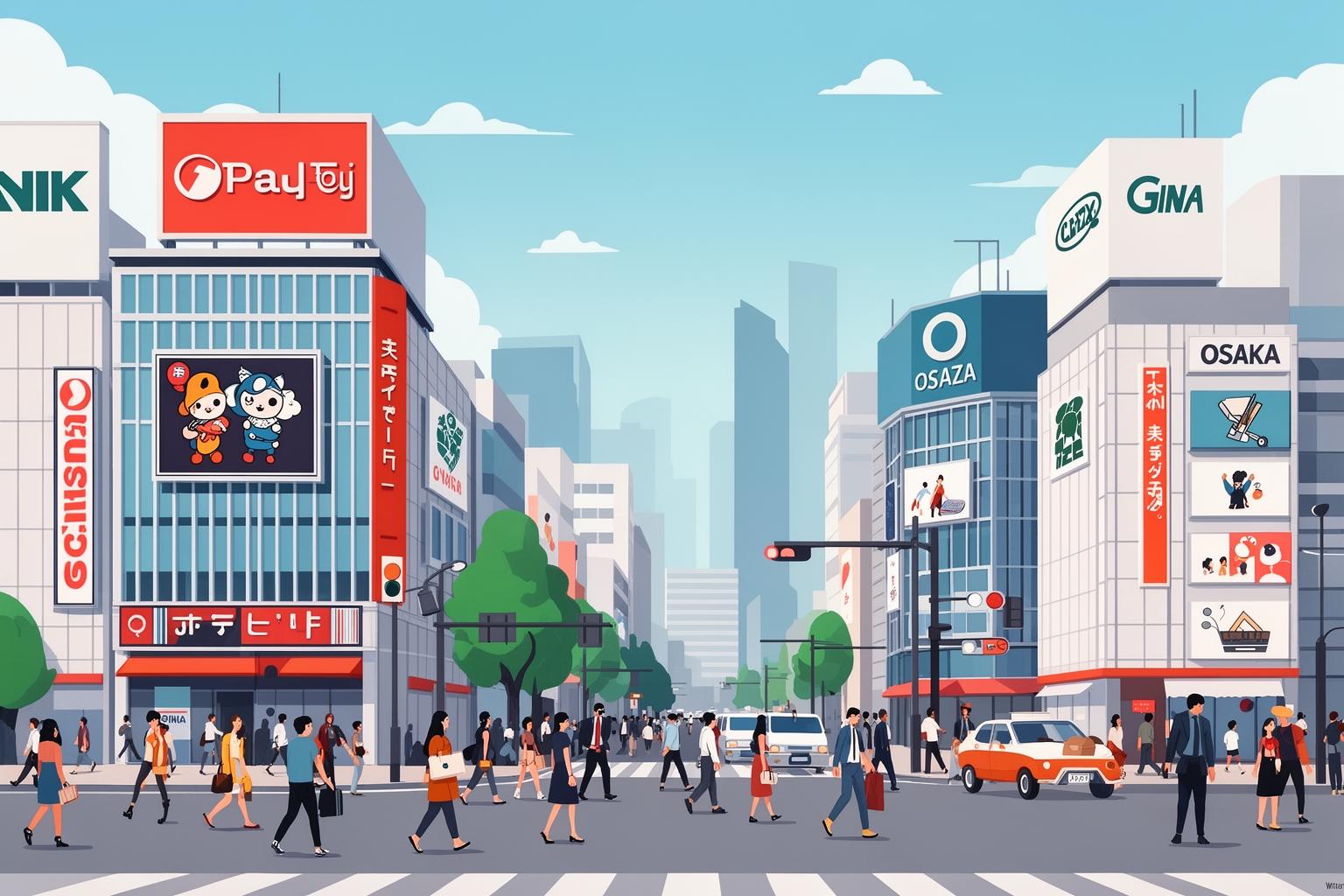
Walk down Ginza’s main drag on a Sunday afternoon. The street is a wide, immaculate river of asphalt, closed to traffic, a temporary paradise for pedestrians. People stroll, they don’t hustle. They carry shopping bags from Mitsukoshi, Wako, and Chanel, paper crisp and logos gleaming. The air smells of expensive perfume and the faint, clean exhaust of a distant side street. Conversations are hushed, a polite murmur against the backdrop of soft, piped-in classical music wafting from a storefront. Every window display is a curated masterpiece, a silent story of elegance and aspiration. This is Tokyo at its most polished, a global symbol of refined taste and flawless execution. It’s beautiful. It’s impressive. And for someone trying to understand the daily pulse of Japan, it’s a beautifully constructed illusion.
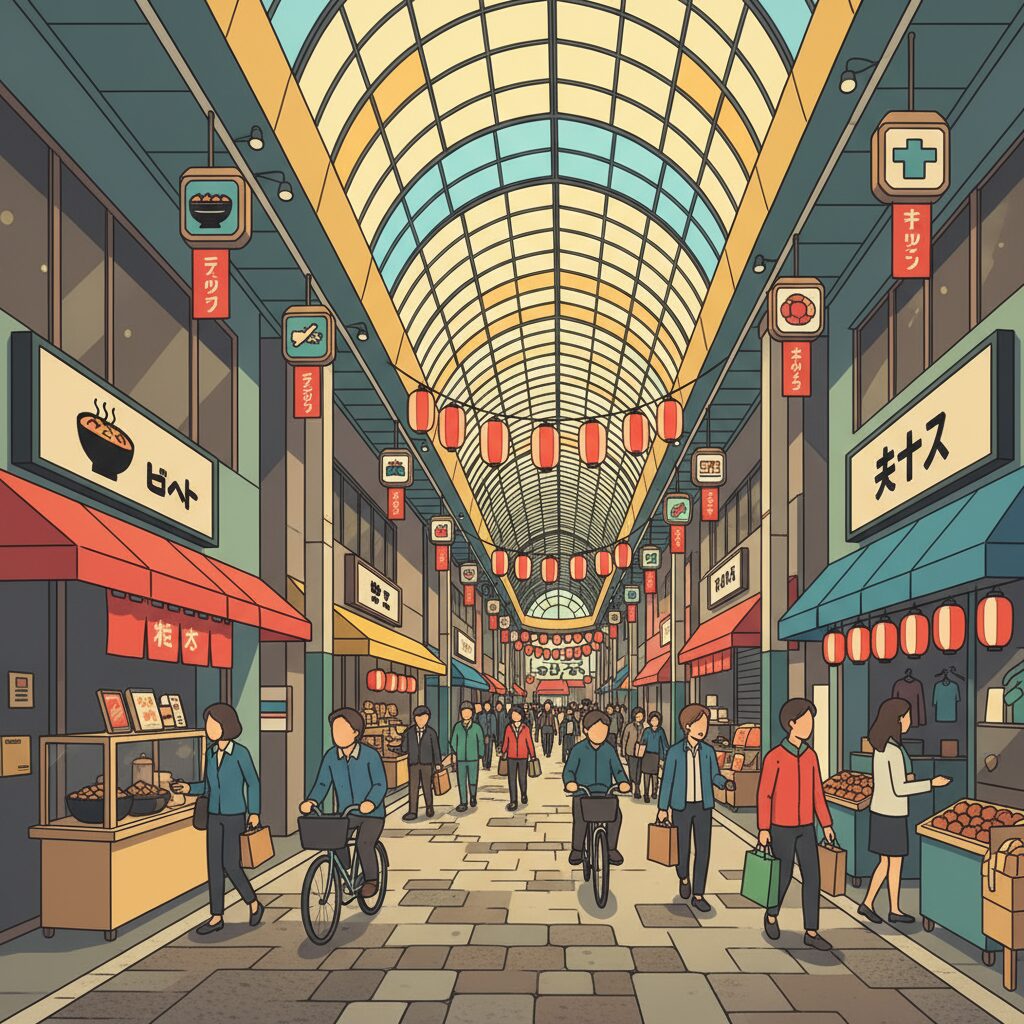
Now, duck under the arched entrance of Tenjinbashisuji Shotengai in Osaka. The illusion shatters. The air, thick with the scent of grilled eel, sweet dashi broth, and cheap fried croquettes, hits you first. It’s a physical presence. The wide, calm river of Ginza is replaced by a narrow, chaotic torrent of humanity. Bicycles, piloted by determined grandmothers with baskets full of daikon radish, weave through the crowd with terrifying precision. Shopkeepers, voices raw and powerful, aren’t suggesting you buy; they’re practically demanding it, their cries of “Yasui de! Mite ya!” (It’s cheap! Look!) a percussive beat in the symphony of sound. The polite murmur is gone, replaced by the hearty, open-throated laughter of friends sharing a joke, the clatter of pachinko balls from a nearby parlor, and the sizzle of an octopus ball hitting a hot griddle. Storefronts aren’t curated displays; they’re explosions of commerce, with goods spilling out onto the walkway, handwritten signs taped to every available surface, and prices slashed with thick red markers.
This isn’t just a difference in style. It’s a fundamental clash of philosophies, a tale of two cities told not through their skyscrapers or temples, but through the simple act of buying and selling. Tokyo’s Ginza offers you a role in a perfectly staged play. Osaka’s Shotengai shoves you onto the stage and tells you to improvise. For anyone living in Osaka, or trying to understand what makes this city tick, grasping the soul of the Shotengai is non-negotiable. It’s more than a covered market; it’s a living, breathing textbook on the Osakan mindset—pragmatic, personal, and profoundly human. It’s where you stop being a consumer and start being part of the conversation. And in Osaka, the conversation is everything.
For a different, more curated side of Osaka’s unique character, explore the city’s retro cafes and vintage shops in Nakazakicho.
The Currency of Connection: Price Tags and People

The most immediate and revealing difference between Ginza and a Shotengai lies not in the price of the goods, but in the cost of the interaction itself. In one, the transaction is a quiet, respectful ritual; in the other, it is a lively, participatory event. This distinction encapsulates how each city defines “value.”
Ginza: The Art of Presentation
Step into a luxury department store in Ginza. The doors glide open with a gentle whoosh. An employee dressed in a crisp uniform, with pristine white gloves, bows deeply. Her greeting is perfectly articulated, a melodic and formal welcome. The atmosphere is cool and serene. Soft lighting is designed to flatter both the merchandise and the people. Here, you’re not just purchasing an item—you’re immersing yourself in an experience. The value offered is rooted in perfection, authority, and implicit trust.
Look at the price tags. They are small, discreet, and printed in an elegant font. The price is definitive—an incontrovertible fact, not an invitation to negotiate. To question it or attempt to haggle would be a serious social faux pas, akin to doubting the skill of a chef in a three-Michelin-star restaurant. It suggests a lack of appreciation for the brand’s heritage, the quality of the materials, and the years of training behind the salesperson’s ability to fold a shirt with geometric precision. The cost includes flawless, silent service, a beautifully crafted bag, a perfectly tied ribbon, and the sensation of being part of a world of luxury.
Human interaction here is exquisitely choreographed. Staff maintain a respectful distance, embodying the concept of ma. They approach only when sensing your need for assistance, moving with fluid, unobtrusive grace. Their language is keigo, the most formal and honorific Japanese, establishing a clear yet respectful hierarchy between customer and provider. They are experts, consultants who guide you to the right choice, explaining the origins of a fabric or the history of a design with quiet authority. The entire experience is designed to be seamless, elegant, and comforting. You pay for certainty—the assurance that what you receive will be perfect. This represents a certain Tokyo ideal: professionalism as art, where emotion is refined into flawless execution. The product is the star, and the human interaction is the sacred ritual framing it.
Shotengai: The Theater of the Deal
Now, approach a fruit stand in a Shotengai. There is no respectful distance. The owner, a woman in her seventies with a gravelly voice and a smile powerful enough to disarm a battleship, stands right there, arranging a pile of strawberries. “Nee-chan, kore oishii de! Amai yo!” (“Hey sis, these are delicious! So sweet!”) she shouts—not just to you, but to everyone passing by. She picks one up, wipes it on her apron, and holds it out. “Tabete mi!” (“Try it!”)
If there is a price tag, it’s a scrap of cardboard with a number hastily written in marker, often with a previous, higher price dramatically crossed out. This number is not fixed; it’s an opening offer. The real price hinges on a complex set of variables: the time of day (prices generally drop as closing nears), how much you buy, whether she knows you, and, frankly, her mood. The game is on.
You might say, “Chotto dake makete kureru?” (“Can you give me a little discount?”). This is not rude; it’s a signal that you want to engage, to play along. She might laugh and refuse, or she might sigh dramatically as if you’re bankrupting her before knocking a hundred yen off. More often, she’ll hold firm on price but, as she bags your purchase, she’ll toss in a handful of slightly bruised mandarins. “Kore, omake!” (“This is a little extra!”) she’ll say.
This is omake culture, at the heart of commerce in Osaka. It signals, “We’re not merely exchanging money for goods; we’re building a relationship.” The bruised mandarins have little economic value to her, but their social worth is immense. They create a small debt of gratitude, a reason for you to return to her stand instead of the next. The interaction is lively, direct, and propelled by a shared understanding that commerce is a human activity, not a mechanical process. Shopkeepers ask about your children, comment on the weather, and offer unsolicited advice on cooking the fish you just bought. Their use of the casual, direct Kansai dialect fosters intimacy and immediacy missing from formal Japanese. To live in Osaka is to learn this language of bargaining, omake, and ongoing, informal negotiation. It’s not simply about saving a few yen; it’s about affirming a connection. Every day, it reminds you that here, value is co-created through conversation, not just set by a price tag.
A Tale of Two Sidewalks: Space, Sound, and Spontaneity
The physical environments of Ginza and the Shotengai differ not only in appearance but also in the distinct ways they shape how people exist within them. One is deliberately designed, the other developed organically, each guiding your movement, what you hear, and how you engage with the surrounding space. One feels like a meticulously curated museum, the other a vibrant, functioning workshop.
Ginza’s Choreographed Calm
Ginza’s atmosphere is defined by order and intention. The sidewalks are broad and uncluttered, paved with smooth, high-quality stone. Trees are planted at precise intervals. Street furniture is minimal and refined. The architecture showcases modern masterpieces, from the gleaming glass fronts of international brands to the dignified stone of historic department stores. A strong sense of visual harmony prevails. Nothing here is accidental. Every detail is crafted to foster an ambiance of luxury and control. Even pedestrian flow is thoughtfully managed. On weekends, when the main street becomes a hokōsha tengoku (pedestrian paradise), the ample open space encourages a leisurely, wandering pace. You have room to breathe, to observe, to appreciate.
Ginza’s soundscape is equally intentional. It is defined by the subtraction of noise. The roar of city traffic is softened by the separation of side streets. There are no street vendors shouting, no competing jingles blaring from tinny speakers. Instead, you hear subtle sounds of affluence: the soft click of expensive shoes on pavement, quiet conversations, and the faint, elegant chime marking a department store’s entrance. Inside these stores, the silence is even more profound— a reverential quiet, punctuated only by polite, modulated staff voices and the soft rustle of tissue paper. This auditory calm is integral to the luxury experience. It encourages slowing down, paying attention, and treating the space and its products with respect. It creates a peaceful bubble, shielding you from the metropolis’s chaos. This environment invites introspection and quiet reflection, turning shopping into a meditative act.
The Shotengai’s Living Arteries
The Shotengai stands as a complete contrast. It is defined by vibrant, unapologetic chaos. The arcade functions as a vital artery rather than a ceremonial boulevard. Its main design aim is not beauty but efficiency—the efficiency of packing as much commerce and life as possible into a confined space, all sheltered from Osaka’s often harsh weather. The walkway is narrow, with every inch contested. Shop displays of vegetables, clothing, and household items spill into the path, creating an obstacle course for pedestrians. Bicycles, delivery carts, and running children are constant, dynamic hazards you learn to navigate with peripheral vision. The floor may be slick from fishmonger water or scattered with discarded flyers. There is no pretense of pristine order because this is a place of work, not mere display.
The soundscape is an intense, multi-layered sensory assault, the true music of the city. Every shop contributes its own sonic signature. The butcher’s rhythmic thump-thump-thump of his cleaver. The electronics store blasting a high-energy, endlessly repeating jingle for a rice cooker. The pachinko parlor adding a steady metallic cascade. Above all are the human voices. Vendors don’t just speak; they project, their calls echoing through the arcade. Friends greet each other with loud, booming laughter, their Kansai dialect rich with expressive, dramatic tones. The sound isn’t a distraction; it is the experience. It creates energy and urgency, declaring that this is where things happen, deals are made, and life is lived at full volume. There is no peaceful bubble here. The city’s chaos is invited in, concentrated, and amplified under the arcade’s roof. Walking through it immerses you in the raw, unfiltered energy of daily life in Osaka, demanding your full attention—not for quiet reflection but for active, engaged participation.
The Soul of the City: Commerce as Culture vs. Commerce as Community
Ultimately, the fundamental difference between Ginza and the Shotengai lies in their purpose. Who are these places meant for, and what role do they fulfill in the life of the city? Ginza is a destination—a stage for showcasing national pride and personal ambition. In contrast, a Shotengai acts as an engine, the vibrant heart of a local neighborhood that addresses the routine, essential needs of everyday life. One is about becoming; the other is about simply being.
Ginza: A Destination for Aspiration
People don’t usually wander into Ginza to pick up milk and bread. They visit Ginza with intention. It’s for special occasions: landmark birthdays, anniversaries, or purchasing significant items such as engagement rings or luxury watches. It’s a place for corporate entertaining, exclusive art gallery exhibitions, or attending a Kabuki performance at the Kabuki-za Theatre. Ginza represents a refined, international image of Japanese culture. It’s the face Japan presents to the world—a face embodying quality, precision, and immense economic strength. Its history is intertwined with Japan’s modernization, rebuilt as a symbol of Western-style progress after the great fire of 1872. It was, and continues to be, a national project.
For individuals, it’s a place of aspiration. You dress up to go to Ginza, presenting a somewhat more polished version of yourself. Shopping there signals success, or at least the hope for it. Foreigners often view Ginza as the quintessential Tokyo, and by extension, Japan. They notice the impeccable service, flawless products, and concentration of wealth, associating these with Japanese culture as a whole. And while this reflects part of the culture, it is the carefully curated, export-quality side. It’s like judging a nation’s cuisine solely by its most expensive restaurants—you experience technical mastery but miss the everyday soul, the everyday comfort food people truly rely on. Ginza is a beautiful and important part of Tokyo, yet it is fundamentally a showroom, not a living room.
Shotengai: The Backbone of Daily Life
In contrast, a Shotengai is the very foundation of the community. It’s not a destination for special occasions; it’s a resource for daily use. Here, you buy ingredients for tonight’s dinner, get your watch battery replaced, pick up a prescription, or buy new everyday shoes when the old ones wear out. Its purpose is deeply rooted in the practical realities of daily life. The covered roof exists to shelter from rain and intense heat, ensuring shopping can continue regardless of weather. The high density of shops is designed for efficiency. Everything about it serves the practical, unglamorous needs of locals who live within walking distance.
But its role goes beyond commerce. The Shotengai is the social fabric of the neighborhood. It functions as a public square, a hub for gossip, and an informal community center all rolled into one. Shop owners aren’t anonymous providers; they’re neighbors. They know customers by name, watch their children grow, and look out for elderly patrons who shop daily. This creates a strong, informal social safety net. If Mrs. Sato doesn’t show up at the fishmonger’s for her usual mackerel, the fishmonger might worry and check on her. This is ningenmi—the human connection—that Osakans cherish. It’s a web of relationships built over years through daily, casual interactions.
Foreigners walking through a Shotengai may see it as a charming, slightly chaotic tourist spot, a place to snap photos of old-fashioned shops. What they often miss is that they are passing through the central nervous system of a community. The mundane transactions occurring around them are strengthening social bonds, exchanging information, and sustaining the neighborhood’s life. This is the part of Osaka that rarely appears in glossy travel brochures, yet it defines the experience of living here. It embodies the understanding that the city is not just a collection of buildings and streets, but a dense, interconnected network of human relationships, forged daily in the lively, messy, wonderful theater of the Shotengai.
What This Means for Living Here
Grasping the contrast between Ginza’s refinement and the Shotengai’s earthiness isn’t merely theoretical; it’s a practical guide to navigating the social dynamics of Japan’s two largest metropolitan areas. It influences how you engage with others, how you cultivate relationships, and ultimately, how you establish your place within the city.
Navigating Tokyo: Reading the Air
Living in Tokyo often feels like living an extended Ginza experience, even in areas far from the city center. There is a strong focus on kuuki wo yomu, or “reading the air.” This unspoken social skill involves understanding a situation and responding appropriately without explicit direction. It demands sensitivity, subtlety, and a commitment to preserving group harmony (wa). The formal, choreographed interactions seen in a Ginza department store represent an extreme example, yet the same principle applies throughout society. Public spaces tend to be quiet. Conversations on trains are discouraged. Direct confrontation is avoided. Most social interactions follow an unspoken script, and your task is to learn your lines and perform them smoothly. It’s a society that values precision, order, and a certain refined reserve. To thrive in Tokyo, you need to become an acute observer and a master of the unspoken language conveyed through gesture, tone, and context.
Navigating Osaka: Joining the Conversation
Living in Osaka requires a completely different skill set. The Shotengai serves as your training ground. Here, reading the air is less crucial than actively joining the conversation. The culture values directness, humor, and eagerness to engage. Waiting for unspoken cues often means being left behind. You are expected to speak up, ask for what you want, express your opinions, and even voice complaints if prices seem too high. This is not perceived as rude but rather as honest and involved. The social currency here is not silent harmony, but active participation.
Consider a simple act like buying vegetables. In a Tokyo supermarket, this is a quiet, efficient process: you select your items, use a self-checkout, and leave. In an Osaka Shotengai, the vendor may stop you and say, “Not that one; this one is better today!” They might go on to explain exactly how you should prepare it. To an outsider, this might feel intrusive, but to an Osakan, it’s a gesture of care. It represents a human connection that transcends a mere commercial transaction. To truly feel at home in Osaka, you must learn to embrace this. You chat with shopkeepers, joke with the person next in line, and graciously accept the omake with a hearty “Ookini!” (“Thanks!”). You understand that the ‘script’ is just a guideline, and improvisation is welcome.
This is the essential choice for any resident. Do you prefer a city that operates with the quiet, seamless elegance of a luxury boutique, or one that thrives on the loud, chaotic, heartfelt energy of a neighborhood market? There’s no right answer. But to genuinely live in and appreciate Osaka, you need to recognize that its spirit isn’t found in polished showrooms or silent temples. It lies beneath the long, cluttered, noisy arcades of its Shotengai, in the midst of a shouted debate over fish prices. It’s a city that invites you not just to observe, but to participate. And if you’re willing to dive in, you’ll discover a community as genuine, resilient, and rewarding as any.