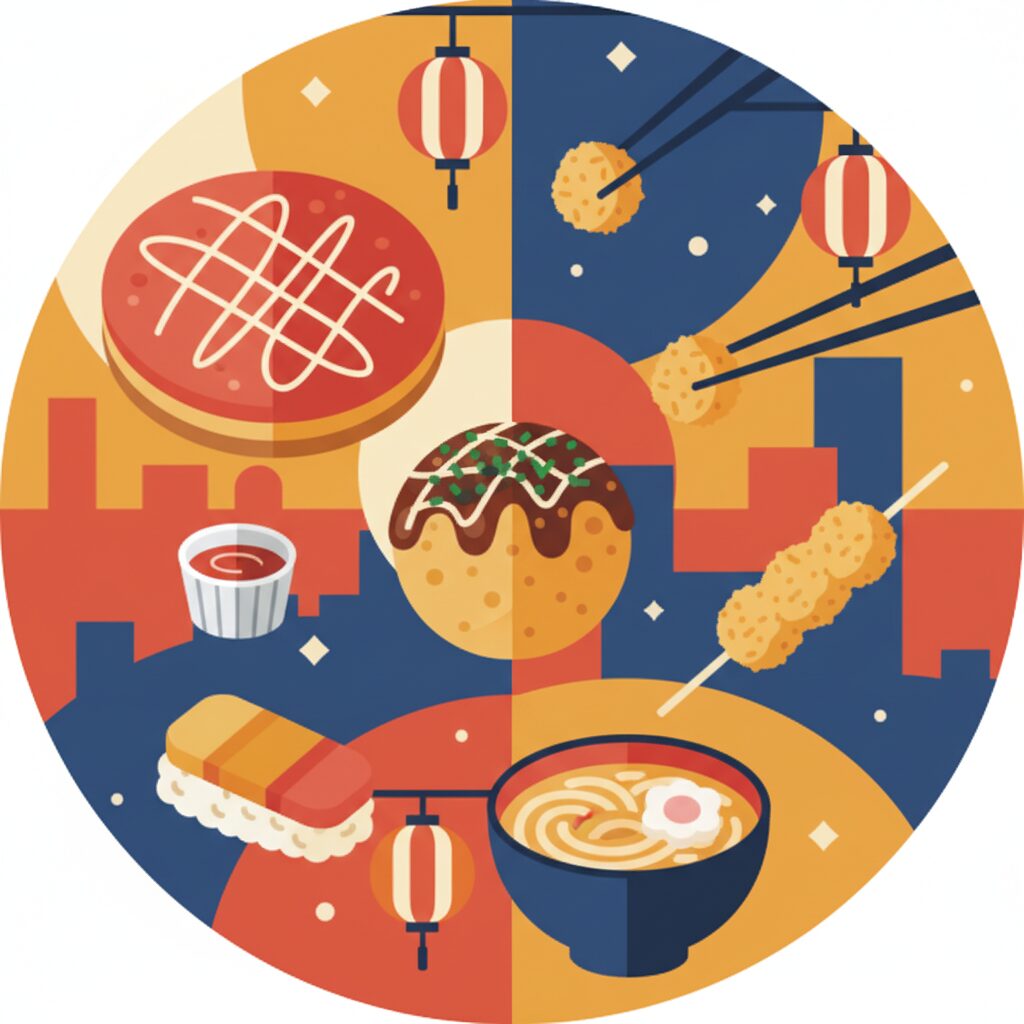
When you first hear about Osaka, you hear about food. You hear about takoyaki, those perfect spheres of grilled octopus batter, sizzling on a hot plate. You hear about okonomiyaki, the savory pancake masterpiece, dancing with bonito flakes. And you hear the city’s unofficial, slightly menacing slogan: Kuidaore. It’s usually translated as “eat until you drop” or, more dramatically, “eat yourself into bankruptcy.” You picture the chaos of Dotonbori, with its giant mechanical crab and the perpetually drumming clown, Taro Kuidaore, and you think, “Okay, these people are serious about gluttony.”
I get it. I thought the same thing. As an event planner from Tokyo, my world was about curated experiences, polished aesthetics, and a certain kind of predictable order. When I started spending more time in Osaka for work, the city felt like a different country. The energy was louder, the colors brighter, the interactions more direct. And this concept of Kuidaore seemed to be at the heart of it all, a chaotic creed of consumption. But living here, watching the daily rhythm unfold not in the tourist hubs but in the quiet residential streets and the sprawling, covered shotengai shopping arcades, I realized we’ve all been reading the signpost wrong. Kuidaore isn’t a command to eat to excess. It’s a philosophy. It’s a deeply ingrained, city-wide obsession with one single, powerful concept: ultimate value-for-money. It’s a daily quest, a game, a form of art. It’s not about how much you can eat; it’s about how well you can live for the money you spend. This isn’t just about food. It’s about everything.
This philosophy of maximizing value extends beyond the dinner plate and into daily routines, where even navigating the unwritten rules of the gomi station becomes a local art form.
The Misunderstood Slogan: From Tourist Trap to Daily Mantra
The phrase itself comes across as aggressive, almost like a direct challenge. Yet to truly understand its meaning, you need to look beyond the cartoonish mascots and flashing neon lights of the city’s entertainment districts. The essence of Kuidaore resides in the ordinary, in the everyday decisions of those who call this city home.
Breaking Down the Kanji: ‘Eat,’ ‘Defeat,’ ‘Fall Down’
Let’s analyze the word: 食い倒れ (kui-daore). The first character, 食 (kui), is derived from the verb “to eat.” The second, 倒れ (daore), comes from verbs meaning “to fall down,” “to collapse,” or “to go bankrupt.” So the literal, straightforward translation makes sense—you eat until your wallet collapses, or until your body gives out. It’s a vivid, dramatic story, perfect for marketing the city as Japan’s wild, fun-loving cousin.
But in everyday conversation, the nuance shifts completely. The “defeat” isn’t a personal loss; rather, it’s a state of surrender to overwhelming excellence and value. You are so thoroughly satisfied and genuinely impressed by the quality and quantity received for the price that you are metaphorically “knocked out.” It’s a knockout caused by pure satisfaction. Imagine discovering a small, family-run udon shop where a giant bowl of tempura udon, loaded with two jumbo shrimp and a variety of seasonal vegetables, costs only 700 yen. You finish every bite, broth and all, recline, and sigh, “I’ve been defeated.” You haven’t gone bankrupt—you’ve won. You’ve reached the pinnacle of dining bliss. That feeling of joyful surrender embodies the true spirit of Kuidaore.
Dotonbori’s Spectacle vs. Neighborhood Reality
Dotonbori is a spectacle. It’s Kuidaore as performance art. The giant pufferfish lantern, the massive gyoza sign, the dragon towering over the ramen shop—it’s all crafted to dazzle the senses and encourage spending. For tourists, it’s a thrilling culinary theme park, hopping from one famous stall to the next, checking off a list of must-try foods. This makes for an entertaining, yet ultimately superficial, take on the concept.
The authentic philosophy reveals itself far from the tourist crowds. It thrives in the sprawling Tenjinbashisuji Shotengai, Japan’s longest covered shopping street. Here, the battle for customer loyalty isn’t fought with oversized signs, but with subtle price tweaks and small acts of kindness. It’s in the side-street butcher selling freshly fried croquettes at 80 yen each, where the elderly woman behind the counter slips an extra piece into your bag with a knowing smile because you’re a regular. That small bonus, that omake, is a vital element of the Kuidaore experience.
A visitor might stroll through Dotonbori and sample takoyaki from three famous vendors, debating which batter is slightly better. Meanwhile, an Osaka local will take the train two stops away to a nondescript stall tucked beneath a railway bridge—unnamed, untouristed—because they know that this particular vendor uses slightly larger chunks of octopus and sells eight balls for 400 yen rather than the usual 500. It’s not just about taste; it’s about knowing you’ve found the perfect balance of quality, quantity, and price. This ongoing pursuit of optimization is the true everyday practice of the Kuidaore philosophy.
The Gospel of “Cos-Pa”: The True Heart of Kuidaore
If Kuidaore is the grand philosophy, then its guiding principle, its daily scripture, is embodied in a simple, powerful, and ubiquitous term: コスパ (kosupa). This loanword, a blend of “cost performance,” stands as the most vital measure for evaluating nearly everything in Osaka. To grasp kosupa is to understand the city’s very essence.
It’s Not About Being Cheap, It’s About Being Smart
This distinction is crucial and often misunderstood by outsiders—including myself when I first arrived from Tokyo. The aim is not to find the absolute cheapest option. Anyone can find cheap. A Tokyoite might praise a 300-yen bowl of plain noodles for its low price. An Osakan, however, would view it skeptically. Where’s the meat? The vegetables? The complimentary side of pickles? While it might be cheap (安い, yasui), its kosupa is terrible.
Kosupa is a comprehensive evaluation, a mental formula that Osakans run constantly and almost subconsciously. It balances price against numerous factors: ingredient quality, portion size, speed of service, staff friendliness, free extras like tea or rice refills, and overall satisfaction. A higher cost can deliver much better kosupa. For instance, a 1,000-yen lunch set featuring grilled fish, delicate chawanmushi (steamed egg custard), sashimi, miso soup, unlimited rice, and post-meal coffee is considered to have god-tier kosupa. In comparison, a plain 700-yen curry rice falls short. The additional 300 yen is not just a cost but an investment in a far superior experience. The goal isn’t saving money—it’s about spending money wisely. Being able to spot high kosupa from afar is a source of great pride and a valued social skill.
The Lunchtime Battlefield: Where Kosupa Reigns Supreme
The fiercest battle for kosupa dominance unfolds during weekday lunch hours. In business hubs like Umeda, Honmachi, or Yodoyabashi, the streets flood with office workers on a mission—not merely to eat, but to conquer. Restaurants respond with an intense arms race of value.
Osaka’s famed “one-coin lunch,” a meal for a single 500-yen coin, is a celebrated institution. Unlike Tokyo, where one-coin lunches might be a simple bowl of noodles or a sparse bento, in Osaka it’s a competitive art form. For 500 yen, you could enjoy a full teishoku (set meal) with a main dish like fried chicken karaage, a bowl of rice, a small side (kobachi), pickles, and miso soup. The restaurant may take a loss on these meals, but it’s a strategic move—an invitation to return for dinner with colleagues and spend more after experiencing exceptional kosupa.
Yet the true lunch champions go beyond price. They compete through extras—those small touches that lift a meal from merely cheap to genuinely great value. The most potent phrase in Osaka’s lunch vocabulary is ご飯お替り自由 (gohan okawari jiyuu)—free rice refills. This is a baseline expectation for any reputable eatery. Some places raise the stakes by offering free raw eggs for making rich tamago kake gohan with your second helping of rice. Others provide self-serve coffee machines, complimentary mini-desserts, or generous soup portions. These perks aren’t just bonuses; they’re declarations of war in the fight for the customer’s yen. An office worker might bypass three perfectly fine restaurants to reach a fourth that offers free refills on the cabbage salad served with their tonkatsu. That is kosupa in action—a deliberate choice to maximize every element of the dining experience.
Kuidaore Beyond the Plate: A Philosophy for Everything
This is where the concept truly flourishes and where Osaka’s character diverges most distinctly from the rest of Japan. The relentless pursuit of value extends beyond restaurants; it is a universal perspective through which the world is seen. From purchasing electronics to selecting an apartment, the principles of Kuidaore and the measure of kosupa dominate.
The Art of the Haggle: Shopping in Osaka
The image of the bargaining Osakan is well-known, and although it’s less overt than in the era of fixed prices and independent shops, the spirit remains vibrant. It has simply transformed. At its core, the listed price is viewed as the starting point for a discussion about value.
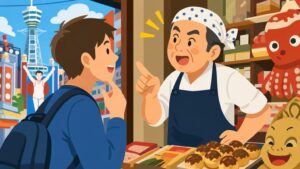
Visit Den Den Town, Osaka’s electronics district and counterpart to Tokyo’s Akihabara. Whereas Tokyo’s Akihabara offers a somewhat sterile experience—you pick your item, pay the advertised price, and leave—the transaction in Den Den Town is part of the experience. Even if the sticker price is firm, the Kuidaore mindset encourages asking for added value. Instead of requesting a discount (makete kuremasen ka?), you ask for a bonus (omake shite kurehen?). “Can you include a case with this?” “How about an extra battery?” “I’m buying the camera—could I get a deal on a memory card too?” This approach isn’t considered greedy but rather a sign of an engaged, savvy customer. Shopkeepers expect it, and the friendly negotiation is part of the process. Walking away with a little something extra is a triumph. You didn’t merely purchase a product; you made a deal. The story of how you scored that free memory card holds as much value as the camera itself.
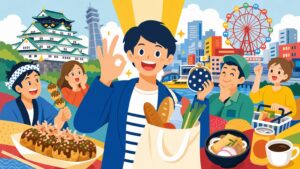
This practice extends to the countless shotengai around the city. At a local vegetable stall, if you buy a few items, the owner might add a free onion or a handful of green onions. It’s a gesture communicating, “I see you, I appreciate your business, and here’s a little extra to prove it.” The culture of omake strengthens the customer-vendor bond and is a core expression of the value-driven philosophy. You receive more than what you paid for, and that is the ultimate aim.
“Mottainai” Amplified: Osaka’s Take on Waste
All Japanese understand mottainai, a deep cultural aversion to waste—the regret felt when food is thrown away or a single grain of rice remains uneaten. In Osaka, this concept is intensified through the kosupa lens. It’s not just about avoiding wasting physical things; it’s about avoiding squandering value and opportunity.
This explains the immense popularity and strategic seriousness with which all-you-can-eat (tabehoudai) and all-you-can-drink (nomihoudai) deals are approached. In Tokyo, these are sometimes viewed as lowbrow, favoring quantity over quality. In Osaka, they are puzzles to be solved, systems to optimize. The aim is to consume strategically in a way that extracts value far beyond the ticket price. It’s a game: start with the priciest dishes, pace yourself, and know exactly what to order to maximize your return on investment. Satisfaction comes not from being full, but from knowing you played the game well and won.
This mindset also underpins the local obsession with coupons, point cards, and time-limited offers. Missing a 10% discount coupon is a real loss. Forgetting to get a stamp on your point card is a small but stinging failure. People map out their day around special sales—not out of desperation, but because the hunt for value is both entertainment and pride.
The Supermarket Showdown
To see the Kuidaore philosophy at its wildest, visit an Osaka supermarket—most famously, Super Tamade. These stores overwhelm the senses: exteriors covered in flashy, multi-colored neon lights flashing endlessly. Inside, aisles are cramped, music blares, and signage is a chaotic mix of clashing colors and handwritten pleas to buy.
This is the opposite of the serene and well-organized department store food halls Tokyo is known for. But Tamade is a kosupa temple, famed for its legendary “1-yen sales,” where, after spending a certain amount, you can buy an item—like eggs, bread, or tofu—for a single yen. Shoppers meticulously plan their purchases just to reach that threshold and claim their 1-yen prize. It’s not about saving 99 yen; it’s the thrill of the hunt and the victory of the bargain. The entire store is a treasure hunt, with shockingly low prices hidden in unexpected corners. Shopping at Tamade is an adventure, not a chore.
This competitive spirit permeates daily life. Housewives faithfully collect and compare flyers (chirashi) from multiple local supermarkets—Tamade, Gyomu Super (bulk goods), Mandai, or Life—designing shopping routes to cherry-pick the best deals: cheap milk at one, discounted vegetables at another, half-price fish at a third. Time and effort don’t matter; the goal is to optimize the weekly grocery budget with the precision of a military campaign.
Real Estate and Rent: The Ultimate Kosupa Decision
This mindset extends to life’s largest financial choices. When selecting a home, kosupa calculations dominate. In Tokyo, prestige and convenience often come first. Living near a major Yamanote Line station or in a trendy neighborhood carries significant social capital. People willingly pay a premium for a smaller, older apartment with the right address.
In Osaka, the approach is more practical. An Osakan viewing an apartment runs a complex calculation in their head: “This place is a 13-minute walk from the station, not 8—that’s a minus. But it’s 15,000 yen cheaper per month, the balcony is twice the size for drying laundry, the kitchen has two gas burners instead of one, and it’s just a 3-minute walk from a Super Tamade and a great bakery. The overall kosupa is far better.” They almost always choose the option offering more tangible, practical value for the money—even if it costs a bit of convenience or prestige. The apartment isn’t just a home; it’s the ultimate deal and the foundation of a value-optimized life.
The Social Fabric of Kuidaore: Communication and Community
The most captivating aspect of this philosophy is how it influences social interactions. The shared pursuit of value forms a foundation of communication, creating a distinctive social dynamic that can feel strikingly different from Tokyo’s more reserved culture.
“How Much Was That?” – A Compliment, Not an Intrusion
In Tokyo, if you arrive wearing a new jacket, a friend might say, “That’s a nice jacket,” and the conversation would move on. Asking, “How much did it cost?” would be seen as extremely rude—a prying, invasive question implying judgment based on spending.
In Osaka, the situation is reversed. A friend will say, “Whoa, that’s a sharp jacket! Soreなんぼやったん?” (How much was it?). This question is not an intrusion but an invitation. It signals genuine interest and, more importantly, serves as a compliment to your shopping skills. The expected response isn’t just the price, but the story behind the purchase: “You won’t believe it. It was listed at 10,000 yen, but it was the last one in my size, and it was the end of the season, so the manager gave it to me for 7,000!” The friend’s role is then to offer crucial affirmation: “Meccha otoku ya na!” (That’s an excellent deal!) or “Kaimon jouzu!” (You’re a skilled shopper!). This exchange is a fundamental social ritual—a way to bond, share knowledge, and mutually uphold the community’s core value: being a savvy consumer is a talent to be celebrated.
The ‘Obachan’ Network: Guardians of Value Information
The high priestesses of the Kuidaore cult are the city’s obachan—middle-aged and elderly women who reign supreme as masters of value. They hold sacred knowledge and serve as living databases of deals. Whether in the shotengai, the local sento (public bath), or chatting on street corners, they form a powerful, informal information network.
This network acts as the city’s real-time news feed for kosupa. “Don’t buy your daikon radishes at that shop today; the one three doors down is 30 yen cheaper.” “The butcher at the arcade’s end is giving away free lard if you ask.” “That new café seems pricey, but their morning set includes a salad and a hard-boiled egg for the price of a coffee.” This isn’t idle gossip; it’s vital economic intelligence shared freely to help the entire community prosper. These women are the protectors of the city’s wallet and enforcers of the Kuidaore code. A shop that repeatedly offers poor value will quickly fall out of favor with the obachan network—a fate few recover from.
Humor as a Transactional Tool
Osaka is renowned for its comedy and the locals’ love of laughter. This isn’t separate from the city’s merchant culture; it is an essential part of it. Humor acts as social lubricant, breaking down barriers and building connections. In transactions, it also serves as a tool.
A playful exchange with a shopkeeper—a bit of banter, a self-deprecating joke, or an exaggerated compliment—can turn a simple purchase into a memorable social interaction. This generates positive feelings and connection, which can often translate into better value. It might not be a discount but could be a small omake, a helpful tip, or improved service. The transaction becomes more than exchanging goods for money; it’s an exchange of positive energy. A good laugh adds value to the experience, enhancing the overall kosupa. This is why service in Osaka often feels more personal, theatrical, and engaging than Tokyo’s formal, polite, but frequently distant service. In Osaka, you’re not just a customer—you’re both audience and potential comedy partner.
The Historical Roots: Why Is Osaka Like This?
This city-wide obsession with pragmatism and value did not emerge suddenly. It is the natural outcome of centuries of history. Osaka’s distinct identity was shaped by commerce, sharply contrasting with Edo’s (modern-day Tokyo) political and military focus.
The Nation’s Kitchen: A Merchant City’s Heritage
During the Edo Period (1603-1868), Japan remained largely isolated from the outside world. In this era, Osaka thrived as the nation’s main trading center. It earned the nickname 天下の台所 (Tenka no Daidokoro), or the “Kitchen of the Nation.” Rice and other goods from across Japan were gathered in Osaka for storage, sale, and redistribution. The city was governed not by samurai, but by a powerful and proud merchant class.
Although merchants were officially ranked lowest in the strict social hierarchy—beneath samurai, farmers, and artisans—they wielded real influence in Osaka. Their value was measured not by birth or swordsmanship, but by business savvy, market insight, negotiation skills, and financial savvy. A practical, rational, and unsentimental approach to money was essential for survival and prosperity. Wasting money was more than just embarrassing; it was a professional failure. This merchant spirit, this profound respect for financial intelligence and the art of the deal, remains the foundation of Osaka’s contemporary culture.
Rice Brokers and the Origins of Futures Trading
This commercial mindset found formal expression in the Dojima Rice Exchange, founded in the late 17th century. It was, essentially, the world’s first organized futures market. Merchants traded “rice tickets,” commitments to deliver rice at a future date for a fixed price. This required a sophisticated grasp of value, supply, demand, and risk.
The entire economy of the city thrived on this advanced reasoning. While Edo’s samurai focused on honor and ceremony, Osaka’s merchants calculated odds and managed risk. This centuries-old tradition of interpreting the world through shifting values and strategic investment endures. The modern Osakan analyzing the kosupa of two different lunch deals is a direct heir to the Edo-period rice broker speculating on the harvest’s future price. The tools may have evolved, but the analytical, value-focused mindset remains unchanged.
Post-War Scarcity and the Spirit of Shotengai
This historical foundation was reinforced by 20th-century experiences. Like many Japanese cities, Osaka was devastated during World War II. In the post-war period of scarcity and rebuilding, the principles of mottainai—avoiding waste—and maximizing limited resources became vital. Neighborhood shotengai (shopping streets) served as community lifelines. People depended on relationships with local vendors for fair prices and quality goods. A spirit of mutual support and resourcefulness flourished. This era solidified the idea that being a savvy consumer was not only a personal virtue but a way to strengthen the community. The collective pursuit of value became a means of survival and recovery, a spirit that still energizes covered shopping arcades today.
So, next time you see the Kuidaore Taro clown banging his drum in Dotonbori, don’t view him as a symbol of mindless indulgence. Instead, see him as the cheerful, slightly eccentric mascot of a city that takes the pursuit of value more seriously than almost anywhere else in the world. He symbolizes the joy of a good meal, yes, but more deeply, he embodies the soulful satisfaction of a great bargain.
Kuidaore isn’t about eating until you collapse. It’s about a relentless, joyful, and deeply clever quest to make the most of every yen. It’s in the free rice refills, the extra onion from the vegetable vendor, the hard-won omake from the electronics store, and the shared chuckle over an excellent deal. To truly understand life in Osaka, you must stop thinking like a tourist and start thinking like a merchant. Begin searching for hidden value. Start calculating the kosupa. When you feel genuine excitement over finding a lunch set with both a small sashimi plate and post-meal coffee for under 1,000 yen, that’s when you know you’re no longer just a visitor. You’re starting to grasp it. You’re on your way to becoming a true Osakan.