The first time it happened, I was completely lost. Standing in line at a butcher shop in the Tenjinbashisuji Shotengai, a covered shopping street that feels like a river of humanity, an elderly woman in front of me pointed at a perfect cut of marbled Kobe beef. It was glistening under the lights, a piece of meat that was more art than food. She looked the butcher dead in the eye and said, with a perfectly straight face, “I’ll take that one. Can you grind it up for my cat?” The butcher, a man with arms like tree trunks, didn’t even blink. He took a deep breath, feigned exhaustion, and sighed, “Ma’am, if your cat eats better than I do, you have to start paying its share of the rent.” The entire line chuckled. The woman grinned, a flash of gold in her teeth, and said, “Fine, fine, just slice it for me then, you cheapskate.” The tension, if there ever was any, vanished. It was a performance, a tiny, two-line play on a Tuesday afternoon. I came to realize this wasn’t an isolated incident; it was the city’s heartbeat, a conversational dance I’d never seen before. This is the world of ‘boke’ and ‘tsukkomi,’ the fundamental rhythm of Osaka life that separates it from every other city in Japan, and perhaps the world. It’s not just about telling jokes; it’s a way of building instant, unguarded community in a country often known for its reserve. Forget what you think you know about Japanese communication; in Osaka, the rulebook is rewritten, page by hilarious page.
To truly immerse yourself in this unique social fabric, consider practicing your own comedic timing at a local standing bar.
The Universal Language of Laughter: Deconstructing Boke and Tsukkomi
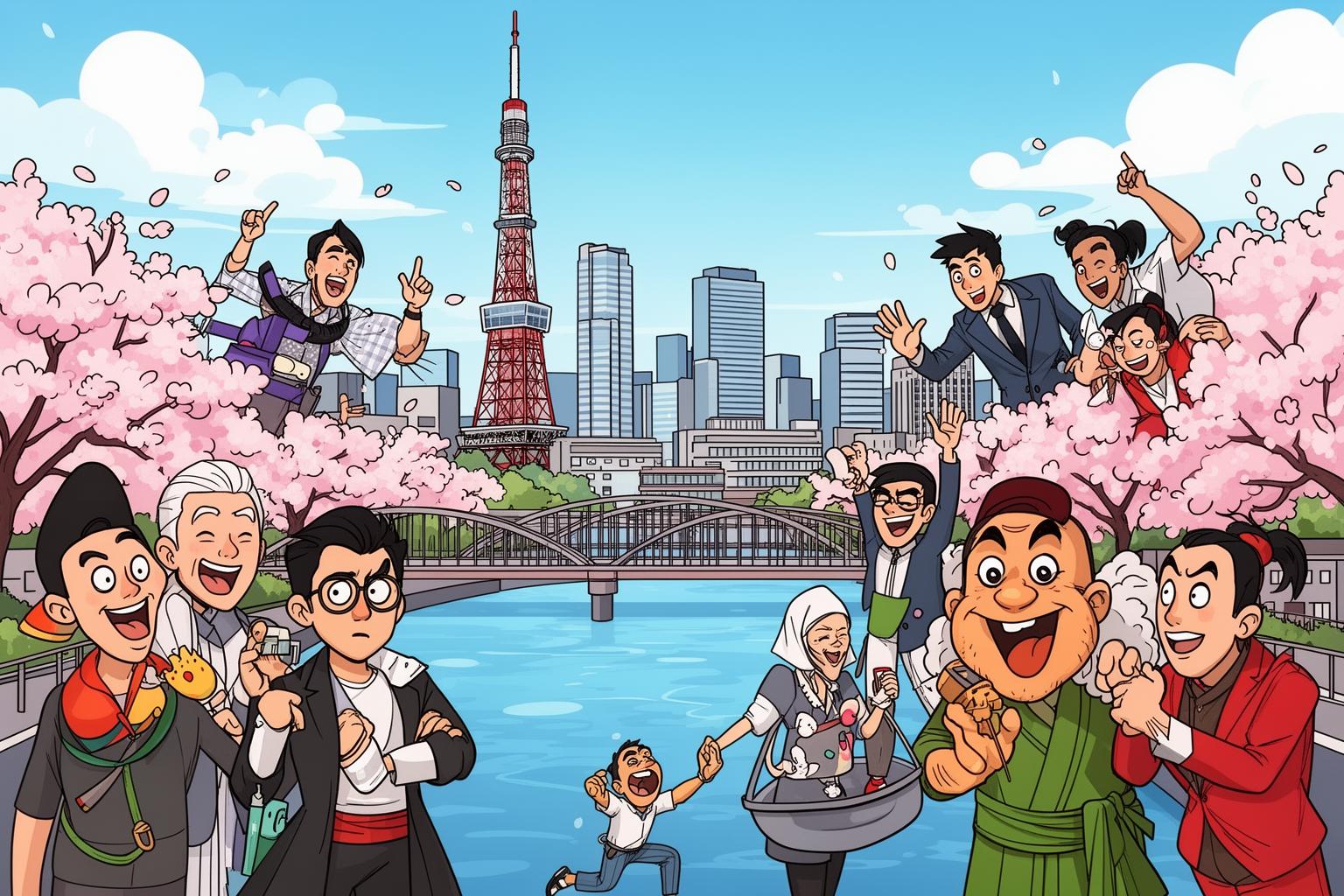
To truly understand Osaka, you first need to grasp the sacred pact between the ‘boke’ and the ‘tsukkomi.’ On the surface, it resembles the straightforward dynamic of a comedy duo, familiar to anyone who’s seen Abbott and Costello or Laurel and Hardy. The ‘boke’ is the fool, the one who utters something absurd, out of context, or simply wrong. The ‘tsukkomi’ is the straight man, who points out the absurdity with a sharp, quick-witted remark, often accompanied by a light, symbolic tap. But in Osaka, this dynamic isn’t just a staged act; it’s the primary way people interact socially. It shapes friendships, shopkeepers’ greetings, and even couples’ arguments. It’s a linguistic and social framework that values wit, speed, and a shared sense of the ridiculous over polite, scripted exchanges. The entire city acts like a stage, and everyone knows their part. Dropping a perfect ‘boke’ is an offering, a gift to the conversation. Delivering a swift ‘tsukkomi’ is accepting that gift and returning it with interest. Missing your cue isn’t merely awkward; it’s a failure to connect on a fundamental Osakan level.
The ‘Boke’: More Than Just the Fool
The essence of the ‘boke’ lies in intentional absurdity. This distinction is crucial for outsiders to understand. The ‘boke’ isn’t truly foolish or mistaken. In fact, they are often the sharpest person in the room, able to spot the surreal in the everyday and present it as a conversational challenge. They are setting a trap, with a perfectly crafted piece of nonsense as bait. It’s both an act of vulnerability and supreme confidence. The ‘boke’ willingly plays the fool, trusting their partner to catch the joke and play along. The aim is to create a small, shared universe of absurdity—a brief escape from logic and expectation. When my neighbor sees me leaving with my camera bag, he might say, “Ah, off to your secret mission as an international spy again?” He knows I’m a photographer, and I know he knows. Yet in that moment, he’s spun a narrative. My response is what counts. Correcting him seriously—”No, Mr. Tanaka, I’m just going to shoot the sunset at the Umeda Sky Building”—breaks the illusion and fails the test. The right response is to join in, building on the absurdity. The ‘boke’ serves the conversation, and it calls for a return.
The ‘Tsukkomi’: The Sharp-Witted Straight Man
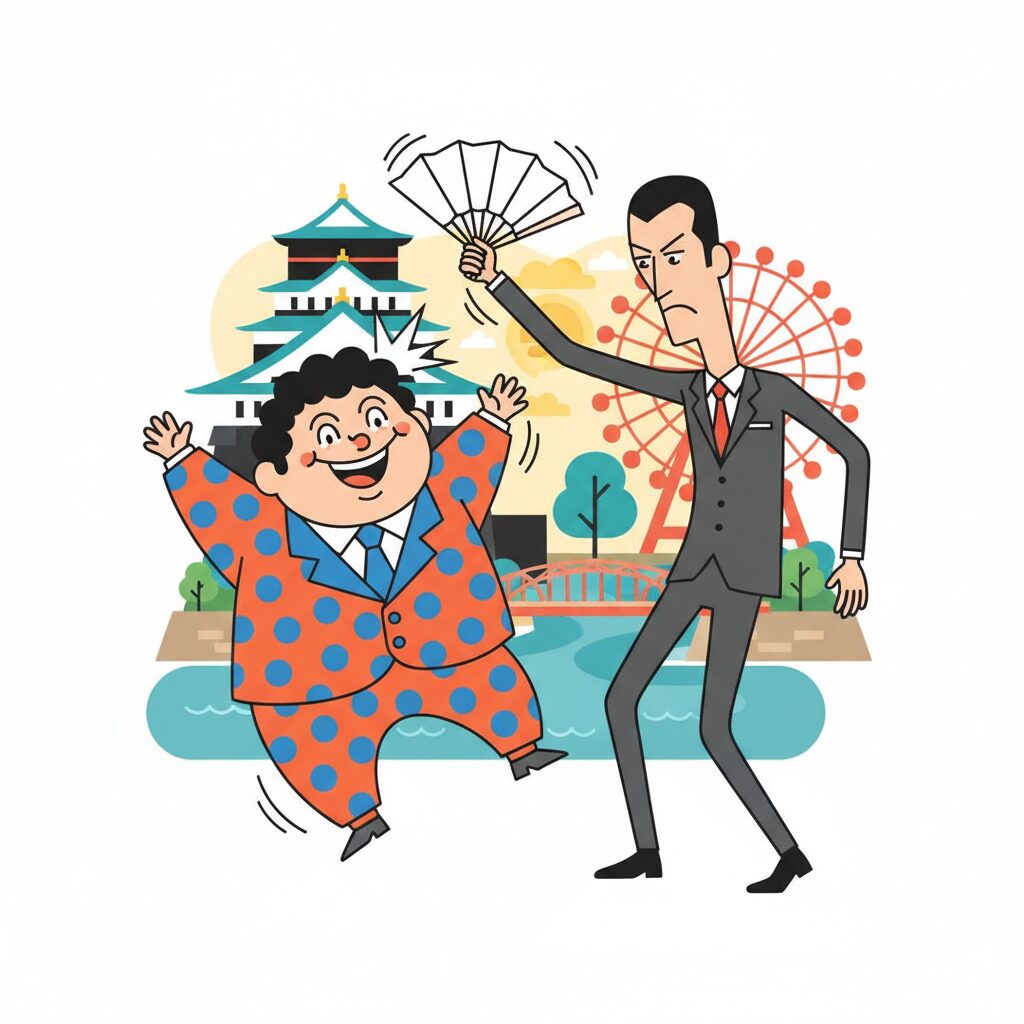
If the ‘boke’ is the serve, the ‘tsukkomi’ is the powerful, perfectly targeted return that scores the point. This role is the system’s backbone. Without the ‘tsukkomi,’ the ‘boke’ is simply someone uttering oddities into thin air. The ‘tsukkomi’ validates the joke by recognizing it and quickly highlighting its flaw, forming the punchline. The most famous ‘tsukkomi’ phrase is, naturally, “Nande ya nen!” roughly translating to “Why?!” or “What the hell are you talking about?!” But it’s less about the words and more about the tone and timing. It must be immediate; a delayed ‘tsukkomi’ falls flat. The response is the release of comic tension the ‘boke’ has created. It’s the sharp retort that pulls conversation back to reality while acknowledging the playful detour. Sometimes the ‘tsukkomi’ is physical. Friends, spouses, or parents often lightly smack the arm or shoulder of the ‘boke.’ To outsiders, this may seem aggressive, but it’s quite the opposite. It’s punctuation— a human exclamation point, a silent way of saying, “I can’t believe you said that, you absolute idiot, and I love you for it.” It’s a gesture of closeness, not anger.
The Unspoken Contract: Why It Works
This entire system is built on an unspoken social contract. When an Osakan delivers a ‘boke,’ they are placing trust in you. They offer a carefully crafted setup and rely on you to provide the punchline. Completing the exchange affirms a social bond: “We share a sense of humor. We’re on the same wavelength. We’re connected.” This is why foreigners can sometimes feel excluded or confused. When faced with a ‘boke,’ a visitor might respond with polite bewilderment or, worse, a literal, serious correction. This is seen as ‘nori ga warui,’ or having poor timing—like a bad dance partner letting the rhythm drop. The Osakan isn’t deeply offended, but a potential moment of connection is lost. The magic lies in the shared responsibility for the joke. It takes two to tango, and in Osaka, it takes a ‘boke’ and a ‘tsukkomi’ to create meaningful conversation. It’s a cooperative effort to generate laughter, and that cooperation forms the foundation of the city’s famously friendly and open atmosphere. The friendliness isn’t just a passive trait; it’s an active, participatory game.
Osaka vs. The World (and Tokyo): A Tale of Two Cities
The distinctive character of Osaka is most evident when contrasted with its eternal rival, Tokyo. Traveling between the two cities reveals a profound cultural shift, akin to switching the radio from a chaotic talk show to a serene classical station. This difference, deeply rooted in centuries of history, is apparent in every daily interaction, from ordering coffee to asking for directions. The dynamic of ‘boke’ and ‘tsukkomi’ is more than just a local quirk; it forms the core cultural framework of Osaka, standing in sharp contrast to the more reserved and hierarchical communication style found in the capital.
The Tokyo Wall of Politeness
In Tokyo, social interactions are shaped by a finely crafted and often impenetrable wall of politeness. This world of ‘tatemae’ (public facade) and ‘honne’ (true feelings) prioritizes smooth, harmonious social exchanges. Conversations with strangers tend to be efficient, respectful, and notably impersonal. A Tokyo convenience store cashier performs their role with balletic precision and a string of formal honorifics—professional and flawless. Conversely, an Osaka cashier might notice you buying a single beer and some edamame and say, “Tough day, huh? Don’t worry, this’ll fix it.” This isn’t unprofessional; it’s human. It’s an effort to break through the wall and connect beyond the transaction. Tokyoites often see this as noisy or intrusive, even rude, while Osakans view the Tokyo style as cold, distant, and robotic. The historical roots run deep: Tokyo was the domain of samurai and shoguns, with rigid social hierarchies and political power, where a misstep in language could have serious consequences. Osaka, the merchant city and the nation’s kitchen, thrived on quickly forming rapport, bargaining, and forging relationships. Shyness was a luxury they couldn’t afford; connection and humor were essential. That pragmatic, direct, and people-centered merchant spirit forms the DNA of modern Osaka.
The “Akan” and “Chau Nen” Rhythms of Kansai-ben
Kansai-ben, the local dialect, perfectly embodies the ‘boke’ and ‘tsukkomi’ dynamic. In contrast, standard Japanese, or ‘hyojungo,’ spoken in Tokyo, can feel somewhat flat and monotone. Kansai-ben is rhythmic, expressive, and melodic, with musical intonations well suited for comedic timing. Its vocabulary is rich with conversational tools: phrases like “Akan!”—a versatile exclamation meaning “No way,” “That’s terrible,” or “You can’t do that”—are fired off like verbal bullets. “Chau nen!” (“That’s not it!” or “You’ve got it all wrong!”) is the classic opener for a ‘tsukkomi,’ a verbal clearing of the throat before correcting the ‘boke’s’ nonsense. Listening to Osakans speak is like experiencing a piece of music, filled with playful jabs, interjections like “Honma ka?” (“Really?”), and resigned sighs of “Shoganai naa” (“Can’t be helped, can it?”). This dialect represents more than different words; it reflects a distinct communication philosophy built for engagement, reaction, and rapid-fire exchanges of ideas and jokes, at the heart of Osaka’s comedic spirit.
When Foreigners Get It Wrong
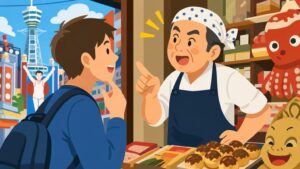
For foreigners new to this culture, navigating it can be fraught with misunderstandings. The most common mistake is interpreting the ‘tsukkomi’ as genuine criticism or hostility. Ask a shopkeeper for a discount and they might laugh, replying, “Aho ka!” (“Are you an idiot!”). In many cultures, this would be deeply offensive. In Osaka, however, it’s often a term of affection, a playful refusal that invites further banter. It means, “I admire your boldness for asking, but no. Now, let’s keep the game going.” The speaker isn’t truly calling you an idiot; they’re acknowledging your daring ‘boke’ with a classic ‘tsukkomi.’ Another frequent error is taking a ‘boke’ literally. If someone mischievously points you in the wrong direction when you ask for directions, they’re not trying to mislead you—they’re inviting you to call them out. Responding seriously kills the mood immediately. The best reaction is to laugh and say, “Very funny, now where is it really?” This shows you understand the game. In Osaka, the greatest social faux pas isn’t making mistakes; it’s lacking a sense of humor about them.
Boke and Tsukkomi in the Wild: A Field Guide to Daily Life
Once you learn to recognize the pattern, you begin to notice it everywhere. The ‘boke’ and ‘tsukkomi’ dynamic extends beyond izakayas or comedy clubs; it permeates the city’s ambient noise, a constant performance unfolding in the most ordinary places. Life in Osaka is a continuous sequence of setups and punchlines, and the ability to identify them is essential to truly grasping the city’s character. This theory comes alive on the sticky floors of noodle shops, in the crowded aisles of supermarkets, and on the rumbling platforms of the subway.
The Supermarket Showdown
The local supermarket serves as a prime stage for this art form. The stars are often the ‘obachan,’ the formidable elderly women of Osaka. They are the undeniable masters, wielding a lifetime of experience and an unfiltered voice. Imagine this: an ‘obachan’ at the checkout with an overflowing basket. The young cashier scans a daikon radish. The ‘obachan’ leans in conspiratorially and, loud enough for all to hear, says, “Be careful with that one, it’s my pet. His name is Daisuke.” This is a pure ‘boke,’ offered openly to the world. The cashier, likely having encountered this scenario countless times, responds without missing a beat, holding the radish near the scanner and saying gently, “Okay, Daisuke-kun, just a little beep, it won’t hurt.” Then she glances back at the ‘obachan’ and adds, “He’s very brave.” Everyone in line smiles. A mundane transaction transforms into a shared piece of micro-theater. It’s not about efficiency; it’s about humanity—finding joy and connection in the simple act of grocery shopping.
Navigating the Train Station Tango
The sprawling, chaotic train stations of Umeda and Namba offer another hotspot. Commuting in most cities tends to be a dreary, anonymous experience. In Osaka, it’s an opportunity. You might witness two friends bidding farewell at the ticket gates. One starts heading toward the platform but suddenly turns and deliberately walks into a wall. The other friend sighs in exasperation, grabs their collar, and physically turns them around, saying, “The train is that way, you idiot. Did you leave your brain at home today?” It’s a physical ‘tsukkomi’ in response to a physical ‘boke.’ Then there are interactions with station staff. In Tokyo, a passenger may ask a station attendant a question accompanied by deep, formal bows. In Osaka, someone might approach an attendant standing directly beneath a giant sign reading “To Namba” and ask, with a completely straight face, “Excuse me, how do I get to Namba?” The attendant, playing along, points up at the sign and replies, “It’s a secret. If I told you, I’d have to… well, just follow the massive sign.” This is a dance of feigned ignorance and witty comeback, turning a routine interaction into something memorable and amusing.
The Izakaya Olympics
The ‘izakaya,’ Japan’s version of a pub or tavern, is the graduate school for mastering ‘boke’ and ‘tsukkomi.’ Fueled by beer and sake, the banter grows faster, louder, and more relentless. Here, you see the art form at its peak. A group of friends places an order. One person, scanning the menu, jokes, “I’ll have the fried air with a side of nothing.” Without hesitation, a friend calls out to the waiter, “He says he’s not hungry! Bring him a glass of water and the bill!” This is a rapid-fire exchange of ‘boke’ and ‘tsukkomi,’ with each person trying to outdo the others. Toasts become competitive games of absurdity. Someone might raise their glass and say, “A toast! To my beautiful hair!” and their friends immediately fire back, “What hair?! You’re going bald!” or “To your hair! Both of them!” It’s an ongoing volley of affectionate insults. The ‘izakaya’ is where you practice and sharpen your skills—a safe environment to try out your own ‘boke’ and test the speed of your ‘tsukkomi,’ surrounded by people fluent in this language of laughter who expect you to join in.
A Special Mention: The Osaka Obachan
No exploration of Osaka’s social dynamics would be complete without a dedicated focus on the ‘obachan.’ These women are more than just elderly—it’s a cultural institution, the guardians of the city’s spirit. Loud, direct, and incredibly warm, they reign as the undisputed grandmasters of the ‘boke’/’tsukkomi’ exchange. Their confidence is awe-inspiring. An Osaka ‘obachan’ won’t hesitate to comment on a stranger’s fashion, offer unsolicited life advice, or, famously, distribute candy (‘ame-chan’) to anyone who looks like they might need it. Their style blends ‘boke’ and ‘tsukkomi’ seamlessly. For example, an ‘obachan’ might spot you on the train and say, “You look tired! Are you eating properly? You’re too skinny! Here, have a candy.” This statement is a performance. The exaggeration (“You’re too skinny!”) serves as the ‘boke,’ while the immediate, non-negotiable solution (“Here, have a candy”) is the ‘tsukkomi.’ There’s no room for refusal. Rejecting the candy breaks the social contract. You must accept the ‘ame-chan.’ It symbolizes this aggressive, intrusive, yet deeply caring form of communication— the ‘obachan’s’ way of saying, “I see you, and I’ve adopted you for the next 30 seconds.”
How to Participate (Without Making a Fool of Yourself… Or, by Intentionally Making a Fool of Yourself)
For a foreigner, the idea of diving into this rapid-fire conversational game can feel intimidating. The fear of saying the wrong thing, misinterpreting the tone, or having your joke fall flat is very real. But the charm of Osaka is that effort is usually valued more than perfect execution. Osakans appreciate when foreigners try to engage on their terms, as it shows a genuine interest in understanding their culture beyond the surface. The key is to start small, observe closely, and embrace the playful spirit that drives it all. Remember, the purpose of the ‘boke’ is to be the fool intentionally, so in a way, you can’t lose.
Your First ‘Boke’: A Beginner’s Guide
Initiating a ‘boke’ is an advanced step, but not impossible for beginners. The safest way to begin is with observational humor that is clearly and obviously incorrect. For example, standing in front of Osaka Castle, you might turn to your friend and say, with complete seriousness, “Wow, Tokyo Tower is smaller than I thought.” This is a classic, low-risk ‘boke.’ The landmark is so well-known that your comment can’t be mistaken for a genuine mistake. Another option is self-deprecating humor. If you trip on the sidewalk, you could strike a dramatic pose and say, “Behold! The grace of a drunken penguin!” This invites your friends to ‘tsukkomi’ you, providing an easy setup. The key elements are a straight face and confident delivery. A hesitant ‘boke’ causes confusion. You must fully embrace the absurdity. Even if your Japanese isn’t perfect, the physical comedy and tone will get the message across. The reward—a shared laugh and a moment of connection—is well worth a little temporary embarrassment.
Mastering the ‘Tsukkomi’ Response
For most foreigners, the ‘tsukkomi’ role is an easier way in. You’re reacting, not creating. Your job is simply to catch the conversational ball thrown your way. The most important skill is listening—not just to the words, but to the playful tone signaling a ‘boke’ is happening. The simplest ‘tsukkomi’ is a single, well-timed word. When your friend says something absurd, a sharp “Nande ya nen!” (“Why?!”) or “Akan!” (“No way!”) is all that’s needed. Timing matters more than vocabulary. Don’t overthink it. Let your reaction be instinctive. If your Japanese isn’t strong, responding in English works too. If a friend points to a poodle and calls it a lion, a quick “You’re an idiot,” said with a grin, fits perfectly. The spirit of the ‘tsukkomi’ goes beyond words. It’s about acknowledging the setup and delivering the punchline. Watch how locals do it—the speed, intonation, affectionate eye-roll—and you’ll catch the rhythm quickly.
Reading the Room: When Not to Joke
This is perhaps the most important advice. The ‘boke’ and ‘tsukkomi’ culture is not a license to be disrespectful or to trivialize serious matters. It’s a language of informal connection, and knowing when it’s inappropriate is crucial. In formal business meetings with clients from Tokyo, diving into a ‘boke’ routine would be a serious error. When handling important topics like health, bureaucracy, or official procedures, stick to clear, polite, and standard Japanese. The banter belongs in bars, shops, on the street—not in boardrooms or hospitals. This playful dynamic is mainly for peers or service encounters where a relaxed atmosphere is already in place. It’s a tool for breaking down barriers, but you must first recognize those barriers exist. As you spend more time in Osaka, you’ll develop a sense for the right contexts. The general rule is: when unsure, start with politeness. Let the Osakan be the one to break the formal tone first. They almost always will, and when they do, you’ll be ready to join in.
The Soul of the City: Beyond the Punchline
It might be easy to dismiss this ongoing banter as trivial, just a cultural peculiarity. However, doing so would overlook the profound philosophy beneath the surface. The art of ‘boke’ and ‘tsukkomi’ is much more than a string of jokes; it serves as the driving force of Osaka’s social fabric, a tool for building resilience, and a testament to a deeply pragmatic and humanistic worldview. Essentially, it is the audible soul of the city. This is a learned skill, a perspective that values connection over formality and laughter over silence. In an increasingly isolated world, Osaka’s dedication to this interactive, cooperative mode of communication feels both revolutionary and essential.
This constant back-and-forth functions as social shorthand, accelerating intimacy. In moments, a ‘boke’/’tsukkomi’ exchange can create a rapport that might take weeks of polite conversation in other cultures. It quickly gauges a person’s warmth, wit, and readiness to engage. It serves as a social litmus test asking, “Are you one of us? Are you willing to play?” This efficiency stems from Osaka’s merchant history, where time was money and trust had to be built fast. There was no room for stiff formalities when business had to be done and relationships forged. That legacy remains today in the city’s preference for directness, even if it comes wrapped in a ridiculous joke.
Moreover, this ingrained sense of humor is a potent tool for resilience. Osaka has faced numerous hardships, from devastating fires in the past to recent economic challenges. Finding the absurd in tough situations and laughing in adversity serves as a survival strategy. It helps maintain perspective, reminding everyone that even amid difficulties, there’s still space for joy and human connection. It is a collective defense against despair—not one of denial, but of confronting problems with an unbreakable spirit.
Ultimately, life in Osaka is an invitation to join in. It calls on you to shed inhibitions, embrace playfulness and absurdity, and connect with others more directly and honestly. It challenges the stereotype of Japan as a place defined by solemnity and reserve. To truly thrive here, you must learn to listen for the setup, appreciate a well-crafted line, and be bold enough to offer your own punchline. It means understanding that when an elderly woman in a bakery tells you the melon bread you’re about to buy is a family heirloom and sings to it at night, the only proper response is to ask if it has a favorite song. This is the art of the comeback. This is the rhythm of life in a city that wears its heart on its sleeve and always, always has a joke ready on its lips.