I remember my first real freelance negotiation in Osaka. It was for a series of photographs for a small, family-run sake brewery tucked away in the city’s south. I’d come from a few years of working with clients in Tokyo, a world of cushioned silences, multi-stage email approvals, and meetings that felt like carefully choreographed plays. I had my pitch ready, a polite, multi-page proposal detailing my process, my vision, and, buried on page five, my rates. I walked into their office, a space that smelled of cedar and fermenting rice, and sat down with the third-generation owner. He was a man with hands like worn leather and a smile that crinkled the corners of his eyes. We exchanged pleasantries, he poured tea, and I launched into my well-rehearsed Tokyo-style presentation. About ninety seconds in, he held up a hand, still smiling. “Okay, okay, I see the pictures in your book. They’re good,” he said in gravelly Osaka dialect. He leaned forward, elbows on the table, and with a glint in his eye asked, “De, nanbo nan?” – “So, how much?”
That question, so blunt and straight to the point, felt like a splash of cold water. In Tokyo, it would have been a shocking breach of protocol, an almost vulgar rush to the finish line. But here, it wasn’t rude. It was the opposite. It was a sign of respect. It meant, “I’m busy, you’re busy. I like your work, you want to work. Let’s get to the important part and see if we can make a deal.” That moment was my real introduction to the Akindo spirit, the soul of the Osaka merchant that animates every corner of this city, from the grandest corporate tower to the most humble freelancer’s laptop screen. This isn’t just a city of friendly people and great food; it’s a city built on a foundation of commerce, pragmatism, and a unique form of human-centered negotiation that has been honed over centuries. For anyone thinking of working for themselves here, whether as a remote employee or a full-blown freelancer, understanding this Akindo DNA isn’t just helpful; it’s essential. It dictates the rhythm of work, the flow of communication, and the very definition of a successful professional relationship in a way that feels worlds apart from the rest of Japan.
This pragmatic, human-centered approach to business is also reflected in the city’s social fabric, where building genuine connections is key, as seen in the vibrant culture of Osaka’s language exchange cafes.
The Akindo DNA: More Than Just Money
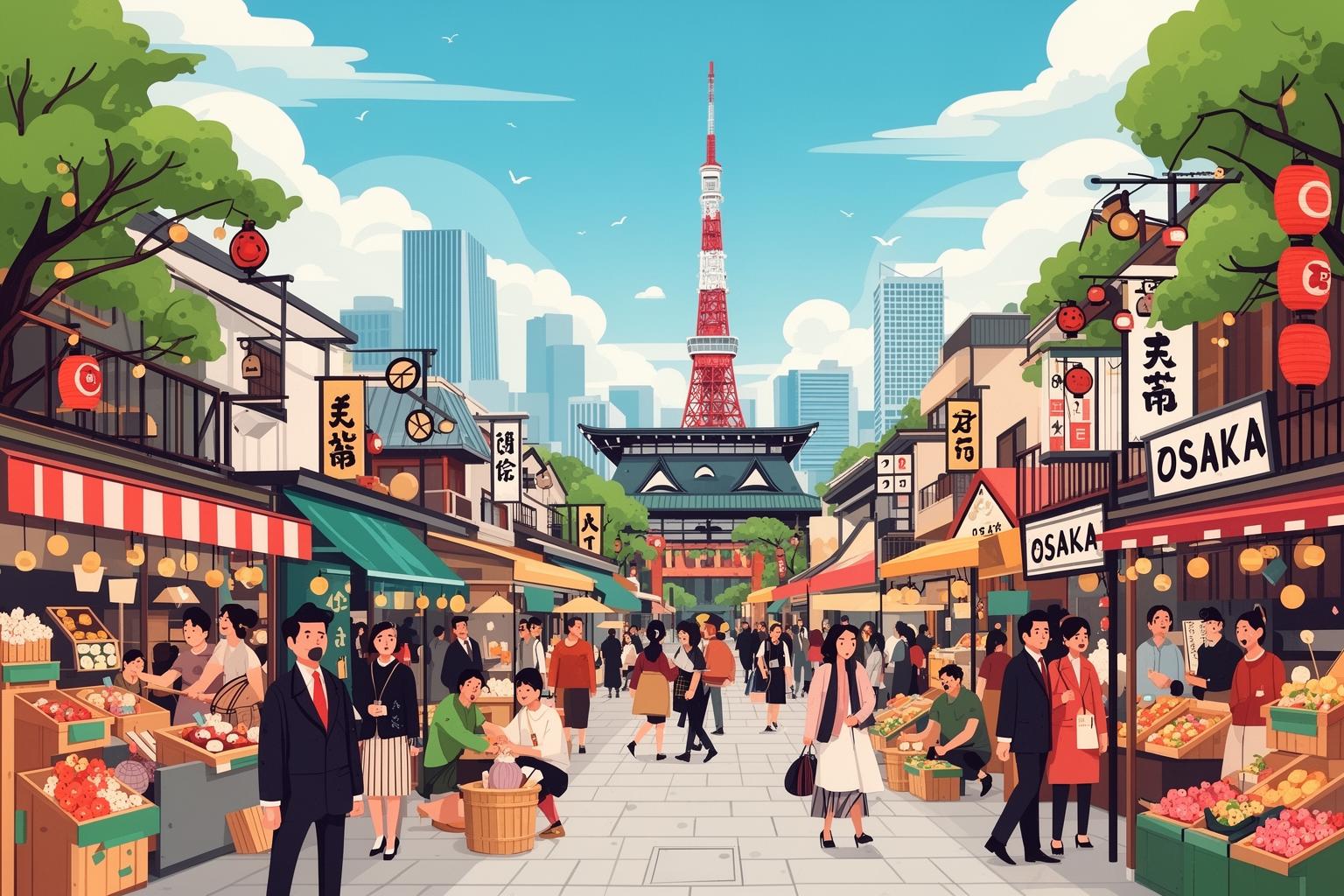
To grasp Osaka’s professional culture, you need to look back in history. During the Edo period, while Tokyo (then Edo) was the center of the samurai government, Osaka was known as the “nation’s kitchen” (天下の台所). It served as Japan’s commercial hub, a city of merchants, artisans, and dealmakers. Power wasn’t determined by birthright or sword-wielding samurai; it was earned through shrewdness, reliability, and the ability to build a successful business. This history ingrained a distinct set of values into the city’s collective mindset, a philosophy often called the Akindo spirit. Outsiders often misinterpret this as a simple obsession with money—stereotyping Osakans as profit-focused. But this is a superficial view. The Akindo spirit represents a much more nuanced and holistic philosophy that influences everything, especially the modern freelance environment.
Shobai as a Way of Life
In Osaka, business—or shobai (商売)—is not just a transaction. It’s a craft, a relationship, and a long-term endeavor. The aim isn’t merely to complete a sale; it’s to establish a sustainable cycle of mutual benefit. A good deal means both parties walk away feeling they gained something valuable, building a foundation of trust for future business. This approach is deeply connected to the concepts of giri (義理), commonly translated as duty or social obligation, and ninjo (人情), meaning human feeling. While these ideas can be formal and rigid in many parts of Japan, in Osaka they are intensely practical. Your giri to a client isn’t just about politeness; it’s about delivering excellent work because their success ultimately fuels your own. Your ninjo isn’t just about sending seasonal gifts; it’s about genuinely caring for their business and seeking ways to support them, even beyond your contract. For freelancers, this manifests powerfully. A client pleased with your work won’t just rehire you; they’ll become your advocate, actively seeking opportunities to recommend you to others. This isn’t pure altruism; it’s pragmatic community-building. A robust network of reliable freelancers and thriving businesses strengthens the whole ecosystem. This sharply contrasts with Tokyo’s more siloed, corporate-style networking, where introductions tend to be formal and transactional. In Osaka, a referral from a satisfied client is the ultimate currency, grounded in the simple Akindo principle that a strong reputation is the most valuable asset.
The Gospel of Cost Performance (コスパ)
At the core of every Osaka business conversation is the concept of kosupa, short for ‘cost performance’. This is perhaps the most misunderstood element of the Akindo spirit. It’s not about being cheap. Let me repeat: it’s not about seeking the lowest price. It’s about maximizing value for the money spent. An Osaka client will scrutinize your quote closely—not necessarily to negotiate a lower price, but to fully understand the return on their investment. They are asking, “If I pay you this amount, what tangible, measurable result will my business gain?” This results-focused mindset is a boon for freelancers who can clearly communicate their value. In Tokyo, clients might be impressed by your previous agency’s prestige or the length of your client list. In Osaka, they value a clear, straightforward explanation of how your copywriting will boost their conversion rate by a certain percentage, or how your graphic design will enhance brand recognition within a specific audience. You need to connect the dots for them. Vague proposals filled with industry jargon won’t work. You must speak their language: the language of results. This means freelancers should focus less on padding resumes and more on building a portfolio full of case studies demonstrating real outcomes. When quoting your rates, don’t just give a number. Explain it. Break it down. Show the “performance” in “cost performance.” For example, clarify that your higher rate for web development includes advanced optimization leading to faster loading times, better Google rankings, and ultimately, more customers. Once they see the value, an Osaka client serious about their business will pay a premium without hesitation. They respect expertise and are willing to invest in quality but refuse to pay for unnecessary fluff.
Negotiation: The Osaka Handshake is a Conversation
If the Akindo spirit could be heard, it would sound like negotiation. Across much of Japan, direct bargaining—especially about price—is often viewed as rude. The price is fixed, and questioning it suggests the seller lacks expertise. However, in Osaka, negotiation is not a confrontation but a cooperative effort. It’s a dialogue aimed at reaching a compromise that satisfies everyone. Negotiation is expected and even enjoyable in business dealings here. Accepting the initial price without discussion may seem odd, as if you’re not fully engaged or unwilling to explore options. This cultural nuance is crucial for any freelancer to understand. Negotiating terms isn’t being aggressive; it’s participating in the local shobai tradition.
“So, How Much?” (で、なんぼなん?): The Direct Approach
The phrase “De, nanbo nan?” is quintessential Osaka shorthand, cutting through formalities to get straight to the point. For foreigners used to polite introductions, it can be startling, but recognizing its purpose is freeing. When a potential client asks this early, it’s a positive sign—they’ve moved beyond initial vetting and are seriously considering collaboration. They’re inviting you to negotiate. Your response should go beyond just stating a price; explain it. For example, “My rate for this project is X yen, which includes A, B, and C, aiming for outcome Y.” This invites dialogue. They might reply, “That’s a bit high. How about Z yen if we exclude C for now?” This exchange is the rhythm of Osaka negotiation—less a contest, more about tailoring solutions. Freelancers should enter meetings with a clear walk-away price but also a flexible service package. Know what you can adjust without compromising your core value. Be confident, transparent, and keep the tone light and friendly; humor is invaluable in Osaka business. A well-timed joke can ease tension and reinforce that you’re on the same team, working out details together.
The Art of the “Little Extra” (おまけ)
One of Osaka’s most delightful negotiation tactics is the omake (おまけ)—a small bonus or freebie. In any Osaka shotengai (shopping arcade), you’ll witness this firsthand. Buy three apples, and the seller might add a fourth with a smile, saying, “Omake!” This isn’t just about clearing stock; it’s a meaningful gesture that turns a transaction into a personal connection. For freelancers, omake is a powerful tool to close deals and cultivate client loyalty. Imagine you’re a photographer negotiating with a restaurant. After discussing price and nearing agreement, you might say, “If we finalize the price today, I’ll include five professionally formatted photos for your Instagram stories at no extra cost.” This small omake shows flexibility and goodwill, signals you understand their needs (like social media), and makes clients feel they’ve gained something special—a small win in negotiations. This sense of appreciation is vital in Osaka and can yield ongoing business and enthusiastic referrals.
Reading the Air vs. Speaking Your Mind
The well-known Japanese concept of kuuki wo yomu (空気を読む), or “reading the air,” is central to communication in Tokyo. It means sensing mood, interpreting unspoken signals, and avoiding blunt remarks that might disrupt harmony. While this skill is still relevant in Osaka, it’s less dominant. Osakans generally favor straightforwardness over ambiguity. For non-Japanese freelancers, this directness in a professional context can be refreshing. If an Osaka client dislikes your proposal, they’re likely to say so openly, often using humor to soften the critique. You might hear, “Ah, Tanaka-san, your idea is very… creative! But our customers are old-fashioned, it might go over their heads! Let’s try something simpler?” The feedback is clear, actionable, and not hidden behind layers of vague politeness that take days to decode. This doesn’t mean being rude or insensitive—it means you can and should express your thoughts honestly yet respectfully. If a client’s request is unrealistic, you can explain why; if you have a better idea, propose it confidently. They value your honest input because it helps achieve better results. Clients aren’t hiring you to agree blindly; they want your expertise. In Osaka, a productive meeting challenges ideas, debates options openly, and reaches clear decisions. This collaborative, dynamic process often feels more natural and efficient to foreigners than Tokyo’s often opaque, consensus-driven meetings.
The Freelance Ecosystem: Where Akindo Meets Digital Nomad
This entrepreneurial spirit isn’t confined to boardrooms; it infuses the entire freelance and remote work ecosystem. The city’s infrastructure, both physical and social, naturally supports the community-oriented, relationship-driven work that freelancers thrive on. From co-working spaces to networking events, the Akindo DNA distinctly shapes the modern work culture into something uniquely Osakan.
Co-working Spaces and Cafes: The Modern Shotengai
While Tokyo boasts numerous sleek, corporate-style co-working spaces, Osaka’s offerings often feel more like neighborhood clubhouses. Places such as The DECK in Sakai-suji Hommachi, or the smaller, niche spots scattered around Nakazakicho or Horie, resemble community hubs more than satellite offices. The atmosphere is noticeably different. People make eye contact and strike up conversations. Barriers between individuals are low. It’s common to ask the person next to you for advice on a coding issue or an impromptu opinion on a logo design. This collaborative spirit directly descends from the shotengai culture. In traditional shopping arcades, vegetable sellers, butchers, and tofu makers were competitors but also neighbors. They shared information, supported one another during tough times, and understood that the arcade’s overall success benefited them individually. Osaka’s co-working spaces operate on a similar principle. They foster collaboration, where a freelance writer might team up with a graphic designer and a web developer they met by the coffee machine to pitch a larger project they couldn’t handle solo. The cafe culture reflects this as well. Many freelancers in Osaka choose a favorite local kissaten (old-style coffee shop) or café to work in, becoming regulars familiar to staff and fellow patrons. These spaces extend their office and social life, blending boundaries in a way that nurtures organic connections.
Networking Events: Less Formality, More Banter
Networking events in Tokyo can be intimidating, marked by formal rituals of exchanging business cards (meishi) with deep bows and rehearsed introductions. In Osaka, such events often feel indistinguishable from a party. The main goal isn’t to collect a stack of cards but to share laughter and connect on a human level. Business discussions often come only after personal rapport is established. Humor acts as universal currency. One of the highest compliments you can give an Osakan is calling them omoshiroi (interesting or funny). In business, this means they are quick-witted, engaging, and don’t take themselves too seriously. The ability to perform tsukkomi (the straight man role in a comedy duo, pointing out absurdities) and even jiko-tsukkomi (self-deprecating humor) is deeply valued. It demonstrates confidence and humility. For freelancers, this means adopting a different approach to networking: don’t start with an elevator pitch. Begin with a story, a question, or a joke. Focus on having genuine conversations. People in Osaka do business with those they like, trust, and enjoy spending time with. Exchanging business cards is secondary—a formality that follows the connection you’ve already built. The real bond is often sealed over shared plates of takoyaki and laughter.
Building a Reputation: Word-of-Mouth is King
In a city driven by personal relationships, reputation is everything. While a polished website and strong social media presence matter, they come second to the influence of word-of-mouth referrals. Osaka’s freelance and small business communities are notably tight-knit. Almost everyone knows someone who knows someone. This has its pros and cons. Deliver excellent work, be reliable and approachable, and your name will spread quickly. Clients will seek you out, pre-vetted and ready to trust based on mutual recommendations. Conversely, missed deadlines, poor work, or a difficult attitude can quickly damage your reputation and make future work scarce. The Akindo mindset here emphasizes long-term investment in your professional character. Every project is a chance to boost your reputation. Every interaction is an opportunity to build a bridge. This means being scrupulously reliable, communicating clearly and proactively—especially when issues arise—and sometimes going beyond the contract because it’s the right thing for the relationship. In Osaka, you aren’t just a service provider—you are your brand. That brand is built one successful project and happy client at a time.
Practical Realities and Common Misunderstandings
Navigating the Osaka freelance scene with this cultural background is insightful, but it’s also crucial to address some common pitfalls and misconceptions that foreigners often face. The Akindo spirit is pragmatic rather than predatory, yet misunderstanding its subtleties can cause frustration. Being mindful of these aspects can help you approach your work with appropriate expectations and a more effective strategy.
Is It All About Haggling and Low Prices?
One of the biggest misconceptions about doing business in Osaka is that everyone is always trying to secure the lowest price possible. This belief leads many new freelancers to undervalue their services from the outset, thinking they need to offer rock-bottom rates to stay competitive. This is a misconception. As noted earlier, the emphasis is on value, not cheapness. Osakans are shrewd and dislike feeling as though they’ve overpaid, but they equally detest paying for subpar quality. They hold deep respect for craftsmanship and mastery—the shokunin (職人) spirit. If you truly excel in your field, you should price yourself accordingly. The key is to prove that your higher fee reflects a superior level of skill, dependability, and ultimately, a better outcome for their business. Rather than viewing negotiation as a struggle to defend your price, see it as a chance to educate your client about the value you offer. Guide them through your process. Share relevant portfolio examples aligned with their goals. Clarify the reasoning behind your costs. When a client realizes they’re not merely purchasing your time but your expertise, creativity, and problem-solving ability, the conversation shifts from cost to investment. The freelancer who can confidently convey their value will always outshine the one who simply provides the lowest bid.
The Language Barrier and “Kansai-ben”
Language is always a consideration for foreign freelancers in Japan, but Osaka adds an extra dimension with its unique dialect, Kansai-ben. To those unfamiliar, it may sound faster, more straightforward, and sometimes even harsher than the standard Japanese (hyojungo) spoken in Tokyo. Words are abbreviated, intonation is more melodic and expressive, and there is a rich collection of distinctive phrases. A client might say “Akan!” (No way!) instead of the more formal “Dame desu,” or use “-hen” instead of “-nai” for negation. Don’t mistake this bluntness for anger or discourtesy. It’s simply the local style of communication, often filled with warmth and humor surpassing that of standard Japanese. Making an effort to understand or even use a bit of Kansai-ben can be a powerful way to build rapport. Saying “Ookini!” (Thank you!) instead of “Arigatou,” or using “Meccha” (Very) instead of “Totemo,” shows that you’re not just a transient foreigner but someone engaging with local culture. Clients appreciate this effort, and it often serves as a great icebreaker. It signals that you belong to the community—or at least are trying to—which fits perfectly with Osaka’s relationship-focused business culture.
Tokyo vs. Osaka: Which Is Better for Freelancers?
This is a common question for anyone planning to establish themselves in Japan. The reality is that neither city is inherently “better”; they are just different and suit varying personalities and professional fields. Tokyo is the undisputed corporate center. It houses the headquarters of most major Japanese and multinational corporations. Projects there tend to be larger in scale, with more substantial budgets and greater opportunities in specialized corporate sectors. However, the environment is more formal, hierarchical, and competitive. As a freelancer, you often interact with multiple layers of management, and the decision-making process can be slow and opaque. Osaka, by contrast, is a city dominated by small and medium-sized enterprises (SMEs). The business structure is flatter, and you are much more likely to deal directly with the owner or final decision-maker, which accelerates processes considerably. The culture is relationship-based, meaning once you’re “in,” you’re truly in. The cost of living and operating a business is also significantly lower, lessening financial stress. The trade-off is that average project budgets may be smaller, and the volume of high-end corporate work is less than in Tokyo. The choice depends on your personality and work style. If you excel at navigating corporate hierarchies and prefer a clear boundary between professional and personal life, Tokyo might suit you better. If you thrive on direct communication, value community, and enjoy building personal relationships as the core of your business, Osaka will feel like home.
A Day in the Life: Weaving Akindo into the Remote Routine
To truly grasp how these principles manifest, it helps to follow a day in the life of a hypothetical freelancer in Osaka—let’s call her Sarah, a freelance marketing consultant. Her day goes beyond tasks and deadlines; it’s a continuous, dynamic engagement with the Akindo spirit.
Her morning begins not in a sterile office but at a small, family-run coffee shop in the Tenma neighborhood, a maze of covered arcades and vintage charm. The owner, a cheerful woman in her sixties, knows her by name and already has her usual dark roast ready. “Big project today, Sarah-chan?” she asks while wiping the counter. They chat briefly about the upcoming Tenjin Matsuri festival. As Sarah pays, the owner slips a freshly baked biscotti into her bag. “Omake,” she says with a smile. This small, warm exchange sets the tone for the day, reminding her that commerce here is rooted in community and personal connection.
In the afternoon, Sarah meets a potential new client—a company specializing in artisanal kitchen knives from nearby Sakai city. The meeting takes place not in a glass-walled conference room but at a quiet, wood-paneled kissaten in Namba. The company president, a man in his fifties, insists on ordering siphon coffee, explaining the details of the brewing process. The first fifteen minutes are pure zatsudan (small talk). They discuss baseball, the oppressive humidity, and his daughter’s recent trip to Canada. Only after this ritual of building rapport does he steer the conversation toward business. He’s straightforward: “Our online sales are stagnant. Tanaka-san says you’re the best. Show me what you can do.” Sarah presents her ideas, not with a dense PowerPoint but with a concise, one-page summary focusing on expected ROI. They negotiate terms openly. He questions her fee; she justifies it by outlining the specific value of each service. They settle on a slightly lower price in exchange for a longer three-month contract and a success bonus if sales increase by 20%. The handshake is firm. The deal is sealed, not through formality but through a practical, human-to-human exchange.
That evening, Sarah doesn’t head straight home. She stops by a small creative meetup in Kitakagaya, an old industrial area now thriving with art galleries and studios. It’s a casual gathering in a shared workshop, with cheap beer and a portable grill making takoyaki. She strikes up a conversation with a videographer and a product designer. They vent about a difficult client, exchange tips on invoicing software, and brainstorm a bold idea for a pop-up shop. By night’s end, they’ve sketched a tentative plan to collaborate on a pitch for a new local brand. The connection wasn’t forced; it grew naturally from a shared space and a mutual spirit of creative hustle. This is the fabric of freelance life in Osaka—a mix of practical pragmatism and warm community, a modern expression of an ancient merchant’s soul. It’s a city where your greatest business asset is a solid reputation, your sharpest negotiating tool is a good sense of humor, and your most valuable contract is one built on genuine human connection.