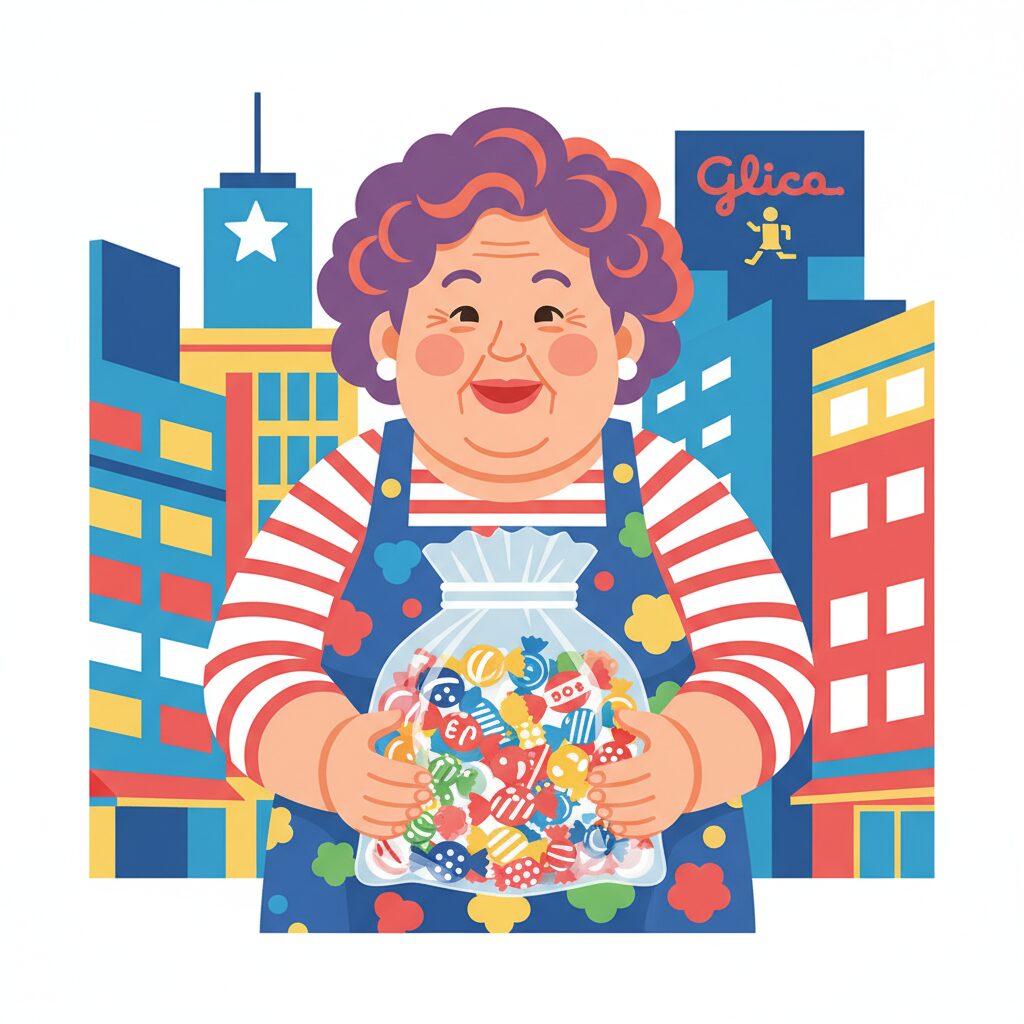
You see it happen before you understand it. It’s a flicker of movement in your peripheral vision, a social transaction so swift and so normal it barely registers. You’re on the crowded Midosuji Line, rattling your way toward Namba. A toddler, tired of the journey, starts to fuss, then wail. The parents exchange panicked glances, murmuring apologies to no one in particular. The air in the train car tenses. In Tokyo, this is where passengers would stare harder at their phones, a silent wall of polite non-involvement. But this is Osaka. From two seats away, a woman with a perm the color of champagne and a leopard-print scarf materializes. She leans forward, not with annoyance, but with purpose. Her hand dives into a cavernous handbag. A crinkle of plastic, and then, an offering. A small, brightly wrapped candy—an ame-chan—is presented to the mother. The mother bows, accepts. The candy is unwrapped, the child is silenced. The tension in the car dissolves. The woman with the leopard-print scarf gives a tiny, satisfied nod and goes back to looking out the window as if nothing happened. To the uninitiated, this moment is baffling. A random act of kindness? A strange local custom? For anyone trying to understand what daily life in Osaka is actually like, this tiny candy is the key. It’s not just sugar. It’s a social tool, a language, and the edible embodiment of Osaka’s entire philosophy on how people should coexist in a crowded world. This is the world of Ame-chan Culture, and learning its rules is your first real lesson in becoming an Osakan.
This unique social fabric is a key reason why Osaka’s tourism economy is booming, attracting visitors eager to experience its authentic culture.
What Exactly is “Ame-chan”? It’s More Than Just Candy
Before we can analyze the culture, we first need to understand the object at its core. Calling it mere “candy” is a linguistic and cultural understatement. It’s specifically ame-chan, and that suffix, that tiny “-chan,” is where the enchantment begins. It offers a glimpse into the city’s spirit, a subtle linguistic shift that changes a simple sweet into a symbol of casual, warm, and distinctively Osakan affection.
The Anatomy of the Obachan’s Purse
The natural environment of ame-chan is the purse of an Osaka obachan—a term for a middle-aged or older woman, but in Osaka, it represents a particular, powerful archetype. This purse isn’t just a fashion accessory; it’s a mobile command center, a Mary Poppins-like bag of tricks designed to tackle any minor urban emergency. If you were to excavate its contents, you’d find a consistent collection of items. There’ll be a pack of tissues, not just for the owner but for any child with a runny nose within a five-meter radius. A small, folded hand towel, or tenugui, is indispensable. Band-aids for scraped knees, a foldable fan for humid summers, perhaps some safety pins, and almost certainly, a small pouch containing a carefully chosen assortment of ame-chan. The candy itself is selected with practical wisdom. You won’t find delicate, melt-in-your-mouth chocolates. Instead, the arsenal consists of sturdy, long-lasting hard candies. Classics like Kuro-ame, a smoky black sugar candy with a deep, earthy molasses flavor. Nodo-ame, or throat lozenges, often herbal or citrus-flavored, ready to be offered at the slightest cough. Simple milk candies, creamy and soothing. Assorted fruit drops in a tin, a rainbow of flavors for every taste. The choice is strategic: these candies don’t spoil, don’t create messes, and provide a sustained, comforting distraction. They serve perfectly their intended social role.
The “-chan” Suffix: A Lesson in Osaka Affection
In standard Japanese, “-chan” is a diminutive suffix expressing affection. It’s attached to the names of children, close female friends, pets, or cute mascots. It softens the word, making it familiar and signaling closeness. A child named Yuki becomes Yuki-chan. A cat, neko, becomes neko-chan. Adding this to ame (candy) is a distinctly Osakan linguistic habit that has spread but remains most potent here. It transforms the object. It’s no longer just a formal “sweet” or “confectionery.” It becomes “little candy,” “dear candy.” This isn’t something bought at a high-end department store as a formal gift. It’s something shared without ceremony. The name itself removes formality and replaces it with an informal, almost familial warmth. When an obachan offers you an “ame-chan,” she isn’t merely handing you an object. She’s using language to frame the exchange as one between familiar equals, even if you’ve never met before. It’s a linguistic handshake, a way of saying, “We’re in this together, so here, have a little something.” It’s the first sign that the candy itself is not the focus; the connection is.
The Unwritten Rules of the Ame-chan Exchange
The distribution of ame-chan isn’t random; it follows a complex, unspoken social script. For newcomers to Osaka, it can feel like a game with unknown rules. But if you observe closely, the patterns become clear. Mastering this etiquette marks a milestone in cultural fluency—a sign you’re moving beyond being a visitor and beginning to understand the local rhythm.
Rule #1: It’s a Conversation Starter, Not a Transaction
An ame-chan is rarely offered silently. It acts as a physical punctuation mark in a social approach—a tool to break the ice, soften advice, or seal a brief moment of connection. In Tokyo, the golden rule in public spaces is to minimize your presence and avoid disturbing others. In Osaka, the rule is to seek opportunities for positive intrusion. The ame-chan is the key that opens that door. Picture a crowded clinic waiting room in Tennoji. An elderly woman might complain aloud, “Maa, kyou wa hito ooi na~” (“Wow, it’s crowded today, isn’t it?”). Another woman across the room nods and adds her own comment. After a minute of shared complaint, a bond is formed. One inevitably reaches into her purse, saying, “Kore, douzo. Nodo ni ee de,” as she offers a throat lozenge (“Here, have this. It’s good for your throat.”). The candy isn’t payment for the chat; it confirms it, solidifying the temporary community of the waiting room. It signals, “Your small talk is welcome. Our brief connection is genuine.” This contrasts sharply with the Kanto region, where starting a conversation with a stranger in such a setting would be unusual. The ame-chan acts as social lubricant, smoothing the way for the casual, friendly interaction Osakans consider the foundation of civilized life.
Rule #2: The Target is Universal, The Reason is Situational
Who qualifies for an ame-chan? The answer is simple: everyone. While crying children are the most classic recipients, the reach extends far beyond. The real skill is in recognizing the moment—an obachan’s remarkable ability to spot minor distress or a need for human connection. A pale, nervous high school student heading to an exam might receive a gentle “Ganbatte ya” (“Do your best”) along with a lemon drop. A tourist puzzled by a complex bus schedule might be approached by an obachan who, despite not speaking English, gestures, points, then offers an ame-chan with a reassuring smile. The candy conveys what words cannot: “I see you’re having a tough moment. Though I can’t fix it, here’s a small gesture of support.” Even simple courtesy can be rewarded. If you give up your train seat to an elderly person, don’t be surprised if an obachan nearby, witnessing the act, offers you a candy as a silent thank-you on behalf of the senior community. It’s a behavior that reinforces community bonds. The reason behind giving is always situational, based on continuous, active observation of social nuances that a small sweet gesture can soften.
Rule #3: The Refusal is Awkward, The Acceptance is Key
This is the most crucial rule for foreigners learning this custom. What should you do when a smiling stranger offers you candy? Your first reaction might be suspicion or polite refusal. Socially, this is the wrong response. You can refuse, but it creates awkwardness and breaks the script. Offering ame-chan is a social invitation; declining it is like refusing a handshake, signaling a desire for distance in a culture that values connection. The correct response is simple yet essential: smile, give a slight nod or bow, say “Arigatou gozaimasu” (the standard “Thank you”) or, for extra local flair, the softer, more melodic Osaka-ben phrase “Ookini,” and then accept the candy. The social contract is complete. The gesture has been given and received; the communication loop is closed.
What if You Don’t Like Candy?
This practical concern arises often. What if you’re on a diet, diabetic, or just don’t have a sweet tooth? It doesn’t matter—you still accept the candy. The act of acceptance is the entire point. Think of it not as receiving food, but as participating in a brief, one-act community play. You can thank the giver, stash the candy in your pocket or bag for later, or even pass it on to someone else—a practice known as ame-chan re-gifting, which is perfectly acceptable. The real misstep isn’t disliking the candy but rejecting the gesture. By accepting, you communicate, “I understand and appreciate your social outreach. I am part of this shared culture.” This matters far more than what happens to the candy itself.
Can a Foreigner Give Ame-chan? The Advanced Technique
After living in Osaka a while, you might want to advance your game. Can a non-Japanese resident give ame-chan? Yes, but it requires finesse. This is an advanced move—like telling a joke in a foreign language—it can either succeed brilliantly or fall flat. Context is key. Using ame-chan effectively shows that you don’t just live in Osaka; you get Osaka. The best place to start is with people you’re beginning to know: the cashier at your local supermarket, the elderly man who runs the corner tobacco shop, a neighbor you see every morning. Offering ame-chan with a cheerful “Itsumo arigatou” (“Thanks for everything”) can be a strong bridge-building gesture. Giving it to complete strangers is expert-level; it requires the same diagnostic skill as the obachan—you must correctly identify the moment it’s called for. A child who just fell in the park, someone who helped you pick up dropped groceries—getting it right often leads to delighted, surprised reactions that signal you’ve been welcomed into Osaka’s inner circle. It’s a truly sweet victory.
The Historical and Cultural Roots of Ame-chan
This tradition didn’t simply emerge out of nowhere. It is intricately embedded in the historical and economic fabric of Osaka. The city’s identity as a center of merchants, its experience with post-war hardship, and the distinctive social role of the obachan all come together in that small, cellophane-wrapped candy. Understanding these origins clarifies why this culture is far more widespread in Osaka than in the more formal, samurai-descended capital, Tokyo.
The Merchant City Mentality: Service and “Osekkai”
For centuries, Osaka was known as Tenka no Daidokoro—the Nation’s Kitchen. It was a city of commerce, rice merchants, and people whose livelihood depended on their ability to cultivate and maintain strong business relationships. In a merchant town, a transaction is never merely a transaction; it’s an interaction. Reputation, trust, and human connection are the true currency. This mindset gave birth to the culture of omake, the custom of giving customers a little something extra for free. Buy a dozen apples, and the vendor might throw in a thirteenth. This isn’t just a discount; it’s a gesture of goodwill, a way of saying, “Thanks for your business, please come again.” Ame-chan culture is the social counterpart of omake. It’s a small additional gift not in a commercial transaction, but a social one. It’s also linked to the Osakan idea of osekkai. In standard Japanese, osekkai often has a negative meaning, implying “nosy” or “meddlesome.” But in Osaka, it usually carries a warmer, more affectionate tone: a proactive, sometimes slightly over-the-top kindness. It’s the spirit that motivates someone to adjust the way you hold your umbrella in the rain or to offer directions spontaneously if you seem lost for even a moment. It’s an interventionist kind of kindness. Giving ame-chan is the essence of osekkai—a small, unsolicited act meant to brighten a situation, even if only briefly.
Post-War Scarcity and the Value of a Small Treat
The generation of obachan who now primarily uphold this culture came of age in the aftermath of World War II. During and immediately following the war, Japan endured severe poverty and shortages. Food was rationed, and luxuries like sugar were rare and precious. For children growing up during that time, a single piece of candy was a treasure—a moment of pure, unfiltered joy in a harsh world. This shared memory is deeply embedded. For that generation, sharing a sweet was no trivial act. It was a meaningful gesture of generosity and care, a way to share a scarce resource to make someone, especially a child, happy. This value system was passed down to their children. Though candy is now inexpensive and plentiful, the emotional significance it once held remains. The act of giving candy retains its symbolic power as a simple, direct method to offer comfort and happiness. It’s a folk memory, a muscle memory of kindness from a time when kindness demanded real sacrifice.
The “Obachan” as a Social Force
It is impossible to discuss ame-chan without honoring the Osaka obachan herself. Often stereotyped for her loud voice, vibrant fashion (leopard print is practically her uniform), and straightforward, no-nonsense demeanor, she is the undisputed matriarch of the city’s public spaces. She is not a passive observer of life; she is an active participant and, in many ways, a maintainer of the social order. The obachan acts with a sense of ownership over her community. She will scold teenagers for being too rowdy, praise a child for good manners, and offer unsolicited advice on everything from cooking to health. Her confidence serves as her armor. In a society that often expects women—especially older women—to be quiet and reserved, the Osaka obachan refuses to fade into invisibility. The ame-chan is a vital tool in her social toolkit. It is a form of soft power. It can soothe (a crying baby), reward (good behavior), build connections (with strangers), and assert her presence in a kind, grandmotherly manner. She is the neighborhood’s watchful guardian, the welcome committee, and the queen of the local shopping arcade, with her purse as her scepter.
Ame-chan Culture in Daily Life: Where You’ll See It
This isn’t an uncommon or ceremonial event. For those living in Osaka, the ame-chan exchange is embedded in the daily buzz of the city. It takes place in the most ordinary settings, turning them into small stages for subtle human interactions. Noticing these spots is part of tuning yourself to the city’s rhythm.
On the Local Train and Bus
The confined, shared space of public transportation is the quintessential stage for ame-chan diplomacy. It’s where strangers are brought close together, creating an ideal environment for Osakan social customs. A prolonged coughing episode may earn you a concerned glance and a nodo-ame. A lengthy delay between stops, leading to a collective sigh from passengers, often triggers a round of candy-sharing among neighbors to lift spirits. It’s a way to acknowledge the shared inconvenience and reaffirm that, during the journey, everyone is united.
In the “Shotengai” (Local Shopping Arcade)
This is ame-chan’s natural habitat. The shotengai, or covered shopping arcade, is the center of neighborhood life in Osaka. Wander through the vast Tenjinbashisuji Shotengai, and you’ll witness it everywhere. The butcher, finishing your order, might tuck a candy into the bag for your child. The woman at the vegetable stall may hand you one along with your change, especially if you’re a regular. This is commerce as it has been practiced in Osaka for generations—personal, relationship-driven, and full of omake. The candy strengthens the bond between shopkeeper and customer, turning a routine purchase into a friendly exchange that ensures you’ll return tomorrow.
At the Sento (Public Bathhouse)
In the steamy, intimate atmosphere of the local sento, social boundaries are shed along with clothing. Here, in the changing rooms, a community of regulars gathers. It’s a hub of local gossip, news, and mutual support. After a long, hot soak, as the women unwind and cool off, someone is almost always ready to open a bag and start distributing ame-chan or other small treats. It’s a ritual that reinforces the deep, simple familiarity of the space, a gesture of neighborly care.
With Your Neighbors
As a resident, your closest and most personal experience with ame-chan culture will likely be with your immediate neighbors. The obachan living down the hall might greet you in the morning with a smile and a candy. If you have children, they’ll quickly become magnets for these sweet gifts. It’s a low-pressure, high-reward way to build a positive rapport. The candy is an opening, a warm-up to conversation: “How are you settling in? Do you need anything?” It’s the first, edible brick in the foundation of a good neighborly connection.
Osaka vs. Tokyo: The Great Ame-chan Divide
To truly understand the importance of ame-chan culture, one must first recognize what it is not—and what it is not, is Tokyo. Comparisons between Japan’s two largest cities often fall into clichés, but when it comes to public social interaction, the contrast is sharp, genuine, and profoundly felt by anyone who has lived in both places. The ame-chan serves as a perfect indicator of this cultural divide.
Tokyo’s “Wa” vs. Osaka’s “Ningenmi”
In Tokyo, the highest social value is Wa (和), meaning harmony. In a megalopolis of 14 million, Wa is primarily maintained through the careful avoidance of conflict. This involves keeping a respectful distance, not imposing on others’ time or space, and limiting interactions with strangers to what is necessary. Public spaces are for transit, not for socializing. Offering candy to a stranger on the Yamanote Line in Tokyo would be, at best, puzzling and, at worst, deeply suspicious—a breach of the unspoken rule not to trouble others. In Osaka, however, the guiding principle leans more toward Ningenmi (人間味), roughly translating to “human-ness” or “human warmth.” Here, harmony is not a passive avoidance of interference but an active engagement achieved through shared laughter, direct communication, and a blurring of lines between public and private space. The ame-chan is a key tool for fostering Ningenmi. It is a friendly intrusion, a deliberate and welcomed break from anonymity.
A Tale of Two Subways
Riding the subway in both cities reveals a striking difference. In Tokyo, the train car is a capsule of collective silence. People focus on their phones, books, or thoughts, avoiding eye contact entirely. The sounds are the rhythmic clatter of the train and the soft, polite announcements. In Osaka, the subway buzzes with a different energy. There’s a gentle murmur of conversation, with friends and even strangers commenting on the weather or a particularly gaudy advertisement. Eye contact, smiles, and engagement are far more common. In this setting, an obachan offering candy to a child feels natural—an extension of the local social vibe. In Tokyo, it would disrupt the flow; in Osaka, it’s part of it.
What Foreigners Often Misunderstand
Without this background, the gesture can be easily misunderstood. A newcomer from a more reserved culture might interpret the candy offer differently. Is it a gift of pity? Does the giver think I look sad or pathetic? Is it a strange attempt to start an unwelcome conversation? For the overly cautious, a paranoid thought might even arise: is this safe to eat? These are all reasonable but culturally incorrect assumptions. The ame-chan is not a commentary on your emotional state. It is not a demand to engage in a lengthy conversation. And it is certainly not a threat. It is a social signal, a friendly “ping.” It says, “I see you, fellow human. We share this space together. Let’s make it a friendly one.” The only expected reply is a simple “ping” back: a smile and a thank you.
Living with Ame-chan: How to Embrace Osaka’s Sweet Side
For anyone planning to live in Osaka, embracing ame-chan culture is a shortcut to feeling at home. It’s about more than just candy; it’s about accepting the city’s invitation to be part of a more interactive, connected, and often chaotic community. It’s about learning to say yes to the small, sweet interruptions that define daily life here.
Your First Ame-chan Encounter
It will happen when you least expect it. You might be standing on a train platform, juggling a heavy bag, or simply looking tired after a long day. An obachan will approach, and before you know it, a piece of candy will be pressed into your hand. In this moment, resist the urge to overthink. Don’t question the motive. Just follow the script. Make eye contact. Smile genuinely. Give a small nod or bow. Say “Ookini.” Accept the candy. That’s it. You have successfully completed your first ame-chan exchange. You have participated in one of the city’s most fundamental rituals. It’s a small step, but a meaningful one. You’ve just shared a conversation without saying much, and you’ve been welcomed, in a tiny way, into the fold.
Building Your Own Ame-chan Stash
If you truly want to commit, the next step is to prepare yourself. This is a fun and practical task. Visit a local supermarket like Tamade or Life, or better yet, find an old-school dagashi-ya (a traditional candy and snack shop). Browse the aisles and assemble your own personal ame-chan stash. Purchase a bag of Pine Ame, the iconic pineapple-flavored hard candy with a hole in the center. Grab some classic milk candy or salty-sweet throat lozenges. Keep a few in your pocket or a small pouch in your bag. You may never use them, but having them makes you feel ready. It makes you feel like an insider. You’re no longer just a potential receiver of ame-chan; now you’re a potential giver. You are part of the network, ready to add to the city’s supply of random sweetness.
Beyond the Candy: The Real Lesson
Ultimately, understanding Ame-chan Culture means understanding the core personality of Osaka. The candy itself is just a symbol. The real lesson lies in the philosophy it represents. It’s about a city that chooses active, sometimes messy, human connection over sterile, anonymous efficiency. It’s about a community that believes small, consistent acts of kindness are the glue that holds everything together. It’s about a distinctive kind of confidence, a social boldness that allows—and encourages—people to briefly step into each other’s lives and make them a little better. For those wondering, “Is Osaka a good place to live?” the answer might be in your reaction to this phenomenon. If the idea of a stranger offering you candy on a train feels alarming or intrusive, the city’s brand of forward friendliness might feel grating. But if it seems charming, warm, and deeply human, then you may have found your place. Living in Osaka means living in a city constantly offering you a small piece of candy, inviting you to join its loud, vibrant, and incredibly sweet conversation.