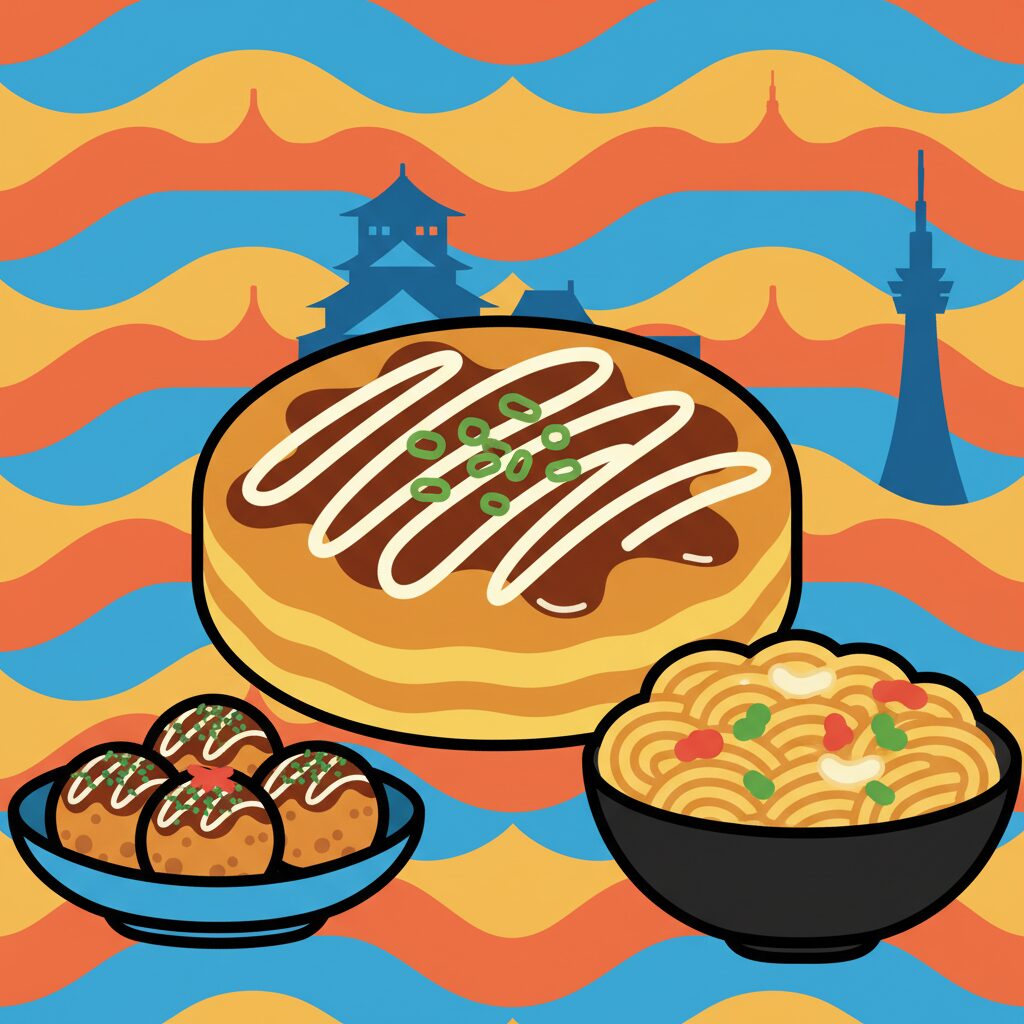
You see them the moment you step into the neon-soaked chaos of Dotonbori. The octopus-adorned signs, the sizzling griddles, the rhythmic clack of metal picks expertly flipping spheres of batter. Takoyaki. Okonomiyaki. To the traveler, this is the quintessential taste of Osaka, a fun, greasy snack to be devoured while soaking in the city’s electric atmosphere. You might think of it as festival food, a street-side indulgence, the culinary equivalent of the Glico Running Man sign—iconic, but ultimately for tourists. But that’s where you’d be making the first, and most fundamental, mistake in understanding this city.
That takoyaki stand isn’t just a business; it’s an embassy. And the food it serves isn’t just a snack; it’s a language. Here in Osaka, we talk about ‘konamon’ (粉もん), which literally translates to ‘flour things.’ This simple term encompasses a universe of food built on batter—takoyaki, okonomiyaki, udon, takosen, and more. But to truly grasp life in Osaka, you have to look past the steam rising from the street stalls and peer into the windows of the city’s apartments and houses. Because konamon isn’t street food that made its way into homes. It’s home cooking that spilled out onto the streets. It’s the bedrock of our social life, the core of our economic philosophy, and the secret code to our entire way of being. Forget the guidebooks. If you want to understand why Osaka feels so different from the polished precision of Tokyo, you need to understand why almost every family here owns a takoyaki maker.
To truly grasp how this culinary philosophy extends into every aspect of city life, one must understand Osaka’s unique merchant spirit.
Beyond the Bright Lights: Konamon as the Heartbeat of the Home
The true story of konamon isn’t told under the bright lights of commercial signs, but rather in the cozy, crowded kitchens and living rooms of everyday Osaka residents. It’s the background to a lazy weekend afternoon, the answer to a potluck meal, and the expression of a family’s culinary identity. While a Tokyo household may pride itself on the perfect seasonal sashimi presentation, an Osaka home measures its richness by the laughter shared around a sizzling hot plate.
The Essential Trio of Home Appliances: Rice Cooker, Microwave, and… Takoyaki Maker?
Step into any major electronics store in Osaka, such as Yodobashi Camera in Umeda or Bic Camera in Namba. In the home section, you’ll find the usual selection of advanced rice cookers and powerful microwaves. But right beside them is an impressively large variety of electric hot plates, including their interchangeable cooking plates. There are flat plates for grilling yakiniku, ridged ones, and inevitably, plates featuring perfectly round half-spheres. These are takoyaki plates. Their widespread presence isn’t just a novelty; it’s a necessity. In Osaka, owning a takoyaki maker is as commonplace as having a kettle.
This isn’t because takoyaki is served every Tuesday night. Rather, the takoyaki maker is the heart of one of Osaka’s most cherished social customs: the ‘Tako-Pa’ (タコパ), or Takoyaki Party. A Tako-Pa is the go-to casual gathering. Friends dropping by? Tako-Pa. Family reunion? Tako-Pa. Birthday celebration? Tako-Pa. It’s the great social leveler. It’s affordable, engaging, and requires no culinary expertise, which is exactly the point.
The host supplies the batter, a simple blend of flour, dashi stock, and eggs. Guests bring the fillings. This is where the playful practicality of Osaka spirit shines. Sure, there’s traditional octopus (tako), but that’s just the base. The real enjoyment comes with the creativity. People bring cheese, sausage bits, kimchi, corn, mochi, shrimp, even chocolate for a sweet twist. It’s a smart way to use leftover fridge items—nothing goes to waste. The activity itself is communal. Everyone crowds around the hot plate, armed with wooden skewers, practicing pouring batter and flipping the tiny balls. There’s a strong feeling of shared creation. No one sits passively waiting to be served. Everyone participates, becoming part of the delightful mess. Your first tries will be oddly shaped lumps, and your friends will happily tease you. This gentle teasing and shared laughter at a crooked takoyaki ball glue friendships together. It’s a far cry from the more formal, reserved gatherings common in Tokyo, where host and guest roles are more rigidly defined.
The Okonomiyaki Debate: A Family’s Culinary Trademark
If the Tako-Pa is the laid-back Saturday hangout, homemade okonomiyaki is the hearty Sunday family meal. Outsiders might see it as a savory pancake made from a simple batter and cabbage mix. To an Osaka family, it’s a mark of identity. Every family, and I mean every family, has its own secret recipe. This isn’t something you find on Cookpad. It’s a tradition.
The discussions are passionate and heartfelt. The type of flour. The precise flour-to-dashi ratio. The key question of the binder: just eggs, or the addition of grated nagaimo or yamaimo (mountain yam), which gives the batter a magical, airy fluffiness distinctive of true Osaka-style okonomiyaki. Then there’s the cabbage, which must be chopped just right—too coarse and it won’t cook properly, too fine and it turns mushy. The biggest dispute of all: do you mix everything into the batter at once, or do you make a base batter layer, heap on the cabbage and fillings, then cover it with another batter layer? To outsiders, these are minor details. To an Osakan, they distinguish your mother’s okonomiyaki—the absolute best—from all other lesser attempts.
Making okonomiyaki at home is often a lively performance. The hot plate is placed at the center of the dining table. The father often assumes the role of head chef, skillfully handling two metal spatulas (kote or hera). Flipping the okonomiyaki is a tense and proud moment. A smooth, flawless flip earns quiet applause. A broken flip invites good-natured heckling. It’s both a meal and a show. It reinforces family roles, creates memories, and fosters a deep pride in each family’s unique flavor. That’s why when you ask someone from Osaka where to find the best okonomiyaki, they often laugh and say, “My house.” They’re not being boastful; they’re simply honest.
The DNA of a Merchant City: Cheap, Filling, and Delicious
To grasp why konamon culture is so deeply rooted here, you need to explore Osaka’s history. For centuries, it was Japan’s commercial center, known as the tenka no daidokoro or “the nation’s kitchen.” This city was filled with merchants, traders, and laborers. The dominant philosophy wasn’t the refined aesthetics of the imperial court in nearby Kyoto or the strict formality of the samurai government in Edo (Tokyo). Instead, it was shoubai (商売)—business. And good business meant delivering the greatest value. Konamon perfectly embodies this merchant spirit.
Flour, Water, Cabbage: The Economics of a Smile
The basic ingredients of konamon are incredibly inexpensive: flour, water, eggs, and cabbage. These are common pantry staples, available to everyone. With just a bit of meat or seafood and a generous pour of sauce, you can create a meal that is satisfying, filling, and bursting with flavor. This exemplifies Osaka’s culinary pragmatism—being resourceful, clever, and efficient. It’s the skill of turning simple ingredients into something valuable. This approach arose from the need to feed a busy, hardworking city without excess expense. The goal was to make people happy and full, giving them the energy to work hard and, in turn, generate income. An empty stomach hurts business.
The principle of yasui, oishii, onaka ippai (cheap, delicious, and filling) guides Osaka cuisine. It’s evident everywhere—from 100-yen conveyor belt sushi to generous bowls of kitsune udon. There is a deeply rooted cultural belief that food should be accessible and plentiful. In Tokyo, you might pay a premium for a tiny, exquisitely made dish. In Osaka, there’s a certain disdain for paying a lot and still feeling hungry. That’s seen as bad business, poor value. Konamon fulfills the Osaka promise: we will feed you well, make you happy, and keep your wallet intact. It’s a kind of generosity—a commercial hospitality that defines the city.
The “Sauce Culture” and the Art of Customization
You can’t discuss konamon without honoring its inseparable companion: sauce. Osaka has what can only be called a “sauce culture.” The thick, sweet, savory brown sauce that coats okonomiyaki and takoyaki is far from uniform. Step into any local supermarket and you’ll find an entire aisle devoted to it. Alongside famous national brands like Otafuku, Osaka has its own local favorites such as Ikari and the fiercely spicy Doro Sauce. Families and restaurants show strong loyalty to particular brands. The choice of sauce is taken very seriously.
But customization goes further. After the main sauce comes the sacred quartet of toppings. First is the divisive yet beloved Japanese mayonnaise, usually Kewpie, richer and tangier, often drizzled in an artistic lattice. Then comes a sprinkle of aonori—vibrant green dried seaweed flakes that add a touch of oceanic umami. Next is a shower of katsuobushi—paper-thin shavings of dried, fermented, and smoked bonito. The heat and steam make these delicate flakes writhe and curl, as if the dish is alive and “dancing.” This flourish adds not only flavor but also a multisensory experience.
This entire topping ritual is highly personal. Typically, customers add these at the table or counter, deciding how much mayo or aonori to use. This offers control over the finished dish and represents a small but meaningful moment of individualism within a communal meal. Unlike the rigid etiquette of traditional Japanese dining, where the chef’s creation is to be respected as is, Osaka food invites participation, letting you make the dish your own. It’s a democratic way of eating.
Udon: The Unsung Hero of Konamon
Although takoyaki and okonomiyaki receive all the international attention, the true everyday heart of Osaka’s konamon culture may well be its udon. Forget the thick, heavy, dark broths typical of the Kanto region near Tokyo. Osaka udon is an entirely different experience. The noodles are usually softer, with a lighter, more pillowy chew. The real highlight is the broth: a light, nearly translucent golden liquid made from a refined and delicate dashi stock, often crafted from high-quality kombu (kelp) and various dried fish flakes. Its flavor is deep and complex, yet subtle enough to let the noodles shine. It is umami at its purest.
The signature Osaka udon dish is Kitsune Udon, invented right here. It features a simple bowl of udon in this exquisite dashi, topped with a large piece of abura-age (thin deep-fried tofu) simmered in a sweet and savory broth. The name kitsune means “fox,” inspired by folklore that foxes love abura-age. This dish embodies Osaka’s food philosophy: astonishingly simple, crafted from humble ingredients, yet delivering profound comfort and satisfaction. It’s the quick lunch for busy workers, the warm meal on cold days, the flavor of home for anyone from Kansai. It proves konamon can be both hearty and refined—both a gentle whisper and a joyful shout.
Speaking the Language of Konamon: How Food Shapes Communication
The influence of konamon culture reaches well beyond mealtime. It shapes social interactions, the pace of neighborhood life, and even the local dialect spoken on the streets. Here, food is not merely nourishment; it acts as a social glue and a means of communication.
“Mokarimakka?” – The Merchant’s Greeting
A well-known, somewhat cliché Osaka greeting is “Mokarimakka?”, which means “Are you makin’ money?” The typical response is “Bochi bochi denna,” or “So-so.” While you may not encounter this exchange daily, it embodies a fundamental aspect of the Osaka mentality. Life is viewed as business, and everyone is in it together. This commercial mindset encourages directness and straightforwardness, which may come as a surprise to those used to Tokyo’s more reserved and indirect style of communication. In Osaka, people generally say exactly what they mean.
This bluntness extends to how food is discussed. Praise is hearty and straightforward. If something tastes great, expect to hear “Meccha umai!” (“Super tasty!”). If something is a good bargain, you’ll hear “Sugoi yassui!” (“Incredibly cheap!”). There is no embarrassment in celebrating a deal; it’s actually a source of pride. This practicality and honesty are intertwined with the konamon philosophy. Just as konamon serves up simple, unpretentious deliciousness, Osaka’s way of speaking often bypasses formalities to get straight to the point.
Inviting someone for okonomiyaki is one of the most common expressions of friendship. It’s informal, relaxed, and conveys a wish for an authentic, easy-going connection. It says, “I want to hang out, share some food and laughter, with no fuss.” It’s an invitation to relax and be yourself, much like the food itself.
The Takoyaki Stand as a Community Hub
To experience this culture firsthand, step away from the tourist spots and into a local shotengai—a covered shopping street. These serve as the lifeblood of neighborhood life in Osaka. Almost every shotengai houses at least one small, often long-established takoyaki stand. This is far more than just a place to buy food; it’s a crucial part of the community’s social fabric.
The owner, frequently an older man or woman with flour-dusted hands and a warm smile, knows everyone by name. They recognize the local kids who drop in for an after-school treat, chat with grandmothers doing their daily shopping, and exchange gossip with nearby shopkeepers. It functions as a listening post, a hub for news, and a spot for casual, low-pressure human connection. Here, you can see the famed Osaka generosity up close. Regular customers might receive an extra takoyaki ball free of charge. This small act of omake (a little something extra) is a fundamental element of the merchant spirit. It fosters loyalty, builds goodwill, and says, “Thank you for your patronage, here’s a little something in return.” It’s a small, edible way of nurturing community bonds.
For a foreigner living in Osaka, becoming a regular at one of these neighborhood stands marks an important step toward feeling like a local. When the owner starts to recognize you and greets you with a knowing nod, you realize you are no longer just a passing face. You’ve become part of the neighborhood’s rhythm.
Misunderstandings and Realities: What Foreigners Get Wrong
Because konamon differs so greatly from the typical image of Japanese cuisine, it is often misunderstood. These misconceptions extend beyond just food; they highlight a deeper cultural disconnect.
It’s Not “Japanese Pizza”
One of the most common and cringe-worthy ways to describe okonomiyaki is as a “Japanese savory pancake,” or worse, “Japanese pizza.” While these terms might be easy shortcuts, they do a great disservice to both the dish and its cultural roots. To be clear: okonomiyaki has no connection to pizza. Its base is a liquid batter, not a solid dough. It’s cooked on a teppan griddle, not baked in an oven. The main ingredient is cabbage, giving it a distinctive texture that is soft yet slightly crunchy. The flavor, centered on savory dashi, sweet sauce, and umami toppings, is worlds away from tomato and cheese. Calling it pizza forces a unique cultural dish into a familiar Western category, diminishing its individuality. To truly appreciate okonomiyaki, you must experience it on its own terms. It is not an imitation but a proud, distinctive creation born in Osaka.
The Myth of Unhealthy “Fast Food”
Because of its low price, street-food status, and generous use of sauce and mayonnaise, many assume konamon is simply unhealthy junk food. This is a shallow judgment. Consider a basic pork okonomiyaki (butatama). Its core ingredients are flour, eggs (protein), a large quantity of cabbage (fiber, vitamins), and pork (protein). At its core, it is a surprisingly balanced and wholesome dish. It was created as a complete, one-dish meal for working people. While smothering it in sauce and mayo increases calories, in essence, it’s far more nutritionally complete than many other types of fast food. This reflects the practicality of Osaka’s food culture—it’s not about delicacy or austerity, but about providing hearty, substantial nourishment. It’s fuel for life, not just food for appearance.
The Carbonara Controversy: Okonomiyaki and Rice
Arguably the biggest culinary culture shock for people from outside Osaka—and even beyond Japan—is the practice of eating konamon as part of a set meal, specifically with a bowl of white rice. This is known as an okonomiyaki teishoku. To outsiders, this seems madness. Flour-based food served alongside rice? It’s carbs on carbs, like a spaghetti sandwich.
But to an Osakan, it makes perfect sense. In the traditional Japanese food structure, rice is the neutral, starchy staple (shushoku), and everything else is the flavorful side dish meant to be eaten with rice (okazu). Within this framework, okonomiyaki, with its rich and savory sauce and fillings, is the ideal okazu. The salty-sweet sauce practically demands to be paired with plain, fluffy rice for balance. The same reasoning applies to eating takoyaki or even ramen with a side of rice. It’s not about strict culinary rules or nutrition science; it’s about a deeply ingrained palate that craves this particular flavor combination. This practice perfectly exemplifies Osaka’s unpretentious, satisfaction-driven food culture. It disregards outside opinions in favor of what is genuinely delicious and filling. If you can grasp and accept the logic of pairing okonomiyaki with rice, you’re well on your way to thinking like a true Osakan.
Weaving Konamon into Your Osaka Life
Intellectually understanding konamon culture is one thing, but truly beginning to feel at home in Osaka comes from integrating it into your daily life. It’s a delicious and surprisingly simple way to connect with the city on a deeper level.
Your First Takoyaki Maker: A Rite of Passage
When you settle into your first apartment in Osaka, head to Don Quijote or a nearby home center. Find the appliance section and pick up a takoyaki maker. It may seem trivial, but this small purchase signals your intention. It shows you’re not just a tourist passing through; you’re planting roots. You’re getting ready to engage with the city’s social life on its own terms.
Then, take the plunge and host a Tako-Pa. Invite Japanese colleagues, neighbors, or classmates from your language school. It’s the best icebreaker you’ll ever find. The shared effort and inevitable mishaps at flipping takoyaki create instant camaraderie. Don’t worry about perfection. The charm of a Tako-Pa lies in its messiness. The more casual and chaotic, the better. Provide the batter and some basic fillings and let your guests bring the rest. You’ll form friendships around that sizzling hot plate faster than you could through formal dinners or polite chatter.
Finding Your Neighborhood Spot
While the famous shops in Dotonbori that draw long lines are worth trying once for the experience, the true heart of konamon lives in the thousands of small, independent shops scattered throughout residential neighborhoods. Make it your mission to find your spot.
Stroll through your local shotengai. Seek out the unpretentious place with a slightly faded awning and an old griddle seasoned by decades of use. Look for the spot where high school students and local grandmas line up. These shops are woven into the community’s fabric. Be bold. Even if your Japanese is limited, a smile and a simple point will earn you a tray of delicious, authentic takoyaki. Over time, become a regular. Let the owner recognize your face. Soon, nods turn into greetings, and greetings into short conversations. This little shop will become your anchor in the city. It’ll be more than just a food stop; it’ll be a sign that you belong.
Ultimately, konamon is far more than just a set of recipes. It’s a philosophy of life. It’s about finding joy in simple, accessible pleasures. It’s about valuing substance over luxury. It’s about realizing that sharing a meal you made together, no matter how imperfectly, builds bonds stronger than any formal ritual. To truly understand Osaka, you don’t begin at the castle or temples. You start at the teppan, spatula in hand, surrounded by friends, with the savory aroma of sizzling batter and sweet sauce filling the air. That’s when you stop being a visitor and start, just a little, to become one of us. That is the soul of Osaka’s palate.