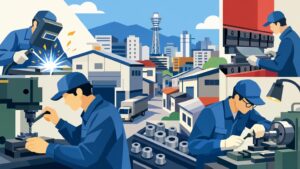
Walk away from the neon glow of Namba, leave the polished towers of Umeda behind. Take the Kintetsu line east, deep into the grid of residential neighborhoods that form the backbone of Osaka. Get off at a local stop, somewhere like Kawachi-Kosaka or Yaenosato. The air changes here. It’s not the scent of takoyaki or department store perfume. It’s the faint, metallic tang of cutting oil, the distant, rhythmic percussion of a power press, the high-pitched whine of a lathe slicing through steel. You’ll see a row of modest, two-story homes, indistinguishable from millions of others across Japan. But then you’ll notice it. One of the garage doors is rolled up, and inside isn’t a family car. It’s a massive, grease-stained milling machine, operated by an elderly man in a work-worn uniform, his movements precise and economical. Next door, you hear the hiss of a welding torch. Across the street, a small truck is being loaded with meticulously crafted metal components. This isn’t an industrial park accidentally dropped into a suburb. This is the suburb. You’ve just walked into the heart of Higashi-Osaka, the pulsing, beating core of Japan’s Machi-kōba culture.
For a foreigner, especially one accustomed to the strict zoning laws of Western cities or the gleaming, corporate facade of Tokyo, this fusion of home and factory is jarring. It feels chaotic, unplanned, a relic from another era. The immediate question is, “Why is all this industry right here, next to where people live, sleep, and raise their families?” This question misunderstands the fundamental logic of Higashi-Osaka. This dense, seemingly haphazard network of small factories, or Machi-kōba (町工場), is not a flaw in the urban design; it is the design itself. It represents a profoundly different way of thinking about work, community, and identity. It is an economic ecosystem built on hyper-specialization, fierce pride, and a web of human relationships so intricate it functions like a single, decentralized organism. This isn’t just about making things; it’s a living archive of Osaka’s merchant soul, a testament to a mindset that values practical skill over polished theory, and a powerful counter-narrative to the monolithic corporate culture that so often defines modern Japan. To understand the Machi-kōba, to hear the symphony in their industrial noise, is to begin to understand the real, unvarnished character of Osaka itself.
To truly grasp the spirit of this decentralized organism, one must experience the daily rhythm of its people, as detailed in our look at the unique work culture and craftsmanship of Higashi-Osaka’s Machi-kōba.
The DNA of a Factory Town: Why Here?

To understand why thousands of small workshops are packed into the eastern wards of Osaka, one must look back at the city’s rebirth after World War II. Osaka, long recognized as Japan’s commercial hub, was severely damaged by bombing. As the nation began its rapid recovery, an enormous demand arose for every imaginable type of manufactured product. While Tokyo emerged as the center of finance, government, and corporate headquarters, building its economy from the top down with large zaibatsu and their successors, Osaka, true to its merchant heritage, rebuilt from the ground up. It became a city of entrepreneurs—people who knew how to make and sell goods. The barrier to starting a small workshop was relatively low. You didn’t need vast land or a large workforce; all you required was a single machine, a specific skill, and a garage.
A Legacy Forged in Post-War Growth
The economic boom of the 1960s and 70s provided the fertile ground for the Machi-kōba ecosystem to thrive. Large manufacturers such as Panasonic (then Matsushita Electric), located nearby, required a huge variety of components for their televisions, radios, and washing machines. Instead of producing every tiny screw, bracket, and wire internally, they outsourced. This created an ideal opportunity for small, agile workshops. One family might invest in a lathe and specialize in turning metal shafts, while their neighbor might purchase a press to stamp out small metal casings. Another would focus solely on chrome plating. They didn’t compete against one another; they depended on each other. The more specialized you were, the more essential you became to the network. This historical background is key. The Machi-kōba were not part of a planned industrial strategy but emerged organically as a grassroots response to economic opportunity, driven by the pragmatic, can-do spirit of Osakans.
Density is Destiny: The Logic of Proximity
The concentration of these factories is not just a historical happenstance; it is central to their operational brilliance. Outsiders might see inefficiency in the constant movement of goods between workshops, but in truth, it is the opposite. It is a highly efficient, flexible, and resilient system. Imagine a complex metal part needing manufacture. In a large, vertically-integrated factory, this involves complicated internal logistics, paperwork, and multiple departmental handoffs. In Higashi-Osaka, the process is smooth and personal. The part’s journey is simply a walk around the block. Raw metal arrives at Tanaka Seikō, a small workshop with three employees who are masters of precision cutting. Once the basic shape is cut, Mr. Tanaka’s son doesn’t fill out a shipping manifest; he places the semi-finished parts on a handcart and wheels them two streets over to Yamamoto Press Kōgyō. The Yamamoto family, with fifty years of experience in metal bending, operates a press that can produce a unique angle unmatched by others. After pressing, the parts may require specialized threading. Mr. Yamamoto calls Sato Neji, located in the alley behind his shop. Sato-san, an expert in screw threads, inspects the parts and takes them back to his workshop. The final step is a specialized coating, handled by a plating expert three blocks in the opposite direction. All of this can be completed in a single day, coordinated not through complex computer systems but by phone calls, face-to-face interactions, and decades of mutual trust. This proximity is the system’s lifeblood, enabling rapid prototyping, instant quality control, and an agility that large corporations can only envy.
The “Go-kinjo” Network
This system rests on more than just business dealings; it is founded on go-kinjo tsukiai (近所付き合い), the intricate network of neighborhood relationships. The factory owners are not just business partners; they are neighbors who grew up together, whose children attended the same schools, and who socialize at the same local izakaya. This personal connection is the lubricant that keeps the Machi-kōba economy running smoothly. When a major Tokyo company places a rush order with a tight deadline, the first workshop owner doesn’t consult a supplier database. Instead, he picks up the phone and calls a friend: “Suzuki-san, I’m in a tough spot. Could you possibly finish polishing these by tomorrow morning? I’ll owe you one.” This isn’t a formal business request but a personal appeal. Reputation means everything. You don’t let your neighbor down because next week, you might need their help. This is where the cliché of “friendly Osaka” gains real meaning. It’s not just superficial cheerfulness—it’s a friendliness rooted in deep, practical interdependence. In the Machi-kōba world, a neighbor’s success is directly tied to your own.
The Machi-kōba Mindset: Pride in the Niche
To truly grasp the culture of these workshops, you must embrace a mindset that often feels foreign to the modern corporate world. It’s a culture that regards specialization not as a limitation but as the greatest source of strength and pride. This ethos prioritizes tangible craftsmanship over abstract strategy and direct communication over formal pleasantries.
“Uchi wa Kore Shika Dekin”: The Power of Specialization
A phrase frequently heard from a Machi-kōba owner, spoken with a blend of humility and immense pride, is “Uchi wa kore shika dekin” (うちはこれしかできん), meaning “This is the only thing we can do.” In a Tokyo business context, such an admission might be viewed as a weakness, a lack of ambition to diversify and grow. However, in Higashi-Osaka, it stands as a powerful claim of mastery. It means, “We don’t waste time on anything else because we are the absolute best at this one specific craft.” This could involve anything from manufacturing a screw with a unique thread pattern for a medical device, to polishing metal surfaces to a flawless mirror finish, or welding titanium alloys with near-impossible precision. This relentless dedication to a single craft, passed down through generations, fosters an irreplaceable depth of knowledge. These artisans are not merely factory workers; they are living vaults of technical skill. Their goal isn’t to build a sprawling conglomerate but to make their family name synonymous with the finest metal springs, the most dependable gears, or the perfect weld in all of Japan. Their ambition isn’t broad expansion; it’s a profound dive into the deepest mastery of their craft.
The Anti-Corporate Ethos
The everyday life of a Machi-kōba sharply contrasts with a Tokyo office. The shachō (社長), or company president, rarely dons a suit and tie in a corner office. More often, he’s on the factory floor, dressed in an oil-stained uniform like his workers, hands skillfully operating the shop’s oldest yet most reliable machine. He is usually the most skilled technician, the ultimate quality controller, and the chief troubleshooter. The hierarchy is flat and pragmatic. There are no endless meetings filled with PowerPoint slides and buzzwords. Issues are resolved directly at the gemba (現場)—the actual place where work happens. When a client brings in a new blueprint, the shachō and his top craftsmen gather around it right on the workshop floor, passionately discussing the best machining approach. It’s a culture of immediate response. If a machine breaks down, they don’t call a remote maintenance team; they roll up their sleeves and fix it themselves. This hands-on, practical approach is central to the Osaka identity. There’s a deep skepticism toward abstract theories and great respect for tangible outcomes. Judgement comes not from your title or presentation skills but from the quality of what you can produce with your own hands.
The Language of the Workshop
This direct, results-driven culture is reflected in the communication style, which can be jarring to outsiders, even other Japanese people. The language used in the workshop is blunt, efficient, and stripped of the elaborate politeness (keigo) typical of formal Japanese. If a younger worker errs, the boss won’t softly correct them but is more likely to shout, “Akan!” (That’s no good!) or “Chau, chau!” (Wrong, wrong!). This isn’t intended as insult or degradation. It’s vital, real-time feedback. In a high-precision environment, a small mistake can ruin an entire batch of costly materials or damage expensive machinery. There’s no room for ambiguity. This straightforwardness permeates the broader Osaka dialect and social manners. Foreigners often find Osakans louder, more direct, and less formal than Tokyoites. This perception stems from a culture such as the Machi-kōba, where clarity and efficiency take precedence over politeness. It’s a communication style engineered for getting things done rather than navigating complex social hierarchies. It’s honest, raw, and when understood in context, notably effective.
A Symphony of Collaboration: The Unseen Production Line
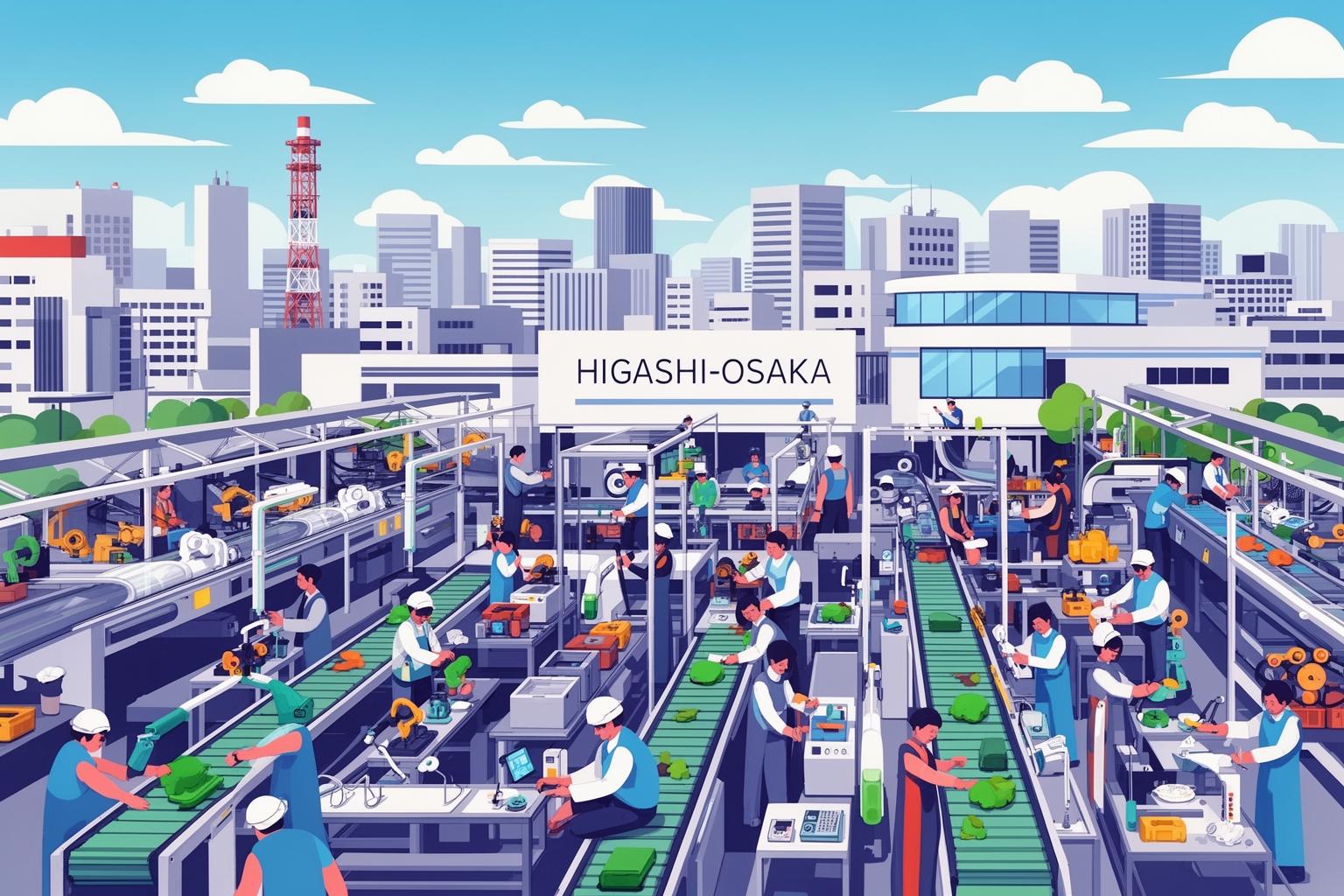
The true wonder of the Higashi-Osaka network lies in how thousands of fiercely independent, highly specialized workshops operate together as a unified entity. It’s not a chaotic cluster of competitors, but a finely orchestrated ensemble of collaborators. Each workshop acts as an instrument, and when a project arises, they perform in seamless harmony, guided by trust and mutual respect.
The Horizontal Web vs. The Vertical Ladder
If you were to map Tokyo’s industrial structure, it would resemble a series of tall, vertical ladders. Towering at the top are giant corporations like Toyota, Sony, and Mitsubishi. Beneath them are their primary suppliers, followed by secondary suppliers, forming a strict hierarchy where power flows downward. Higashi-Osaka’s structure is entirely different. It’s an expansive, horizontal web with no single company at its core. Power is decentralized. A small workshop with just five employees might be world-renowned for a specific type of gear manufacturing, making it an essential partner for a multinational corporation. The relationships are peer-to-peer. Any node in the web might initiate a project. A design specialist could win a contract and act as project manager, assembling trusted partners for stamping, cutting, and finishing. The following week, the stamping company might receive a major order and do likewise, calling on the design specialist. This dynamic, symbiotic interaction starkly contrasts the rigid subcontractor model common elsewhere. It fosters a sense of shared ownership and collective responsibility. They are not merely suppliers; they are co-creators.
The “Tonari no Oyaji” Connection
To see this web in action, imagine a medical research institute needing a prototype for a new surgical instrument—a complex device requiring multiple high-precision parts. The journey begins not at a large conglomerate, but at a small design and engineering firm in Higashi-Osaka—let’s call it Ikeda Engineering. Ikeda-san, the owner, studies the blueprints. Though he has no factory himself, he knows everyone who does. He thinks, “The main casing must be milled from a single block of titanium. Only Kobayashi Seimitsu can handle that. Their five-axis machine is unmatched.” So, he walks three blocks to Kobayashi-san’s workshop. While discussing the project, Kobayashi-san notes a potential challenge: “This internal spring needs very specific tension. My spring expert is Yamamoto Hatsujō. The oyaji (old man) there is a genius.” Together, they visit Yamamoto-san, a man in his late seventies who has been crafting springs his entire life in a workshop behind his home. After reviewing the design, he exhales and says, “Difficult. But possible.” He agrees to create the custom spring. The prototype also requires a microscopic lens holder needing special anti-corrosion plating. For that, everyone knows to go to Tanaka Plating, whose secret chemical formula is a closely guarded family legacy. Within days, Ikeda-san has assembled his dream team. He is the conductor, Kobayashi-san the lead violinist, Yamamoto-san the master percussionist, and Tanaka-san provides the flawless finish. They communicate constantly, exchanging parts, making minuscule adjustments on the fly. There are no formal progress reports or bureaucratic delays. It’s a dynamic, creative process, founded on the simple yet powerful bond of knowing that the tonari no oyaji (the old guy next door) is the best in the world at what he does.
When Satellites Are Made in a Back Alley
This collaborative model extends beyond small prototypes, achieving results of global caliber. The most renowned example is the “Maido-1” satellite. In the early 2000s, a group of Machi-kōba owners in Higashi-Osaka sought to demonstrate to the world—and themselves—the capabilities of their network. They formed a cooperative, the Astro-Technology SOHLA, and set an ambitious goal: to build and launch their own satellite. This was normally the exclusive domain of national space agencies and large aerospace firms. Over a hundred small factories contributed their specialized expertise. One fabricated the satellite’s exterior panels, another crafted the intricate internal wiring, and another produced precision bolts designed to endure the vacuum of space. They pooled their knowledge, resources, and relentless pride. In 2009, Maido-1, born in the back alleys and small workshops of Higashi-Osaka, was successfully launched into orbit. It became a powerful emblem of the Machi-kōba spirit—proof that a horizontal web of small, dedicated artisans could collectively accomplish something monumental.
Daily Life in the Factory’s Shadow
For the residents of Higashi-Osaka, the Machi-kōba culture is far from an abstract economic concept; it forms the very fabric of everyday life. The neighborhood’s pace is set by the opening and closing of workshop doors, with the community centered around the shared craft of making things and intrinsically connected to the industry that supports it.
The Rhythm of the Whistle
The day begins early in Higashi-Osaka. Long before commuters in central Osaka board crowded trains, workshop lights are already glowing. The morning’s first sounds are not birdsong, but the steady hum of machines warming up. This industrial soundtrack is the heartbeat of the neighborhood. The steady thump-thump-thump of a stamping press is as familiar as a pulse. Lunch breaks are brief and efficient; workers flow into local, no-frills eateries for a quick bowl of udon or a satisfying teishoku meal. Afternoons are a whirlwind of activity—deliveries arriving and departing, owners calling out over the machine noise. As dusk settles, the machinery slows, rollup doors close, and the streets quiet down. Yet the day isn’t quite over. Workshop owners and workers often gather at a local tachinomi (standing bar) or small izakaya, sharing inexpensive beer, airing grievances about difficult clients, or celebrating completed orders. In these moments, the distinctions between boss and employee, supplier and client, fade away. They are all part of the same guild, united by craft and community. Life and work are not separated but intertwined, woven from the same sturdy, enduring fabric.
The Smell of Success (and Cutting Oil)
Living in a neighborhood where your home borders a metal plating shop offers a unique sensory reality. There is a constant, low hum of activity and the distinct, oddly pleasant scent of machine oil and heated metal. To outsiders, this might appear to be pollution or a sign of urban decay. But for locals, these are the markers of a thriving, functioning community. The noise signals their neighbors earning a living; the metallic smell is the scent of productivity—the perfume of the local economy. Children grow up with a direct connection to work. They witness what their parents and neighbors’ parents do every day. They understand that the objects filling their world—from bicycles to smartphones—don’t just appear on shelves magically; they are made here, with skill and sweat, by people in their own community. This fosters a grounded, practical perspective that is distinctively Osaka. It is a culture that honors hard, tangible labor because it sees, hears, and smells it daily.
The Next Generation’s Challenge
That said, life in the Machi-kōba world is far from romantic. The culture faces significant challenges. The master craftsmen, the shokunin who built this ecosystem, are aging. The kōkeisha mondai—the problem of finding successors—is a persistent concern. Many of their children, educated in a different Japan, are drawn to the perceived stability and allure of white-collar jobs in gleaming skyscrapers. They are reluctant to inherit noisy, greasy workshops and the pressures of running small businesses. Moreover, global competition from countries with lower labor costs has put enormous strain on these small factories, many of which have closed in recent decades. Yet the Machi-kōba spirit endures. In response, a new generation is innovating. They organize “Open Factory” events, inviting the public to witness their extraordinary skills firsthand. They collaborate with young designers to develop new, high-end consumer products. They adopt new technologies while respecting long-standing traditions. This ongoing struggle is a tribute to the resilience and adaptability that have always defined this community.
What This Means for You, the Foreign Resident

Understanding the world of the Machi-kōba goes beyond being a mere sociological curiosity. It serves as a key to unlocking a deeper appreciation of Osaka’s distinctive character and offers a practical framework for navigating everyday life in the city. The mindset developed in these workshops influences every facet of Osakan culture, from its dialect and business manners to its sense of community.
Beyond the Tourist Trail
Living in Osaka, you soon realize that the city’s true essence isn’t found in its castles or flashy shopping areas. Instead, it lies within the dense, lively, and intensely local neighborhoods. The Machi-kōba culture sheds light on what makes Osaka unique. It reveals the city’s pragmatism and its strong commitment to kosupa (cost performance). In a world where every raw material carries significant expense, efficiency and demanding value for money become second nature. It also clarifies the skepticism toward excessive formality and bureaucracy: why waste time on elaborate rituals when a direct conversation can solve the problem? It highlights the deep pride in local identity. Just as a workshop owner takes pride in his family’s craft, Osakans hold fierce pride for their city, its cuisine, and their distinctive way of doing things. They view themselves as artisans among a nation of bureaucrats.
Decoding Osaka Behavior
The next time you meet an Osakan who seems unusually straightforward or blunt, remember the language of the workshop, where clarity is kindness. When you see a shop owner bargaining with a supplier, recall the pragmatism of the Machi-kōba, where every yen matters. If you experience the strong sense of neighborhood community in a local shōtengai (shopping arcade), think of the go-kinjo network of factories, where survival depends on mutual aid. The Machi-kōba ethos is the city’s operating system, quietly running in the background. It fuels Osaka’s renowned entrepreneurial spirit. The city boasts one of the highest rates of new business creation in Japan, a legacy of the same drive that enabled someone to start a factory in their garage with just one machine and determination.
Finding Your Place in the Gears
For foreigners living in Osaka, particularly in the eastern areas, engaging with this culture can be deeply rewarding. Don’t just regard these workshops as noisy neighbors—see them as the engines powering your community. Support the small restaurants and shops serving the factory workers. If there’s an open factory day, attend it. Witness the remarkable skills on display. Appreciate that the rhythmic noise heard during the day is the sound of a proud and resilient culture in motion. By doing so, you move beyond being a mere resident to becoming a true observer of the city’s inner workings. You begin to realize that Osaka is not simply a cheaper, friendlier version of Tokyo. It is fundamentally different, with its own history, economic framework, and worldview. It is a city built not from the top down by shoguns and emperors, but from the ground up by merchants and makers. And amid the symphony of sparks rising from the workshops of Higashi-Osaka, you can still hear the powerful, authentic rhythm of its creation.