
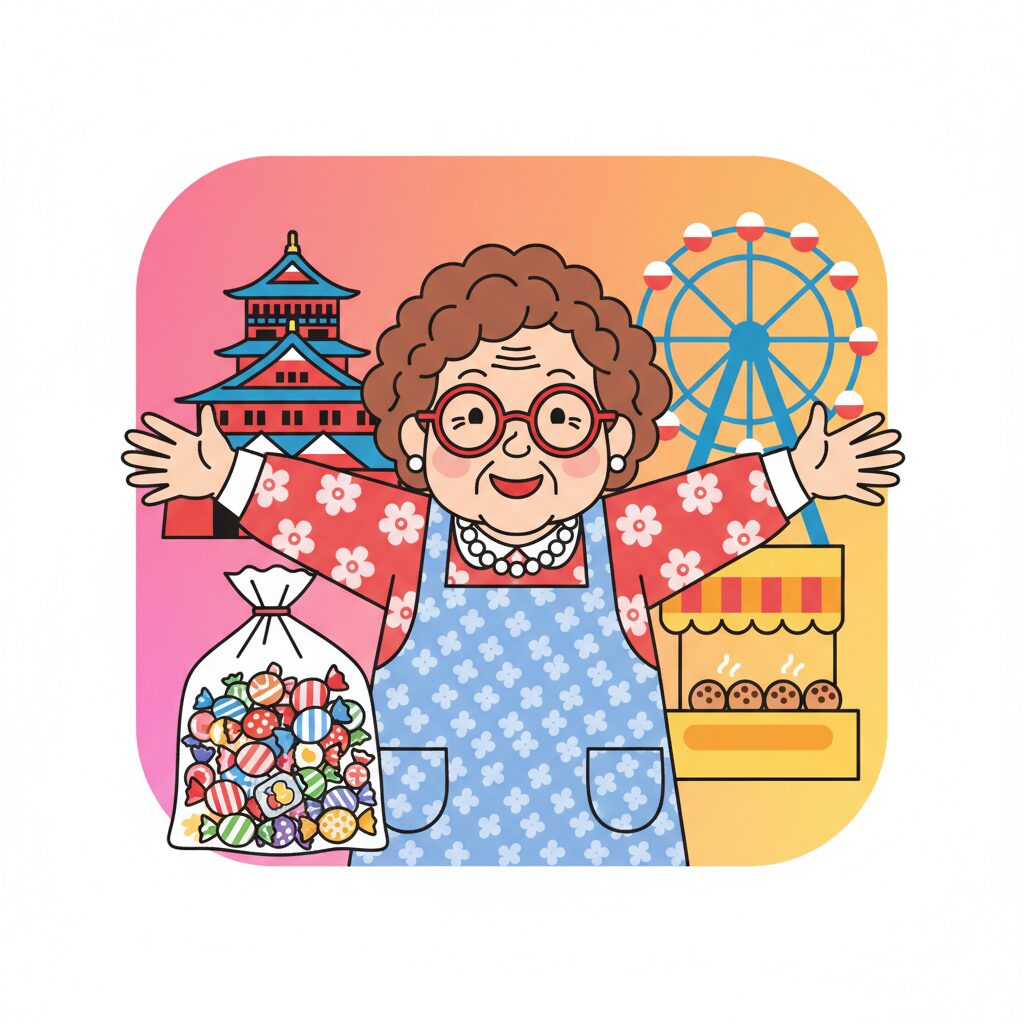
The first time it happens, it feels like a glitch in the social matrix of Japan. You’re standing on the Midosuji Line platform, minding your own business, maybe scrolling through your phone. Suddenly, a woman with a cloud of perfectly permed, slightly purple-tinted hair and a dazzling leopard-print blouse pats your arm. You flinch. She points at your bag, which is slightly unzipped. With a flurry of rapid-fire Osaka dialect and a grin that crinkles her eyes, she makes a zipping motion, says something that sounds like “Akan de!” (No good!), and then, the masterstroke. She rummages in her handbag, a universe of floral patterns and sturdy leather, and produces a small, cellophane-wrapped candy. She presses it into your palm with a decisive “Hai, dozo!” (Here, you go!), turns on her heel, and boards the train, her mission accomplished. You’re left standing there, slightly bewildered, with a single piece of hard candy in your hand, wondering what just happened. Welcome to Osaka. You’ve just had your first encounter with the city’s most powerful, misunderstood, and essential social force: the Osaka Obachan.
This isn’t Tokyo. In the capital, a similar situation might earn you a worried glance, or more likely, complete and utter silence. The unspoken rule is to maintain a bubble of polite, anonymous distance. But Osaka plays by a different set of rules, and the Obachan are the referees, star players, and devoted fans, all rolled into one. They are the living, breathing soul of the city’s famous warmth and pragmatism. They are not just “aunties” or “middle-aged women”; they are an institution, a social rank earned through years of navigating life with gusto, humor, and a purse full of hard candy. To understand the Obachan is to unlock the core operating system of daily life in Osaka, to see past the tourist clichés of takoyaki and neon signs, and to grasp the city’s true, vibrant, and incredibly human rhythm. This guide is your key to decoding their language, their gestures, and the profound meaning behind that simple piece of candy, the legendary “ame-chan.”
To truly appreciate this profound social gesture, it’s essential to understand the sweet social currency of Osaka.
Decoding the Obachan: More Than Just an ‘Auntie’
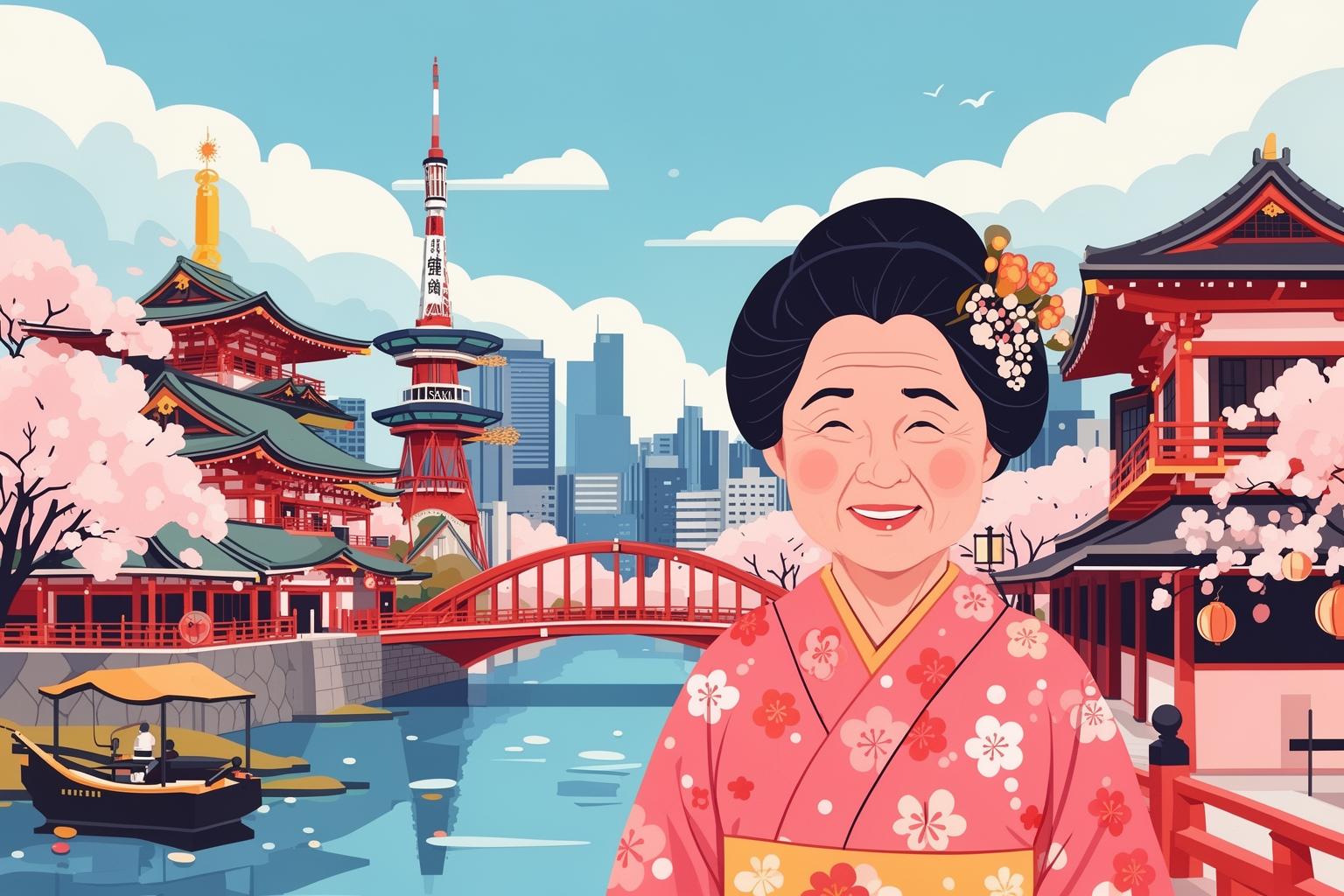
Before we explore the daily rituals, it’s important to first understand who we’re referring to. The term “Obachan” itself needs a cultural translation. In standard Japanese, calling a woman you don’t know “obasan” (the usual equivalent) can be somewhat of a faux pas, subtly suggesting she is “old.” But in Osaka, “Obachan” — with the affectionate “-chan” suffix — carries a different meaning. It’s a title of respect, acknowledging a woman’s status as an experienced life veteran and a pillar of the community. It’s a role one grows into, with specific social privileges and responsibilities attached.
Who Qualifies as an ‘Obachan’?
Becoming an Obachan isn’t strictly tied to age. It’s more a state of being. It marks the moment a woman moves beyond social self-consciousness to embrace a strong, pragmatic, and community-oriented identity. While there’s a visual stereotype — the well-known perm, fondness for animal prints, comfortable yet surprisingly flashy shoes, and a bicycle that serves as a personal chariot — the real essence is in behavior. An Obachan is defined by what she does.
She is the woman who will tell you, a complete stranger, that rain is coming and you should bring in your laundry. She’s the one who strikes up a conversation in the supermarket line about the price of daikon radishes. She doesn’t hesitate to ask a lost tourist where they’re headed, then give animated, slightly confusing, but ultimately helpful directions. She radiates a confident maternal energy that extends throughout the neighborhood. This confidence is often mistaken for brashness by those used to the more reserved social codes of other Japanese cities. But in Osaka, it’s not brashness; it’s care expressed directly and efficiently. There’s no time for subtlety when your neighbor’s futon is about to get soaked.
The Obachan as a Social Institution
The Osaka Obachan acts as an essential piece of social infrastructure. Think of them as the original neighborhood watch, the analog social network, the keepers of communal harmony. They are the eyes and ears of the local shotengai (shopping arcade) and residential streets. They know who just moved in, whose child is studying for exams, and which nearby clinic offers the best flu shots. This isn’t invasive gossip; it’s a network of information that keeps the community connected and safe.
Their directness is a key aspect of their role. An Obachan will not hesitate to enforce unspoken rules. If you park your bicycle blocking the path, you won’t find a passive-aggressive note; you’ll get a firm but friendly lecture from an Obachan on her way to the greengrocer. If your trash sorting is wrong, she will cheerfully point it out, not to embarrass you but to maintain order on the block. This can be startling for newcomers, especially those from cultures that prioritize non-confrontation. But once you understand the reason — a fierce pride and protective instinct for her community — it becomes a form of tough love. They are the guardians of shared quality of life, and they take that responsibility very seriously. In a sprawling, anonymous city, they are the force that transforms a mere collection of buildings into a genuine neighborhood.
The Morning Ritual: Greetings as a Community Heartbeat
One of the first things you’ll notice about daily life in Osaka, especially if you’ve spent time in Tokyo, is the sound. Osaka is simply louder, and this is most evident in the morning greetings, a ritual led by the Obachan.
“Ohayo!” in the Shotengai
Take a stroll through a neighborhood shopping arcade like Tenjinbashisuji or a smaller, local one in areas such as Nakazakicho or Shonai around 10 a.m. The air is filled with a chorus of greetings. It’s not the hushed, almost whispered “Ohayogozaimasu” you might hear in a Tokyo office. This is a full-throated, energetic “OHAYO!” or a hearty “MAIDO!” (a merchant’s greeting that’s now a general hello). The Obachan are at the heart of this symphony.
They greet the fishmonger, the tofu maker, and the pharmacist not with just a word, but with a full-blown inquiry. “Ohayo, Tanaka-san! Genki? Kinou wa atsui datta na~!” (Morning, Mr. Tanaka! You well? Yesterday was hot, wasn’t it!). This is more than a pleasantry—it’s a genuine check-in. It’s a daily reaffirmation of relationships. They notice details. They comment if the shopkeeper looks tired. They ask about a sick family member. This ongoing, low-level social monitoring weaves the fabric of the community together. It builds a baseline of familiarity and trust. It’s how people care for each other without making a big show of it. It’s practical, everyday kindness.
The Volume and Energy: An Osaka Specialty
The energy of these exchanges is uniquely Osaka. A greeting is not passive; it’s an active declaration of presence and vitality. It’s a performance. An Obachan might yell a cheerful “Konnichiwa!” to a friend across a busy street, unfazed by the traffic between them. This act breaks down the invisible barriers that usually exist between people in a big city.
For a foreigner, this can be both intimidating and wonderfully welcoming. You might be standing at a crosswalk when an Obachan, having just finished a loud chat with the fruit stand owner, turns to you and says, “Kyo mo ee tenki ya na!” (Nice weather again today, huh!). Suddenly, you’re seamlessly brought into the fold. This casual inclusion of strangers in the daily narrative is a cornerstone of Osaka life. In Tokyo, strangers are often treated as part of the background. In Osaka, a stranger is seen as a potential, if temporary, participant in the ongoing conversation of the city. The Obachan are the main drivers of this spirit, using their strong voices and open attitudes to transform a sterile public space into a shared, lively environment.
The Sacred ‘Ame-chan’: A Currency of Connection
If the morning greeting is the heartbeat of Osaka, then the “ame-chan” is its lifeblood. This small piece of candy stands as the most powerful tool in the Obachan’s social toolkit—a versatile device for communication, expressing gratitude, and fostering community.
What is ‘Ame-chan’?
Let’s start by breaking down the name. “Ame” (飴) is the Japanese term for candy, specifically hard candy. The suffix “-chan” (ちゃん) is affectionately used for children, pets, or close friends. It is diminutive and conveys warmth. Adding “-chan” to an inanimate object like candy is a distinctive linguistic trait of the Kansai region—it turns “candy” into something like “little sweet candy” or “dear candy,” making it feel intimate and personal. The candy itself is usually simple. Common types include classic Kuro-ame (a dark candy made from unrefined brown sugar), Nodo-ame (herbal throat lozenges), and basic fruit or milk-flavored hard candies. These are chosen for their practicality: they have a long shelf life, are individually wrapped for hygiene, and offer a small, comforting sugar boost.
The Ritual of Giving
Giving ame-chan is far from random—it is a highly ritualized act responding to specific social signals. An Obachan’s purse is not just a candy container; it is a tactical social kit, and the ame-chan is deployed with deliberate precision.
Typical moments for offering ame-chan include: when a child starts fussing on the train (serving as a distraction and a peace offering to parents and other passengers); as a thank you if you help her retrieve something she dropped or give up your seat; or as an icebreaker if you happen to sit beside her at a bus stop for several minutes. It can also act as a reward for a small kindness—for example, complimenting her stylish bag might earn you an ame-chan. The candy serves many roles: a silent apology for a child’s noise, a thank-you token, a conversation starter, and a gesture of goodwill. It’s a way of saying, “I see you, you share this space with me, and I wish you well.”
The Unspoken Rules of Ame-chan
For newcomers, navigating an ame-chan exchange can be delicate because there are unspoken rules. The most crucial rule is that you must always accept it. Refusing an ame-chan is akin to rejecting a handshake or a friendly wave, potentially creating awkward social tension and seeming dismissive of the goodwill behind the gesture. The proper response is a slight bow, a smile, and a clear “Arigato gozaimasu” (Thank you very much) or the more deferential “Sumimasen, itadakimasu” (Excuse me, I humbly receive this). Another rule is that you never ask for an ame-chan—it is a gift given, not a commodity to be requested. The Obachan controls its distribution. Lastly, understand the significance behind the gesture: you’re not simply receiving sugar; you are being welcomed into a micro-community, however brief. You are being acknowledged. It is a tiny, edible contract of social harmony.
The Mystical Obachan Purse
To truly appreciate ame-chan, one must understand its origin: the Obachan’s handbag. This is no ordinary fashion accessory. It acts as a mobile command center, a Mary Poppins-like survival kit for urban life. Inside, you’ll invariably find a dedicated pouch or tin filled with assorted ame-chan. Alongside them are a neatly folded hand towel, tissues, wet wipes, a foldable fan for hot days, a small first-aid kit with bandages and ointments, a sewing kit for emergencies, and an array of point cards for local drugstores, supermarkets, and bakeries within a five-kilometer radius. This remarkable preparedness reflects the Obachan’s self-appointed role as community caretaker, always ready for minor emergencies—from a coughing fit to a scraped knee to a loose button. Ame-chan is simply the most frequently used tool from this impressive arsenal of practical care.
Obachan vs. The Tokyo ‘Okusama’: A Tale of Two Cities
To truly understand the unique social role of the Osaka Obachan, it is helpful to compare her with her counterpart in the capital, the Tokyo ‘Okusama.’ While both are generally married women of middle age or older, their ways of engaging in public life and social interaction are vastly different, highlighting the profound cultural divide between the two cities.
Communication Styles
The Osaka Obachan excels in direct, witty, and often self-deprecating communication. She expresses herself openly, utilizing the vibrant and expressive Osaka dialect to great effect. She isn’t shy about asking personal questions that might be seen as intrusive in Tokyo, such as “Where are you from? Are you a student? Do you like Japanese food?” These questions are not intended to pry but are rapid attempts to establish a connection and find common ground. Humor acts as a social lubricant, and she often jokes at her own expense to help others feel comfortable. Her laughter is both loud and heartfelt.
In contrast, the Tokyo Okusama generally follows the principles of enryo (restraint) and tatemae (public facade). Communication with strangers, if it occurs, tends to be formal, polite, and indirect, with personal questions considered off-limits. The aim is to maintain a smooth, unobtrusive public environment where everyone respects personal space and privacy. Humor is more subtle, and overt emotional expressions are rare. Public spaces are for quiet passage, not for spontaneous connections.
Public vs. Private Space
This divergence in communication mirrors a fundamental difference in how public space is viewed. For the Osaka Obachan, the boundary between public and private is blissfully blurred. Whether on a train, a park bench, or in a supermarket aisle, these places become stages for social interaction. She regards the city not as a sea of strangers but as an extension of her neighborhood, almost like her own living room. She feels a sense of ownership and responsibility for the atmosphere and well-being of these shared spaces.
In Tokyo, the divide is much clearer. Public space remains just that—public, and therefore neutral ground. The typical attitude is to minimize one’s presence and be as unobtrusive as possible. This results in a city that is highly efficient and orderly but can seem cold or impersonal to those used to Osaka’s lively sociability. Attempting to strike up casual conversation with a stranger on a Tokyo train would likely provoke polite bewilderment or even discomfort. In Osaka, it might lead to a fifteen-minute friendship.
The Logic of Frugality and Negotiation
Drawing on Osaka’s long history as Japan’s merchant capital, the Obachan embraces a celebrated love of a good bargain. This attitude isn’t about stinginess, but about being savvy and valuing money wisely. The practice of haggling, or neuchi, in a local shopping street perfectly illustrates this. An Obachan approaches a shopkeeper with a playful, determined cry of “Chotto makete~!” (Please give me a little discount!). This is not an aggressive demand but the opening move in a well-established dance of commerce and conversation—a playful sport. The negotiation builds a relationship between buyer and seller. Scoring an extra spring onion for free is a triumph as much social as financial.
This sharply contrasts with Tokyo’s retail scene, dominated by department stores and boutiques with fixed prices. Haggling in a Shinjuku department store is unimaginable. The price is final. This reflects a distinct value system—one that favors standardization, formality, and efficiency over the personal relationships and flexible negotiations that define the commercial spirit of Osaka.
Navigating Your First Obachan Encounter: A Practical Guide for Newcomers
For any foreigner settling into life in Osaka, learning how to engage with the local Obachan is an essential skill. It can be what separates feeling like a stranger from feeling truly at home. Here are some practical tips.
Don’t Be Surprised by Directness
If an Obachan straightens your jacket collar, points out a bit of rice on your cheek, or moves your shopping basket to a better spot in the queue, don’t take it as criticism or a violation of your personal space. This reflects her practical, problem-solving mindset. She notices a minor issue and fixes it. The gesture comes from a place of communal care. The best response is to smile and say, “Ah, arigato gozaimasu!” You’ve just been looked after, Osaka-style.
The Power of a Smile and Simple Words
You don’t need to be fluent in Japanese, or even understand Osaka-ben, to have a positive interaction. A warm smile is a universal language. When an Obachan speaks to you, even if you don’t catch a word, making eye contact and smiling shows appreciation. Equip yourself with a few basic phrases. Saying “Konnichiwa” (Hello), “Arigato” (Thank you), and “Sumimasen” (Excuse me) will take you far. For bonus points, learn a bit of Osaka dialect like “Meccha oishii!” (Really delicious!) when discussing food, or “Honma?” (Really?), which often brings delighted surprise and an even warmer welcome.
When in Doubt, Accept the Candy
This is worth repeating: it is the golden rule. That small, cellophane-wrapped candy is a bridge. It’s a key to the city. By accepting it graciously, you signal that you understand, or at least are willing to join in, the local culture of friendly, casual connection. It’s a simple act that costs nothing and earns a moment of genuine human interaction. Think of it as your first rite of passage, a sweet introduction to the complex, lively, and wonderfully caring world of Osaka.
Ultimately, the Osaka Obachan is not merely a stereotype to laugh at. She is the fierce, funny, and deeply pragmatic guardian of Osaka’s unique cultural identity. She is the force behind its famous friendliness, the upholder of its communal spirit. In an increasingly impersonal world, she champions face-to-face interaction, looking out for neighbors, and the powerful idea that a small act of kindness—or a single piece of candy—can turn a stranger into a friend. The next time a woman in a vibrant tiger-stripe shirt pats your shoulder and offers you ame-chan, you’ll know exactly what’s happening. You’re not just receiving a sweet treat—you’re being welcomed into the very heart of Osaka.








