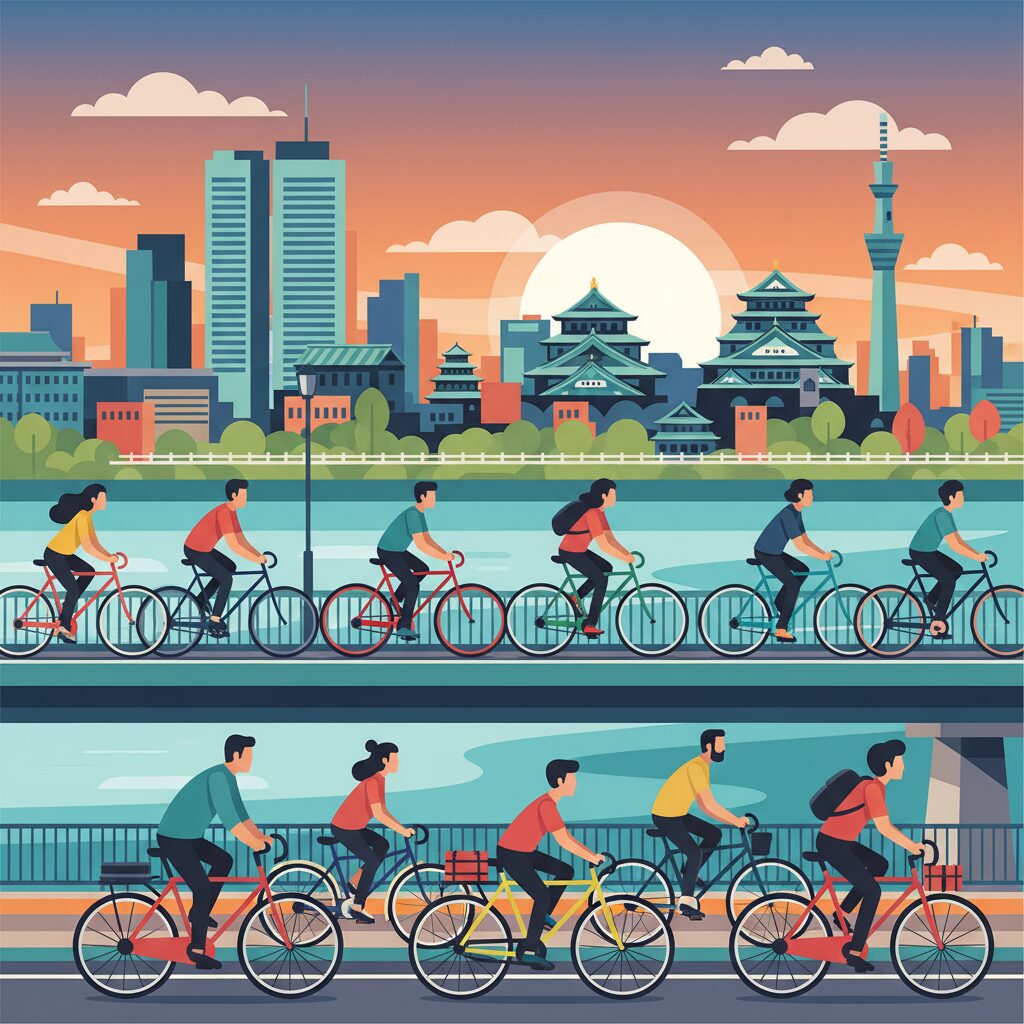
Step off the Shinkansen at Shin-Osaka Station, and you’re greeted by the sleek, punctual efficiency of Japan’s world-famous rail network. It’s a vision of futuristic order, a testament to a nation’s mastery of mass transit. But to truly understand Osaka, to get to the city’s rumbling, beating heart, you need to look away from the train tracks. Look down. Look at the river of steel and rubber flowing through every street, every alleyway, every covered shopping arcade. Look at the bicycles. They’re everywhere. Not sleek, carbon-fiber racing machines or trendy fixed-gear bikes, but legions of humble, practical, basket-equipped chariots known as mamachari. In Tokyo, life is dictated by the station you live near, your world defined by train lines and transfer times. Life unfolds in neatly segmented slices around the Yamanote Line. But Osaka? Osaka is different. Osaka is a city built on a plain, flat as a griddled okonomiyaki, and its lifeblood flows on two wheels. The bicycle isn’t a hobby here; it’s an extension of the self, a declaration of independence from the train schedule, a tool of ultimate practicality. Forgetting this fundamental truth is the first mistake foreigners make. They see the subway map and think they understand the city’s geography. But the real map of Osaka is an invisible network of bike paths, back alleys, and mental shortcuts known only to the locals. To live here, to truly get it, you have to learn to navigate that map. You have to understand the culture of the squeaky brake, the overloaded basket, and the unspoken rules of the road. This is your guide to doing just that.
To truly integrate into the local fabric, understanding the kairanban is as crucial as mastering the bicycle, as it serves as the community’s central information hub.
The Soul of the City: Why Bicycles Rule Osaka
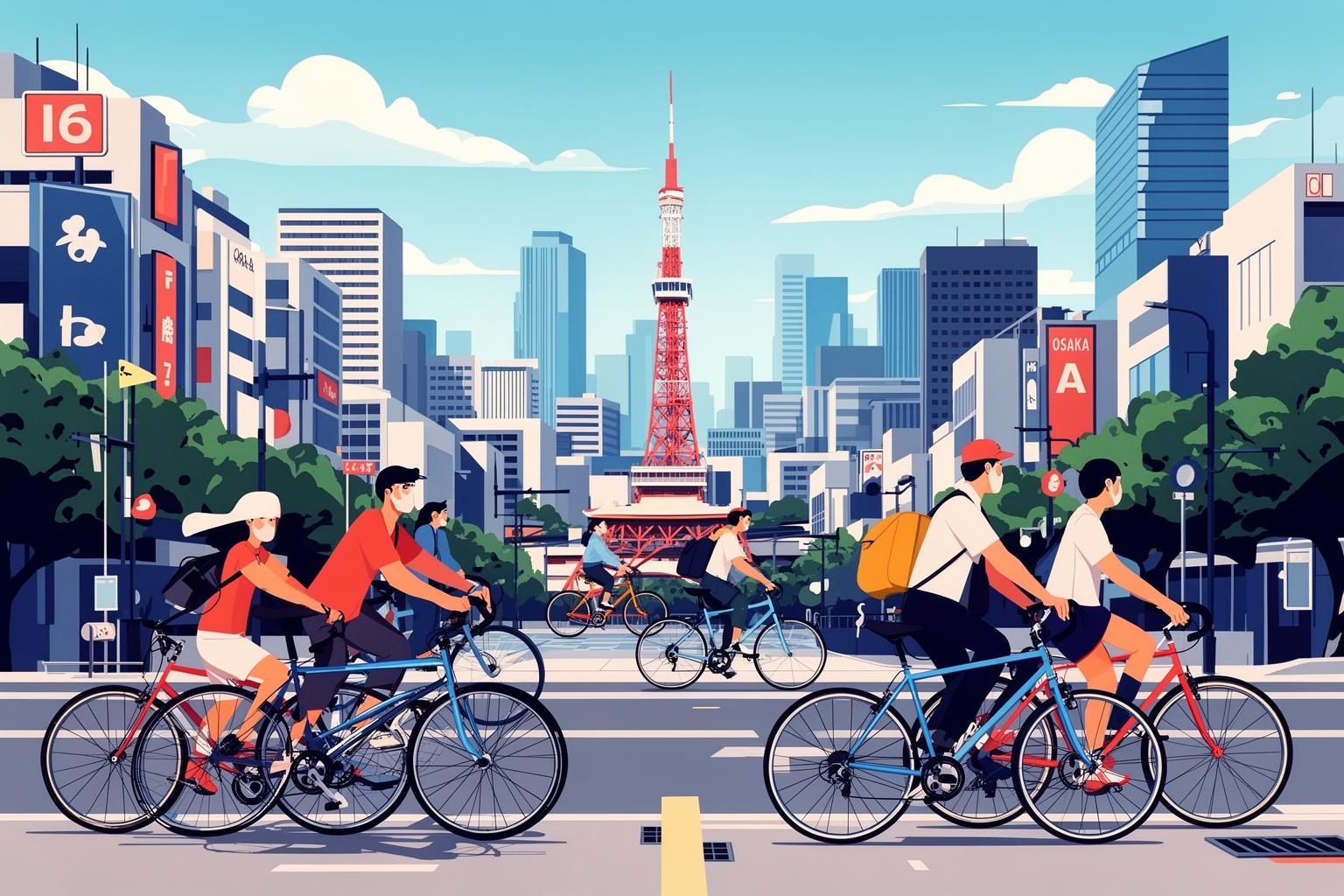
Before you even consider buying a bike, you need to understand why they are so deeply ingrained in the city’s culture. It’s not merely a trend or a mode of transportation; it’s a fundamental part of Osakan identity, shaped by the geography and a strongly practical mindset. This isn’t the Amsterdam of Japan, with scenic canals and neatly arranged bike lanes. It’s something much more chaotic, organic, and distinctly Osakan.
Flat as a Pancake, Twice as Convenient
The primary reason for Osaka’s bicycle enthusiasm is its simple topography. The city lies on the Osaka Plain, a wide, flat stretch of land. Unlike areas of Tokyo with steep hills and winding roads, or Kobe, squeezed dramatically between mountains and the sea, Osaka is gloriously flat. You can cycle from Namba in the south to Umeda in the north without breaking a sweat or needing to shift gears. This geographical advantage changes how distances are perceived and what defines a “neighborhood.” In Tokyo, your local area is often limited to a 2-3 stop radius on the train line, and going beyond that requires consciously tapping your transit card and descending underground. In Osaka, a 15-minute bike ride can take you through three or four distinct neighborhoods, each with its own vibe, shops, and eateries. The city feels less like separate hubs connected by rail and more like a vast, interconnected mosaic. This freedom encourages a different kind of urban exploration—slower, more personal, and at street level. You find the hidden coffee shop in a side alley, the family-run tofu maker, or a park you never knew existed, all because you’re not just rushing between underground stations.
The ‘Mamachari’ Mindset: Utility Over Style
Now, consider the symbol of Osaka cycling: the mamachari (ママチャリ), literally “mom’s chariot.” These bikes are the city’s workhorses. They are heavy, mostly single-speed, and come equipped with a front basket, a built-in rear wheel lock, a dynamo light powered by the wheel itself, a sturdy kickstand, and a frame designed for easy step-through access. They are the opposite of stylish. They exist for one reason: utility. And this reflects the Osaka mindset perfectly. Why spend 180 yen on a one-stop subway ride to the supermarket when you can cycle there in five minutes for free? This is not just about saving money; it reflects a deep cultural value often mislabeled by others in Japan as kechi, or “stingy.” A better translation is “frugal” or “resourceful.” An Osakan instinctively seeks a smarter, more efficient solution when faced with a costly or inefficient option. The mamachari is the perfect embodiment of this. You see them overloaded with groceries, with one child seated in front and another behind. Salarymen in suits pedal them to the station. Grandmothers use them for their errands. Recently, electric-assist mamachari have become a prized status symbol for parents, enabling them to easily handle steep overpasses and bridges with kids and shopping in tow. Here, the bicycle isn’t a sporting tool or fashion statement; it’s a household appliance, as essential to daily life as a refrigerator or washing machine. Grasping this shift—from bike as leisure to bike as appliance—is the first step to thinking like a local.
Gearing Up: How to Get Your Own Set of Wheels
Convinced? Great. Your life in Osaka is about to improve dramatically. But getting your own bike isn’t as simple as just grabbing one and riding away. There’s a process involved, some important decisions to make, and one absolutely essential legal step you cannot bypass.
The Rental Option: Short-Term Use vs. Long-Term Investment
For newcomers, renting bikes often seems like the obvious first choice. You’ll notice bright, shiny rental bikes for tourists near popular spots, but these aren’t really practical for daily use due to their price and location. A better choice for residents is the expanding network of community cycle-share programs. These electric-assist bikes can be found at docking stations all over the city. You sign up through an app, then pick up a bike at one dock and return it to another. They’re perfect for one-way trips or days when you plan to take the train home. However, they have drawbacks. You rely on dock availability—it’s frustrating to reach your destination only to find the dock full. Plus, for those spontaneous late-night trips to a 24-hour store, nothing compares to having your own bike waiting at your doorstep. Renting is a good way to start, but owning a bike is key to truly embracing Osaka life.
Buying a Bike: Exploring the Market
Buying a bike in Osaka means choosing between new and used, each with its own pros and considerations.
Brand New: Big Chain Stores and Local Shops
If you want a smooth, worry-free experience, buying new is the way to go. The biggest player is Cycle Base Asahi, a huge chain with locations throughout the city. Walking into an Asahi feels like entering a bicycle megastore. You’ll find everything from basic single-speed mamachari around 20,000 yen to advanced cross bikes and electric models. The staff are knowledgeable, they’ll help you select the right size, and most importantly, they’ll handle the crucial registration right then and there. Many smaller neighborhood bike shops (jitenshaya-san) also sell new bikes and offer a more personal service. Buying new means peace of mind: everything is in perfect condition, there’s a warranty, and the paperwork is done for you. It’s the simplest, most dependable option.
Secondhand Finds: The Recycle Shop Adventure
For those who are more budget-conscious and adventurous, secondhand bikes offer a treasure trove of options. “Recycle Shops” in Japan are similar to pawn or thrift stores, often with used bicycles displayed outside. You can find fantastic deals here, with solid mamachari starting as low as 7,000 or 8,000 yen. But this route requires careful attention. Inspect the bike thoroughly—check for tire cracks, test the brakes, listen for chain noise, and ensure the dynamo light works. The biggest hurdle is re-registration. The bike will still be logged under the previous owner, so you must get the seller to provide the necessary paperwork (jouto shoumeisho, or transfer certificate) proving the sale is legitimate, allowing you to register it yourself. Some larger secondhand shops assist with this, but smaller cash-only places might complicate the process. It’s a bit of a gamble, but scoring a great deal and giving a bike new life is a rewarding part of living practically in Osaka.
Making It Legal: The Vital ‘Bouhan Touroku’ Registration
This is the single most important step in bike ownership in Japan, yet many foreigners overlook it. It’s called bouhan touroku (防犯登録), or Crime Prevention Registration, and it’s legally required. When you buy a new bike, the shop will register it for a small fee (around 600 yen). They take your name, address, and phone number, and you receive a small orange (sometimes yellow) sticker with a registration number, which is affixed to your bike’s frame. This sticker serves as your proof of ownership. Police often stop cyclists, especially foreigners, to check registration by scanning this sticker and comparing it to your ID. Riding an unregistered bike or one registered to someone else can lead them to assume it’s stolen, which can result in a long and unpleasant conversation at a police station. This registration is also your best—and only—chance to recover your bike if it’s stolen. If buying used, you must visit any bike shop (not necessarily where you purchased it) with your proof of purchase/transfer and ID to have the bike re-registered in your name. Do not skip this step. That small orange sticker is your bike’s passport, and without it, you’re inviting trouble.
The Unwritten Rules of the Osaka Road
Owning a bike is one thing; riding it is quite another. Osaka’s cycling culture functions within a complex framework of written laws and, more importantly, a vast network of unspoken rules, shifting hierarchies, and mutual understandings. Mastering these is essential for peacefully coexisting with pedestrians and fellow cyclists.
Sidewalk or Street? The Perpetual Osaka Dilemma
This is where most confusion arises. Legally, bicycles are classified as vehicles in Japan and are supposed to be ridden on the left side of the street alongside traffic. In practice, however, nearly everyone cycles on the sidewalk. So, what’s going on? The truth is a hybrid system based on calculated risk and situational awareness. You ride on the street when the road is quiet or marked with a clear bike lane. You move onto the sidewalk when the road is a busy thoroughfare with trucks roaring by, or when the sidewalk is wide and marked with a bicycle symbol. The golden, unbreakable rule is that pedestrians reign supreme. You are a guest on their territory. This means riding slowly, giving them plenty of room, and being ready to stop at any time. You don’t weave aggressively through crowds. You don’t ring your bell wildly to demand they move aside. A gentle, polite rin-rin from a distance serves as an “excuse me, I’m coming through,” but it is a request, not a command. If the sidewalk is too crowded, you get off and walk. That’s it. It’s a dance, and your role is to be the most courteous dancer on the floor.
The ‘Shotengai’ Shuffle: Maneuvering Through Pedestrian Havens
One uniquely Osakan challenge is navigating the shotengai, the covered shopping arcades. These bustling corridors are the heart of many neighborhoods, often a chaotic mix of shoppers, store displays, and cyclists. Some longer arcades, like the 2.6km Tenjinbashisuji, serve as major cycling routes. Riding through one during a busy afternoon is a masterclass in slow-motion navigation. You’re constantly scanning, anticipating a child chasing a ball, a grandmother stopping suddenly to examine pickles, or a shopkeeper stepping out with a new sign. It’s a low-speed, high-stakes ballet. Some arcades post signs requiring cyclists to dismount and walk during peak hours, a rule observed with varying levels of enthusiasm. The key is to read the atmosphere. If everyone else is walking, you walk. If there’s a steady but slow flow of cyclists, you join them, keeping your speed low and your senses keen.
The Rain Poncho Brigade: Cycling in Any Weather
Life in Osaka doesn’t stop for rain, nor do its cyclists. The rainy season reveals a whole new level of cycling creativity and commitment. The essential gear is a proper cycling poncho—not a flimsy emergency one, but a heavy-duty, full-body covering with a clear front panel so you can see your basket and headlight. On rainy days, the streets fill with these colorful, gliding figures—a silent army of all-weather commuters. You’ll also spot the infamous handlebar-mounted umbrella holders, a contraption of questionable legality and even more questionable physics that lets you ride beneath an open umbrella. While tempting, these are usually a bad idea, since a strong gust can turn your umbrella into a sail and send you careening into traffic. The poncho is the mark of the true local. It symbolizes the Osakan refusal to be deterred by something as minor as the weather.
The Symphony of Bells and the Gaze of the ‘Obachan’
Communication on Osaka’s bike paths is a subtle art. As noted, the bell is not a tool of aggression but a gentle alert. Yet there’s a social hierarchy at play, with the obachan (a familiar term for an older woman or grandmother) on her electric-assist mamachari at the summit. These women are the undisputed queens of the road. Having raised children, managed households, and navigated the city for decades, they possess an impressive level of situational awareness and sheer determination. They glide silently and surprisingly swiftly, baskets often filled with daikon radishes, and they expect others to yield. And you do. You always give way to the obachan. A stern glare from one holds more power than any traffic law. They are a force of nature, and respecting their domain is a fundamental rule of survival.
The Parking Predicament: Where to Leave Your Noble Steed
You have your bike, you know the unspoken rules of the road, and you feel like a true local. Then you park it outside the train station to run an errand, come back an hour later, and it’s gone. Welcome to the final, and perhaps most painful, lesson in Osaka cycling: the parking dilemma.
The Illusion of Freedom: Why You Can’t Park Just Anywhere
At first, a visitor might think that you can park a bike anywhere. You see them lined up against fences, tucked under overpasses, and clustered outside convenience stores. This is a dangerous misconception. While parking in quiet residential areas is often tolerated, parking in busy commercial zones, especially near train stations, is a completely different matter. These areas are strictly regulated. You will find signs with clear warnings and diagrams marking no-parking zones. Ignore them at your own risk. City workers frequently patrol these spots, and if they find a bicycle parked illegally, they first attach a warning tag. If the bike isn’t moved within a short time frame (sometimes just a few hours), they will cut the lock if needed and remove it.
Decoding the Churinjo: Your Guide to Paid Parking
The solution is the churinjo (駐輪場), or bicycle parking lot. There are two main types, and knowing how to use them is crucial.
The 100-Yen Lot: Temporary Havens
For short-term parking, seek out automated, paid lots. The system is simple and clever. You roll your bike into a slot, and a metal bar rises to lock your front wheel in place. When you return, you enter your slot number at a central pay station, pay the fee (usually around 100-150 yen for 8-12 hours), and the bar releases. Many offer the first one or two hours free, making them perfect for quick errands like grocery shopping or meeting a friend for coffee. Using these lots costs little for the peace of mind that your bike will be exactly where you left it.
The Monthly Contract: Securing Your Spot
If you ride to the same train station daily for work or find your apartment lacks bicycle parking, you’ll need a getsugaku churinjo (月極駐輪場), a monthly contract parking space. These tend to be larger, often multi-level lots run by the city or private companies. You apply for a spot, pay a monthly fee (usually between 1,500 and 3,000 yen depending on location), and get a sticker for your bike confirming your paid membership. This guarantees you a space and eliminates any parking worries from your daily routine. Many Osaka residents consider this a standard monthly cost.
The Walk of Shame: The Journey to the Bicycle Impound Lot
So, what happens if you ignore all this advice? Eventually, you’ll return to find an empty spot where your bike once stood, marked only by a bright yellow notice on the pavement. The notice informs you that your bicycle was illegally parked and has been towed. Your heart sinks. It includes a phone number and the location of the municipal bicycle impound lot (jitensha hokanjo) where your bike is held. This place is never conveniently located. It might be in an industrial area by the port, beneath a remote stretch of elevated highway, or some other out-of-the-way part of the city, reachable only after a long walk from a little-known bus stop. The trip is a form of punishment. When you arrive at the large, bleak yard filled with hundreds of other abandoned bikes, you present your notice, ID, and your bike lock key to prove ownership. Then, you pay the fine—usually around 2,500 yen. The staff, having seen it all before, may give you a stern but weary lecture on parking rules. Finally, you’re reunited with your bike and must endure the “walk of shame,” wheeling it out of the lot, having learned a costly and valuable lesson about life in Osaka. Almost every long-term resident has done this at least once—it’s a rite of passage.
Beyond the Basics: Maintenance, Modifications, and Mindset
Once you’ve woven the bicycle into your daily routine, it becomes more than just a machine. It becomes part of your neighborhood’s identity, a canvas for self-expression, and a lens through which you view the city.
The Neighborhood ‘Jitenshaya-san’: Your Bicycle’s Trusted Ally
Every neighborhood has at least one small, cluttered, slightly greasy bike shop run by a seasoned mechanic. This is the jitenshaya-san. He is a community cornerstone. This is where you go when you get a flat tire (panku shuri), when your brakes feel spongy, or when your chain starts making strange noises. For a few hundred yen, he’ll patch your tire while you wait. He’ll dispense gruff advice and keep your dependable steed running smoothly. Building a friendly, nodding acquaintance with your local bike guy is essential to feeling at home in your neighborhood. He’s as vital as the corner baker or bartender.
Pimp My ‘Mamachari’: Customization and Accessories
Though the mamachari is primarily a utilitarian machine, that doesn’t stop people from making it their own. You’ll notice little touches that transform a mass-produced bike into a personal statement. A brightly colored cover over the basket to shield groceries from rain and curious eyes. Streamers on a child’s handlebars. A more comfortable saddle for a long commute. A charming character-themed bell. These subtle modifications quietly express ownership and pride, turning the bike into a true member of the family’s daily life.
A Final Reflection: The Bicycle as a Symbol of Osaka
In the end, the bicycle perfectly symbolizes Osaka itself. It’s not as sleek or polished as Tokyo’s train system. It can be chaotic, a bit noisy, and follows rules that seem baffling to outsiders. But it is also remarkably efficient, fiercely independent, deeply practical, and connects you to the city on a human scale. It compels you to engage with your surroundings, to notice the changing seasons, the aromas from a local restaurant, the sounds of a neighborhood festival. Choosing the bicycle is choosing a different way of life—one that values convenience and freedom over rigid order. Understanding the patient shuffle through the shotengai, appreciating the all-weather resolve of the poncho brigade, and knowing the cold dread and eventual relief of retrieving your bike from the impound lot reveals something profound about this city’s character. Osaka doesn’t run on a strict schedule. It runs on its own energy, at its own pace, with a bell on its handlebars and a basket full of groceries. And there’s always room for one more rider.