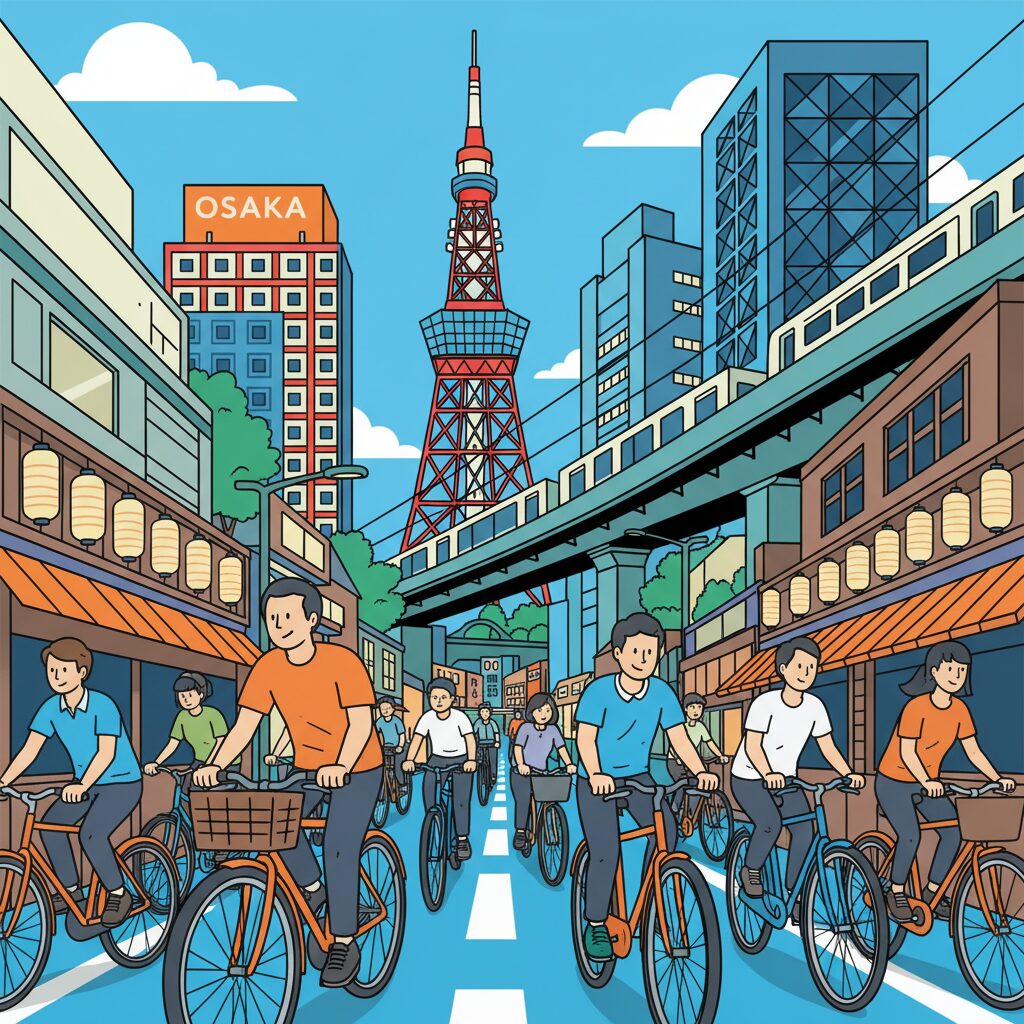
Step off the train in Osaka, and the first thing that hits you isn’t the neon glare of Dotonbori or the grand silhouette of Osaka Castle. It’s the motion. A silent, ceaseless, two-wheeled river flowing through every artery and capillary of the city. It’s a current of steel frames, rattling baskets, and determined faces. This is the kinetic soul of Osaka, and its vehicle of choice is the humble bicycle. In Tokyo, a bicycle often feels like a conscious choice, a recreational tool or a commuter’s solution within a rigidly structured system. It fits into the city’s plan. In Osaka, the bicycle is the plan. It’s not an accessory to life; it’s an extension of the self, a prosthetic limb for navigating a city that values momentum above all else. This constant, swirling dance of cyclists is where the city’s true character is revealed—a complex blend of breathtaking pragmatism, startling impatience, and a form of chaotic, unspoken community. To the outsider, it looks like anarchy. To the Osakan, it’s just the most logical way to get from A to B. Forget the subway maps for a moment; the real key to understanding how this city breathes, works, and lives is found in the unwritten rules of its bike paths, which are, more often than not, the sidewalks themselves. This is a deep dive into the convenience and the chaos, the freedom and the frustration, of life on two wheels in Japan’s most wonderfully unfiltered metropolis.
For a practical guide on navigating this two-wheeled world, from rental to parking, see our article on Osaka bicycle rental and commuting.
The Unspoken Laws of the Mamachari Metropolis
Before you can truly understand the rider, you must first grasp the nature of their ride. The undisputed monarch of Osaka’s streets isn’t some sleek, carbon-fiber racing bike, but the reliable, incredibly practical mamachari—the “mom’s chariot.” This bicycle stands as the foundation of the entire culture, a rolling testament to utility triumphing over style.
The “Mamachari” as Osaka’s Chariot
The mamachari is a triumph of functionality. Its design philosophy is straightforward: carry as much as possible, as comfortably as possible, with minimal maintenance. Take a closer look. The frame features a low step-through design, allowing easy mounting and dismounting even while wearing a skirt or carrying a child. The handlebars are high and swept back, encouraging an upright, relaxed posture ideal for scanning the hectic surroundings ahead. At the front, a deep wire or plastic basket isn’t optional—it’s standard. This basket offers a glimpse into daily life, often brimming with leeks and daikon from the supermarket, a briefcase en route to the office, or a schoolchild’s backpack. At the rear, a sturdy rack usually carries a formidable child seat, sometimes two. These seats serve as thrones for the city’s next generation, who learn balance and traffic awareness from an early age. The mamachari is heavy, constructed from steel rather than aluminum. It accelerates slowly but maintains momentum—an urban battle tank. Perhaps its most essential features are the simplest: a chain guard that protects trousers from grease, fenders to block puddle splashes, and a dynamo-powered headlamp that automatically turns on at dusk, powered by the wheel’s rotation—no batteries or hassle. The mamachari’s sound is iconic: the gentle hum of the dynamo, the assertive clank of its horseshoe-shaped lock securing the rear wheel, and the distinctive click-click-click of its sturdy kickstand supporting the bike steadily, even when laden with forty pounds of groceries. This vehicle is Osaka’s answer to a station wagon or SUV, symbolizing family life, errands, and the relentless daily grind. It declares, “I have tasks to complete, people to transport, and no time for nonsense.” The image of a mother navigating a mamachari with one child in front, another behind, a week’s worth of shopping precariously balanced in the basket, all while chatting on her phone (a common, though illegal, feat) is a quintessential Osaka portrait of grit and multitasking.
Sidewalks, Streets, and the Gray Zone In-Between
Here lies the greatest cultural shock for anyone arriving from Tokyo or most other parts of the world. In Osaka, the strict division between sidewalk and street functions less as a rule and more as a suggestion. Cyclists inhabit a fluid, liminal space, weaving between the two with an instinctive grace that borders on the terrifying. Although Japan’s traffic laws technically classify bicycles as vehicles that belong on the road, the reality in Osaka is one of negotiated anarchy. Sidewalks are the primary domain. Riders glide through pedestrians, their bells serving as a sonic radar. It is a ballet of close calls and subtle adjustments. This behavior isn’t born from malice or a desire to intimidate walkers; it’s a pragmatic adaptation to the city’s infrastructure. Many of Osaka’s roads are narrow, congested with traffic, and lack dedicated bicycle lanes. To locals, riding in the street alongside buses and trucks feels far more dangerous and inefficient than navigating the flow of pedestrians on the spacious, covered sidewalks of a shotengai (shopping arcade). This fluidity is governed by a complex, unspoken social contract. Riders learn to read the crowd’s body language—a slight turn of the head, a hesitation in stride—signals the need to slow down or change course. This is a non-verbal negotiation, a continuous, flickering conversation of intent. It’s a hive mind in motion, where everyone is expected to be aware, anticipate others’ movements, and maintain the flow. A tourist standing still in the middle of the sidewalk, staring at a map, becomes a boulder in the river, forcing cyclists and pedestrians to swirl and eddy around them amid quiet sighs and expertly executed detours.
The Hierarchy of the Path: Pedestrians, Bicycles, and Cars
Though it might appear chaotic, a subtle hierarchy does exist on Osaka’s paths—but not the one outlined in law. At the top sit the elderly and mothers with young children or strollers. Cyclists give them wide, respectful clearance, often slowing to a crawl or dismounting completely. There is a deep, ingrained understanding to protect the most vulnerable. Beyond this, hierarchy depends on confidence and momentum. A focused cyclist with a clear destination wields more right-of-way than a wandering window shopper. An office worker rushing to a meeting will thread tight gaps that a leisurely rider would avoid. It’s a physics of social interaction where mass and velocity determine priority. The relationship with cars is another matter. In direct confrontations, the car always has the advantage, and cyclists know it. Yet this awareness doesn’t breed fear. Instead, it encourages a brand of opportunistic aggression. Osaka cyclists will dart in front of cars at intersections, slip through traffic gaps, and ride against one-way streets, all on the assumption that drivers see them and, not wanting the hassle of an accident, will brake. It’s a city-wide game of chicken, built upon a reluctant, shared understanding. Cars hold power, but bicycles boast agility and a marked disregard for minor traffic rules. This dynamic sharply contrasts with the more deferential relationship between cyclists and drivers in other Japanese cities, where the car reigns as undisputed king of the road.
The Osakan Cyclist Mindset: Pragmatism on Two Wheels
Riding a bicycle in Osaka means embracing a distinctive worldview. It is a mindset shaped by a merchant city’s culture—a philosophy that values efficiency, practicality, and a healthy skepticism toward rules that hinder getting things done. This perspective sheds light on nearly every puzzling and brilliant facet of the city’s bike culture.
“Mendokusai”: The Aversion to Inconvenience
To truly understand Osaka, one must grasp the notion of mendokusai. While it roughly translates to “bothersome,” “troublesome,” or “a pain in the neck,” its cultural weight runs much deeper. It is the core driving force behind much of Osakan behavior and the cyclist’s guiding principle. Cycling culture is essentially a battle against mendokusai. Why walk twelve minutes to the subway when you can bike there in four? That eight-minute difference is precious. Why wait at a pedestrian signal when a quick look reveals no cars coming? Standing still is sheer inefficiency. Why lock your bike to a designated rack half a block away when you can lean it against the convenience store wall you’re popping into for just thirty seconds? Those extra steps are pure mendokusai. This is not laziness, but a fervent, almost religious commitment to optimizing time and energy—a spirit born of merchants who knew time equals money and unnecessary moves equal lost profit. In Tokyo, satisfaction often comes from correctly following processes and rules to maintain harmony. In Osaka, it comes from finding the smartest, fastest, most direct shortcut. The bicycle perfectly embodies this philosophy, enabling riders to cut through the city’s grid, ignoring traffic lights, one-way streets, and even the idea of waiting in line.
The Art of the “Chari-tome”: Parking as a Philosophy
Bicycle parking, or chari-tome, represents the ongoing struggle between the city’s regulations and its people’s deep-seated dislike of mendokusai. Outside major train stations like Namba or Umeda, the scene reflects this clash. Thousands of bikes create a chaotic landscape—handlebars, baskets, and locks intertwined, tied to fences, signposts, each other, or nothing at all, spilling from sidewalks into streets. The city government tries to impose order with designated, often paid, bicycle lots, many of them multi-story or automated underground facilities. While many use these, more do not. The reasoning is straightforward: why pay 150 yen and add an extra two-minute walk when there’s a free, convenient spot at the station entrance? This leads to the familiar urban drama of bike removal. City workers periodically distribute brightly colored warnings to illegally parked bikes, and if not moved, the bikes are towed to a remote impound lot. Retrieving a bike involves a trip to an inconvenient location, a fine, and a lecture—a rite of passage for long-term residents. Yet by the next day, the sea of illegally parked bikes reappears. This is not an act of protest but a collective cost-benefit analysis: the daily convenience outweighs the rare risk of impoundment. This sums up the Osakan spirit—push limits, exploit loopholes, and face the consequences if caught—all in the noble pursuit of avoiding hassles.
Rain or Shine: The Unstoppable Osakan Rider
Nothing captures the resilience and practical ingenuity of the Osakan cyclist better than their attitude toward bad weather. A downpour that would send most city dwellers running for the subway barely fazes them. Their solution is as clever as it is unconventional: the sasube. This device clamps onto the bicycle’s handlebars, holding a full-sized umbrella overhead to create a mobile, personal canopy. It’s a hands-free, brilliant fix for cycling in the rain—though technically illegal and not ideal in high winds. Its widespread use, however, speaks volumes. The need to get groceries, pick up children, or get to work won’t be stopped by a typhoon. The sasube symbolizes Osakan ingenuity born of necessity, a piece of folk engineering that says, “I will not be stopped.” Riders glide through the rain, one hand on the handlebar, the other often holding a smartphone, cigarette, or bag, perfectly dry beneath their umbrella shield. It’s a display of exceptional balance and a steadfast refusal to let weather dictate the flow of their day. Life doesn’t pause for rain, and in Osaka, neither do the bicycles.
The Great Divide: Osaka vs. Tokyo on Two Wheels
Comparing the cycling cultures of Japan’s two largest cities is like comparing two distinct languages. They may share a common grammar, but the accent, slang, and overall philosophy of communication are worlds apart. The bicycle exposes the deep-rooted cultural contrasts between Tokyo’s meticulous order and Osaka’s pragmatic hustle.
Speed and Aggression: A Tale of Two Cities
Cycling in Tokyo often feels polite, almost timid. Riders usually keep to the left side of the road, as required by law. They stop patiently at red lights, yield to pedestrians, and give cars a wide, respectful berth. A Tokyo cyclist moves like a guest within the city’s transportation system, careful not to disrupt the established order. In contrast, cycling in Osaka is a completely different experience. It is faster, more fluid, and boldly assertive. The idea of sticking strictly to the left side is seen as a flexible guideline, easily set aside if the right side offers a clearer path. An Osakan cyclist doesn’t wait for a gap in traffic; they make one. They ride with the confidence of a majority stakeholder in public space. The bell in Tokyo is a gentle ting-ting, an apologetic request to pass. In Osaka, the bell is a sharp, staccato RING-RING-RING!, not a request but a statement: “I am here. I am moving. Adjust accordingly.” To use an analogy, Tokyo cycling is like a carefully choreographed ballet, where every dancer knows their steps and place. Osaka cycling resembles improvisational jazz—chaotic, energetic, occasionally dissonant, yet held together by a shared sense of rhythm and an ability to respond instantly.
The Rule of Law vs. The Rule of Flow
This difference in behavior reflects a fundamental divergence in social philosophy. Tokyo thrives on strict adherence to laws. Rules, signs, and designated areas offer comfort and predictability in a sprawling metropolis. Following rules is a social duty, ensuring the city’s complex machinery operates smoothly for all. Osaka, by contrast, follows the “Rule of Flow.” The goal isn’t to obey rules blindly, but to maintain momentum—both for the individual and the group. A rule that disrupts flow, especially when it seems illogical (like waiting at an empty intersection), becomes an obstacle to be bypassed. This isn’t about anarchy or disrespecting authority; it’s a deep-rooted pragmatism that values observable reality over abstract regulations. A foreigner might see a cyclist running a red light and think, “How rude and dangerous.” An Osakan might think, “Good, there were no cars, and no time was wasted.” This difference is a major source of confusion for newcomers. What may appear as selfish rule-breaking is, from the local perspective, situational common sense designed to increase efficiency for everyone. The system functions because everyone operates under this shared, unwritten understanding.
The Social Fabric: Bikes and Neighborhoods
In Osaka, the bicycle is the thread that weaves the social fabric of neighborhoods. It’s the preferred vehicle for navigating narrow, intimate streets and bustling shotengai. Daily trips to the local market, tofu shop, or public bath are made by bicycle. The sound of a neighbor’s squeaky brake or the sight of a uniquely decorated mamachari parked outside a home is part of the community’s tapestry. It connects people to their immediate surroundings on a human scale. You see your neighbors, greet shopkeepers, and become part of the grassroots life of your community. In Tokyo’s vast urban sprawl, especially in central wards, cycling can feel more anonymous—often a solitary journey from a high-rise apartment to a sterile office. While Tokyo has cozy, village-like neighborhoods, the bicycle’s role as a primary tool for community life feels more pronounced and universal in Osaka. It reinforces the city’s reputation for being more down-to-earth and interconnected. Your bicycle is your passport to neighborhood life, and the shared, chaotic dance on the sidewalks is a daily ritual of community engagement.
Living with the Chaos: A Practical Guide for Residents
For anyone planning to live in Osaka, adopting the bicycle is not merely recommended; it’s virtually essential to fully experience the city. However, integrating into this distinctive culture involves more than just purchasing a bike. It means acquiring the skills, etiquette, and survival instincts of a local rider.
Choosing Your Ride: The Mamachari vs. Others
For beginners, the choice is straightforward: opt for a mamachari. Ignoring its appeal in favor of a sleek road or mountain bike is a common rookie error. The mamachari is what the system is designed around. Its upright position offers the best vantage for spotting hazards. Its basket is indispensable. The built-in lock is handy. Crucially, its modest look makes it a less likely target for thieves. You can find well-functioning second-hand mamachari at local shops for a fair price. As you settle in, you may notice the rise of electric-assist mamachari, new status symbols on Osaka streets, especially favored by parents tackling slopes with kids in tow. They maintain the classic practicality but add a powerful boost, allowing riders to accelerate quickly from traffic lights. While fancy road bikes and fixed-gear models have their appeal, they have drawbacks. Their aggressive posture isn’t suited for weaving on sidewalks, they lack storage, and their high value makes parking nerve-wracking. To truly ride like a local, you must first ride like a local.
Navigating the System: Registration, Insurance, and the Law
Despite the seeming chaos, a layer of bureaucracy exists. When buying a bicycle in Japan, you must complete a bohan toroku, or crime-prevention registration. This links your name and address to the bike’s serial number with a small orange sticker on the frame. It’s vital; police conduct random checks, and an unregistered bike can raise questions about ownership. Recently, the government has pushed to bring more order to the streets. Bicycle liability insurance is now mandatory in Osaka Prefecture, responding to rising accidents involving cyclists and pedestrians. Additionally, a helmet law has been introduced as an “effort-based” rule—strongly encouraged but without fines for non-compliance. Reception to this mandate has been typically Osakan: luke-warm at best. Children and serious cyclists often wear helmets, but most mamachari riders continue bare-headed. The reasons are familiar: it’s hot, inconvenient, and messes up your hair—in short, mendokusai. This slow acceptance highlights the tension between top-down regulation and the practical grassroots culture.
Survival Skills: How to Ride Like a Local
Becoming a skilled Osaka cyclist involves unlearning and relearning. It’s less about strict rule-following and more about tuning in to the city’s rhythm.
- Cultivate 360-Degree Awareness: Your greatest asset is peripheral vision. Never assume a path is clear. Pedestrians may step out unexpectedly. Bikes can silently appear from blind spots. Car doors might suddenly open. Maintain constant, low-level vigilance. Avoid music with headphones; your ears are essential for early warnings.
- Master the Bell: Your bell isn’t a toy but a communication tool. A quick, polite ting alerts a distracted pedestrian from afar. A stronger ring-ring signals you’re approaching faster and need them to stay put. A rapid, continuous RING-RING-RING is an emergency alarm for someone stepping directly into your path. Learn the bell’s language.
- Perfect the Slow Weave: Navigating crowded sidewalks is less about speed and more about flow. Master controlling your bike at very low speeds, making subtle handlebar adjustments to slip through gaps without putting your foot down. Stopping and restarting breaks the flow and annoys those behind you. Aim for continuous motion.
- Embrace the Backstreets: While main roads are direct, they’re also chaotic. True masters of Osaka cycling use the quiet backstreets (roji) paralleling main routes. These secret highways are free from heavy traffic and crowds, allowing faster, safer travel.
- Assume Nothing, Anticipate Everything: This is the golden rule. Assume cars won’t stop. Assume pedestrians will suddenly change direction. Assume the bike ahead may brake unexpectedly. Ride defensively but with confidence. It’s a delicate balance, critical for safe and efficient navigation.
Beyond Convenience: The Soul of the City on a Saddle
The bicycle in Osaka represents far more than just a means of transportation. It stands as a cultural emblem, an economic driver, and a social equalizer. It unveils the core of the city’s identity—its history, values, and distinctive approach to communal living.
The Bicycle as a Great Equalizer
On Osaka’s streets, everyone rides a bike. The high school girl in her uniform, the executive in his suit, the grandmother heading out to buy groceries, the construction worker returning home after a long day—they all share the same routes, face the same challenges, and engage in the same chaotic dance. The bicycle transcends all demographic and socioeconomic boundaries. It creates a shared experience that quietly unites the diverse people of the city. Among riders, there is an unspoken camaraderie born from navigating the same system. A shared nod after skillfully avoiding a collision, or a mutual sigh of frustration at a crowded intersection—these small moments of connection in a vast city are nurtured by the universal experience of cycling. In a society often marked by hierarchy, the bicycle remains a remarkably democratic institution.
A Reflection of Osaka’s History: The Merchant’s Hustle
To fully understand Osaka’s bicycle culture, one must look to its past. Osaka has always been a city of merchants (shonin no machi), the commercial heart of Japan. Its identity was shaped not by samurai courts, but by the busy markets and hardworking workshops of ordinary people. This merchant spirit, or shonin-damashii, embodies pragmatism, efficiency, a sharp eye for deals, and a certain impatience with bureaucracy. Today’s cyclist carries on this legacy. The relentless pursuit of speed and efficiency, the savvy rule-bending to gain an edge, the instinct to bypass the middleman (be it a train schedule or traffic light), and the unstoppable hustle—all reflect the merchant class’s values translated into bicycle culture. The mamachari, heavily loaded and ridden with fierce determination, is the present-day symbol of the same energy that propelled Osaka into economic prominence. It’s the hustle in motion.
The Freedom and the Friction
Ultimately, life with a bicycle in Osaka is a study in contrasts. It grants a profound sense of freedom. A bike opens up the whole city—you aren’t limited by train times or subway routes. You can explore winding backstreets, find hidden temples and quirky cafés, and engage with the city on a tactile, street-by-street level. It invites you to participate in the city’s life, not just pass through it. Yet this freedom demands a price: continual mental effort to stay alert, the frustration of hunting for parking, the adrenaline spike from near misses, and the overwhelming sensory experience of navigating crowded spaces. This blend of liberation and irritation defines the authentic Osaka experience. The city isn’t a tranquil, polished gem—it’s loud, chaotic, lively, and profoundly human. Its charm lies not in flawlessness but in vibrant, unapologetic disorder. To grasp the rhythm of its bicycles—the way they flow, collide, and connect—is to understand Osaka’s essence. It’s a wild ride, but the best way to see the city. Just keep your head sharp and your bell ready.