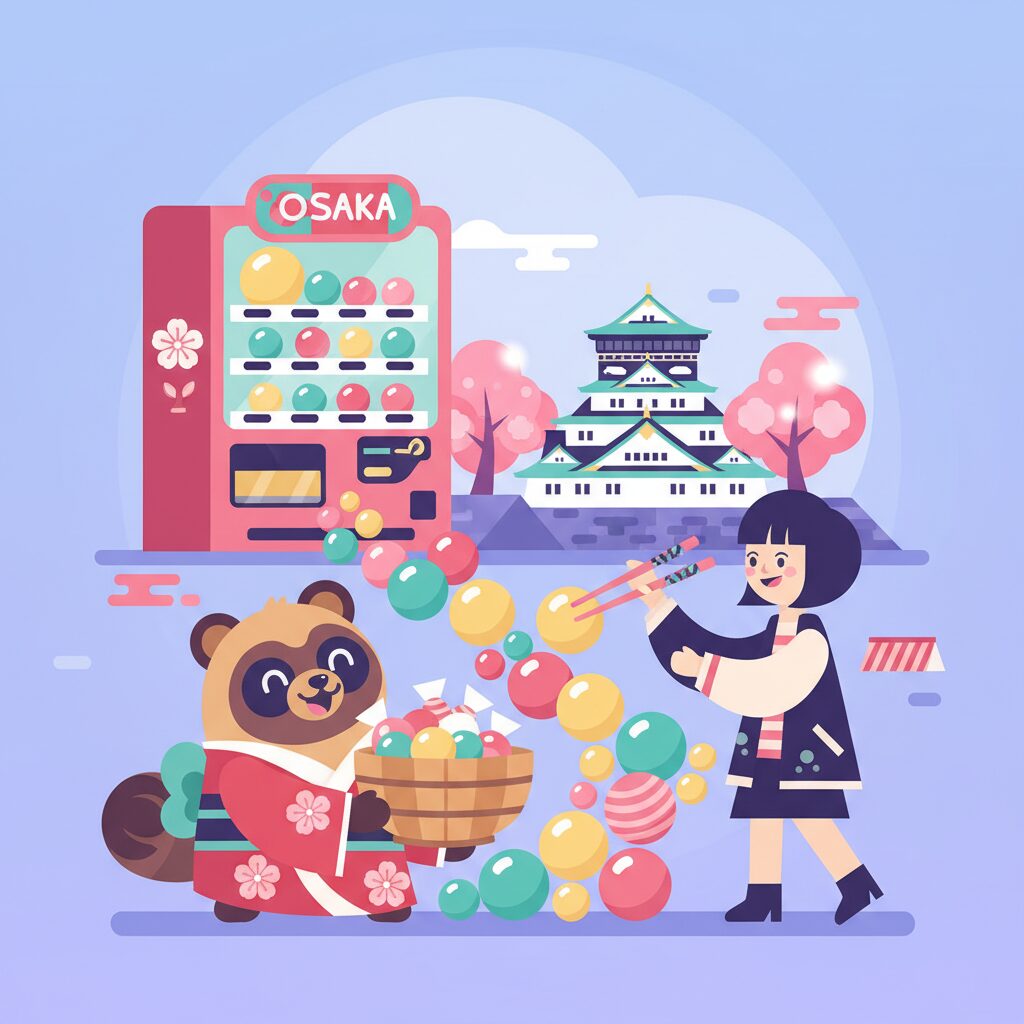
So, you’ve landed in Osaka. You’re navigating the electric labyrinth of Namba, figuring out the train lines at Umeda, maybe even finding your local supermarket in a quieter neighborhood like Tenma or Nakazakicho. You’re starting to get the rhythm of the city. Then, one day, it happens. You’re standing in line, maybe waiting for the bus, or perhaps just admiring the sheer variety of instant noodles at the store. An older woman, a complete stranger, turns to you. She rummages in her handbag – a cavernous leather tote that seems to hold the secrets of the universe – and produces a small, brightly colored object. With a crinkle of plastic and a warm, knowing smile, she extends her hand. “Ame-chan, iru?” she asks. “Want a little candy?” You stand there for a second, a foreigner processing a social interaction that your cultural software has no file for. Is this a trick? A sales pitch? A test? In most major cities around the world, accepting food from a stranger is rule number one in the “how not to get into trouble” handbook. In Tokyo, this interaction is virtually unthinkable; the invisible walls between strangers are thick, polished, and rarely breached. But this isn’t Tokyo. This is Osaka. And you’ve just had your first encounter with one of the city’s most fundamental, unwritten social rituals: the giving of Ame-chan.
This small gesture is a universe in a candy wrapper. It’s more than just a sweet treat; it’s a social lubricant, a conversation starter, an icebreaker, and a diagnostic tool for the entire cultural operating system of Osaka. It’s the city’s way of saying, “Hey, you and me, we’re here in this moment together. Let’s make it a little warmer.” For anyone trying to understand what daily life in Osaka is really like, beyond the takoyaki stands and the Glico Running Man sign, understanding the profound significance of Ame-chan is your first and most important lesson. It’s a key that unlocks the city’s heart, revealing a communitarian spirit that feels both ancient and refreshingly direct in the modern world. This is the story of that little piece of candy, and how it explains almost everything you need to know about the people of Osaka.
This communitarian spirit is also evident in the city’s unique approach to neighborhood communication, where the traditional kairanban system continues to serve as a vital, analog heartbeat.
The Anatomy of an Ame-chan Encounter
To truly understand the concept, you need to analyze the moment carefully. The Ame-chan exchange is a small piece of street theater, a performance with defined roles, settings, and props. It’s a daily ballet enacted thousands of times each day throughout the city, from the lively shotengai shopping arcades of Shinsaibashi to the quiet benches in Nagai Park.
The Giver: The quintessential Osaka Obachan
The main distributor of Ame-chan is usually the Osaka obachan—an older woman, typically in her 60s or older. But don’t confuse her with a frail, quiet grandmother. The Osaka obachan is a powerhouse. She’s practical, sharp-witted, and completely unsentimental, yet she holds a deep reservoir of communal warmth. Her handbag is her survival kit, and inside it, alongside her wallet, tissues, and a foldable fan for the humid summers, is a seemingly endless supply of candy. This isn’t just a casual habit; it’s a state of readiness. She carries Ame-chan for the same reason scouts carry compasses. It’s a tool for navigating social terrain.
She’s the neighborhood matriarch, the unofficial mayor of her block. She knows the best deals at the local supermarket, the train conductor’s timetable, and which neighborhood kids are about to fall ill. Her offer of candy isn’t random; it’s a deliberate act of social connection. She might offer it to a crying child to soothe them (and their anxious parent). She might offer it to you, the foreigner, as a way to bridge the language barrier and provide a silent gesture of welcome. Or she might offer it to the person beside her in a long, slow-moving line just to acknowledge the shared, mild discomfort of waiting. She is the guardian of this tradition, the engine behind this micro-economy of kindness.
The Setting: Public, Yet Personal Spaces
The exchange seldom occurs in highly formal or private settings. Its natural environment is the “third space”—the communal, public, yet intimate places where everyday life unfolds. Think of the line at the post office, the waiting area at a local clinic, a shared table in a food court, or benches at a bus stop. It thrives in moments of shared experience. When you’re both waiting, enduring the same sticky summer heat, watching the same street performer, a temporary bond is created. The Ame-chan solidifies that bond.
One of the most classic locations is the local shotengai. These covered shopping arcades are the lifeblood of Osaka neighborhoods. They serve as ecosystems of interaction, where the boundaries between commercial and social life blur. As you walk through, you’ll hear shopkeepers chatting with customers and neighbors exchanging gossip. It’s in this vibrant, human-scale environment that the Ame-chan exchange feels most natural. It’s part of the general hum of communication that defines these spaces—a non-verbal dialect shared by everyone.
The Prop: Not Just Any Candy
The candy itself matters. This isn’t about offering fancy Godiva chocolates or gourmet treats. The classic Ame-chan is humble, traditional, and practical. There are a few archetypes you’ll see repeatedly.
Kuro-ame (黒飴): Black sugar candy. This is a true classic. Made from unrefined Okinawan black sugar, it has a deep, rich, slightly molasses-like taste. It’s a flavor of old Japan that evokes tradition and comforting simplicity. It’s the sturdy, reliable choice.
Nodo-ame (のど飴): Throat lozenges or cough drops. This is a particularly practical choice. The obachan isn’t just giving you a treat; she’s offering a bit of care. If you cough, or if the air is dry, a nodo-ame is a gesture that says, “I see you. Take care of yourself.” It often has herbal or menthol flavors and is a common offering in the cold and flu season.
Assorted Fruit Drops: These come in colorful tins or clear plastic bags with a variety of flavors—lemon, orange, strawberry, melon. They are cheerful and universally appealing, a safe option for any recipient.
Neri-ame (練り飴): A sticky, taffy-like candy, often served on a small stick. This is a bit more old-fashioned and might be given more to children, but it is part of the Ame-chan family.
The crucial point is that the candy is individually wrapped. This is important. It ensures hygiene, portability, and ease of sharing. The crinkle of the wrapper is the opening note of the interaction. It’s a sound that cuts through the city’s background noise, signaling that a friendly gesture is about to be made.
The Unspoken Language: What Ame-chan Really Says
If you think this is merely about a sugar rush, you’re missing the whole point. The act of giving Ame-chan is a nuanced form of communication, a shortcut to intimacy in a society that can often feel formal and hierarchical. It’s a kind of edible slang, and grasping its significance is essential to truly understanding life in Osaka.
Breaking the Barrier of Strangerhood
In many cultures, and certainly in other parts of Japan, there’s a clear and firm boundary between acquaintances and strangers. You don’t impose on strangers or initiate unnecessary contact. You keep a polite, respectful distance. This is especially true in Tokyo, a city governed by an unspoken agreement of mutual non-interference. On a crowded Tokyo train, people excel at being physically close while remaining socially distant. Eye contact is avoided, and small talk is rare.
Osaka rejects that rulebook entirely. The culture here values connection over personal space, engagement over anonymity. Ame-chan is the key tool in tearing down the wall of strangerhood. By offering a small, non-threatening gift, the giver is essentially saying, “I choose to see you not as a stranger, but as a fellow human being sharing this moment with me. I’m opening a channel of communication. The ball is in your court.”
It’s a low-risk, high-reward social move. If you accept, a conversation might begin—you might chat about the weather, the long queue, or where you’re from. If you politely decline, no offense is taken. The channel closes, and life goes on. But the attempt has been made. The silence is broken. The default mode shifts from isolation to potential connection. This is a core difference in the social climate. In Tokyo, silence is the norm. In Osaka, openness to interaction is the default.
A Display of Practical Empathy
Osaka is a city of merchants. Historically, it was Japan’s commercial center, a place where business was conducted, deals were made, and people’s livelihoods depended on their ability to quickly and effectively build relationships. This pragmatism runs deep in the city’s character. The Ame-chan gesture perfectly embodies this mindset: it’s an incredibly efficient way to build goodwill.
It’s a tiny act of kindness. It costs almost nothing, takes only a moment, yet can instantly lift the mood. It’s a way of managing the collective emotional climate. Is a child on the train getting restless? An Ame-chan can calm the situation, helping the parent and soothing fellow passengers. Is the person beside you looking tired and stressed? An Ame-chan offers a small boost, a silent acknowledgment of their state. It’s practical, everyday empathy. It doesn’t solve major issues, but it eases the minor irritations of urban life.
This is why foreigners often become the recipients of this kindness. An Osaka obachan notices you, maybe looking a bit lost or overwhelmed, and her instinct isn’t to ignore you. It’s to offer a small gesture of help. The candy is a message saying, “Welcome. Don’t worry. We’re not so intimidating here.” It’s a far more powerful welcome than a formal greeting because it’s personal and spontaneous.
The Power of the Suffix: Why “Chan” is Everything
To truly appreciate the cultural depth, you need to examine the name itself: Ame-chan. In Japanese, ame (飴) simply means candy. The suffix -chan (ちゃん) is a diminutive often used for children, pets, young women, or very close friends. It conveys affection, familiarity, and warmth. You add it to a child’s name, like “Yuki-chan,” to express endearment.
Adding “-chan” to an inanimate object like candy personifies it. It turns candy from a simple item into something cute, friendly, and full of character. It’s not just “candy”; it’s “little miss candy” or “our dear friend, candy.” This linguistic nuance is quintessentially Osaka. The language reveals a worldview where everything—even a simple piece of hard candy—can be made more human, familiar, and less formal.
Saying “Ame, taberu?” (“Eat candy?”) is grammatically correct but socially cold. It’s a blunt, functional question. Saying “Ame-chan, iru?” (“Want a little candy?”) resonates emotionally. It’s softer, kinder, and carries the full cultural weight behind it. It frames the interaction as a gentle offering between equals, not a transaction. This small linguistic choice reflects the divide between Osaka and Tokyo. Tokyo communication often emphasizes correctness and formality, while Osaka communication values emotional warmth and connection, even if it means bending the rules of formal Japanese.
The Rules of Engagement: How to Navigate the Ame-chan Exchange
For a newcomer, being offered an Ame-chan can trigger a brief moment of panic. What’s the proper protocol? Are there unspoken rules? Relax. The system is meant to be friendly and low-pressure, but understanding the etiquette will help you blend more smoothly into the local culture.
Receiving Gracefully
The key rule is to accept with a smile. The appropriate response is a simple “Arigato gozaimasu” (Thank you) or, to sound more local, “Okini,” which is the Osaka-ben (Osaka dialect) equivalent. A small bow or a nod is also a nice addition. The giver isn’t expecting a long, heartfelt speech; they just want a simple acknowledgment that their gesture has been appreciated.
You don’t have to eat the candy immediately. You can just say thank you and tuck it into your pocket or bag. The important part is the act of acceptance. It completes the social exchange.
What if you don’t want it? You can refuse, but it takes some social tact. A blunt “No” or “Iie” might come off as cold or dismissive, which can be interpreted as rejecting the person, not just the candy. The best way to decline is with a gentle, apologetic tone—something like “Ah, daijoubu desu, arigato gozaimasu” (Oh, I’m fine, but thank you very much) or “Sumimasen, ima wa chotto…” (Sorry, now isn’t a good time…). The key is to smile warmly and acknowledge the kindness behind the offer, even as you decline. This shows you recognize and appreciate the spirit of the gesture.
Common Misunderstandings by Foreigners
Many non-Japanese residents initially misread the Ame-chan gesture through their own cultural lens, leading to some typical misunderstandings.
Suspicion: The most frequent initial reaction. “Why is this stranger giving me something? What do they want?” In many Western cultures, such a gesture from a stranger often signals a scam, a sales pitch, or worse. In Osaka, that’s almost never the case. There is no hidden agenda. The purpose is simply the interaction itself. The reward is a brief human connection.
Feeling Indebted: Some believe that accepting the gift creates an obligation. They think they must reciprocate or engage in a lengthy conversation. This is not true. While a conversation may naturally follow, it’s not mandatory. A simple, sincere “thank you” fully satisfies the social expectation. Your duty is fulfilled.
Seeing It as Trivial: Another mistake is to dismiss the gesture as childish or silly. “It’s just a piece of candy.” This overlooks its deep social significance. To the giver and the culture, it is a deliberate act of community-building. Dismissing it is like refusing a handshake. It’s a small gesture that signals a much larger social disconnect.
The Leap to Giver: Can a Foreigner Join In?
So you’ve lived in Osaka for some time. You’ve accepted dozens of Ame-chan. You begin to feel the rhythm. Can you, as a foreigner, become a giver? The answer is a definite yes, but it’s a role you must earn.
Becoming an Ame-chan giver is a sign of deep integration. It shows you’ve moved past being a passive observer and are now an active participant. It shows you get it. However, some unwritten rules apply.
First, read the room. You can’t just hand out candy randomly. It’s about finding the right moment—a shared silence, a mutual inconvenience, a bored child. The gesture should feel natural, not forced.
Second, confidence is essential. You need to channel a bit of that Osaka obachan energy—a warm smile, a straightforward yet friendly approach. The offer should feel open and natural, not hesitant or awkward.
If you succeed, the response can be very rewarding. You will likely be met with a surprised but delighted smile. An Osakan, especially an elder, will immediately recognize what you’re doing. They’ll see you not simply as a foreigner giving candy, but as someone who has understood and embraced a key part of their identity. In that moment, you’re no longer just a gaijin; you become, for a moment, an honorary Osakan. You’re speaking their language—the true, unspoken language of the city.
Beyond the Wrapper: Ame-chan as a Microcosm of Osaka Culture
The Ame-chan ritual is not an isolated oddity; it’s the most apparent expression of a broader cultural mindset that defines Osaka and distinguishes it from the rest of Japan. It embodies a life philosophy valuing directness, warmth, humor, and community over formality and reserve.
The Spirit of the Shotengai
The culture behind the Ame-chan gesture is the same one that sustains the shotengai. While traditional shopping arcades are vanishing across much of Japan, they remain lively centers in Osaka. Why is that? Because they are more than just places to shop; they are places for human connection. The relationship between shopkeeper and customer goes beyond mere transactions. The fishmonger will ask about your family, and the vegetable seller might share cooking tips for your daikon radish. People stay, chat, and laugh. This is the Ame-chan spirit on a larger scale. It represents a belief that commerce should be rooted in community, where every transaction is also an opportunity for connection. This sharply contrasts with the efficient, anonymous, and often quiet experience of a Tokyo convenience or department store.
Humor as a Default Setting
Osaka is famously Japan’s comedy capital, home to manzai, a style of stand-up performed by a duo, and its dialect and rhythm naturally lend themselves to humor. Osakans treasure a good laugh above nearly everything else. They enjoy joking, teasing, and finding humor in everyday life. The Ame-chan fits seamlessly into this mindset: it’s a slightly playful, disarming gesture that lightens the atmosphere. It’s difficult to remain overly serious or formal when a kindly old lady hands you a pineapple-flavored hard candy. This impulse to bring levity and warmth into daily life is a core Osaka trait. People here believe that life is tough enough, so why not make the small moments a bit sweeter, a bit funnier? This contrasts with the more reserved and serious public demeanor often seen in Tokyo, where maintaining a polished, professional facade is key.
A Different Kind of Politeness
Foreigners often come to know Japanese culture through Tokyo’s lens, which emphasizes a particular politeness based on non-imposition, indirectness, and maintaining distance (enryo). By those standards, Osaka can sometimes appear rude. People are loud. They speak plainly. They might ask personal questions. They might hand you candy.
But this is simply a different style of politeness. Osaka’s politeness is not about distance, but inclusion. It’s the politeness of making sure everyone feels noticed and part of the group. Ignoring someone who seems lost is, in Osaka’s view, truly rude. The polite response is to approach them, ask if they need help, and perhaps offer an Ame-chan to break the ice. It redefines politeness as not leaving people alone, but actively welcoming them in.
At its core, the humble Ame-chan symbolizes this philosophy. It’s an edible invitation to shed the pretense and formality of modern urban life and connect on a simple, human level. It represents a city that, despite its vast size and bustling economy, has preserved a village-like sense of community. It reminds us that efficiency and warmth can coexist, and that strong communities grow not from grand gestures, but from countless small, sweet, and spontaneous acts of connection. So, the next time you’re in Osaka and a stranger offers you a small wrapped candy, don’t be puzzled. Just smile, say “Okini,” and accept it—you’ve just been welcomed into the city’s heart.