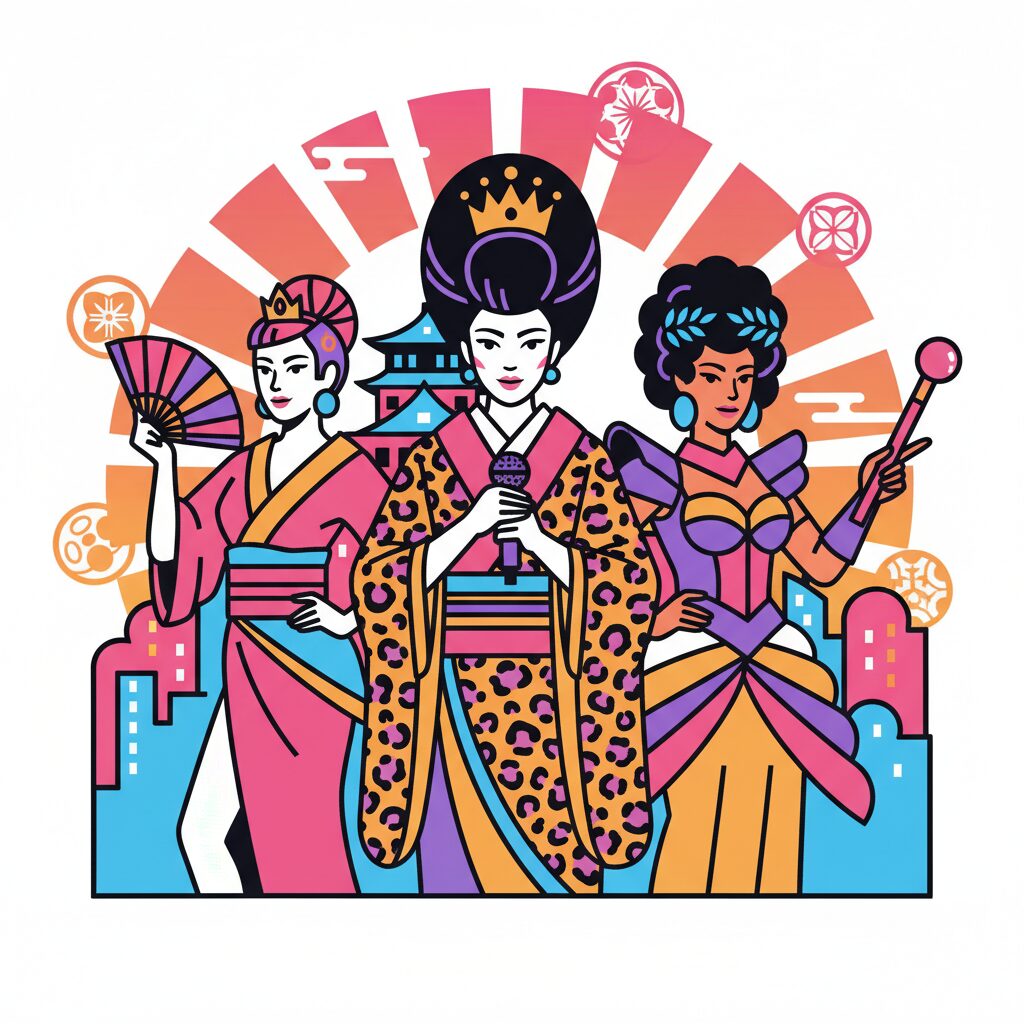
The first time it happened, I was completely paralyzed. Standing in the chilled aisle of a local Tamade supermarket, staring at a wall of tofu, trying to decipher the subtle differences between kinugoshi and momen. From my left, a blur of motion. An electric-blue shopping cart, steered by a woman with a magnificent cloud of permed, purplish hair, clipped my basket with a resonant clang. I flinched. She stopped, looked me up and down, then pointed a single, decisive finger at the package in my hand. “Not that one,” she declared in a thick, rolling Osaka dialect. “This one’s better value. Cheaper today. And it holds up better in a stew.” She then grabbed a different block of tofu, thrust it into my basket, gave me a powerful pat on the shoulder that nearly sent me into the yogurts, and zoomed off toward the discounted vegetables, leaving me speechless. There was no apology for the collision. There was no polite preamble. Just a direct, unfiltered, and surprisingly helpful intervention. I had just had my first classic encounter with the Osaka Okan.
For anyone new to this city, especially coming from the polished, whisper-quiet reserve of Tokyo or the carefully constructed personal space of the West, the Osaka Okan can be a system shock. She is the middle-aged woman of this city, but that description is woefully inadequate. She is not just a mother, or an ‘auntie.’ The Okan is a social archetype, a force of nature, the unofficial CEO of neighborhood life. She is the woman in leopard print on a bicycle laden with groceries, weaving through pedestrian traffic with terrifying precision. She is the loud, laughing voice you hear across three train carriages. She is the one who will hand your child a candy (ame-chan) while simultaneously telling you that you look tired and should eat more fish. To the uninitiated, her actions can feel intrusive, her speech abrupt, her presence overwhelming. But to dismiss her as just a loud, garish stereotype is to fundamentally misunderstand the engine that powers this city. Understanding the Okan is the key to unlocking the real, beating, gloriously chaotic heart of Osaka. She is not an outlier; she is the operating system.
This vibrant, pragmatic spirit, which powers the city’s social engine, is also a key driver behind the current Osaka tourism boom that is attracting major international investment.
Who is the Osaka Okan? Defining a Cultural Icon

To understand Osaka, you first need to create a working profile of its most influential demographic. The Okan is more than just an individual; she represents a role, a mindset, and a style of public interaction that shapes the city’s daily rhythm. She embodies Osaka’s historical identity as a pragmatic, no-nonsense commercial center.
Beyond the Stereotype: Leopard Print and Permed Hair
Let’s address the visual clichés upfront because they are both accurate and often misunderstood. Yes, you will encounter a remarkable amount of animal prints, especially leopard patterns. You’ll see gravity-defying permed hair, frequently in shades of auburn or vivid violet. You’ll notice practical, wide-brimmed visors that could easily double as welding shields, and you’ll spot fleets of sturdy, basket-equipped bicycles known as ‘mama-chari,’ maneuvering through the streets like armored divisions.
However, this isn’t merely quirky, kitschy fashion. It’s a uniform of practicality and confidence. The leopard print is not a subtle nod to trends; it’s a bold proclamation: “I am here. I am not invisible. Deal with it.” It rejects the muted, self-effacing styles often favored elsewhere in Japan. In a culture valuing conformity, the Okan’s fashion is a declaration of individuality and a refusal to be overlooked. The permed hair is a durable, low-maintenance style that maintains its shape. The visor is the most effective sun shield imaginable—elegance aside. And the bicycle is the city’s reliable workhorse, essential for managing the three critical tasks of groceries, children, and errands. Every aspect of the Okan’s look is grounded in function, resilience, and an utter disregard for fleeting fashion trends. It serves as urban armor for the woman who gets things done.
The Psychology of the Okan: Pragmatism, Power, and Public Space
The Okan’s mindset resembles that of a chief operating officer. She manages the household budget with steely resolve, coordinates the family’s schedule, and most importantly, acts as the central hub in the neighborhood’s information network. Her worldview is rooted in deep pragmatism. Is this useful? Is it a good value? Does it solve the problem? These questions drive her decisions, from choosing a brand of soy sauce to handling a noisy neighbor.
This pragmatic approach also shapes her view of public space. In Tokyo, a train car or supermarket aisle is neutral and anonymous; the social expectation is to minimize presence, avoid eye contact, and reduce friction. In Osaka, the Okan sees these spaces as an extension of her domain. The neighborhood is her territory, and she navigates it accordingly. That’s why she might speak loudly to a friend across the street or push her cart with firm resolve through a crowded aisle. It is not rudeness; it’s the natural behavior of someone who feels ownership and responsibility for her surroundings. She is not a guest in the city but a host, a manager, and a matriarch. This fundamental difference in how public and private spaces are perceived marks one of the most significant cultural divides between Osaka and other Japanese cities, with the Okan at its core.
The Language of the Okan: Communication That Cuts Through the Noise
Engaging with an Osaka Okan means adopting a new communication playbook. The subtle, high-context cues that shape much of Japanese interaction are often set aside in favor of a style that is direct, efficient, and deeply relational. It’s a language founded on humor, honesty, and the strategic use of small kindnesses.
Directness, Not Rudeness: Understanding ‘Ame-chan’ Diplomacy
An Okan won’t hesitate to speak her mind. She may comment on your weight gain, ask how much you paid for your apartment, or critique your Japanese pronunciation. For foreigners, this can feel highly intrusive. But it’s essential to grasp the intent behind these words. Her directness is not meant as an attack; it’s a shortcut to intimacy. By bypassing polite formalities, she treats you not as a stranger (yosomono), but as part of the local community, someone sturdy enough for honest banter.
This frankness is nearly always softened by a signature gesture: offering an ame-chan (a piece of hard candy). The Okan’s purse is a portable confectionery, a ready arsenal of sweets to be deployed at any moment. The sequence is classic: a sharp comment quickly followed by candy. “My, you look pale today! Are you overworking? Here, have this for your blood sugar.” The candy acts as social balm. It conveys an unspoken message: “My words are sharp, but my heart is warm. We’re connected now.” This is ‘Ame-chan Diplomacy,’ a cornerstone of Okan communication. It’s a transaction that establishes a bond of tough love and shared community.
The Power of Humor and the ‘Tsukkomi’ Culture
Osaka is the undisputed home of Japanese stand-up comedy, especially the Manzai style, which features a duo: the boke (the funny fool) and the tsukkomi (the sharp-witted straight man who corrects him). The Okan is the master of everyday tsukkomi. Her speech is laced with witty retorts, playful jabs, and sharp observations that serve as punchlines.
This style is both a social tool and a defense mechanism. It keeps conversations light, defuses tension, and fosters rapport through shared laughter. For instance, if you struggle to use a ticket machine at the station, a Tokyo resident might politely offer help or look away. An Osaka Okan is more likely to say, “What’s wrong, did you forget how to use your fingers? Step aside, I’ll show you.” The sting of the initial remark is quickly erased by genuine assistance, and the entire exchange becomes a moment of lighthearted comedy. Learning not to take the initial tsukkomi personally is key to surviving in Osaka. Understand that you’ve just been made a temporary boke in her daily routine—it’s a sign of inclusion, not rejection.
The Unspoken Language: Reading the Cues
Though her verbal communication is direct, subtle cues remain vital. Tone of voice is crucial. There’s a clear difference between her usual booming public voice and a truly angry one. Observe her eyes and hands. A sharp word paired with a crinkling of the eyes and a gesture to come closer means you’re within her inner circle. Also, listen for the common Osaka phrase, shiran kedo (“I don’t really know, though”). It’s often appended to a strong, specific piece of advice or gossip. This phrase serves as a verbal escape hatch: “This is my firm opinion, but I’m giving it without full responsibility for its accuracy.” It’s a brilliant example of confident ambiguity that lets her be both authoritative and non-committal simultaneously.
The Okan in Action: Navigating Daily Life in Osaka

To truly understand the Okan’s role, you need to observe her in her natural environments. She reigns as the queen of the supermarket, commands the commuter train, and stands as the guardian of the neighborhood streets. Her presence is felt in every facet of daily life.
The Supermarket: A Battleground of Bargains and Banter
There is no better place to see the Okan in her element than a local supermarket, especially in the late afternoon when discount stickers (nebiki) start appearing on perishable items. This is no calm, orderly shopping trip; it is a competitive sport. The Okan has an eagle eye for the red and yellow stickers, spotting a 50% off bento box from twenty paces. She moves with determination, using her cart both for transport and to carve out personal space in a crowded aisle.
The air buzzes with lively conversation. She’ll call out to a neighbor two aisles away to share news of a good deal on eggs. She might glance into your basket and offer an unsolicited yet usually excellent recipe suggestion for the fish you just selected. She will engage the butcher in a lengthy, laughing negotiation over the best cut of pork—a conversation as much about social connection as commerce. The supermarket is her stage, a place for performance, information exchange, and daily reinforcement of community bonds. For the Okan, a silent shopping trip is a failed shopping trip.
The Public Transit System: Masters of Their Domain
Boarding a train on the Osaka Loop Line during rush hour is a lesson in Okan physics. Where others hesitate, she spots a potential seat with hawk-like precision and moves toward it, firmly confident in her right to be there. She doesn’t push aggressively but flows into empty space with an irresistible momentum. Once seated, she may engage in a lively conversation with a friend audible several seats away, a sharp contrast to the pin-drop silence found on Tokyo subway cars.
But her role on public transit is not just self-serving. She is the unofficial guardian of social order. I have personally seen an Okan loudly reprimand a group of high school boys for refusing to give up their seat to an elderly man. I have witnessed another expertly organize shuffling commuters to make space for a mother with a stroller, using sharp commands and hand gestures. And if you, as a foreigner, look lost or confused while staring at a transit map, she’s often the first to approach, ask “Where you go?”, and with a mix of gestures and loud, clear Japanese, ensure you board the right train. She is the train’s fierce, self-appointed conductor.
The Neighborhood Watch: The Eyes and Ears of the Community
The Okan is the neighborhood’s central processing unit. From her porch or through her window, she sees everything. She knows who is new to the building, which children are fighting, which dog barks too much, and when garbage collection rules are broken. This is no idle gossip; it is an essential community function. This information network, often called idobata kaigi (well-side chat), is how the neighborhood governs itself.
She is the caretaker of the community’s well-being. She’s the first to notice if an elderly neighbor hasn’t opened their curtains for days and will go knock on their door. She organizes the local summer festival (matsuri) and makes sure every child wins a prize at the games. This concept of looking after others, known as sewa, is deeply ingrained. For a foreigner moving into an Osaka neighborhood, this might initially feel like a lack of privacy. You are being watched. But you quickly realize you are also being watched over. If you’re sick, an Okan neighbor will likely show up at your door with a container of rice porridge. If you’re struggling with your groceries, one will appear as if from nowhere to help. In Tokyo, you can live for years without knowing your neighbors. In Osaka, the Okan makes sure that is simply not an option.
The Osaka vs. Tokyo Divide: How the Okan Defines the Difference
The presence and influence of the Okan is perhaps the most significant cultural distinction between Osaka and Tokyo. She is the reason the two cities feel so deeply different on a personal level, even when their buildings and infrastructure appear similar.
Community vs. Anonymity
Tokyo’s core social contract is based on polite, mutual anonymity. The city’s high population density makes this approach a necessary survival tactic. People keep to themselves, avoid bothering others, and expect the same in return. This creates an atmosphere of calm, efficient, but sometimes cold isolation. In contrast, Osaka’s social contract, championed by the Okan, is fundamentally different. It relies on active, direct, and often loud engagement. Community is not just an abstract idea; it is practiced daily through interaction, interference, and mutual support. The Okan would see the quiet anonymity of a Tokyo neighborhood not as peaceful but as lonely and unnatural. She builds community by sheer determination, with one lively conversation, one unsolicited piece of advice, and one ame-chan at a time.
The Economic Roots: A Merchant City’s Mentality
This cultural difference has deep historical origins. Tokyo (formerly Edo) was the city of samurai and bureaucrats—a place defined by hierarchy, formality, and strict rules. Osaka, conversely, was the nation’s kitchen, a city of merchants, traders, and artisans. In a merchant culture, success depended on different skills: quick thinking, sharp negotiation, cultivating personal relationships, and a healthy dose of skepticism. You needed to assess others swiftly, speak directly, and constantly seek a good deal. Spending time on elaborate, empty pleasantries was bad for business.
The Osaka Okan is the contemporary bearer of this merchant spirit. She acts as the CFO of her household, approaching life with a distinctly economical mindset. This goes beyond finances; it’s about value. She possesses an instinctive dislike for pretension and a preference for things that are genuine, practical, and modestly priced (shounai). This attitude explains her straightforwardness, love of bargains, and unpretentious character. She embodies the soul of a city that has always prized substance over style and a good deal over polite illusion.
How to Thrive in an Okan-Dominated World: A Foreigner’s Guide
For newcomers to the city, the Okan can feel overwhelming. Her energy might hit like a tidal wave. But mastering the art of riding that wave, rather than being carried away by it, is the key to truly enjoying life here. It’s not about changing who you are, but about fine-tuning how you communicate.
Embrace the Interaction, Don’t Retreat
When an Okan talks to you, your initial reaction might be to panic, smile awkwardly, and back away. That approach is a mistake. Her first comment, no matter how abrupt, is an invitation. The right response is to engage. You don’t need perfect Japanese—a smile, a laugh, and a simple phrase like “Hontou desu ka?” (Really?) or “Arigatou gozaimasu!” (Thank you!) will do. If you seem puzzled, she’ll often switch to easier Japanese or use more gestures. Showing a bit of vulnerability signals trust, and it will almost always be met with increased kindness. She’s testing the waters, and if you show you’re open, she’ll gladly welcome you in.
The Gift of the ‘Ame-chan’: Reciprocity Matters
Okan’s social interactions rely on reciprocity. If a neighbor shares vegetables from her garden or gives candy to your child, the unspoken rule is to return the favor eventually. This doesn’t have to be immediate or match in value. Bringing back a small souvenir from a trip, offering a snack from your homeland, or even complimenting her dog helps strengthen the connection. It shows you understand the give-and-take that keeps the community strong. You become a participant, not just a resident.
Learn to Laugh at Yourself (and with Them)
Humor is the universal bond in Osaka. The culture of tsukkomi means light teasing is a form of affection. If an Okan jokes at your expense, the best response is to laugh along. It shows you’re not overly sensitive and that you get the playful spirit. Don’t take the bluntness as a personal insult. See it as a cultural way of saying, “I see you, and I’m treating you like one of us.” If you can smile when told your shirt is an odd color, you’ve passed an important citizenship test in Osaka.
The Evolving Okan: A Modern Perspective
Certainly, the iconic, leopard-print-clad Okan is a strong archetype, but it is not a fixed stereotype. Society is evolving, and so too is the Okan. Younger generations of Osaka women may forego the traditional perm or the loud, commanding voice. Many pursue professional careers and hold a more global outlook. The visual stereotype is gradually softening.
Nonetheless, the core essence of the Okan remains intact. The essential values—pragmatism, resilience, straightforwardness, fierce loyalty to community, and a refusal to be ignored—continue to be inherited. Today’s Okan might don minimalist Uniqlo attire instead of leopard print, but she remains the one who organizes the PTA, speaks out at neighborhood meetings, and isn’t afraid to tell a stranger on the train to turn down their music. The Okan represents a distinctive form of Osakan female empowerment. She wields social influence not through formal authority, but through sheer personality, a complex web of relationships, and firm confidence in her own judgment. She leads her world from the ground up.
Final Thoughts: The Heartbeat of the City
Ultimately, the Osaka Okan is not a flaw in the system; she embodies the system itself. She is the city’s chaotic, generous, and uncompromising spirit. She can be loud, intrusive, and will surely invade your personal space. Yet, she is also the reason Osaka feels less like a sprawling megacity and more like a patchwork of lively, interconnected villages. She serves as the social glue that binds the neighborhoods together.
Living in Osaka means existing in a world shaped by these women. They act as unofficial mayors, volunteer social workers, street-corner comedians, and guardians of a culture that prioritizes human connection over sterile formalities. At first, you might find them confusing or even overwhelming. But over time, you’ll come to recognize them as the city’s greatest strength. When an Okan stops to fix your collar, offers you a candy, or tells you where to find the cheapest onions, she’s not merely being nosy. She’s conveying, in her own distinctive and powerful way, that you belong here. And in that moment, you will realize you are truly home.