Ask anyone, Japanese or foreign, to describe Osaka. They’ll paint a picture with a familiar palette: the electric glow of the Glico Man, steam rising from takoyaki stalls, the roar of crowds in Tigers jerseys, and a cacophony of vendors shouting in that thick, musical Kansai dialect. It’s a city defined by its commercial heart—a vibrant, relentless engine of commerce and consumption. For years, living in the city, I thought that was the whole story. Osaka was Umeda’s towering department stores and Namba’s chaotic energy. A fantastic place to live, for sure, but one that always felt plugged in, always on.
But then you hear whispers. Friends talk about heading “north” for the weekend, not to Kyoto, but just… north. They talk about hiking trails you can reach by train, about community art projects in the middle of nowhere, about a different kind of quiet. They’re talking about the land served by a tiny, almost mythical train line: the Nose Electric Railway, or as the locals call it, the Noseden. It peels off from the major Hankyu Takarazuka line at a junction just over the border in Hyogo prefecture, and winds its way into the forgotten folds of Osaka’s northernmost territory. This isn’t the Osaka you see on postcards. This is the Osaka where the concrete finally gives way to rice paddies and forested hills, where the city’s pulse slows to the rhythm of the seasons. I decided to spend a weekend riding it to the end of its two lines, to understand this other Osaka, the one that exists beyond the hustle. What I found wasn’t just a geographic shift, but a deep dive into the region’s true character, a side that explains the city’s soul far better than a plate of okonomiyaki ever could.
To further explore the hidden rural charm and Satoyama culture of this unique region, consider planning a perfect weekend trip to Nose, Osaka’s northern countryside.
The Great Divide: Crossing from Hankyu Corporate to Noseden Local
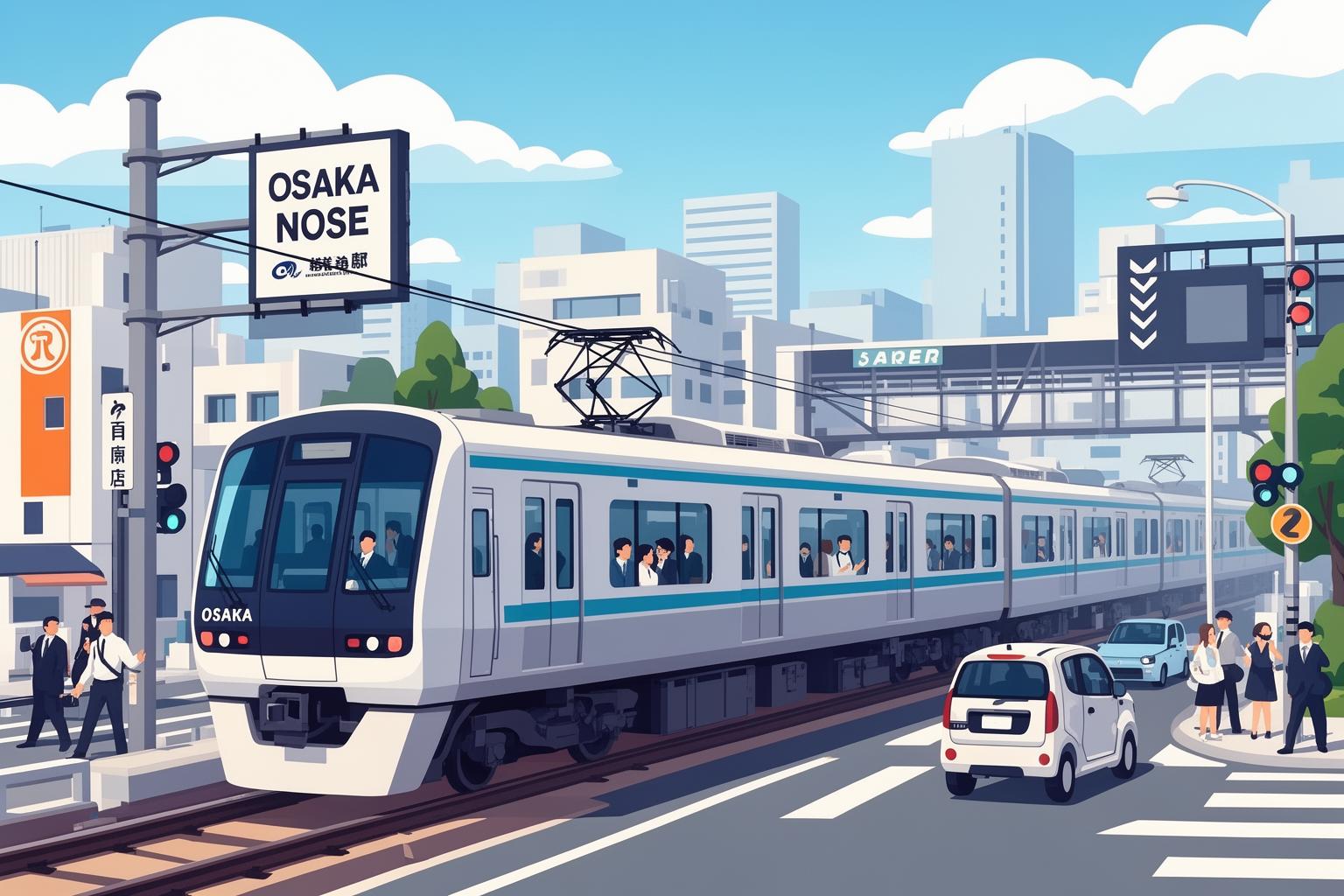
The journey doesn’t start with a grand departure but with a simple platform change at Kawanishi-Noseguchi Station. This transition is crucial. You arrive on a sleek, maroon Hankyu train, a symbol of the powerful private railway empire that helped shape modern Kansai. Hankyu embodies the aspirational, refined side of the region—the department stores, the Takarazuka Revue, and the orderly commuter towns. The atmosphere on a Hankyu train is crisp and professional. It serves as the lifeline connecting central Osaka to its affluent suburbs.
Next, you move to the Noseden platforms. The change is immediate and tangible. The trains are shorter, often only a few cars long, decorated with cheerful and almost whimsical designs. The pace slows noticeably. The passengers change as well. Sharp suits and designer bags give way to hiking gear, families with strollers, and elderly couples heading out for a stroll. This isn’t a commuter line in the Tokyo sense—a high-pressure tube ferrying workers. It feels more like a community shuttle, a rolling village hall linking a series of small, distinct settlements.
This platform switch reveals a basic truth about life in Kansai that often puzzles outsiders, especially those from Tokyo. Tokyo is a monolithic city centered around the JR Yamanote Line. Your status and lifestyle are frequently measured by your proximity to this loop. Kansai, however, is not a single hub but a constellation of city-states connected by competing private railways. Your identity is tied to your line: Are you a Hanshin person, gritty and grounded? A Keihan person, balancing between the cultural poles of Osaka and Kyoto? Or a Hankyu person, part of a more polished, middle-class world?
The Noseden is a branch of that Hankyu world, but it signifies a deliberate choice to live one step apart. The people here are not “anti-city.” Many work and shop in Umeda. Yet, they’ve chosen a life where the city is a place to visit, not a place that defines their entire existence. This preference for a slower, more deliberate lifestyle is central to the northern Osaka mindset. It represents a quiet rebellion against the commercialism the rest of the world associates with Osaka.
Myokenguchi’s Satoyama: Where Community is a Crop
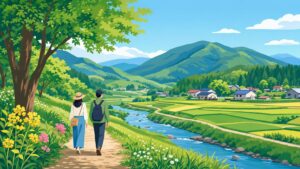
I traveled along the Myoken Line branch all the way to its final stop, Myokenguchi Station. Stepping off the train felt like passing through a portal. The dense grid of suburban houses disappeared, replaced by an open valley, terraced fields ascending the hillsides, and the lush greenery of the mountainside. This is the world of satoyama—a traditional Japanese concept describing the landscape that lies between the mountains (yama) and the cultivated plains (sato). It is a managed ecosystem, where human life and nature are closely intertwined.
Here, you encounter a different, deeper form of the well-known “Osaka friendliness.” The loud, sales-driven friendliness of a Kuromon Market vendor is a commercial tool. It’s part of akinai, the art of business. While charming, it is transactional. The friendliness in the satoyama of Nose stems from something entirely different: shared space and mutual dependence. As I walked along the paths winding through the fields, people greeted me—not with the booming “Irasshaimase!” of the city, but with a simple, quiet “Konnichiwa” and a nod. An elderly man tending his daikon patch paused to point out the best trail up to Myoken-san shrine. A woman arranging flowers at a small temple offered me a piece of candy.
This isn’t about being talkative; it’s about recognizing a shared presence within a small community. In Tokyo’s anonymous sprawl, you learn to ignore those around you as a survival strategy. In central Osaka, interaction is purposeful—to buy, sell, or joke. Here, engagement is simply part of the natural environment. Life follows the seasons, not the fiscal quarter. I passed several unmanned vegetable stands—small wooden shacks with produce displayed and a simple wooden box for payment. No cameras, no locks—just a sign with prices and a profound, unspoken trust that you will pay for what you take. This honor system would be unthinkable in the city center, but it’s the default way of life here. It reflects a social contract that has been lost elsewhere. This is daily life in the overlooked pockets of Osaka: slower, quieter, and grounded in a trust that feels almost radical in modern Japan.
The Noseden Artline: A Museum Without Walls
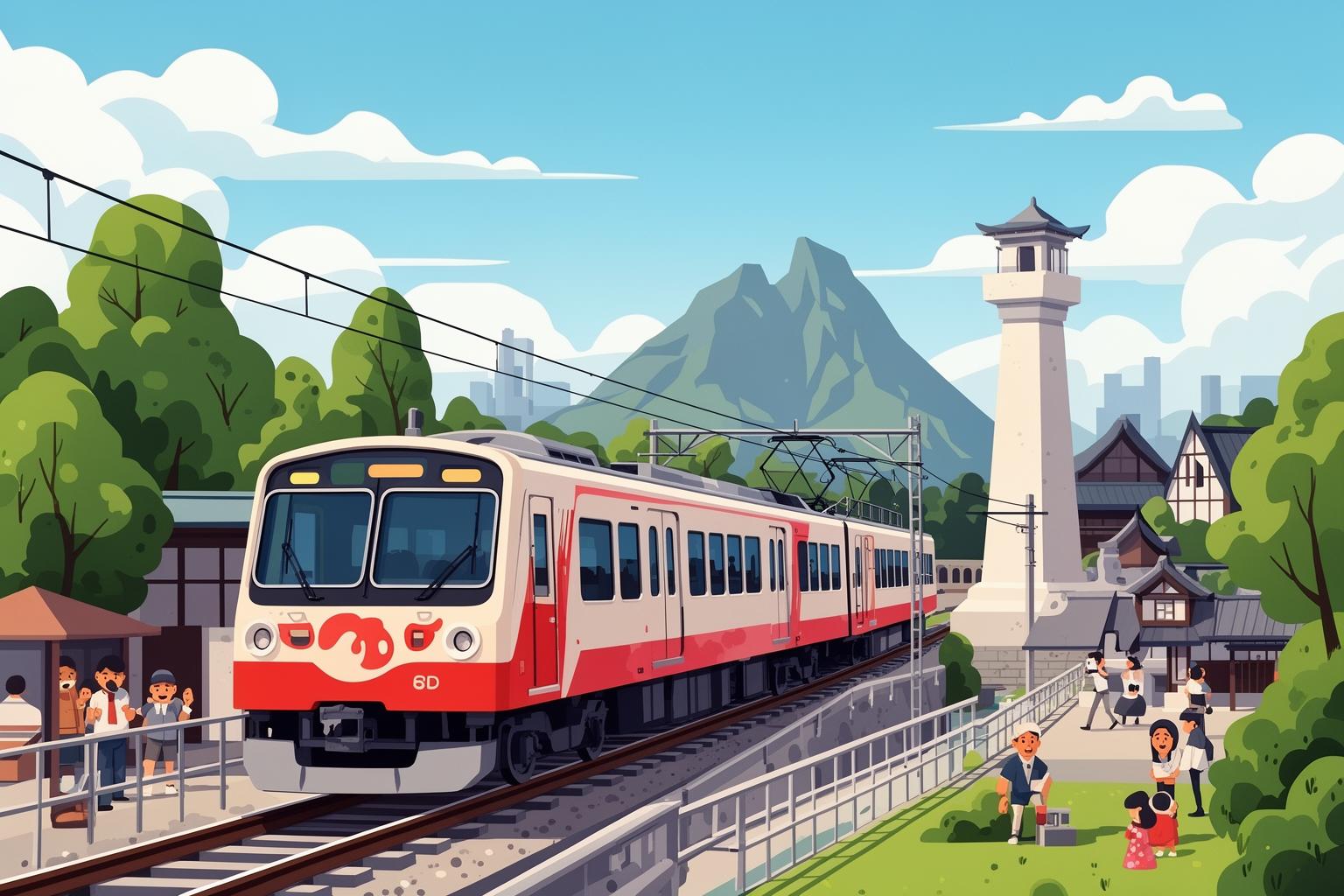
In recent years, this deeply traditional landscape has transformed into a stage for something strikingly modern: the Noseden Artline. This isn’t about constructing a sterile, white-cube museum simply to attract tourists—that would be the Tokyo style, a grand, top-down initiative. Instead, the Osaka approach, as exemplified by the Artline, is far more organic, quirky, and woven into everyday life.
Every few years, artists from Japan and abroad are invited to produce site-specific works around the Noseden stations. A waiting room becomes a sound installation; a forest clearing hosts a mysterious sculpture; an old, abandoned house turns into an immersive piece of art. The “museum” is the railway line itself, and admission is merely the price of a train ticket. This reflects Osaka’s pragmatic and democratic attitude towards culture. Art is not something to be confined within a special building visited once a year—it’s something to encounter on the way to the supermarket, something that can transform a routine commute into a moment of wonder or perplexity.
The project also offers a clever, characteristically Osakan response to a genuine challenge: the aging and depopulation of rural areas. Rather than letting these communities quietly vanish, the railway, in collaboration with local towns, uses art to inject new vitality and draw visitors. It doesn’t erase local identity but enhances it. The art encourages people to disembark, explore footpaths, and visit neighborhood noodle shops. It turns the entire region into a destination for a new kind of tourism—one centered on discovery rather than consumption.
A Conversation in the Woods
Near Uneno Station, I followed a small sign leading down a dirt path into a bamboo grove. There, nestled among the towering stalks, was a strange and beautiful installation of woven materials that seemed to move with the wind. An elderly woman was there, carefully sweeping fallen leaves from around the base of the artwork. She wasn’t a curator or gallery staff but a local resident volunteering to maintain the piece.
She noticed me watching and we began talking. She explained that the artist had lived in the village for a month, engaging with residents and learning the area’s history before creating the work. “At first, we thought it was strange,” she said with a laugh, “but now, it feels like part of our forest.” The art wasn’t an alien object imposed from outside; it had become a source of local pride and a conversation starter. It gave her a reason to be out here and me a reason to find this hidden spot. This interaction perfectly encapsulated the project’s success: fostering connections—between art and nature, visitors and locals, past and present. It’s a solution that feels quintessentially Osaka: practical, community-oriented, and a little bit quirky.
The Other Terminus: Nissei Chuo and the New Town Dream
If Myokenguchi embodies Osaka’s pastoral spirit, then the terminus of the Nissei Line, Nissei Chuo, signifies its aspirational, post-war heart. Nissei Chuo is a “New Town,” a planned community constructed in the 1970s to offer modern housing for the families of salarymen fueling Japan’s economic miracle. Stepping off the train here reveals a complete change in atmosphere. The organic curves of the satoyama give way to the clean lines and orderly grid of a planned urban area.
Wide boulevards, large apartment complexes (danchi), and a central commercial center featuring a supermarket and a library—this captures the essence of middle-class stability. For many foreigners, these New Towns can appear sterile, lacking the chaotic charm of older Japanese neighborhoods. It’s a common misconception to dismiss them as dull. But to do so is to overlook a significant part of Osaka’s story. For generations of families, relocating here from cramped, often industrial city neighborhoods was the fulfillment of a dream. It meant a brand-new apartment with indoor plumbing, safe parks for children to play in, and access to good schools.
This represents the Osakan compromise. The residents of Nissei Chuo exchanged the raw energy of the city for peace, security, and space. Life here is organized and predictable. The community is shaped not by ancient agricultural rhythms, but by the modern life cycle of the nuclear family: school entrance ceremonies, weekend soccer games, and seasonal festivals organized by the neighborhood association. While Tokyo’s vast suburbs can feel anonymous, Osaka’s New Towns often cultivate a surprisingly strong local identity. People are not merely residents of a generic suburb; they are residents of Nissei Chuo. This self-contained world offers a powerful sense of belonging, a different type of community from that found in the satoyama, but a community nonetheless.
The Rhythm of the Rails: Reading the Unspoken Rules
Spending a weekend simply riding the Noseden back and forth, you begin to grasp the rhythm of life here. The train itself serves as a social space, a microcosm of the communities it connects. In the morning, it fills with high school students in their crisp uniforms and commuters transferring to the Hankyu line. The atmosphere is quiet, yet it’s a comfortable silence—not the tense, guarded quiet of a crowded Tokyo subway car. People make room for one another. When an elderly woman boards, a student promptly offers his seat without a word exchanged.
Around midday, most passengers are seniors heading to appointments or the small cafes near the stations. They greet the station staff by name. Occasionally, neighbors run into each other and catch up in soft Kansai-ben, their voices a gentle murmur beneath the clatter of the tracks. The train acts as a lifeline, a connection to the wider world, but also feels like an extension of their living rooms.
As someone who spends weekdays immersed in the high-energy, deadline-driven world of central Osaka, the 30-minute ride on the Noseden serves as a form of decompression. You can literally watch the landscape and social atmosphere evolve outside the window. Tight clusters of buildings gradually give way to gardens, the gardens to fields, and the fields to forests. The psychological distance from the city feels much greater than the actual mileage suggests. This daily transition is the reality for hundreds of thousands of people in the Osaka metropolitan area. Their lives are a continual balancing act between two worlds: the demanding, anonymous urban workplace and the familiar, community-oriented environment of their home station. This railway line is the hyphen that bridges those two realities.
Beyond the Neon Glow
To truly grasp Osaka, you must look past the dazzling, chaotic image it projects to the world. The city’s identity is not only shaped by its merchant history but also by the quiet hills and valleys to its north. The Noseden railway is more than just infrastructure; it serves as a narrative thread linking the varied facets of the region’s character.
It connects the ambitious modernity of the Hankyu corridor with the deeply rooted traditions of the satoyama. It unites the planned utopias of the New Towns with the wild, creative spirit of the Artline. Riding this modest train reveals the choices and compromises that shape the daily lives of many Osakans. It’s a life constantly seeking balance—between work and family, city and nature, commerce and community.
The stereotype of the loud, money-driven Osakan isn’t wrong, but it is deeply incomplete. It’s the public mask worn in the marketplace. The city’s deeper truth is found in places like Nose—in the quiet greetings along mountain paths, the trust behind an unmanned vegetable stand, and the shared experience of watching the landscape soften through the window of a local train heading home. To truly understand Osaka, skip Dotonbori for a day. Buy a ticket to the end of the line. You’ll discover a city and people far more complex and captivating than you ever imagined.