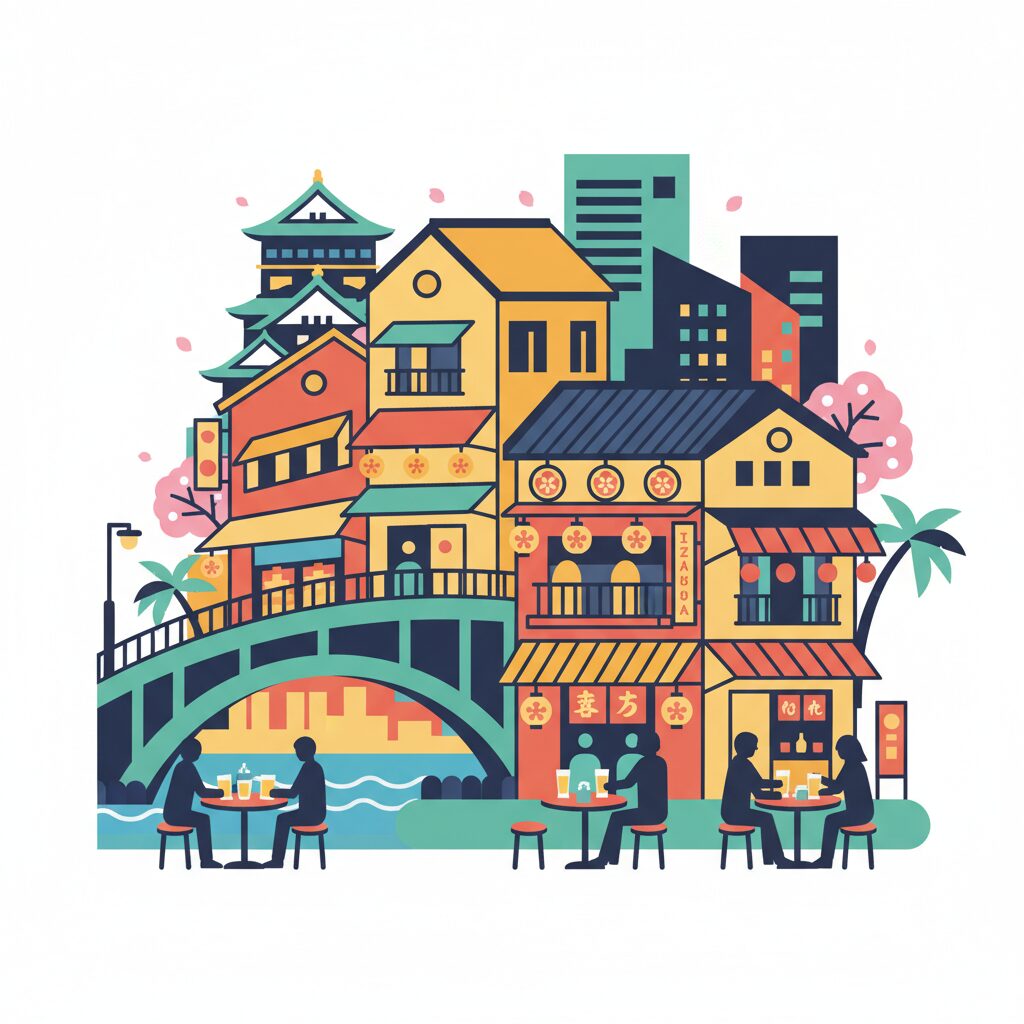
Hello lovelies! It’s Sofia. Let me paint you a picture. It’s 5 PM on a Wednesday in Osaka. The sky is still a brilliant shade of blue, but in the narrow, lantern-lit alleyways of districts like Tenma or Kyobashi, the evening has already begun. You’ll see them: clusters of people, men and women of all ages, spilling from tiny storefronts onto the pavement. They’re laughing, gesturing wildly, and balancing small plates of food on crowded countertops, all while standing. There are no chairs, no reservations, and seemingly no rules. This, my friends, is your first glimpse into the world of tachinomi, Osaka’s standing bar culture. For a newcomer, it can look a little chaotic, maybe even intimidating. It feels a world away from the hushed, serene bars you might find elsewhere in Japan. But what you’re really seeing is the heart of Osaka, beating in plain sight. It’s here that the city’s true personality—pragmatic, communal, and utterly unpretentious—is on full display. And at the core of this experience is a magic word, a philosophy, a challenge: senbero. The term is a portmanteau of sen-en (1,000 yen) and berobero (to get drunk or tipsy). The mission, should you choose to accept it, is to get pleasantly buzzed and have a bite to eat for the price of a single, crisp 1,000-yen note. This isn’t just about cheap drinks; it’s a cultural ritual, a social lubricant, and the most authentic way to understand what makes this city tick. Forget the tourist traps and the fancy cocktail lounges for a moment. To truly know Osaka, you need to stand with its people.
To truly understand the city’s unique social fabric, you might also be interested in how your interaction shapes your meal at an Osaka kappo counter.
The Unwritten Rules of the Tachinomi Counter

Stepping into a tachinomi for the first time feels like barging into a private party. The space is often no larger than a walk-in closet, filled with regulars who all seem to know one another. The air hums with the sizzle of the griddle alongside a lively chorus of booming Osakan dialect. But here’s the secret: you’re not crashing. You’re expected. The barrier to entry is merely an illusion; all that’s needed is your willingness to cross the threshold and join the fray. Unlike the more formal venues in Kyoto, which may still enforce a ‘no first-timers’ policy, Osaka’s tachinomi thrive on a foundation of radical inclusivity. However, this openness comes with a set of unspoken rules guiding the social dance unique to these standing bars.
More Than Just Standing: The Philosophy of Proximity
In Tokyo, space is a precious commodity. People maintain a polite, invisible bubble around themselves—on the train, in cafes, everywhere. In an Osaka tachinomi, that bubble bursts. Standing shoulder-to-shoulder with strangers isn’t an inconvenience; it’s the entire point. The absence of chairs is an intentional design that encourages a distinctive kind of temporary community. You’re not isolated at your own table; you become part of a single, flowing organism gathered around the counter, which acts as a communal hearth. This physical closeness naturally fosters social connection. You’ll be asked to pass the shichimi pepper down the line. You might overhear a spirited debate about the Hanshin Tigers baseball team and before long, you’ll be invited to offer your opinion. An elderly man could point to your plate of doteyaki (slow-cooked beef tendon) and offer an unsolicited but genuinely helpful tip: “Add a little mustard. It cuts the richness.” This isn’t nosiness; it’s a gesture of connection. The tachinomi operates on the belief that sharing a space means sharing an experience. It’s a wonderfully efficient way to break down the social barriers that modern life erects, one shared soy sauce bottle at a time.
The Art of Quick Entry and Graceful Exit
One of the biggest mistakes newcomers make is treating a tachinomi like a regular bar. You don’t settle in for the night. You don’t stake your ground and defend your spot. A tachinomi is a current, not a pond. It’s a pit stop—a brief social refueling before you move on to your next destination, whether that’s another bar, the train home, or a ramen shop. Rhythm is key. The ideal visit lasts between thirty minutes and an hour. You arrive, find a small space at the counter, order a drink and a light dish, finish, pay, and leave. This transitory nature is fundamental to the culture, keeping energy fresh and allowing more people to cycle through the limited space. When the bar fills up, you’ll notice a subtle, collective shift—people instinctively make themselves smaller, turn their shoulders, pull their bags closer. If someone wants to order at the counter, you step back briefly. If a new group arrives and there’s no room, it’s a silent cue for those who’ve lingered to consider wrapping up. There’s no bouncer to eject you—just a shared understanding of social responsibility. This contrasts sharply with Tokyo’s izakaya culture, where groups reserve tables and camp out for hours with all-you-can-drink deals. The Osaka style is more spontaneous, more fluid, embodying the city’s restless, mercantile spirit. It’s a culture of bar-hopping, not bar-sitting.
Decoding the ‘Senbero’ Set: A Masterclass in Osakan Economics
The 1,000-yen bill in your pocket isn’t just currency; it’s a key that unlocks a distinctive Osakan mindset. The idea of senbero represents the ultimate expression of the city’s merchant spirit. It’s a culture fixated on value, practicality, and the excitement of scoring a good deal. To outsiders, it might seem like simple thriftiness. But to an Osakan, managing to get satisfyingly tipsy and fill your stomach for under 1,000 yen is a triumph. It’s an art form, a game of skill, and a source of great pride.
The ‘Kakaku Haki’ (Price Destruction) Mentality
Osaka has long been Japan’s commercial powerhouse, a city founded by merchants rather than samurai. This heritage has instilled a deep appreciation for kosupa, or cost performance. People here don’t just want things to be cheap; they want them to be exceptionally good for the price. This embodies the spirit of kakaku hakai, or “price destruction,” where businesses fiercely compete to provide the best value. A senbero set is this philosophy poured into a glass and plated on your dish. Chalkboards outside bars proudly advertise deals: “Two beers and a plate of kushikatsu for ¥980!” or “Three highballs and your choice of two appetizers for ¥1,000!” The bar is promising outstanding value, and customers come to see if they deliver. The food is never just an afterthought. It’s simple, tasty, and designed for quick enjoyment: skewers of deep-fried meat and vegetables (kushikatsu), rich beef tendon stew (doteyaki), or fresh, straightforward sashimi. It’s hearty, humble fare that perfectly pairs with a cold beer or a crisp chu-hai. Discovering and sharing news of a great senbero deal is a widely recognized social currency, far more impressive locally than boasting about a visit to a Michelin-starred restaurant.
It’s Not About Being Cheap, It’s About Being Clever
A common misunderstanding among foreigners is that tachinomi and senbero culture cater only to those on a tight budget. While undoubtedly economical, its appeal spans all social and economic backgrounds. In a single bar, you might find a construction worker in his work gear standing beside a woman in an elegant business suit, next to a young university student. The tachinomi is the great equalizer. Within this space, your job or bank balance doesn’t matter. Your social standing depends on your ability to be a good neighbor at the counter and your appreciation for a smart deal. The joy of senbero isn’t saving money, but the savvy involved. It’s proof of local know-how. You know where to go, what to order, and how to get the most from your 1,000 yen. It’s an interactive game between the patron and the establishment, and everyone who takes part feels accomplished. In Tokyo, status might be shown through brand names and pricey meals. In Osaka, it’s conveyed through the story of that amazing little spot where you got three drinks and a plate of grilled octopus for ¥950. It’s a fundamentally different, and arguably more democratic, way to define value.
The Geography of Standing: Where to Find the Real Osaka
While tachinomi bars are scattered throughout the city, certain neighborhoods stand out as cultural epicenters, each delivering its own unique twist on the standing bar experience. To truly grasp the intricacies of Osaka, you need to explore its key districts through their drinks. These areas are not just clusters of bars; they function as living ecosystems that mirror the city’s rich diversity.
Tenma: The Maze of Endless Options
Tenma is a vibrant, chaotic maze. Centered on Tenjinbashisuji, Japan’s longest covered shopping arcade, this neighborhood offers a sensory feast in the best sense. The sheer concentration of tachinomi bars here is staggering. Tiny establishments, often just big enough for five or six patrons, are squeezed side by side, their lights and sounds blending together. This scene embodies Osaka’s spirit of competition and abundance. Each bar carves out its niche: one focuses on craft sake, another serves Italian-inspired small plates, while a third features super-chilled, extra-strong highballs. The air is thick with the aromas of grilled meat, dashi broth, and cigarette smoke. You weave through laughing crowds, dodging bicycles and delivery carts. Tenma is loud, lively, and endlessly engaging. It represents the contemporary face of tachinomi culture, where tradition is reinvented for a younger generation, yet the core values of value and community remain steadfast. A night in Tenma isn’t about picking the perfect bar—it’s about the journey, the discoveries, and the exhilarating overwhelm of too many choices.
Kyobashi: The Salaryman’s Refuge
If Tenma is a lively food festival, Kyobashi is the unpretentious, no-frills staff canteen. Situated at a major railway junction, Kyobashi caters to commuters, and its tachinomi bars reflect this. They tend to be older, darker, and more functional. The decor is simple, often just a well-worn wooden counter and faded posters of sumo wrestlers or beer ads aged yellow. This is where the true essence of working-class Osaka is found. Conversations revolve around the daily grind: complaints about bosses, dissecting new projects, or, most importantly, celebrating the close of another workday. The atmosphere focuses less on culinary adventure and more on dependable comfort. The senbero sets are straightforward and generous. Camaraderie here is immediate and deep. In Kyobashi, tachinomi serves as a crucial “third place,” offering the city’s workforce a much-needed outlet. It may be less picturesque than Tenma, but in many respects, it’s more genuine, providing a raw, unvarnished look into the daily lives of Osaka’s people.
Shinsekai: Nostalgia in a Glass
Drinking in Shinsekai is like stepping back in time. The district, with its emblematic Tsutenkaku Tower overhead, is steeped in the faded charm of the Showa Era. The tachinomi bars here are institutions, serving the same menu to generations of families. This is the kushikatsu heartland, where the standing bars remain fiercely traditional. You’ll encounter the old guard, guardians of the customs, who will kindly but firmly enforce the cardinal rule: “No double-dipping!” The atmosphere is saturated with naniwa, a term capturing Osaka’s distinctive spirit—a blend of grit, humor, sentimentality, and local pride. At these tachinomi bars, the culture is lovingly handed down. An elder might patiently show a younger patron the proper way to hold a skewer, or a grandmother running the shop might chide you for leaving even a single piece of cabbage uneaten. It’s a more performative, almost theatrical expression of tachinomi culture, deeply rooted in history and a determined resistance to change. It’s a vital, beautiful piece of the city’s soul.
The Tachinomi Social Contract: Conversation as Currency
Ultimately, the tachinomi experience goes beyond just food, drink, and savings—it’s about communication. In these packed, standing-room-only venues, conversation serves as the main currency. The Osakan personality, often stereotyped as loud and direct, fits this environment perfectly. Behavior that might be seen as overly familiar or intrusive elsewhere is the norm for social interaction here. Mastering this social contract is the final and most crucial step in truly embracing the art of the tachinomi.
Why Strangers Engage You
For many foreigners, one of the most unexpected aspects of visiting a tachinomi is being spontaneously drawn into conversation by a complete stranger. A man beside you might ask where you’re from, or a woman nearby might comment on your drink choice. This is not the exception but the rule. Silence can often be interpreted as discomfort or displeasure. Osakans are natural hosts who feel a collective duty to ensure everyone in their shared space is enjoying themselves. Their questions come from genuine curiosity and a desire to include you. They don’t see you as a distant tourist but as a temporary local—a new member of the temporary family gathered at the counter that night. The best response is warmth and openness. Answer their questions, then ask your own. Before long, you’ll be swapping stories and laughing like old friends. This is the magic of the tachinomi: it creates moments of serendipity.
Mastering the Osaka ‘Tsukkomi’
To truly connect, it helps to understand the flow of Osakan humor, which is rooted in the comedic tradition of manzai. In these two-person acts, one person plays the boke (the silly fool) who says something absurd, while the other is the tsukkomi (the straight man) who responds with a sharp, witty correction. This pattern shapes everyday banter in Osaka. People often engage in playful teasing. If you’re fumbling with chopsticks, someone might joke, “Are you trying to conduct an orchestra with those?” That’s the boke setting you up. Reacting with embarrassment or offense is the wrong move. The right response is to play the tsukkomi. You might reply with a smile, “Of course! This piece is called ‘Ode to Yakitori.’” This usually earns laughter and approval, showing you know how to play the game. This verbal back-and-forth is how connections are built, demonstrating that you don’t take yourself too seriously—a highly valued trait in Osaka. It acts as the social lubricant keeping the communal spirit of tachinomi alive and well.
A Final Word on Etiquette: Pay As You Go
Many tachinomi operate on a cash-on-delivery system, locally called “cash on.” When your food and drink arrive, you pay immediately. Usually, a small tray or bowl is provided for your money, and the staff gives change from there. This system might seem unusual at first, but it perfectly reflects the tachinomi philosophy. It’s efficient, avoiding the hassle of splitting a bill or waiting for it. It’s transparent, so you always know exactly how much you’ve spent. And it suits the transient nature of the bar, allowing you to leave quickly and easily when you’re ready. This straightforward transaction embodies the Osakan character: direct, no-nonsense, and honest. In the world of tachinomi, as in Osaka itself, what you see is what you get. And for a thousand yen, you receive far more than just a drink.