I remember my first week in Osaka with the clarity of a fever dream. Jet-lagged and clutching a grocery basket, I was standing in line at the local supermarket, feeling triumphant for having successfully navigated the vegetable aisle. The woman at the register, a cheerful lady with a perm that defied gravity, scanned my single, solitary leek. She paused, looked at the leek, looked at me, and then declared to the entire queue, in a voice loud enough to be heard in Kyoto, “Just one? Having a big, wild party tonight, are we?” My mind raced. Was she being sarcastic? Was this a genuine question? Was my single-leek purchase a social faux pas? I mumbled something about making soup, paid, and fled, my face burning. It took me months to realize she wasn’t mocking me. She was inviting me to play. She was throwing a conversational ball, and I had let it drop with a thud. Welcome to Osaka, where daily conversation isn’t just an exchange of information; it’s a performance, a game, a delicate and hilarious dance known as manzai.
This city runs on a rhythm unfamiliar to those accustomed to the polite, reserved cadence of much of Japan. Here, the social fabric is woven with two distinct threads: the boke, the funny fool who says something absurd, and the tsukkomi, the sharp-witted straight man who calls them out on it. This isn’t just for comedians on stages in Namba; it’s the operating system of daily life. It’s in the banter with the butcher, the chatter at the school gates, and the jokes flying across a crowded izakaya. Understanding this dynamic is the secret key to unlocking the city. It’s the difference between seeing Osaka as loud and chaotic, and seeing it as warm, engaging, and relentlessly human. For those who love quick wit and playful banter, it’s paradise. For the literal-minded, it can be a minefield of confusion. But fear not. Once you learn the steps to the dance, you’ll find it’s the most fun you can have just buying a leek.
If you’re ready to move beyond supermarket banter and dive into the heart of Osaka’s convivial spirit, consider hosting your own konamon party at home.
The Boke and Tsukkomi Show: Osaka’s Unofficial Language
To genuinely understand life in Osaka, you need to look beyond travel guides and language textbooks. True fluency isn’t about mastering complicated grammar, but about grasping the city’s distinctive conversational rhythm. This rhythm thrives on the constant, playful exchange of boke and tsukkomi. It’s so deeply embedded in local culture that people engage in it as naturally as breathing, often without realizing it. This is the secret ingredient that sets Osaka’s interactions apart from the more formal and nuanced communication typical of Tokyo. In Osaka, conversation is a collaborative act, a shared effort to create humor, and your active participation is not only welcomed—it’s expected.
What Exactly Are ‘Boke’ and ‘Tsukkomi’?
Let’s explore the roles in this two-person comedic play that unfolds countless times daily on Osaka’s streets. At its heart, it’s a comedy partnership.
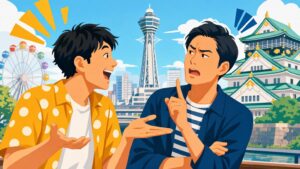
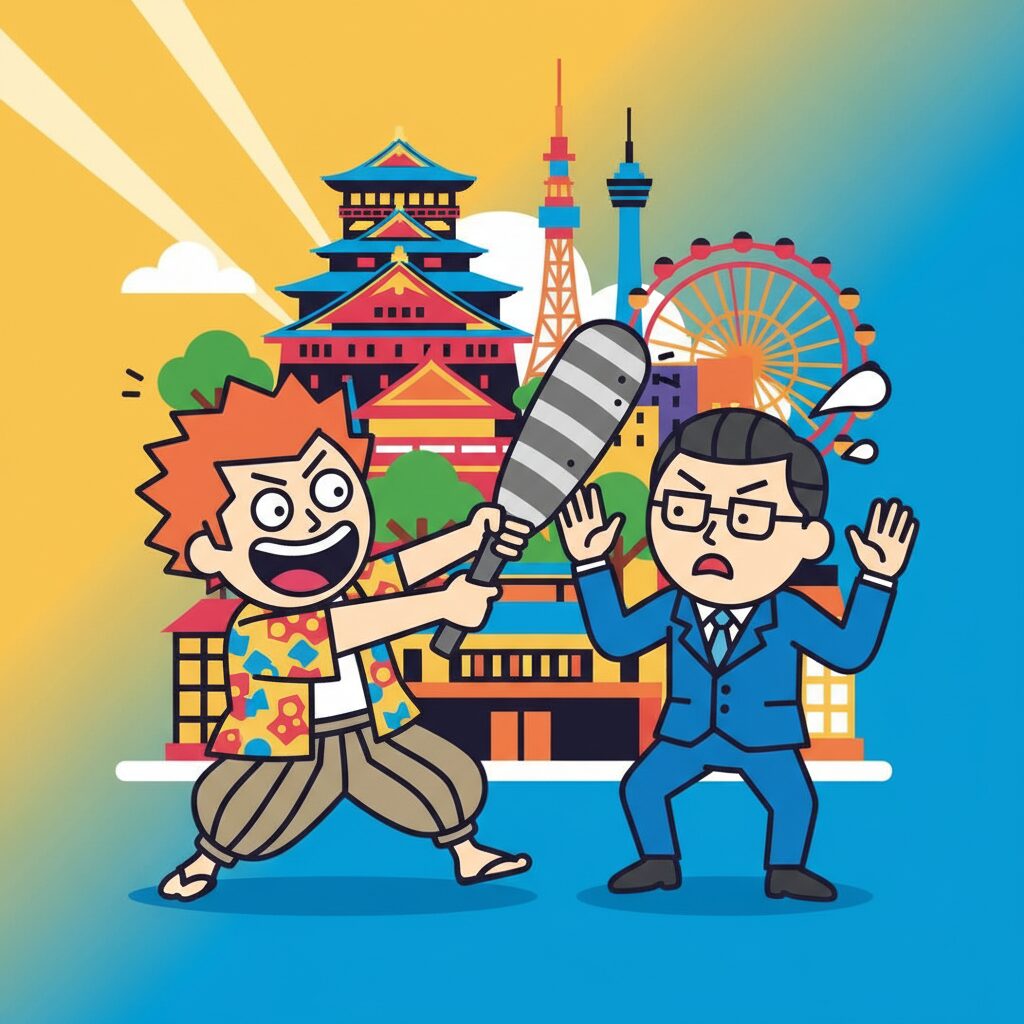
The Boke (ボケ) is the funny character, though not in the sense of a stand-up comedian. The term derives from the verb bokeru, which means to become senile or air-headed. The boke deliberately says or does something silly, out of place, or plainly wrong. They might pretend to be ignorant, exaggerate wildly, or state the obvious with deadpan seriousness. The boke sets the scene, tossing an easy pitch for their partner to respond to. A perfect boke keeps a straight face, making the absurdity even more striking. It’s a conscious act of playing the fool to create an opening for laughter.
The Tsukkomi (ツッコミ) is the straight man, the responder. The word comes from the verb tsukkomu, meaning to poke or thrust in. This person quickly points out the boke’s foolish statement. Their reply is the punchline—sharp, fast, often delivered with mock frustration. It’s like a gentle slap on the back of the head. The tsukkomi isn’t rude or hostile; they complete the joke. Without the tsukkomi’s comeback, the boke’s remark would hang awkwardly in the air. The tsukkomi confirms the humor and brings the exchange to a satisfying conclusion.
Think of it as call and response. The boke offers an absurd note, and the tsukkomi provides the resolving chord that turns it into music. This dynamic powers Japanese manzai comedy, but in Osaka, the stage is everywhere.
Why Is This So Important in Osaka?
This style of communication is deeply rooted in Osaka’s history. Unlike Tokyo, which grew as the political and military center of the samurai class, Osaka developed as a city of merchants. For centuries, it was Japan’s commercial hub—the “nation’s kitchen.” In the world of trade, success relied on quickly establishing relationships, thinking on your feet, and using wit to ease negotiations. Banter was more than entertainment; it was a tool. It broke down barriers, built rapport, and enabled direct, efficient communication.
This sharply contrasts with Tokyo’s cultural norms. In the capital, communication tends to be more indirect, emphasizing harmony and the subtle skill of kuuki wo yomu, or “reading the air.” People are expected to sense unspoken meanings and avoid direct confrontation. But in Osaka, the air is meant for breathing, not for reading. Communication is more straightforward and expressive, with humor acting as the preferred social lubricant. A well-timed joke can accomplish what hours of polite, indirect exchange in Tokyo might not. It’s a cultural shorthand that says, “We’re equals. We can relax. Let’s get down to business, or just share a laugh.”
Importantly, being the target of a tsukkomi is a sign of affection. When a shopkeeper teases you or a neighbor laughs at your mismatched socks, they’re not mocking you—they’re welcoming you into their world. They’re treating you like a local, like one of their own. Silence and polite distance belong to strangers. Banter is reserved for friends.
Spotting Boke and Tsukkomi in the Wild: Your Daily Field Guide
Once you recognize what to look for, you’ll begin noticing this dynamic everywhere. It’s an ongoing performance, with the entire city serving as the stage. Your everyday errands can turn into endless entertainment if you learn to catch the cues and eventually join in. Here are a few common situations where you’re likely to experience this cultural dance.
The Supermarket Checkout
This is a classic training ground. Cashiers, especially the seasoned obachan, are often experts at this craft. As I discovered with my single leek, they use their role to make small, humorous remarks about customers’ purchases. This isn’t intrusive; it’s a playful game.
- The Boke Setup: You’re buying a giant bag of snacks along with a single bottle of oolong tea. The cashier might scan the tea and say seriously, “Ah, going for a health kick, I see!”
- The Wrong Response (The Vibe Killer): Responding literally or defensively, such as, “Well, I am trying to be healthy, but the snacks are for my family.” While truthful, this shuts down the conversation.
- The Tsukkomi Payoff: A playful comeback that acknowledges the joke. You might say, “Exactly! It’s all about balance,” with a wink. Or embrace the silliness: “This tea cancels out all the calories. It’s magic!” The cashier will laugh, you’ll share a moment, and the interaction becomes more than a simple transaction.
Chatting with Neighbors
Neighborly conversations in Osaka rarely revolve solely around the weather, unless the weather is being used as comedic material. The aim is connection, and humor is the quickest path.
- The Boke Setup: It’s pouring—typhoon-level rain. Your neighbor spots you struggling with an inside-out umbrella and says with a straight face, “Perfect day for a walk in the park, isn’t it?”
- The Wrong Response: A puzzled look followed by, “But it’s raining.” Once again, the humor is missed.
- The Tsukkomi Payoff: This is the perfect moment to whip out the most famous Osaka tsukkomi phrase: “Nande ya nen!” (なんでやねん!). This roughly means “Why?!” or “What the heck?!” or “You’ve got to be kidding me!” It’s a punchline delivered as a question, not an angry remark. Saying it with a laugh instantly shows you get the joke and are playing along. Another good reply: “Absolutely! I was just about to go sunbathing!”
At the Izakaya or Local Restaurant
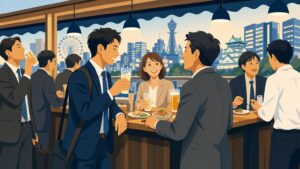
Small, family-run spots are hotbeds of boke and tsukkomi. The owner (taisho or oyaji) has often perfected their comedic timing over many years. They treat regular customers like extended family, ready for banter.
- The Boke Setup: You order a large beer. The owner sets down a tiny teacup in front of you. “Here you go, one large beer.”
- The Wrong Response: Becoming genuinely annoyed or confused. “Excuse me, I ordered a large beer.”
- The Tsukkomi Payoff: Play along. Pick up the tiny cup, examine it, and say, “Wow, this beer packs a punch! One sip might be my limit!” Or deliver a direct retort: “Oi, oyaji! Trying to cut me off before I even start?” This back-and-forth builds a lasting connection. You’re no longer just a customer; you’re part of the nightly comedy show.
The Foreigner’s Dilemma: To Tsukkomi or Not to Tsukkomi?
Okay, so you grasp the theory. But actually putting it into practice can be intimidating. What if you mess up? What if your timing is off? What if your Nande ya nen! sounds genuinely angry? This anxiety is real, but the key is to rethink the situation. It’s not a test you can fail. It’s an invitation to connect, and any attempt, no matter how awkward, is usually appreciated far more than a polite, silent withdrawal.
The Perils of a Literal Mind
One of the biggest challenges for many non-Japanese residents is moving beyond a literal interpretation of words. Osakans love to communicate through exaggeration, irony, and playful insults. Their words often hold a second, humorous meaning, which is the real message.
A classic example is a compliment. You manage to put together a basic sentence in Japanese. Your Osaka friend might dramatically gasp and say, “Nihongo perapera ya na!” (“Your Japanese is so fluent!”). A newcomer’s instinct is to take this literally. You might blush and say, “Oh no, thank you, but my Japanese is still very bad.” This response is humble and polite but misses the joke. The statement is an obvious exaggeration—a boke. The intended tsukkomi reply would be something self-deprecating and exaggerated, like, “I know, right? I’m thinking of writing a novel next week!” This shows you understand the playful nature of the compliment and can respond in kind.
Your Tsukkomi Starter Kit
You don’t need to be a comedy expert to join in. Having a few simple phrases ready can make all the difference. The key is in the delivery: keep it lighthearted, with a smile or a laugh.
- _Nande ya nen!_ (なんでやねん!): The Swiss Army knife—use it whenever something is clearly ridiculous.
- _Honma ka?_ (ほんまか?): “Really?” or “Seriously?” Said with playful disbelief.
- _Akan ya n!_ (あかんやん!): “Oh, come on!” or “That’s not good!” Perfect for when someone does something silly, like pretending to give you the wrong change.
- _Meccha iu ya n!_ (めっちゃ言うやん!): Loosely, “Look who’s talking!” or “You’re one to talk!” Great for when someone teases you about something they’re also guilty of.
If words fail you, don’t worry. A theatrical eye-roll, a hand thrown up in mock despair, or just a hearty laugh can serve as an effective non-verbal tsukkomi. It communicates the most important thing: I get it.
When Silence is the Worst Response
Here’s the most important takeaway for any foreigner trying to navigate Osaka’s social scene. The opposite of a good tsukkomi isn’t a bad one—it’s a blank stare. A serious, literal correction or, worse, silence is what truly kills the interaction. It builds a wall. The person who offered the boke is left hanging, their friendly gesture rejected. They might interpret your silence not as confusion, but as coldness or disinterest. In a city that thrives on engagement, retreating into polite silence is the surest way to stay an outsider. A failed joke is still a shared moment. An ignored one is just an awkward silence.
How This Culture Shapes Life in Osaka
The steady interplay of boke and tsukkomi is more than a mere conversational habit; it acts as the driving force that shapes the city’s entire character. It reveals much about why everyday life here feels so fundamentally distinct from the rest of Japan.
It’s Not Rudeness, It’s Engagement
One of the first things foreigners often notice—and sometimes find bothersome—is that Osakans can come across as loud, direct, and even somewhat nosy. An elderly woman may comment on your child’s outfit while on the train. A man at a ramen shop might lean over and tell you that you’re using too much chili oil. From a Tokyo viewpoint, this might feel like an invasion of personal space and a breach of unwritten social norms.
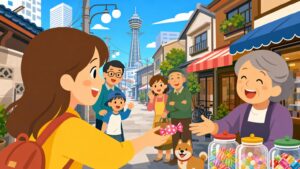
However, seen through the perspective of tsukkomi culture, it’s better understood as proactive interaction. That woman isn’t criticizing your parenting; she’s initiating a conversation. The man isn’t judging your taste; he’s expressing his passion for ramen. They notice something and respond to it openly and with a personal touch. In Tokyo, if you’re standing at a street corner looking lost with a map, people will typically give you plenty of space to avoid intruding. In Osaka, an obachan might seize the map from your hands, declare you’re going the wrong way, point you in the right direction, and then ask if you’ve eaten yet. This isn’t impoliteness; it’s the city’s default mode—connecting, helping, engaging, and performing a tsukkomi on your confusion.
The Value of a Good Laugh
In Osaka, there’s a deeply ingrained belief that humor is an essential social currency. A hearty laugh is prized more than a polite bow. This adds a sense of lightness and resilience to everyday life. People are quick to make jokes, even about their own setbacks, as a way of coping and fostering solidarity. As a result, the city feels less formal, less hierarchical, and more egalitarian. Everyone is a potential comedic partner.
This mindset extends into business as well. While large corporations maintain formal Japanese etiquette, in smaller businesses and everyday commercial interactions, breaking the ice with a clever boke is often the quickest way to build trust. It shows you’re not stiff or overly formal—that you’re a real person who can share a laugh. In Osaka, people generally prefer to do business with someone they can enjoy a bit of humor with. Efficiency and humor are not mutually exclusive here; they work together to get things done.
A Final Word: Embrace the Absurd
Living in Osaka feels like having a lifetime pass to an interactive comedy show. At first, you may simply be an audience member, puzzled by the inside jokes and rapid-fire humor. But the longer you stay, the more you discover you’re being invited onto the stage. You don’t need to be a star performer; you just need to be willing to join in.
Don’t stress about perfecting your Japanese accent or mastering complex conversational patterns. Instead, tune into the rhythm. Listen for the setup, the absurd remark, the playful exaggeration. And when you catch it, don’t withdraw into silence. Take a chance. Try a Nande ya nen! Share a laugh and a shake of your head. Roll your eyes with flair. Your clumsy attempts will be met not with criticism, but with joy. Because in that moment, you’re no longer just a foreigner in their city; you’re part of its culture.
Learning to navigate the world of boke and tsukkomi is the final step to truly feeling at home here. It’s when you realize the shopkeeper teasing you is not a stranger, but a neighbor. It’s when you understand that in Osaka, the shortest distance between two people isn’t a straight line, but the shared arc of a perfectly timed joke.