Walk into a conversation in Tokyo, and you’ll find it moves with a certain polite, predictable rhythm. People wait for their turn, offer gentle affirmations, and carefully navigate topics to maintain a smooth, undisturbed harmony. It’s a dance of social grace. Then, you step off the Shinkansen in Osaka, and the music changes entirely. The rhythm is faster, a little syncopated, and full of unexpected beats. The first time I, a Tokyo native, tried to order a coffee here, the barista looked at my indecisiveness and quipped, “You think about it any longer, it’ll be nighttime and you’ll need a beer instead.” I froze. Was he being rude? But then his colleague next to him lightly smacked his arm and shot back, “Leave her alone! She’s picking a coffee, not a life partner.” The whole counter erupted in a soft, knowing chuckle. I wasn’t being insulted; I had stumbled onto a stage. In Osaka, everyday conversation isn’t just a transfer of information. It’s a performance, a game, a comedy routine. And the core of this routine is a dynamic duo of communication styles known as boke and tsukkomi. Understanding this isn’t just about learning slang; it’s about decoding the very soul of Osaka’s social life. It’s the key to figuring out why a chat with a shopkeeper can feel more like a comedy show than a transaction, and why what sounds like an argument is actually a sign of affection.
This comedic back-and-forth is as much a part of the city’s fabric as its renowned food culture, which will be on full display at the upcoming Kyoto Sweet Potato Expo in 2026.
The Unspoken Rules of the Osaka Comedy Club
At its core, the dynamic is straightforward, directly borrowed from the stand-up comedy routines known as manzai, which are a fundamental part of Kansai culture. There are two roles: one person takes on the boke, the funny one, the airhead who says something absurd, nonsensical, or simply incorrect. The other plays the tsukkomi, the straight man, who instantly points out the absurdity with a sharp, witty comeback. The boke throws the ball, and the tsukkomi spikes it. The outcome is laughter and, more importantly, a connection. It acts as a conversational engine driving interactions throughout the city, turning everyday moments into chances for shared amusement. This isn’t reserved for special occasions; it’s the default mode of communication. It’s the lubricant that keeps the gears of Osaka society turning with a smile and a quick jab.
Boke: The Art of the Absurd
The boke role embodies playful ignorance. It involves viewing the world through a slightly skewed perspective and vocalizing it. This isn’t about genuine stupidity; it’s a performance of foolishness meant to amuse. A skilled boke is fully aware of what they’re doing. They might see a tiny poodle in a sweater and exclaim, wide-eyed and serious, “Wow, look at that ferocious lion! We need to run for our lives!” They’re not crazy—they’re offering an invitation, holding up a sign that says, “Let’s not be so serious right now. Let’s play.” The boke can take many forms: a grand exaggeration like “I’m so hungry I could eat this whole building,” a deliberate misunderstanding such as responding to the time with “It’s time for a nap,” or even a simple physical gesture like struggling to open an automatic door. The essence of the boke moment is that it disrupts the normal flow of reality, introducing a small crack in the façade of sensible, adult behavior, creating a space where laughter can emerge.
Tsukkomi: The Sound of Connection
If the boke is the setup, the tsukkomi is the punchline—and yet it’s much more than that. The tsukkomi role is key because it affirms the boke. By highlighting the absurdity, the tsukkomi says, “I see what you did there. I’m paying attention. I’m involved.” An ignored boke is a sad, lonely thing, hanging in the air and making the speaker seem genuinely odd. The tsukkomi catches it, grounds it, and transforms it into a shared joke. The best-known tsukkomi phrase is, naturally, “Nande ya nen!” which roughly means “Why the heck?!” or “What are you saying?!” It’s often paired with a light, playful tap on the arm or shoulder—not aggression, but a physical punctuation mark. Other tsukkomi responses are just as familiar: replying to the ferocious lion poodle with a deadpan, “That’s a dog. Probably named Coco. Calm down,” or telling the man who claims he could eat a building, “Start with the menu, you’re scaring the other customers.” The tsukkomi isn’t about being mean or shutting down the other person. On the contrary, it’s an expression of affection, showing you care enough to join in. It’s the sound of engagement—the very rhythm of social bonding in Osaka.
Where Comedy Lives: From the Stage to the Supermarket
This conversational style didn’t just emerge spontaneously. Osaka is undeniably the epicenter of Japanese comedy. It hosts Yoshimoto Kogyo, the entertainment powerhouse responsible for nearly every famous comedian in Japan over the past century. TVs in Osaka households are almost always tuned to manzai shows. Children grow up watching these fast-talking, sharp-witted duos, absorbing their rhythms and timing. This comedic framework becomes woven into their linguistic identity. They learn that conversation is a collaboration, a back-and-forth exchange where the aim is not only to convey information but also to entertain one another. This model is then applied to nearly every facet of daily life, turning the city into an expansive, interactive stage where everyone knows their cues—or at least how to improvise.
The Manzai Blueprint
Consider manzai as the cultural programming operating in the background of every Osakan’s mind. It offers a guide for handling social tension, quickly building rapport, and discovering humor in everyday situations. In business meetings, a moment of awkwardness might be eased by a manager making a goofy boke remark about sales numbers, giving a subordinate the opportunity to respond with a respectful tsukkomi that breaks the tension and strengthens their bond. This framework provides a safe, predictable way to be direct without coming across as confrontational. The tsukkomi, which might sound blunt elsewhere, is understood in this comedic context as part of a friendly routine. It’s a shared cultural code deeper than language, rooted in watching countless hours of professional comedians do the same thing on TV. This common understanding is what makes the whole system effective. Everyone’s in on the joke because they’ve been exposed to the source material their entire lives.
Real-Life Scenarios: Your Daily Dose of Banter
Moments of boke and tsukkomi happen constantly and often in fleeting exchanges. You’re at a takoyaki stand, and the vendor hands you your steaming tray. As you juggle it, you say, “Wow, this is hot enough to melt steel!” That’s your boke. The vendor instantly fires back, “Then eat it fast before it melts your hand! I’m not footing your hospital bill.” That’s the tsukkomi. You both share a laugh. A connection is made. Or picture yourself at the supermarket checkout, realizing you forgot your reusable bag. You sigh, “Ah, I forgot my bag. My memory’s like a sieve.” A classic boke setup. The elderly woman behind you leans in and says, “A sieve? At your age? I use a fishing net and still can’t catch a single thought!” Everyone nearby smiles. This minor personal slip turns into a small, shared moment of public humor. It happens on train platforms, in office elevators, and across neighborhood fences. It’s the city’s way of talking to itself—a steady flow of setups and punchlines that makes life feel a bit lighter.
Osaka vs. Tokyo: A Tale of Two Conversational Cities
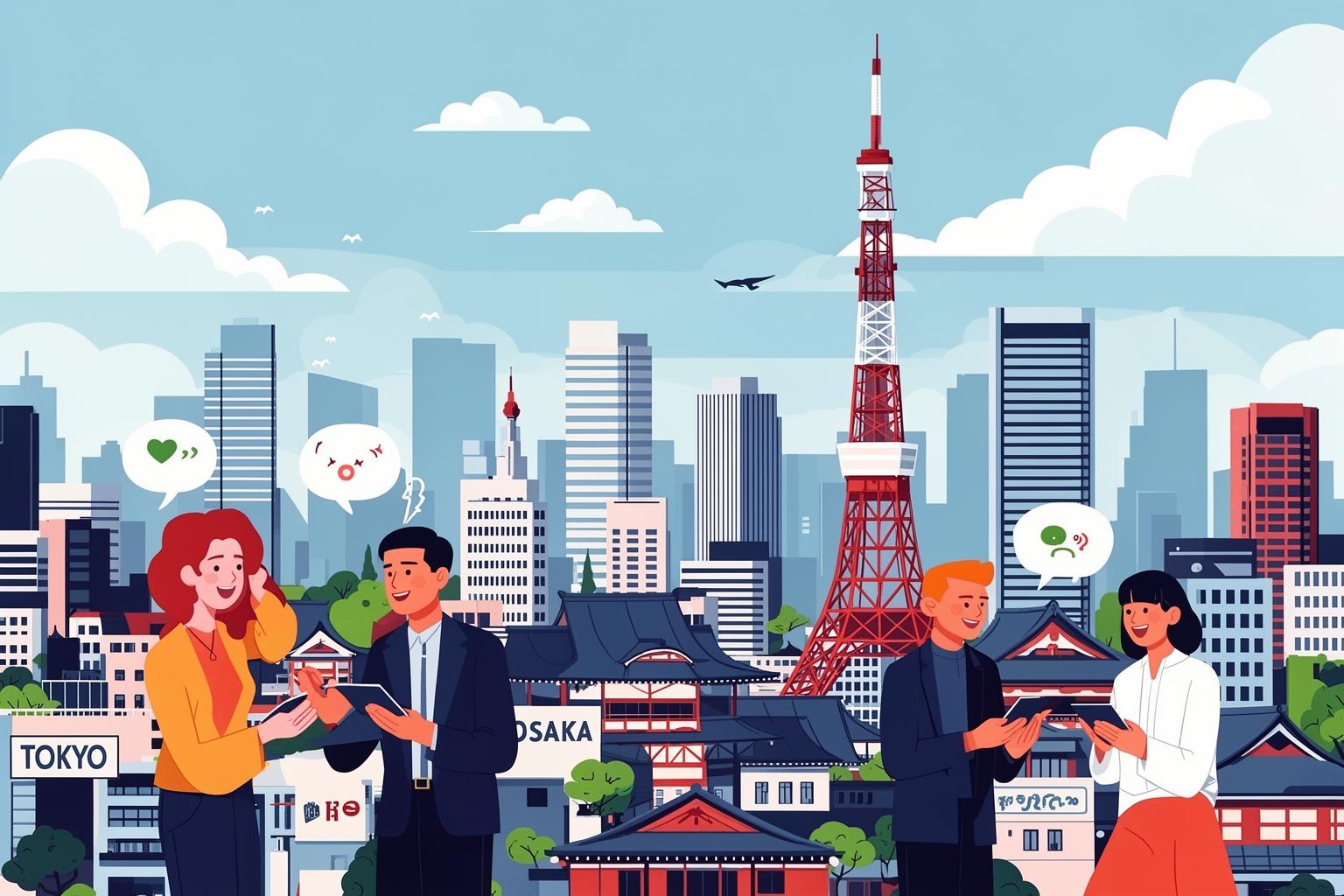
The contrast in communication styles becomes strikingly apparent when comparing Osaka with Tokyo. It’s not a matter of one being superior to the other; rather, they function on entirely different social frequencies. Living in Tokyo, I grew used to a particular conversational caution. The main objective often centers on preserving wa, or group harmony. This involves being indirect, “reading the air” (kuuki wo yomu), and steering clear of anything that might cause tension or discomfort. Playfully calling out someone’s silly remark often seems too blunt, too risky. In Osaka, however, the opposite applies. Harmony is maintained through interaction, not avoidance.
The Tokyo Silence
In a Tokyo workplace, if a coworker made a slightly absurd, boke-style comment—like, “If I stare at this spreadsheet any longer, my eyes might turn into pie charts”—the typical response would likely be a polite, non-committal smile. Or perhaps a kind, “That’s a lot of data, isn’t it? Gambatte.” While the comment would be acknowledged, the comedic invitation would be gently declined. Responding with a sharp tsukkomi might be perceived as disruptive or even somewhat aggressive. The social emphasis is on keeping things smooth. Strangers seldom engage in this kind of playful exchange. The invisible barriers between people are thicker. You mind your own business, and others do likewise, maintaining a respectful distance. It’s a culture of reserved cordiality, where you avoid imposing on others’ personal space, whether verbally or otherwise.
The Osaka Rebound
Now, imagine the same spreadsheet scenario in an Osaka office. The boke about eyes turning into pie charts would be an irresistible invitation. A colleague would almost certainly shoot back immediately: “Great, maybe then you’ll finally understand these numbers!” Another might chime in, “Just make sure the budget’s in the apple pie section, not the cherry one.” The original speaker wouldn’t feel offended; they’d feel pleased. Their boke worked. It sparked a reaction. This is the key difference: in Osaka, ignoring a boke can be seen as cold or uninterested. It’s like someone threw you a ball and you just let it drop. The tsukkomi shows you’re joining in, that you’re on the team. This direct, responsive style is the local expression of friendliness. It breaks down walls instantly, forging a temporary—and often lasting—connection through shared laughter. It’s a culture of lively engagement, where reaching out with a joke is the highest social compliment.
A Foreigner’s Guide to Playing Along (or Just Surviving)
For someone unfamiliar with a steady dose of manzai comedy, entering this world can be quite confusing. The rapid-fire exchanges may seem exclusive, and the bluntness of the tsukkomi can easily be misinterpreted as harsh criticism. The first few times an elderly woman at the bus stop points out that your shirt is inside out, you might feel a warm flush of embarrassment. But when she adds, “Or is that the latest fashion from Paris?” with a wink, you start to understand. It’s not an attack; it’s an invitation. Learning to navigate this is one of the key steps to feeling truly at home in Osaka.
Is That an Insult? Decoding the Tsukkomi
The biggest challenge for foreigners is distinguishing a playful tsukkomi from a genuine critique. The clue lies in the non-verbal signals. Observe their face. Are they smiling? Is there a sparkle in their eye? Pay attention to their tone. Is it sharp but playful, or is it heavy and flat? Almost always, the context is comedic. A tsukkomi typically responds to a perceived boke, whether intentional or not. If you say something slightly silly or make a minor, harmless slip, you’ve unintentionally set the stage. The tsukkomi that follows is the other person’s gentle way of hitting the ball back, saying, “I see you, and it’s all good.” Once you realize it’s a performance, a switch flips. It’s no longer about being judged; it’s about being included in this local ritual. A tsukkomi from a stranger is Osaka’s version of a friendly nod.
Your Role in the Routine
The good news is, you don’t need to be a top-notch comedian to join in. The pressure isn’t on you to deliver a flawless punchline. Often, the best response is the simplest: just laugh. A sincere laugh shows you got the intention and appreciated the joke. You’ve completed the exchange successfully. If you want to go a bit further, you can learn a few simple, playful replies. A slightly exaggerated “Hidoi!” (That’s so mean!) with a smile is a perfect comeback. Or a casual, “Bareta?” (Did you catch me?). You can also attempt a small, obvious boke yourself. Point at the famous Glico running man sign in Dotonbori and ask with a straight face, “Is that a famous marathon runner?” You’re sure to get a dozen joyful tsukkomi responses from everyone nearby. Showing you understand the game instantly earns respect and warmth.
The Joy of Dropping the Punchline
For every long-term foreign resident in Osaka, there comes a moment when it finally clicks. A friend makes a boke, and without hesitation, a perfect tsukkomi slips out. The timing is spot on, the tone just right. Your friends burst into surprised, delighted laughter. In that instant, you’re no longer an outsider looking in. You’ve absorbed the city’s rhythm. You’ve learned the local language that textbooks never teach. It’s a deeply gratifying feeling, a sign that you’re not merely living in Osaka, but that a part of Osaka now lives within you. It’s the feeling of finally joining the dance, not just hearing the music, but adding your own beat to the city’s lively, endless rhythm.
More Than a Joke: Why This Habit Matters
It might be tempting to dismiss this entire dynamic as frivolous—a quirky but ultimately insignificant local custom. However, that perspective completely misses the essence. The culture of boke and tsukkomi offers a glimpse into Osaka’s historical and social fabric. It reflects the city’s merchant heritage, serves as a means of social cohesion, and represents a philosophy for facing life’s challenges with humor and resilience. It’s not merely about being funny; it’s about fostering connection.
Building Bonds with Laughter
In an increasingly isolating world, Osaka’s style of conversation acts as a potent remedy. It’s a remarkably effective way to establish rapport. A brief boke-tsukkomi exchange with a stranger can instantly create a fleeting yet genuine bond, recognizing shared humanity and a common appreciation for the absurd. This ongoing practice of connecting through humor fosters an overall atmosphere of openness and approachability. It’s a key reason Osaka is often regarded as “friendlier” than other major Japanese cities. This friendliness isn’t just a vague impression; it’s the concrete outcome of a culture that actively encourages lighthearted, positive interaction. Laughter functions as the city’s social currency—and everyone is wealthy in it.
The Merchant’s Wit
This tradition is deeply embedded in Osaka’s history as Japan’s commercial center. For centuries, the city was home to merchants, traders, and artisans. Success relied not only on the quality of goods but also on the ability to communicate, negotiate, and quickly build relationships. Sharp wit, quick thinking, and social intuition were vital survival skills. Humor was a potent tool in the merchant’s arsenal: it could ease tense negotiations, establish trust with new clients, or simply lighten a long day of bargaining. This heritage endures today. The brisk, responsive, and pragmatic spirit of the merchant class is reflected in the lively back-and-forth of boke and tsukkomi. It’s a communication style refined over generations to be both efficient and engaging.
Embracing the Beautiful Absurdity
At its core, the culture of boke and tsukkomi reveals a fundamental truth about Osaka’s mindset: life is somewhat absurd, so it’s better to laugh about it. It’s a philosophy of not taking oneself too seriously—finding joy in small flaws, human mistakes, and the gap between reality and possibility. While Tokyo often pursues sleek, polished perfection, Osaka embraces the messy, humorous, and unpredictable nature of being human. It’s a city that openly wears its heart on its sleeve and isn’t afraid to laugh at itself. By inviting everyone to join in the humor, Osaka fosters a strong sense of belonging. Whether you’re the one making the silly remark or the one pointing it out, you’re part of the same wonderfully chaotic, hilarious routine. You’re part of the show. And in Osaka, the show is always running.