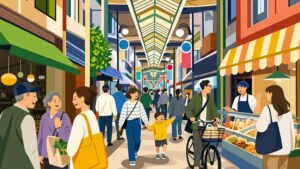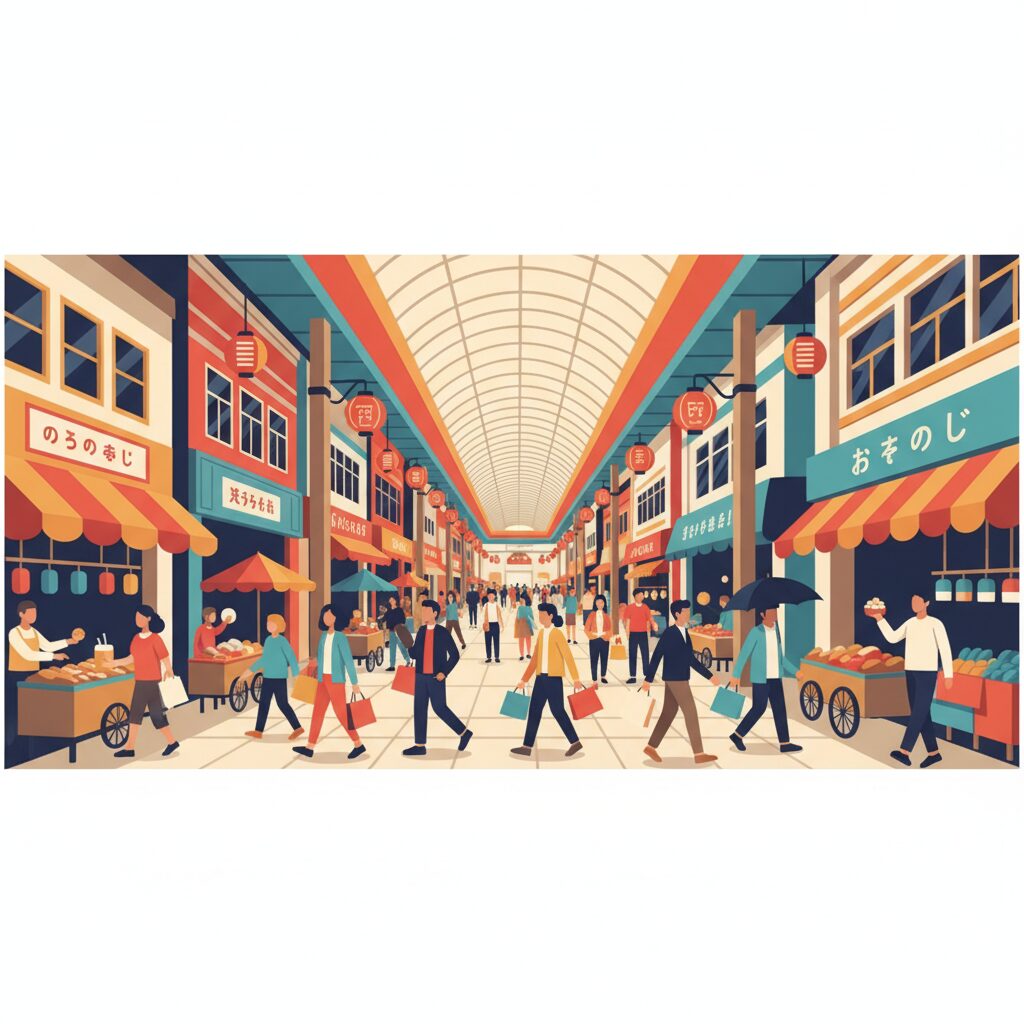
When you first arrive in Osaka, you’ll probably see the big, flashy shopping arcades first. Shinsaibashi, with its endless parade of brand names and trendy cafes, or Dotonbori, a chaotic river of neon and giant plastic crabs. It’s easy to walk through these places and think, “Okay, a covered shopping street. It’s for tourists and teenagers.” And you wouldn’t be totally wrong. But you’d be missing the most important part of the story, the part that explains what life in this city actually feels like, day in and day out.
The real soul of Osaka isn’t in those sprawling commercial zones. It’s tucked away in the quieter residential neighborhoods, in the hundreds of local shotengai that snake through the city like vital arteries. These aren’t just places to buy groceries. They are the living, breathing heart of Osaka’s community culture. In Tokyo, life often revolves around the sleek, efficient train station department stores and sprawling supermarkets. It’s a system built for convenience and anonymity. Osaka operates on a different frequency. Here, the shotengai is the neighborhood’s front porch, its kitchen, and its living room all rolled into one. To understand how these covered streets function is to understand the unspoken social rules and the unique rhythm of Osakan life. Forget the tourist maps for a moment; this is where the city truly happens.
In these vibrant shotengai, locals not only build community ties but also enjoy discovering culinary traditions, as highlighted in this guide to authentic prepared foods that enhances everyday life in Osaka.
More Than Just a Place to Shop: The Shotengai as a Community Living Room
Step into a typical neighborhood shotengai on a weekday afternoon, and what you observe is more than just commerce. It’s a dynamic social ecosystem in action—a place where the boundaries between customer and neighbor, and between transaction and conversation, are beautifully and wonderfully blurred. This may be the most striking cultural difference a newcomer will notice, especially if they come from a more reserved city like Tokyo.
The Unspoken Social Contract
In a Tokyo supermarket, interaction with staff is often limited to a polite, routine exchange at the checkout counter. It’s efficient, neat, and impersonal. In an Osaka shotengai, shopping is about building relationships. The butcher doesn’t just sell you pork; he knows you prefer lean cuts, asks how your son’s exams went, and might share a cooking tip for the day’s special. You’re not just customer number 37; you’re Tanaka-san’s daughter who recently moved back to the neighborhood.
This is grounded in daily, repeated interactions. The calls of “Maido!” (literally “every time,” but meaning “thanks for your continued business!”) and “Okini!” (a warm Kansai dialect “thank you”) are more than mere pleasantries. They serve as verbal acknowledgments of an ongoing relationship. Shopkeepers watch their customers’ children grow up. They know who recently retired, who’s become a new parent, or who’s caring for an elderly relative. A foreigner might initially feel like an outsider in this familiar web of faces, but the barrier to entry is surprisingly low. All it takes is becoming a regular visitor. Frequent the same vegetable stand, and soon the owner will set aside the best daikon for you or offer your child an extra strawberry—a small gesture saying, “I see you. You’re one of us now.”
A Support System for the Elderly and Families
This close-knit community fabric is more than a source of comfort; it’s an essential piece of social infrastructure. For Osaka’s sizable elderly population, many living alone without cars, the shotengai is a lifeline. It offers a safe, walkable, familiar environment to find daily necessities. More importantly, it ensures vital social contact.
Shopkeepers act as informal neighborhood watchers. They’re the first to notice if Mrs. Suzuki hasn’t come by for her daily tofu and pickles in several days. A quick phone call or a neighbor check-in can mean the difference between a minor issue and a serious crisis. This level of care is something a large, anonymous grocery chain cannot provide. For families with young children, the shotengai is a trusted space. Parents feel comfortable sending their elementary-aged kids to the corner store for milk, knowing many pairs of eyes are watching out for them. The entire street becomes an extended family, nurturing a sense of collective responsibility that feels increasingly rare in modern urban living.
The “Osaka Price”: Haggling, Discounts, and the Value of a Good Deal
Now, let’s discuss money. Osaka was founded by merchants, and the spirit of shobai (business) runs deeply through its veins. This is often mistakenly stereotyped as people being cheap or stingy, but that’s a fundamental misconception. Osakans aren’t cheap; they are value-conscious. They appreciate a good product at a fair price and enjoy the process of achieving that. The shotengai serves as the main stage for this everyday performance.
It’s Not Rude, It’s a Relationship
A foreigner might feel hesitant or awkward asking for a discount, thinking it’s rude or confrontational. In many areas of Japan, especially Tokyo, that would be true. However, in an Osaka shotengai, it’s often part of the ritual. It’s a form of communication, a playful dance. This isn’t aggressive haggling like in a tourist market; it’s more subtle and centered on the relationship you’ve built.
The exchange often begins with a compliment. “These tomatoes look great today!” The shop owner agrees. You choose a few. As they’re weighed, you might casually say with a laugh, “Chotto make-te kureru?” (“Can you give me a little discount?”). The owner might pretend to sigh dramatically, then reply, “Shoganai naa” (“Can’t be helped, I guess!”) before knocking a few yen off the price or, more commonly, adding an extra onion or a handful of green peppers to your bag. This is called “omake” (a little something extra) or “saabisu” (service). It’s a gesture that strengthens your bond. It says, “You’re a valued customer, and I appreciate you.” Attempting this on your first visit may not work, but once you become a familiar face, it naturally becomes part of the rhythm.
“Nembera” and the Psychology of the Discount
The price tag, or “nembera” in Osaka dialect, is often considered a starting point, not a final price. This especially applies to items without a fixed cost, like fresh produce or fish that must be sold by day’s end. As closing time nears, the shotengai bursts into a chorus of vendors shouting time-sale prices. This is when true bargain hunters come alive. Scoring a great deal isn’t just about saving money; it’s a point of pride, a story to share. It’s about being a savvy consumer tuned into the market’s rhythm.
This mindset contrasts sharply with Tokyo’s standardized, fixed-price culture, where the price is final, no questions asked. Foreigners often misread Osaka’s price focus as a sign of lower quality, but it’s quite the opposite. The aim is to get the best quality for the best price. It’s a skill, and the shotengai is where you develop it. It reflects a practical, grounded approach to life that defines the city’s character.
The Sensory Overload: Sound, Smell, and the Rhythm of the Arcade

A shotengai is an assault on the senses, but in the most delightful way. It’s a living, breathing entity with its own distinctive soundtrack and scent profile. This sensory immersion plays a major role in making it feel so unlike the sterile, climate-controlled atmosphere of a modern mall.
A Soundtrack of Everyday Life
Close your eyes and listen closely. You’ll catch the rhythmic thud of a butcher’s cleaver, the high-pitched sizzle of takoyaki batter hitting a hot iron plate, and the lively, continuous calls of the vendors. “Yasukushitoku de!” (“I’ll make it cheap for you!”), “Hora, moriagatte iko!” (“Hey, let’s get lively!”). These are not pre-recorded announcements; they are the authentic, booming voices of people passionate about their wares. Beneath this, you can hear the cheerful, somewhat tinny strains of enka or pop music playing through the arcade’s aged speaker system, the gentle rumble of bicycles rolling along the central lane (a practice that would earn disapproving looks elsewhere in Tokyo), and the ongoing murmur of neighbors exchanging the latest news. It’s a symphony of organized chaos, a soundscape that is quintessentially, unfiltered Osaka.
A Culinary Map in the Air
The air itself weaves a story. As you stroll through the arcade, the aromas shift every few steps. One moment, you’re surrounded by the rich, smoky scent of grilling unagi (eel). The next, it’s the clean, savory aroma of dashi broth simmering at a tiny udon stall. Then emerges the sweet, soothing fragrance of anko (red bean paste) from a traditional wagashi shop, followed by the salty, toasted scent of freshly baked senbei (rice crackers). Your nose knows you’re nearing the fishmonger well before you spot the glistening rows of tai and saba. This olfactory journey is not only pleasant; it’s practical. It serves as a real-time menu of what’s fresh, in season, and what your neighbors might be having for dinner tonight. It’s a profoundly human, analog experience that ties you directly to the food you eat and the people who provide it.
Shotengai vs. Supermarkets: A Tale of Two Shopping Cultures
While large supermarkets undoubtedly exist in Osaka, the enduring popularity of the shotengai highlights a different set of cultural values. Choosing between the two means choosing between two fundamentally distinct ways of life.
Specialization Over One-Stop Shopping
Supermarkets offer the convenience of having everything in one place. In contrast, the shotengai operates on a model of specialization. Instead of going to a single store, you visit several. You buy tofu from the maker who has been crafting it in the same location for sixty years. You get your fish from the fishmonger whose expertise was passed down from his father. You purchase your vegetables from the vendor who personally knows which farmers grew them. This showcases a deep-rooted Osakan respect for the shokunin, the master craftsman. There is an unspoken trust that someone who exclusively sells fish knows far more about it than a supermarket employee who might alternate between stocking yogurt and fish. Osakans often prefer this specialized expertise and higher quality over the convenience of a single checkout line.
The Changing Tides: Survival and Adaptation
It would be misleading to portray every shotengai as thriving. Many face challenges. The populations around them are aging, and the ongoing competition from chain stores and online shopping is intense. Some arcades feel quiet, with numerous shuttered shops. Yet Osaka is a city of resilient pragmatists. Many shotengai are fighting back by evolving with the times. They organize lively local festivals and flea markets to attract visitors. They create unique mascot characters to build a recognizable brand identity. Most importantly, they are gradually welcoming a new generation. Young entrepreneurs are opening trendy coffee shops, craft beer bars, artisanal bakeries, and unique galleries alongside long-established pickle stalls and fishmongers. This blend of old and new generates a vibrant energy, ensuring the shotengai remains a living, evolving centerpiece of the neighborhood rather than becoming a relic of the past.
What This Means for Living in Osaka
If you’re thinking about settling down in Osaka, understanding the shotengai is more than just a cultural insight; it’s a crucial tool for navigating everyday life and becoming part of your community.
Choosing a Neighborhood
When searching for an apartment, pay close attention to the local shotengai. Is it lively and bustling, or quiet and half-empty? The condition of the shotengai serves as one of the most reliable indicators of a neighborhood’s overall vitality. A vibrant arcade signals a connected, engaged, and often safer community. It shows that people don’t just sleep here; they live, interact, and look out for one another. Living near a thriving shotengai can significantly enhance your quality of life, offering not only convenience but also a genuine sense of belonging and place.
How to “Join” the Community
The shotengai is your shortcut to becoming part of the local community. The friendly, welcoming merchants create a perfect, low-pressure setting to practice your Japanese and build connections. The key is to break away from the habit of anonymous shopping. Don’t just take what you need and leave. Slow down. Make eye contact. Offer a simple “Konnichiwa.” Choose a few shops to visit regularly. Become a familiar face. Ask a simple question like, “Kyo no osusume wa nan desu ka?” (“What do you recommend today?”). These small gestures gradually dissolve the invisible barrier between “resident” and “neighbor.” This is the practical reason behind the saying “Osaka people are friendly.” Their friendliness is active, not passive. The shotengai invites you to engage, participate, and become part of its daily rhythm. When you accept that invitation, you’re no longer just living in Osaka; you’re truly part of it.