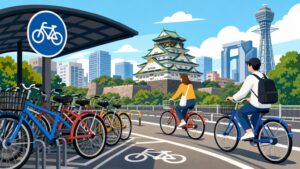
Step out of a local train station in residential Osaka, away from the neon glow of Namba or Umeda, and the first thing you’ll notice isn’t a landmark. It’s a sound. A constant, gentle whirring of a thousand bicycle chains, punctuated by the sharp ding-ding of a bell and the soft squeak of brakes on a crowded sidewalk. Then you see them. Rivers of bikes—chari, as they’re colloquially known—flowing through narrow lanes and populating every available inch of public space. They’re chained to guardrails, piled in shimmering mountains outside supermarkets, and navigated with a fluid, chaotic grace that seems utterly impossible. Coming from Tokyo, where life pulses to the metronomic rhythm of the Yamanote Line, Osaka feels fundamentally different. It moves at the speed of a well-oiled, slightly rusty bicycle. This isn’t just a quaint detail about getting around. The chari is the key that unlocks the city’s entire operating system: its physical design, its unspoken social contract, and the pragmatic soul of its people. The humble bicycle dictates the scale of neighborhoods, the flow of daily errands, and the unwritten rules of coexistence. To truly live in Osaka, you must first master the art of the chari.
The city’s vibrant street life is but one aspect of a broader social framework, where understanding local neighborhood pacts reveals the intricate balance of daily interactions in Osaka.
The Chari as an Extension of the Self
More Than a Machine: The Philosophy of Convenience
In Tokyo, your identity is often linked to your nearest train station. Your commute, social life, and entire daily routine are mapped out by the intricate web of JR and Metro lines. In Osaka, however, your world is more likely defined by a 15-minute bike ride. Your chari isn’t just transportation; it’s your personal range of freedom. It marks the clear difference between being bound by train schedules and spontaneously deciding to grab late-night takoyaki from a favorite stand across the neighborhood. This straightforward mechanical freedom nurtures a strong, practical independence—an essential Osakan value. Why wait ten minutes for a train to travel one kilometer when you can pedal there in five? This mindset extends further. It explains Osaka’s preference for directness in business and conversation, bypassing middlemen, and finding the most efficient route from A to B, even if it diverges from official protocol. The bike is the ultimate tool of pragmatism, and in Osaka, pragmatism reigns supreme.
The Mama-chari: Osaka’s Family Minivan
You can’t discuss Osaka chari life without giving credit to the undisputed queen of the road: the mama-chari. These are far from sleek, lightweight racing bikes. They are sturdy machines. Constructed with heavy-duty frames, a low center of gravity for balance, a large front basket, and—most importantly—secure child seats mounted on both front and back. Watching an Osaka mother navigate a bustling shotengai (shopping arcade) during peak hours with two children and a week’s worth of groceries piled high is witnessing a masterclass in balance, spatial awareness, and sheer determination. The mama-chari is more than just a vehicle; it’s a symbol. It embodies the relentless, practical, get-it-done spirit that drives the city. It’s the machine that runs the household, transports the next generation to daycare, and keeps the local economy moving, one grocery run at a time. It’s a rolling testament to the Osakan belief that if a tool works, you use it to its fullest capacity—and then some.
The Unspoken Dance of the Sidewalks
Fluid Dynamics vs. Rigid Rules
For newcomers, especially those from more orderly cities or countries, cycling in Osaka can seem like a terrifying spectacle. Cyclists ride on sidewalks clearly meant for pedestrians. They breeze through red lights with only a quick glance if the way is clear. They weave through dense crowds with what seems like mere millimeters to spare. A visitor perceives chaos, recklessness, and rudeness. A local, over time, begins to see a complex, self-regulating system. This is perhaps the biggest source of cultural friction and misunderstanding.
Tokyo functions on a principle of strict adherence to the letter of the law. You wait patiently for the little green man to signal, even if no cars are in sight for miles. In Osaka, the written rule is often viewed as more of a strong suggestion. The real, unwritten law is situational awareness. An Osaka cyclist is constantly calculating, predicting the movements of pedestrians, other bikes, and cars. They expect you to do the same. That sudden swerve in front of you wasn’t aggression; it was a calculated move based on the unspoken assumption that you, a fellow participant in this urban ballet, would instinctively take a half-step aside to maintain the flow. It’s a high-trust, high-stress system that values collective momentum over individual right-of-way.
The ‘Eeyan’ Mentality on Two Wheels
This behavior is supported by a core Osaka phrase: eeyan (ええやん). It’s a wonderfully flexible expression roughly meaning “It’s fine, isn’t it?” or “Good enough!” or “Why not?” Are you technically supposed to be cycling on this narrow sidewalk? Probably not. But is anyone seriously hurt? Is traffic dramatically disrupted? If the answer is no, then eeyan. This mindset can be maddening when you’re dodging an oncoming bike, but it’s the same social lubricant that makes daily interactions in Osaka feel more relaxed, direct, and less formal than in Tokyo. It’s a double-edged sword: the city feels more human and less suffocatingly regulated, but it also requires a higher tolerance for casual rule-breaking and a thicker skin. You quickly learn to stop expecting profuse apologies for near-misses and instead offer a slight nod—a mutual, unspoken acknowledgment that “we’re all just trying to get where we’re going here.”
How Bicycles Shaped the Cityscape
The Human-Scale Metropolis
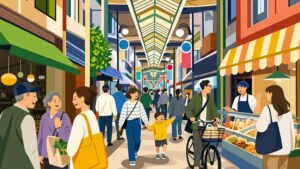
The overwhelming presence of bicycles has deeply influenced Osaka’s urban design. Although the city features large, multi-level train hubs like Umeda and Namba, the expansive residential areas between them feel fundamentally different from those in Tokyo. These neighborhoods are mostly flat, making cycling effortless. More importantly, they are built around the idea of self-sufficient local communities. Your daily life centers on your local shotengai. These covered shopping arcades, such as the famously long Tenjinbashisuji, serve as the community’s lifeblood. They are too narrow for cars and often too lengthy to be practical for pedestrians alone. Instead, they are perfectly designed for bicycles. You can ride your chari directly to the butcher’s shop, the tofu maker, and the vegetable stand, filling your basket as you go. This creates a city made up of interconnected villages. Your everyday needs are met within a small, pedal-powered radius, fostering a local community spirit often missing in Tokyo’s station-centered sprawl. You get to know the shopkeepers. You cross paths with neighbors. The bicycle is the unassuming thread that weaves this close-knit social fabric together.
The Parking Paradox: A Sign of Success and Failure
Walk past any train station in Osaka, and you’ll encounter the same scene: a towering mass of bicycles. They are crammed into designated multi-level parking structures, chained three deep to fences, and spilling onto nearby sidewalks in disorganized clumps. To outsiders, it appears chaotic, and truthfully, it is. The city continuously battles abandoned and illegally parked bikes, with crews frequently tagging and impounding them. A foreigner might interpret this as a sign of civic neglect or widespread disregard for public space. However, it more accurately reflects the bicycle’s overwhelming success. It shows that for tens of thousands of people, the bike serves as their main connection to the city’s public transit system. It’s the “last mile” solution for the masses, not just a trendy tech startup idea. The issue is not that people are lazy or disrespectful; it’s that the infrastructure is failing to keep up with the bike’s immense popularity. This chaotic scene tells the story of a city that has embraced cycling far more intensely than its planners ever expected. It’s a living, breathing system—messy, imperfect, and constantly evolving. As a resident, you quickly learn the local parking rules: where the unofficial “safe” spots are, how long you can leave your bike before receiving a warning, and which paid lots are worth the 150 yen for peace of mind.
Mastering Your Own Chari Life
Choosing Your Steed
Your first big choice as a new resident of Osaka isn’t which train pass to purchase, but which type of chari to acquire. Your selection reveals something about you. The classic, single-speed mama-chari with a basket is the practical workhorse, the default option. It’s simple, affordable, and almost indestructible. For those living in slightly hillier areas like Uehonmachi or the northern suburbs, an electric-assist version has become the new symbol of practical luxury, letting you glide up inclines without breaking a sweat. Then there are university students on sleek fixed-gear bikes and the occasional salaryman with a clever foldable model that can be taken on trains. But by far, the city runs on the humble, reliable mama-chari. Buying one second-hand, often from expansive lots that refurbish bikes impounded by the city, is a rite of passage for any budget-conscious new resident.
The Essential Skills: Bells, Brakes, and Balance
Biking in Osaka demands a very different skill set than a relaxed Sunday ride in the park. Your bell is not a polite request to pass; it’s more like a sonar ping. A quick ding-ding as you approach a blind corner or come up behind a pedestrian distracted by their phone isn’t rude—it’s an essential signal that says, “I’m here, please watch your surroundings.” Your brakes are meant for gradual slowing, blending smoothly into traffic, not for sudden stops that could cause a crash behind you. Most importantly, you must develop a strong sense of balance—not just for yourself, but for your cargo. You’ll learn to ride one-handed while holding an umbrella in the rain (the infamous and technically illegal kasa-sashi). You’ll master securing a case of beer in your front basket with a single, worn bungee cord. You’ll perfect the subtle weight shift needed to hop onto a curb without getting off. These aren’t just tricks; they’re the essential language of daily life in Osaka. It’s a physical fluency that, once acquired, lets you navigate the city with a grace and closeness that a train pass can never offer. It’s the moment you stop resisting the chaotic flow and become part of it, one determined pedal stroke at a time.