
Ever been in the middle of a story here in Osaka, sharing a simple anecdote from your day, and felt the energy in the room just… dip? You see your Osakan friend’s eyes glaze over slightly. They’re listening, sure, but they’re also waiting. Then comes the inevitable question, a phrase that can send a cold shiver down the spine of any newcomer: “De, ochi wa?” — “So, what’s the punchline?”
You freeze. Punchline? You were just talking about the long line at the bank. There was no punchline. It was just a thing that happened. But in that moment, you realize a fundamental truth about this city. In Osaka, a story without an ‘ochi’ is like a meal without rice, a train without tracks, a sky without a sun. It’s an incomplete thought, a conversation left hanging in the air. This isn’t Tokyo, where the polite exchange of information is the gold standard of conversation. This is Osaka, where dialogue is a sport, a performance, and a shared gift of entertainment. Every chat, no matter how small, is an opportunity to create a moment of shared laughter and connection. Forget what you know about reserved Japanese communication; we’re diving deep into the lively, demanding, and utterly brilliant world of Osaka’s conversational etiquette, where the punchline isn’t just a part of the story—it’s the entire point.
Beyond the social spectacle of Osaka’s lively anecdotes, many professionals now harness the artful strategic use of Osaka-ben to turn everyday dialogue into compelling business interactions.
What Exactly is an ‘Ochi’? More Than Just a Joke
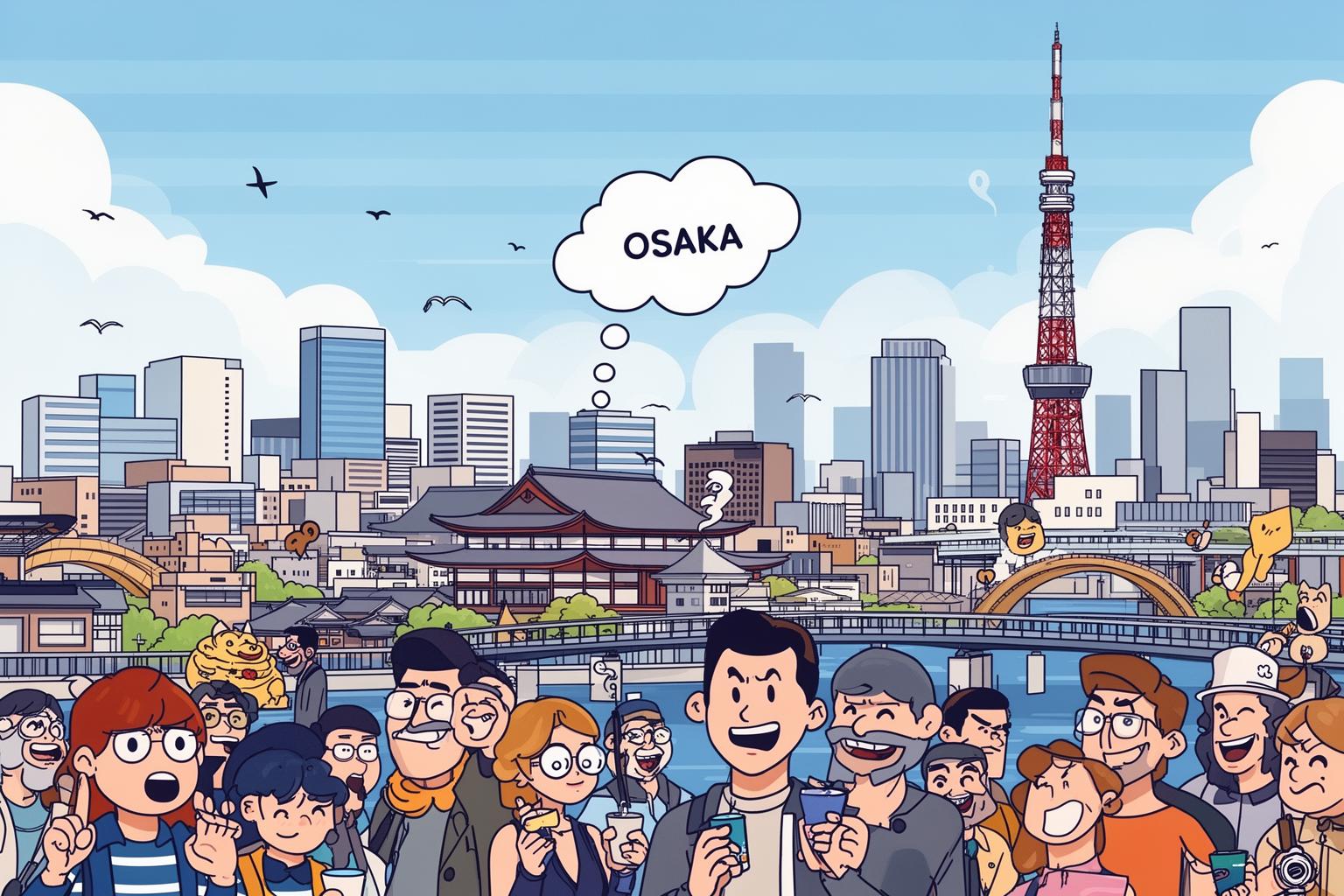
Before you rush to memorize knock-knock jokes, let’s clarify one thing. The ‘ochi’ isn’t merely a Western-style punchline. It’s a broader, more subtle concept. It’s the core of a story, the twist that brings everything together, the final moment that gives the entire narrative its value. Grasping this is the key to understanding the nuances of Osaka communication.
Defining the Drop
The word ‘ochi’ (オチ) literally means “the fall” or “the drop.” Think of it like the drop on a rollercoaster. You have the slow, clattering climb—that’s the story’s setup. You build tension, introduce characters and the scene. Then comes the peak, a moment of suspense. The ‘ochi’ is the thrilling, stomach-dropping plunge afterward, the part that makes everyone laugh or scream. It’s the resolution, the reward for the listener’s engagement.
An ‘ochi’ can take many forms. It might be a genuinely funny punchline, but it can also be a moment of ironic surprise, an unexpected twist, a clever play on words, a touching insight, or a hilarious self-deprecating remark. The key is that it provides a satisfying conclusion. A story that just fizzles out is considered poor form here.
Consider a simple example. A story without an ‘ochi’ goes like this: “I was walking through Tennoji Park this morning, and I saw a man feeding the pigeons. There were a lot of them. Then I went to work.” An Osakan listener would be politely baffled, thinking, “Okay… and? What’s the point of this pigeon story? Did one of them steal his wallet? Did he start conducting them like an orchestra? Give me something!”
Now, let’s add an ‘ochi’: “I was walking through Tennoji Park this morning, and I saw this distinguished-looking man in a suit carefully feeding the pigeons. He was so serious, it was like he was closing a major business deal with them. Suddenly, his phone rings. He picks it up and says, in the most serious voice I’ve ever heard, ‘Sorry, can’t talk. I’m in a meeting with some very important clients.’ Then he hangs up and tosses another handful of seeds. The pigeons were his clients!” Notice the difference? The story has a setup, a twist, and a funny resolution. It has a reason to exist. That’s the ‘ochi’.
The DNA of Osaka Comedy
This focus on punchlines isn’t random; it’s embedded in the city’s cultural DNA. Osaka is the undisputed capital of Japanese comedy. The entertainment giant Yoshimoto Kogyo, the company behind most of Japan’s famous comedians, is headquartered right here in Namba. For over a century, this company has shaped the national sense of humor, rooted deeply in Osaka.
The dominant comedy style is ‘manzai’, a stand-up routine performed by a duo. The pair consists of the ‘boke’ and the ‘tsukkomi’. The ‘boke’ is the funny one, the fool who says absurd, illogical, or silly things. The ‘tsukkomi’ is the straight man, who corrects the ‘boke’, points out their absurdity with a sharp retort, and often gives a light smack on the head. This fast-paced exchange of setup (‘boke’) and payoff (‘tsukkomi’) is the rhythm of Osaka.
People in Osaka grow up steeped in this culture. They watch ‘manzai’ on TV from childhood. This rhythm of ‘boke’ and ‘tsukkomi’ isn’t just for the stage; it’s the default pattern in everyday conversation. In any casual chat, people naturally play these roles. One person tells a story with a slight ‘boke’ twist—an exaggeration, a silly error—and the listener delivers the ‘tsukkomi’—an incredulous “Nande ya nen!” (“Why the heck!”) or a clever comeback. The ‘ochi’ is the storyteller’s ultimate aim, the moment that makes the entire ‘boke’ bit worthwhile.
The ‘Ochi’ in Action: Navigating Daily Conversations
Grasping the theory is one thing, but encountering the ‘ochi’ in its natural setting is quite another. It appears everywhere—from the checkout lane at the local Tamade supermarket to after-work drinks with coworkers. Learning how to recognize it, and even contribute to it, is your key to feeling like a genuine local.
Why Your Stories Aren’t Resonating
If you’ve ever felt your conversations in Osaka just aren’t hitting the mark, the missing ‘ochi’ is very likely to blame. When an Osakan asks, “So, what was the point of that story?” it can come off as blunt or even rude. In many cultures, and certainly in other parts of Japan, this would be a major social misstep. You might think, “I was just sharing! Why do I need a point?”
Here’s the crucial cultural insight: they aren’t dismissing you. Quite the opposite—they’re showing deep engagement. They’ve been listening carefully, following your narrative, and are now eagerly awaiting the payoff you’ve been building toward. Their question is an invitation. It’s a verbal lean-in, a way of saying, “I’m with you, now bring it home! Entertain me!” A polite, silent nod is the true insult—it often signals boredom.
This sharply contrasts with Tokyo. In the capital, especially in professional or semi-formal contexts, conversations mostly serve as smooth, polite information exchanges. Meandering stories without a clear point may be seen as time-wasting. In Osaka, information is secondary. The main goal of casual talk is to strengthen social bonds through shared entertainment. The ‘ochi’ sparks that bond.
Reading the Room: When Is an ‘Ochi’ Expected?
Don’t worry—you don’t have to close your quarterly budget report with a punchline about the CFO. Context matters. Osakans are experts in code-switching. In serious business meetings, doctor’s visits, or somber discussions, the demand for an ‘ochi’ completely vanishes. The tone remains serious and direct.
The pressure for an ‘ochi’ rises in direct proportion to how casual the setting is. It’s highest in these situations:
- Izakaya and Bars: The prime environment. After a few drinks, everyone takes a turn telling stories and listening. Stories should be funny, exaggerated, and always have a solid ‘ochi’.
- With Friends and Colleagues: During lunch or after-hours hangs, the ‘manzai’ dynamic emerges. This is where camaraderie builds through shared laughter.
- With Shopkeepers and Neighbors: Osaka is known for its warm, talkative shopkeepers. A quick trip to buy fruit can become a five-minute comedy act. Engaging with them, with a small funny story ready, is part of the local culture.
In essence, if the purpose of the conversation is social bonding rather than just exchanging information, having an ‘ochi’ ready is essential.
The Self-Deprecating ‘Ochi’: Osaka’s Ultimate Move
If there’s one surefire way to win friends and influence people in Osaka, it’s mastering the self-deprecating ‘ochi’. Making yourself the butt of the joke is a conversational superpower. It accomplishes multiple things: it guarantees laughs, demonstrates humility and that you don’t take yourself too seriously, and makes you highly relatable.
Rather than just complaining about a problem, turn it into a story highlighting your own hilarious blunders. A Tokyoite might say, “I made a mistake on a report today, and my boss wasn’t happy. It was a stressful afternoon.” It’s factual and reserved.
An Osakan would spin it like this: “You won’t believe what I did today. I was so sure about this report, I strutted over to my boss’s desk like I’d just hit the jackpot. I handed it to him, and he stared at it, then at me, asking if I’d invented a new type of math. Turns out I’d misplaced the decimal point throughout the entire sales forecast. We didn’t make ten million yen last quarter; we made one hundred thousand. For a second, I considered just running out of the building and never coming back!” This version is funnier, more memorable, and instantly connects through the shared human experience of messing up. It turns stress into entertainment. Master this, and you’ve mastered Osaka.
How to Survive (and Thrive) in a Punchline-Driven World
Alright, you grasp the concept. You witness it happening all around you. Now, how do you actually join in without feeling like you’re on stage at an open mic night? The good news is, no one expects you to be the next comedy superstar. It’s about joining in, not being perfect.
You Don’t Have to Be a Comedian
Let’s be clear: the bar for foreigners is incredibly low, and that’s a good thing. Your Osakan friends know you didn’t grow up watching ‘manzai‘ every weekend. The simple fact that you’re trying to understand and engage with this conversational style will earn you great respect. Your accent might be slightly off, your timing might be awkward, but your effort is what matters. Don’t let the fear of not being funny enough hold you back. Authenticity and effort always beat comedic genius.
Practical Tips for Crafting Your ‘Ochi’
When you feel ready to try, here are some straightforward storytelling tips to keep in mind. These can help you turn everyday experiences into ‘ochi’-worthy stories.
Observe and Absorb: The best way to learn is by listening. Pay close attention to how your Osakan friends tell stories. Notice the rhythm: they begin with a simple setup (“Kii-te!” – “Listen to this!”), build some tension or absurdity, then deliver the ‘ochi’ with style. They use their hands, change their tone, and make eye contact. It’s a full-body performance. Just by watching, you’ll begin to internalize the structure.
Amplify the Absurdity: Take a normal, everyday event and gently turn up the volume on what makes it strange or funny. You’re not lying; you’re just adding a comedic lens. Say you got stuck behind a slow walker. The basic story is dull. The amplified story: “I was trapped behind a woman walking so slowly, I think I saw a snail pass her. She moved at such a glacial pace that it made me question the very nature of time and space. I honestly think I aged a year in that one block.”
Find the Irony: Irony is a goldmine for ‘ochi’. The contrast between what you expect and what actually happens is naturally funny. For example: “I spent an hour this morning getting ready for a date, making sure every hair was perfect. I was feeling great. I walked out the door, and a pigeon immediately pooped right on my head. I guess that’s Osaka’s way of telling me not to get too full of myself.”
The “No Ochi” Ochi: This is an advanced but brilliant way out. If you start a story and realize halfway that it’s a dud with no satisfying conclusion, you can save yourself by making that the punchline. You just stop, look at your friends with a sheepish grin, and say, “…to iu, nan no ochi mo nai hanashi.”(「〜という、何のオチもない話」)— “…which is a story with no punchline at all.” This act of meta-commentary, acknowledging your failure to provide an ‘ochi’, ironically becomes the ‘ochi’ itself. It’s a charming and very Osakan way to recover.
The Listener’s Role: Mastering the ‘Tsukkomi’
Remember, conversation is a partnership. You don’t always have to be the one telling jokes. You can play an equally important role as the ‘tsukkomi’. Offering sharp, funny interjections is a fantastic way to join in and show you’re on the same wavelength.
Learning a few key ‘tsukkomi’ phrases will make you a beloved conversational partner:
“Nande ya nen!” (なんでやねん!): The undisputed king of ‘tsukkomi’. It means “Why the heck?!” or “That makes no sense!” Use it when someone says something absurd. It’s the perfect reply to a ‘boke’.
“Honma ka!?” (ほんまか!?): “Really?!” or “For real?!” Said with healthy skepticism, it encourages the storyteller to elaborate on the most unbelievable parts of their story.
“Akan yaro!” (あかんやろ!): “That’s not right!” or “You can’t do that!” A great reaction when someone shares a story about a minor mistake or failure.
By weaving these into your conversations, you fulfill your role in the ‘manzai’ duo. You show you’re not just passively listening but actively co-creating the entertainment. It takes the pressure off and makes the interaction more lively and fun.
Beyond the Laughs: What ‘Ochi’ Culture Says About Osaka
This conversational quirk goes beyond being just an amusing habit. It offers a glimpse into the essence of Osaka, unveiling the city’s history, values, and what distinctly sets it apart from the rest of Japan. It represents a life philosophy disguised as a style of communication.
A City Built on Commerce and Connection
Osaka has long been known as a city of merchants (‘shonin no machi’). Unlike the samurai and bureaucrats who shaped Tokyo, Osaka’s character was born in the marketplace. Success as a merchant required more than a quality product; one had to be quick-witted, personable, and memorable. Building immediate rapport and trust with customers was essential.
Humor served as the ultimate tool for this. A shared laugh could break down barriers, smooth negotiations, and turn a one-time customer into a lifelong client. This commercial spirit, valuing quick, effective, and warm human connections, permeated every aspect of the city’s culture. The ability to tell a good story and leave a positive, lasting impression became a skill valued by all, not just merchants. The ‘ochi’ is the enduring legacy of this merchant spirit; it acts as social currency that demonstrates your worth as a conversational partner.
Valuing Humanity Over Formality
This highlights a core difference between Osaka and Tokyo. Tokyo culture often centers on ‘tatemae’, the public facade of politeness and social harmony, aiming to maintain smooth relations and avoid direct confrontation. Osaka, conversely, operates on ‘honne’, a person’s true feelings and intentions.
Osakans frequently find Tokyo’s persistent formality cold and distant. They prefer to dive into the real, flawed, and human aspects of interaction. The ‘ochi’ acts as a conduit for ‘honne’. Sharing a laugh over a self-deprecating story fosters a genuine bond far more quickly and effectively than exchanging polished but empty pleasantries. It serves as a shortcut to intimacy, conveying, “I’m not perfect, you’re not perfect, let’s laugh together.” This is why Osakans may come across as nosy or overly familiar to outsiders—they aren’t being rude; they’re aiming to move past ‘tatemae’ to connect with the real person beneath.
The Misunderstanding: “Rude” vs. “Engaged”
For many foreigners, the biggest challenge is adjusting their sense of politeness. In many cultures, interrupting is rude, asking blunt questions is rude, and being loud is rude. In the context of Osaka conversations, these behaviors often signal positive engagement.
A ‘tsukkomi’ is inherently an interruption, but a welcome one. It shows you’re listening so closely that you can’t hold back your reaction. The question “De, ochi wa?” may seem blunt, but it’s a request for deeper connection, not rejection. The aim is a lively, overlapping, high-energy exchange. While silence and passive listening are polite in Tokyo, in Osaka, they can be taken as disinterest. Osakans want you to join in actively—to push back, laugh, and participate fully in creating a good time together.
Embracing the Osaka Flow

Living in Osaka is an invitation to relax and let your guard down. It offers a space where humor is prized as much as politeness, and where a good story is the most valuable currency you can hold. The culture of ‘ochi’ isn’t a challenge to overcome; it’s a gift you are invited to join in.
So, the next time you share a story, don’t just stick to the facts. Seek the twist, the irony, the small moment of absurdity. Enhance it a bit. Perform it. And when your friend looks at you with that eager shine in their eye and asks, “De, ochi wa?”, don’t worry. Smile. You know what they’re really asking. They want you to connect, to share a bit of your humanity, to transform a simple moment into a shared memory of laughter. Land that punchline, and you won’t just be telling a story—you’ll be speaking the true language of Osaka.