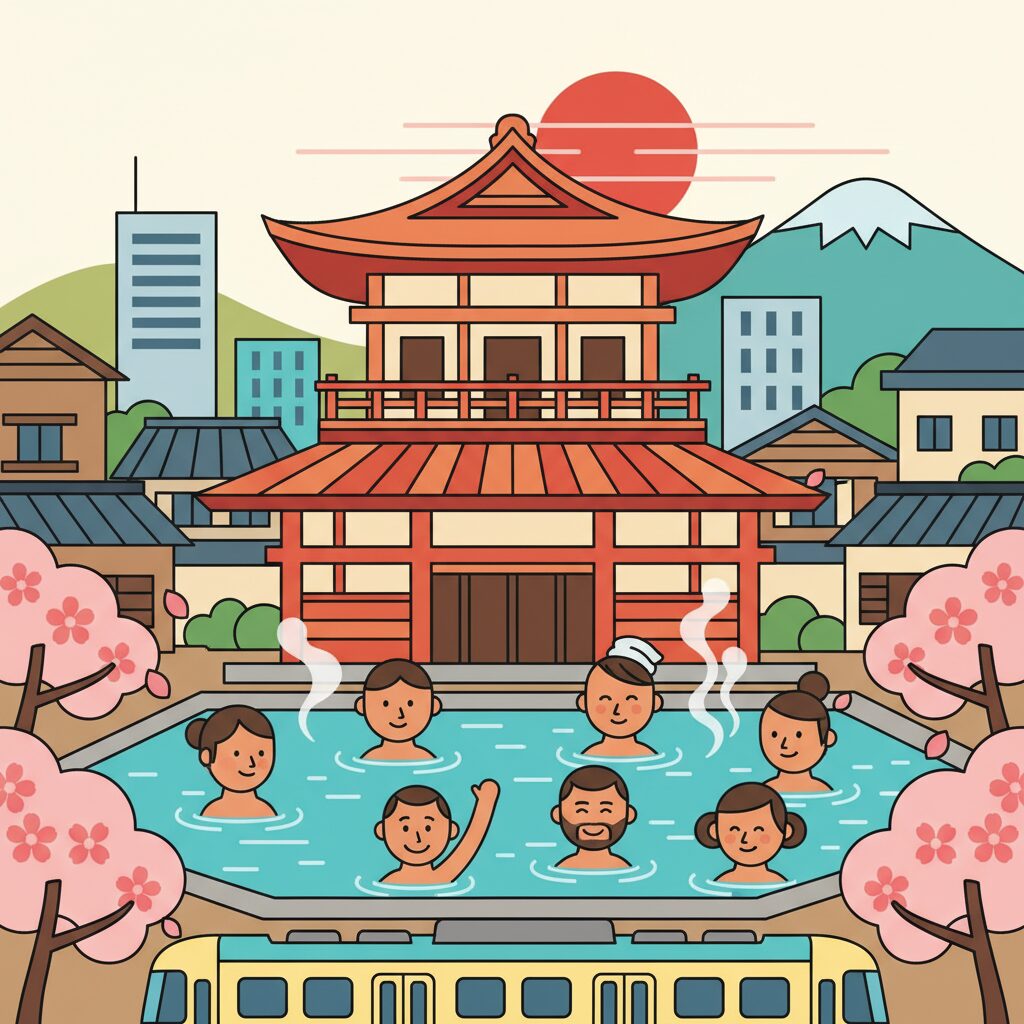
You see them tucked away on quiet side streets, their distinct high chimneys piercing the skyline of residential neighborhoods. A traditional tile roof, a warm light spilling from a sliding door marked with the unmistakable ゆ (yu) symbol for hot water. This is the local sentō, the public bathhouse. For many foreigners, the initial thought process is a simple one: it’s a kind of Japanese spa, a place for a deep, relaxing soak, maybe a touristy cultural experience to check off a list. You might even feel a little intimidated, a mix of curiosity and the nagging fear of breaking some complex, unspoken rule in a very, very vulnerable state. But stand outside one in Osaka for just a minute, especially around dusk. You won’t hear the serene, meditative silence you might expect from a spa. You’ll hear laughter. You’ll hear loud, boisterous chatter in the thick, fast-paced Kansai dialect. You’ll see neighbors arriving on bicycles, towels slung over their shoulders, greeting each other like they’re walking into a friend’s house. This isn’t a place of quiet contemplation. It’s the neighborhood’s living room, its social club, and its information nerve center, all rolled into one steamy, welcoming package. The common misunderstanding isn’t about the etiquette of washing or the temperature of the water; it’s about the very purpose of the place. Tourists come for the bath; locals come for the connection. In Osaka, the sentō is where the city’s heart beats, loud and clear.
Discover even more of Osaka’s unique communal energy by exploring shotengai banter, where vibrant street conversations further reveal the city’s spirited local culture.
The Unspoken Social Contract of the Bathhouse
In Japan, there is a concept called ‘hadaka no tsukiai,’ which literally means ‘naked communion’ or ‘naked relationship.’ The idea is that by removing your clothes, you also shed your titles, wealth, and social status. For a brief moment, the CEO and the part-time convenience store clerk become simply two individuals sharing the same hot water. It serves as a powerful cultural equalizer, a place where pretense vanishes within the steam. In most areas of Japan, this is a quiet, introspective experience, characterized by a mutual, unspoken understanding that allows for a comfortable shared silence. However, this is Osaka, and Osaka is anything but quiet. Here, ‘hadaka no tsukiai’ is an active, vocal, and participatory affair. The social contract goes beyond mutual respect; it entails mutual engagement. The dissolution of social hierarchy is not passive; it invites you to speak your mind, complain about your boss, boast about your children, or ask the person next to you about their interesting tattoo, all without the usual social filters. The sentō in Osaka follows the principle that if we are all equal in the nude, then we are all free to converse as equals. There is no need for formal introductions or the careful, hierarchical language that dominates much of Japanese society. In the sentō, you are not defined by your job title. You are simply a neighbor, a fellow city resident, and that alone is enough reason to start a conversation. This key difference often surprises many newcomers, both Japanese and foreign. They expect a peaceful retreat but find themselves in the midst of a lively, open town hall meeting where the only uniform is a small washcloth.
It’s Not a Spa, It’s the Local Information Exchange
The sentō functions less as a wellness center and more as a pre-digital, hyper-local fusion of Twitter, Facebook, and the evening news. The information shared here is the neighborhood’s lifeblood—a level of detailed insight you won’t find online or in any newspaper. It acts as a living, breathing archive of the community’s daily life, continuously updated in real-time by its most committed members.
The Gossip Mill and News Channel
Major headlines don’t matter here. The news that counts is exchanged within the echoing, tiled walls of the bathhouse. You’ll discover which local politician is making empty promises once again, which street is scheduled for repaving next week, and why the queue at the new bakery down the road is absolutely worth the wait. This is a steady flow of commentary, advice, and unfiltered opinion. You might overhear two elderly men debating the merits of different instant noodle brands with the gravity of world leaders negotiating trade deals. In the changing room, a group of mothers might share tips on the most patient pediatricians or the parks with the best playground equipment. This isn’t mere small talk; it’s essential, practical information that keeps the community functioning smoothly. Before deciding anything local—from choosing a butcher for your croquettes to selecting a trustworthy dry cleaner for a delicate sweater—the sentō provides the most reliable source of crowdsourced reviews. It’s the original five-star rating system, delivered with a characteristic Osaka frankness.
The Cross-Generational Bridge
Modern urban life often divides us by age. We work alongside our peers, socialize with them, and live in buildings that can sometimes feel anonymous. The sentō breaks down these generational barriers. It’s one of the rare places where a university student, a middle-aged salaryman, a retired grandfather, and a group of elementary school children all share the same space on equal footing. This is where implicit cultural knowledge is handed down. You might see a ‘nushi,’ an old bathhouse master who has come daily for fifty years, teaching a young father how to douse his child properly to avoid a shock from the heat. Grandmothers often offer unsolicited, yet surprisingly wise, life advice to young women concerned about their careers. This intergenerational interaction is essential, offering a sense of continuity and belonging that is increasingly uncommon. For the elderly, it’s a vital defense against social isolation. For the young, it’s a link to the history and identity of their neighborhood. It serves as a classroom where lessons about community, respect, and the simple art of sharing a moment with neighbors are taught.
Osaka vs. Tokyo: The Volume Gets Turned Up
If you’ve ever visited a sentō in Tokyo, you might believe you know what to expect. You’d likely be mistaken. The regional distinctions between Kanto (which includes Tokyo) and Kansai (which includes Osaka) are clearly evident in public baths. The experience is not just somewhat different; it’s fundamentally distinct in its sound, energy, and social customs.
The Sound of Silence vs. The Roar of the Tub
The typical Tokyo sentō experience is usually one of quiet solitude. People enter, wash, soak, and leave with minimal interaction. It’s a private moment within a public setting. The emphasis is internal—relaxing your muscles, clearing your mind, and enjoying the heat in peace. Speaking to a stranger is uncommon and may even be seen as a slight disturbance to the quiet, contemplative environment. Conversely, the Osaka sentō is the complete opposite. Silence is rare, not the norm. The atmosphere buzzes with energy. Friends catch up, strangers turn into acquaintances, and discussions about the Hanshin Tigers baseball team reverberate off the tiled walls. The expectation is not to keep to yourself, but to be open to interaction. A silent visitor might even be gently encouraged into conversation: “Hey, you’re not from around here, are you?” This is not meant to intrude; it’s a sign of inclusion. In Osaka, sharing a space means sharing conversation. The city’s characteristic lack of personal space extends to the sentō, where people are genuinely curious and see no reason why a shared bath shouldn’t foster a shared story.
The Art of the ‘Tsukkomi’ in the Nude
Osaka’s identity is deeply connected to its comedy culture, particularly the manzai style of stand-up involving a ‘boke’ (the silly fool) and a ‘tsukkomi’ (the sharp straight man). This dynamic is not limited to the stage; it’s the everyday rhythm of conversation, and the sentō is one of its main arenas. Someone will dramatically complain about their day (the ‘boke’), and another regular from across the tub will immediately fire back a witty, sarcastic response (the ‘tsukkomi’). For instance, a man might sigh heavily and say, “Ah, my wife is making me repaint the whole house this weekend.” From the jet bath, a voice responds, “That’s because she can’t stand looking at your face or those ugly walls!” Laughter follows. It’s a performance, a friendly verbal spar that builds social bonds through humor. This is almost unthinkable in a Tokyo bathhouse, where such an interruption would be met with awkward silence. In Osaka, it signals a healthy, engaged community. It’s a way of saying, “I see you, I hear you, and I’m involved enough in this shared moment to join in the fun.”
What Foreigners Get Wrong: It’s Not About Being ‘On Display’
For many non-Japanese people, the biggest obstacle to enjoying a sentō is the idea of public nudity. The concern is twofold: the personal discomfort of being naked around others, and the fear of being judged or scrutinized. This is perhaps the greatest cultural misunderstanding of all.
Overcoming the Nudity Hurdle
In the context of the sentō, nudity is completely non-sexual and highly practical. It is simply the necessary state to get clean. The reality is, no one is staring at you. They are not evaluating your body type, your scars, or your tan lines. People are too absorbed in their own routines, their aches and pains, and, most importantly, their conversations. The local regulars have seen it all before, countless times. A foreign body is, for a brief moment, a novelty, but that novelty fades in about five seconds. Afterward, you’re just another person trying to rinse soap out of their eyes. The best way to overcome self-consciousness is to observe the locals. They move with a casual, unthinking confidence. Their focus is on the task at hand—washing, soaking, relaxing. Adopt that practical attitude, and you’ll find your own anxieties quickly dissolve into the steam.
You’re a Guest, Not an Intruder
Another common worry is making a faux pas. What if I use the wrong stool? What if I accidentally splash someone? What if my Japanese isn’t good enough? While there are basic hygiene rules—mainly, washing your body thoroughly before entering the communal tubs—the social atmosphere in an Osaka sentō is far more forgiving than you might expect. In Tokyo, a mistake might be met with a silent, disapproving glance. In Osaka, you’re more likely to receive a loud, direct, but ultimately friendly correction. Someone might say, “Oi, brother! Scrub behind your ears!” or “Don’t bring that big towel in the water, use the little one!” It can seem blunt, but it comes from a desire to include you in the proper way of doing things, not to exclude you for being different. It’s their way of showing you the ropes. If you smile, say thank you, and follow their advice, you’ll quickly turn a potential embarrassment into a moment of connection. They’re not reprimanding an intruder; they’re helping a guest feel at home.
A Practical Guide to Your First Neighborhood Dip
So, how do you transition from a curious observer to an active participant? It’s less about following a strict set of rules and more about tuning into the social atmosphere. This isn’t a checklist for visitors, but rather a guide to navigating the warm, inviting environment of your local Osaka bathhouse.
Reading the Room (or the Steam)
Each sentō has its own distinct character. Some are quieter, modern ‘super sentō‘ attracting families and younger couples, while others are longstanding, well-used spots filled with a loyal group of elderly regulars. Before you even start undressing, take a moment to observe the atmosphere. Is the changing room bustling with lively conversation? Do you hear laughter coming from the bath? Are there groups of men gathered around the TV in the lobby? These indicate a highly social, classic Osaka sentō. If it’s more subdued, with people mostly keeping to themselves, then follow their lead. The key is to match the energy of the regulars—they set the tone, and being respectful of that is what makes a good guest.
Breaking the Ice, Osaka-Style
If you find yourself in a chatty sentō and want to join in, the barrier is very low. You don’t need a clever pickup line. The shared setting provides plenty to talk about. A simple remark to the person next to you, like “Ii oyu desu ne” (“This is nice hot water, isn’t it?”), works as a universal icebreaker. You can also comment on distinctive features of the bath, such as the ‘denki buro’ (electric bath), with a wry but lighthearted expression. In Osaka, straightforwardness is appreciated. Asking something like, “Is there a good place to grab a beer nearby after this?” is not only acceptable but often encouraged. It shows your interest in the neighborhood, something locals pride themselves on. Don’t hesitate to start a conversation; here, that’s often seen as a sign of confidence and friendliness.
The Post-Bath Ritual: The Real Social Hour
For many regulars, the bath itself is just the beginning. The main socializing happens in the ‘datsuijo’ (changing room) and the adjoining lobby. This is where the community truly comes alive. After drying off, people don’t immediately dress and leave—they linger. They sit on benches in their yukata, rehydrating with a cold bottle of fruit milk or a beer from the vending machine. They gather around the TV to discuss the news or a baseball game. They flip through the day’s newspaper, sharing stories with their neighbors. This is the cool-down phase, where conversations that started in the bath continue at a slower pace. Don’t rush this part. Grab a drink, find a seat, and simply listen. This is where you’ll gain the richest insight into the rhythm of community life. It’s the ultimate ‘third place’—not home, not work, but a vital gathering spot where everyone belongs.
The Sentō as a Window into Osaka’s Soul
Ultimately, the local sentō is far more than just a place to wash. It is a living, breathing institution that wholeheartedly embodies the spirit of Osaka. It’s practical and straightforward—you come here to get clean and unwind, not to be indulged. It is intensely communal, emphasizing the group experience over individual solitude. It’s loud, direct, and driven by a love of conversation and good-natured humor. Most importantly, it is deeply human, a space where people of all ages and backgrounds can connect on the most basic level. To understand the sentō is to understand why the cliché “Osaka people are friendly” is both accurate and incomplete. Their friendliness isn’t mere surface politeness; it stems from a culture of tight-knit, neighborhood-level interdependence nurtured in shared spaces like the public bath. It’s a culture that treasures the bonds formed in everyday life, through the simple, repeated act of sharing a hot bath and a good laugh with neighbors. So next time you pass by that old building with the tall chimney, don’t just see it as a bathhouse. See it for what it truly is: one of the last genuine bastions of urban community and a perfect reflection of Osaka’s warm, unfiltered, unapologetically social heart.