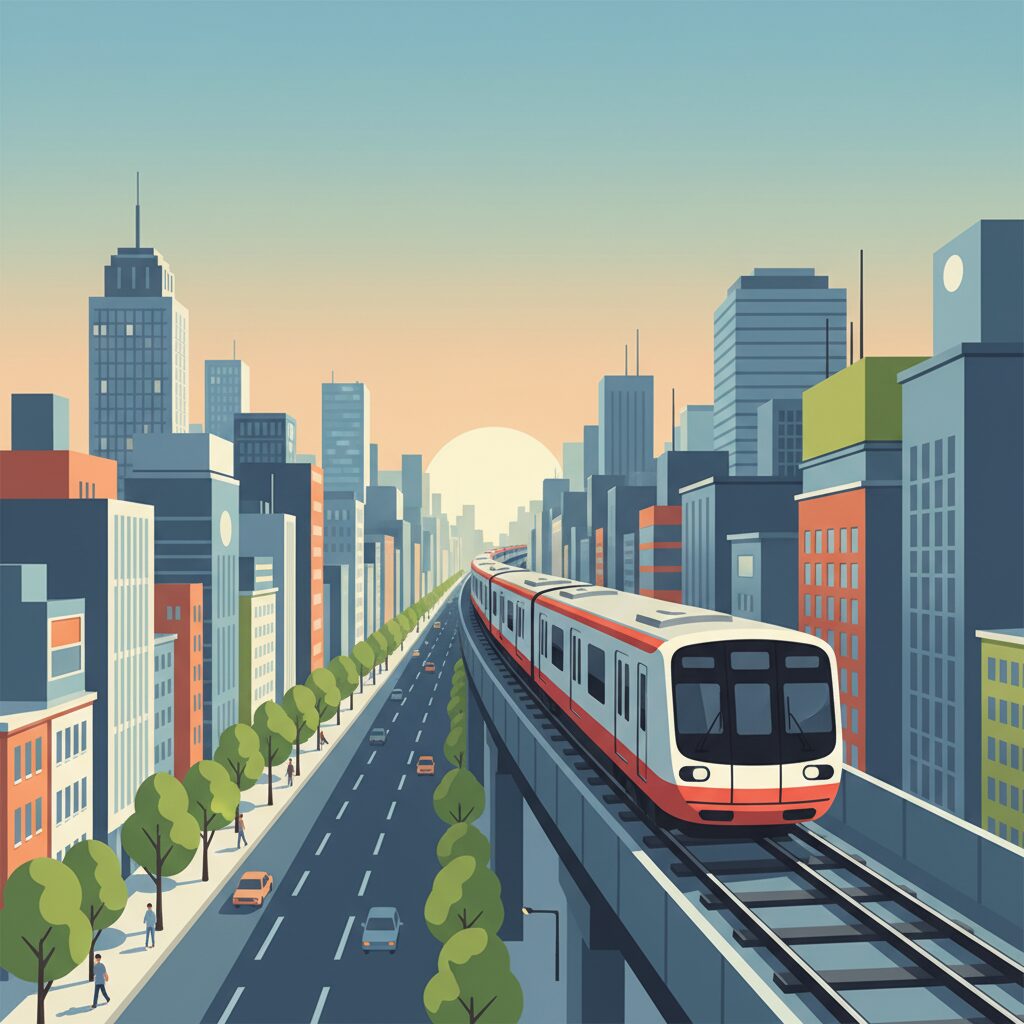
They call it the city’s artery, the big red line that slices Osaka straight down the middle. From the corporate calm of the north to the chaotic, vibrant pulse of the south, the Midosuji Line is more than just a subway. It’s a thirty-kilometer-long story. It’s a rolling, rumbling lesson in how this city works, how its people think, and why it feels so fundamentally different from the polished, reserved rhythm of Tokyo. Forget the tourist maps for a moment. If you really want to understand the soul of Osaka, you need to understand the human geography of its most important train line. This isn’t a guide to the best photo spots. It’s a decoder ring for the daily performance of Osaka life, one station at a time. You’ll see the city shift in real-time, the language getting thicker, the fashion getting louder, the invisible walls between strangers growing thinner with every stop heading south. It’s a journey from one version of Japan to another, all within the borders of a single, magnificent, and misunderstood city.
For a deeper dive into the city’s vibrant local scene, explore Osaka’s sentō culture where neighborhood baths double as true community living rooms.
Esaka and Shin-Osaka: The Functional Handshake

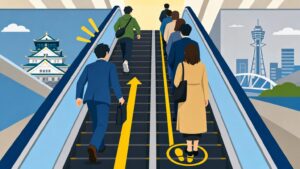
Our journey begins at the top, in the clean, crisp air of Esaka and the fleeting whirlwind of Shin-Osaka. This is Osaka’s gateway, its formal welcome mat to the rest of Japan. Shin-Osaka station, the city’s Shinkansen hub, is a place of purpose. People move with a clipped, efficient pace, pulling roller bags and clutching bento boxes. The dominant energy isn’t excitement; it’s transit. This isn’t where Osaka lives; it’s where it connects.
Nearby, Esaka is a neighborhood designed for the corporate soldier. It’s filled with the headquarters of major companies and residential blocks housing tanshin-funin—employees transferred by their companies, leaving their families behind. The vibe is professional, detached, and overwhelmingly practical. Restaurants cater to solo diners, and bars offer quick, after-work decompression rather than boisterous parties. This is the Osaka that values efficiency above all else. It directly reflects the city’s merchant DNA, where time is money and pleasantries come second to the deal. Foreigners often expect the loud, funny Osaka from TV the moment they step off the bullet train, but what they find here is a city that’s all business. This northern terminus is Osaka with its tie straightened and its game face on, a necessary but sterile handshake before the real introduction begins.
Umeda: The Gleaming Labyrinth of Ambition
Three stops south, and the world bursts open. Welcome to Umeda. If Shin-Osaka is the handshake, Umeda is the power suit. It’s a vast, multi-layered maze of interconnected stations, department stores, and office towers. They call it the ‘Umeda Dungeon’ for good reason. Navigating its underground corridors is a rite of passage, a challenge to decode the city’s chaotic logic. But this complexity isn’t a flaw; it mirrors Osaka’s relentless ambition.
Umeda is Osaka’s counterpart to Tokyo’s Shinjuku or Shibuya, but with its own unique local flair. The department stores—Hankyu, Hanshin, Daimaru—are more than places to shop; they are commercial empires, monuments to Osaka consumerism. Here, you witness the paradox of the Osaka mindset. People will fiercely haggle over a 100-yen discount at a market, yet proudly carry a 100,000-yen designer bag through the halls of Grand Front Osaka. It’s not about frugality; it’s about the thrill of a good deal and the pride in earned success. The fashion here sharply contrasts Tokyo’s understated chic. It’s bolder, brighter, and more individualistic. The infamous leopard print, the hyo-gara, is more than just a pattern; it’s a declaration of confidence. It says, ‘I’m here, and I’m unafraid to be seen.’ Umeda represents Osaka’s attempt to outshine Tokyo, building taller, shinier, and more intricate structures to assert its relevance. It’s a spectacle of prosperity—both exhausting and exhilarating.
Yodoyabashi and Honmachi: The Merchant’s Soul
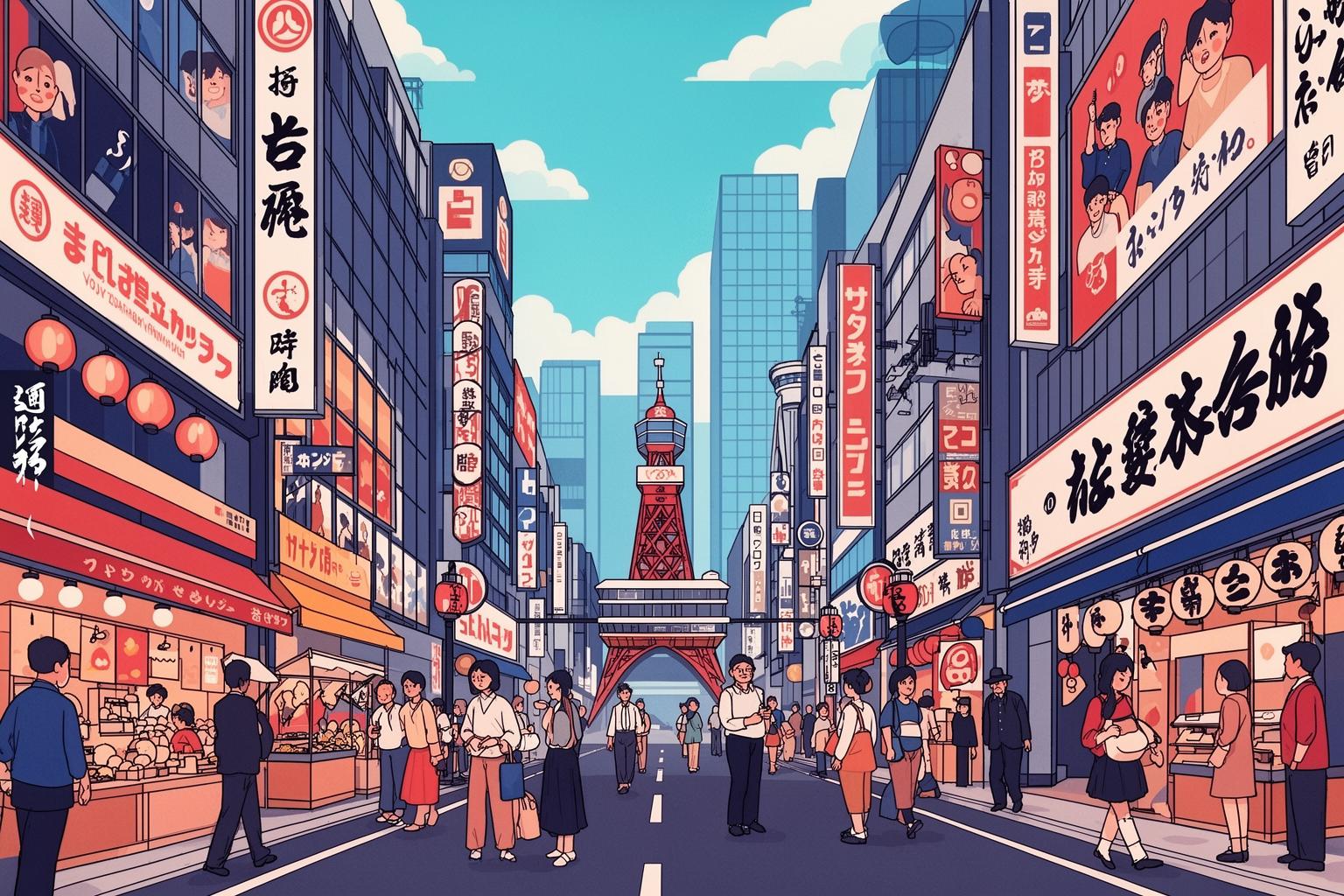
Just a short ride south, the sparkling facade of Umeda gives way to something more grounded and substantial. Yodoyabashi and Honmachi represent the historical heart of Osaka’s commerce. This is where the city’s wealth originated—not in gleaming towers, but in the trading houses and textile wholesalers that have lined these streets for centuries. The atmosphere shifts noticeably. The pace remains brisk, but it’s the deliberate stride of serious people conducting serious business. The architecture is a blend of stately, pre-war buildings, like the Osaka City Central Public Hall, alongside sober, functional office blocks.
This area reveals the true source of Osaka’s pride. People here don’t view themselves as second to Tokyo; rather, they see Tokyo as the seat of government and themselves as the driving force of the economy. The old merchant greeting, “Moukarimakka?” (Making money?), now somewhat of a cliché, stems from this mindset. It wasn’t a prying question; it was a gesture of camaraderie, an acknowledgment of shared purpose. In Honmachi, you can still sense this energy in the air—the scent of fabric from the wholesale shops, the sight of couriers weaving through traffic. People here are straightforward, their conversations cutting directly to the point. It’s a communication style forged through centuries of negotiation. This is the understated, powerful core of Osaka, a place that doesn’t need bright lights to proclaim its significance. It knows its own value.
Shinsaibashi: The Urban Catwalk
Cross the invisible line south of Honmachi, and you find yourself in Shinsaibashi, the city’s vibrant hub of youth culture and street fashion. This is where Osaka’s creative spirit runs wild. The covered shopping arcade, Shinsaibashi-suji, is a bustling river of people—a chaotic yet exhilarating flow of shoppers, students, and tourists. However, the true heart of the district lies a few blocks west in Amerikamura, affectionately known as ‘Amemura.’
While Tokyo boasts Harajuku with its carefully curated and often theatrical looks, Amemura feels more natural and lived-in. The fashion here is a raw, eclectic blend of vintage, streetwear, and pure self-expression. It’s less about fitting into a particular subculture and more about crafting a distinctive personal style. The renowned Osaka directness shines through as well. People openly give and receive compliments—strangers might stop you and say, “Sono fuku, meccha ii yan!” (Those clothes are awesome!). It’s not a flirtation, but an honest, spontaneous show of admiration. This sets it apart from other Japanese cities, where such direct interaction with strangers is uncommon. Shinsaibashi is a vibrant gallery of Osaka’s individuality, a place where being different is not just accepted but celebrated.
Namba: The Glorious, Beating Heart of ‘Kote-Kote’
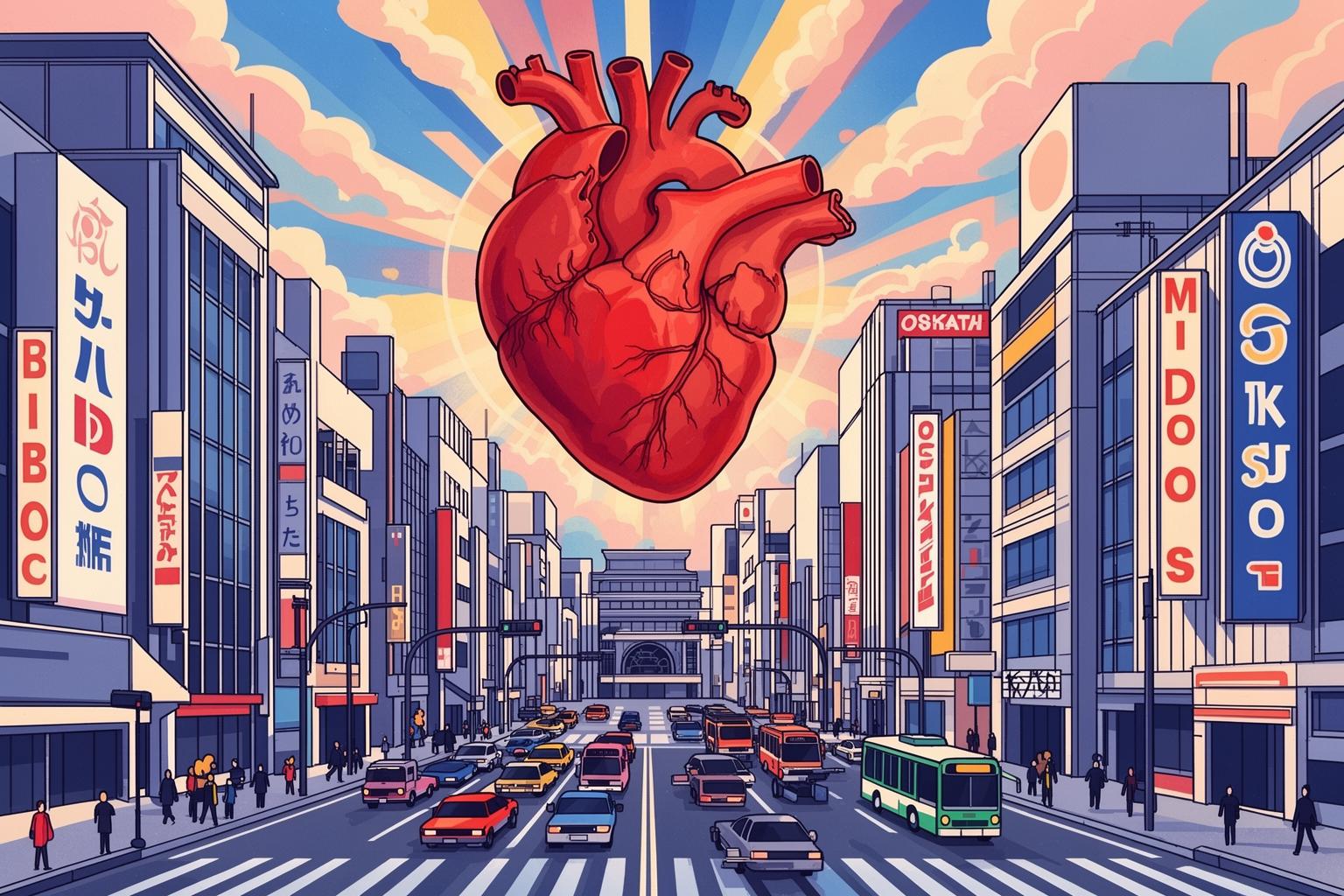
If the Midosuji Line serves as a major artery, then Namba station is the heart that pumps energy throughout the entire city. Stepping into the Dotonbori area is a full sensory bombardment. The enormous mechanical crabs, the towering Glico Running Man sign, the lively calls of barkers, and the music—all converge here in the vibrant core of kote-kote Osaka. Kote-kote is a term that resists simple translation. It means thick, rich, heavy, and perhaps a bit gaudy. It describes a flavor profile, but it also represents an aesthetic and an attitude. It stands in stark contrast to the subtle, minimalist wabi-sabi style often associated with Japan.
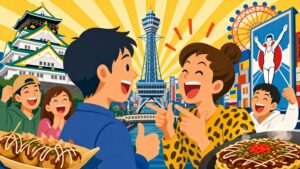
Namba is where the image of the friendly, humorous Osakan is shaped amid the heat of takoyaki grills. The renowned Osaka dialect, Osaka-ben, is spoken here as the native language. It’s quicker, more melodic, and more direct than standard Japanese. The style of communication is almost a performance. Ordering food from street vendors often involves playful banter, light teasing, or shared laughter. A foreigner’s attempt to speak Japanese, regardless of how flawed, is usually met not with polite tolerance but with enthusiastic participation and good-natured corrections. The well-known phrase “Nandeyanen!” (roughly translating to ‘What the heck!’ or ‘Why!’) is frequently used as a comedic punchline, serving to ease tension and create instant rapport. Many outsiders mistakenly interpret this directness and humor as loud or even rude, but this reflects a misunderstanding of the cultural context. In Namba, communication goes beyond exchanging information; it’s about forging connections and entertaining.
Dobutsuen-mae: The Unvarnished Truth
Just one stop south of Namba’s neon-lit dream lies a contrasting world. Exiting at Dobutsuen-mae station brings you to the doorstep of Shinsekai, a neighborhood seemingly frozen in the mid-20th century. Dominated by the nostalgic Tsutenkaku Tower, Shinsekai reveals Osaka with its facade stripped away. It’s gritty, worn, and profoundly authentic. This is the city’s working-class heart, a place filled with inexpensive kushikatsu eateries, smoky pachinko parlors, and elderly men sipping tea while playing shogi on the sidewalks.
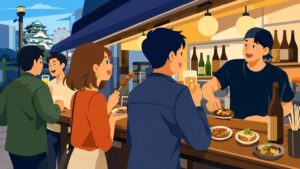
This area, along with the nearby Airin district, showcases a side of Japan often unseen by tourists and even many locals. It’s a place marked by poverty, day laborers, and those living on society’s edges. Yet, it’s also a space of intense pride and strong community bonds. The culture of senbero (getting tipsy for 1,000 yen) thrives here, creating a spirit of camaraderie in standing-only bars. Overlooking this part of the Midosuji Line is to overlook the very foundation of the city’s prosperity. Osaka’s renowned pragmatism and passion for a good bargain aren’t mere cultural traits; for many, they are essential survival tactics. This station stands as a necessary, sobering contrast to the northern glamour. It reminds us that Osaka is a real city with genuine challenges, not just a caricature from a comedy show.
Tennoji: The City at a Crossroads
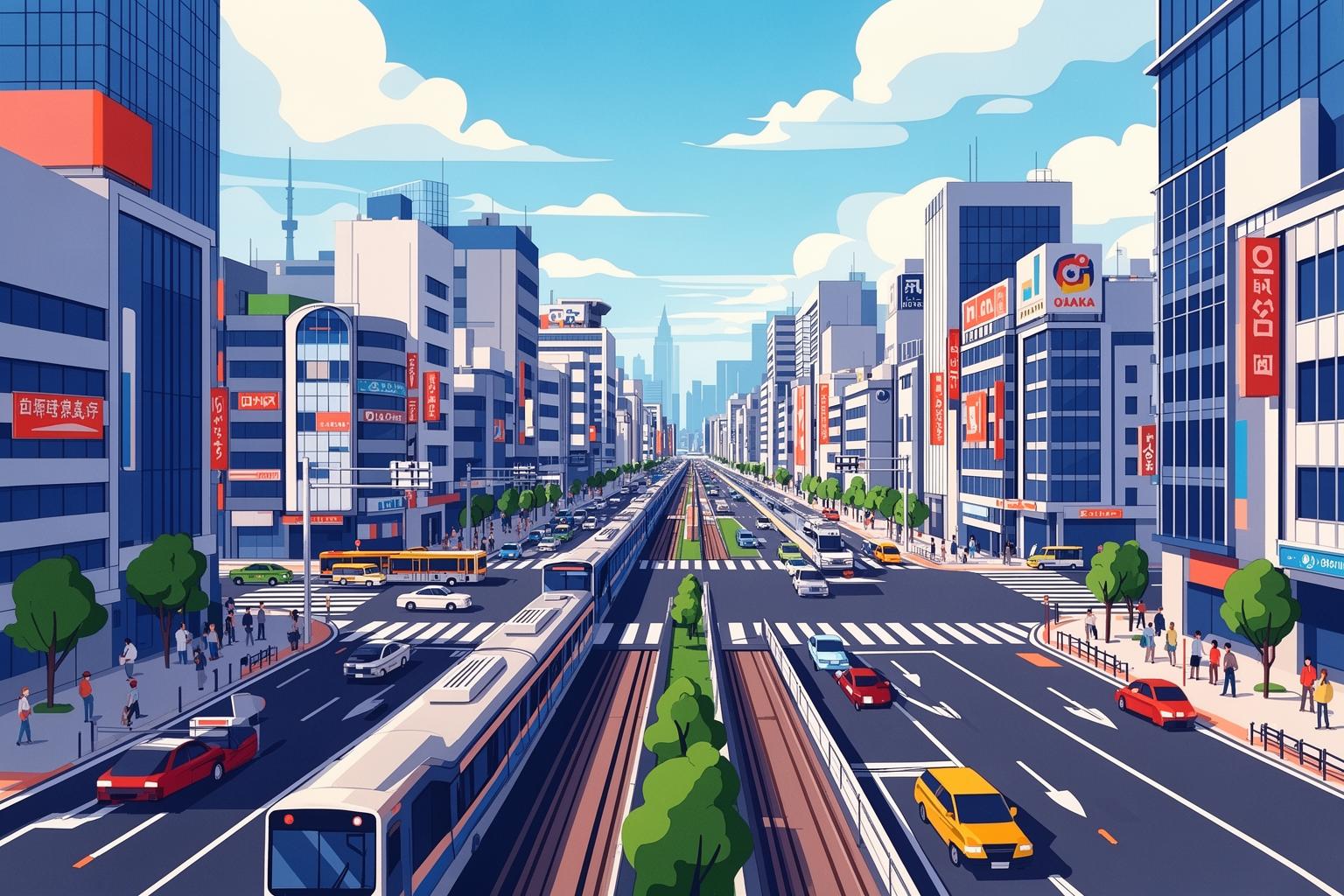
Tennoji is where the many facets of Osaka converge and coexist. It’s a remarkable blend of the ancient and the ultra-modern. Here, you can stand within the tranquil grounds of Shitennoji, one of Japan’s oldest Buddhist temples, and look up at the sleek, futuristic spire of Abeno Harukas, the tallest skyscraper in the country. The station itself is a lively hub, but the crowd differs from that of Umeda or Namba. It’s a mix of families heading to the zoo, devoted grandmothers visiting the temple, teenagers shopping at the Mio complex, and salarymen transferring to other train lines.
This station perfectly exemplifies Osaka’s relationship with its own identity. Unlike Kyoto, which can sometimes feel like a museum, Osaka doesn’t preserve its history in amber. It lives alongside it, builds upon it, and embraces the messy contradictions that arise. The city respects its past but is not bound by it. It’s constantly striving, reaching for the future (quite literally, with Abeno Harukas), while keeping its roots firmly grounded. Tennoji feels like the most ‘complete’ neighborhood on the line, a microcosm of the entire city’s demographic and historical sweep. It’s where the high-energy commercialism of the city center begins to mellow into the more residential character of southern Osaka.
Nakamozu: The Suburban Exhale
At last, the red line reaches its southern terminus: Nakamozu. The train empties, the noise diminishes, and the city’s rhythm transforms completely. This is suburban Osaka. The scenery transitions from towering concrete structures to expansive apartment complexes (danchi) and modest single-family houses. Life here revolves not around massive commercial centers, but around the local shotengai (shopping street), the neighborhood park, and school sports day.
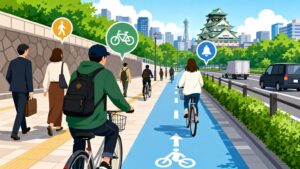
This is where most of Osaka’s population lives their daily lives, removed from tourists and the downtown bustle. It’s a world of bicycles, mothers chatting outside the supermarket, and the evening chime signaling children to return home. Traveling the train all the way to the end reveals a core truth about Osaka: despite its loud, boisterous, and chaotic public persona, at heart it is a city of close-knit communities and strong family values. The energy and ambition driving the city center are supported by the millions living quiet lives here. This is the city’s exhale—the place where the show ends and genuine, everyday life begins.
The journey on the Midosuji Line, from the professional north to the passionate south, is a passage through Osaka’s social and psychological layers. The city is not a singular entity; it is a spectrum. It is the ambitious salaryman in Umeda, the sharp-witted shopkeeper in Namba, the proud historian in Tennoji, and the young family in Nakamozu. The bluntness that may seem startling is a means of connection. The fixation on a good bargain is a legacy of its merchant past. The humor serves as both a shield and social lubricant. To truly grasp Osaka, you don’t need a guidebook—you just need a train ticket. Ride the red line from one end to the other. Observe the changing faces. Hear the shifting language. Sense the ebb and flow of energy. You’ll leave the station with not only a better sense of direction but a deeper understanding of the brilliant, complex, and profoundly human city that is Osaka.