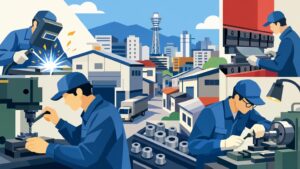
Forget the gleaming glass towers of Umeda, forget the neon-drenched canyons of Namba. To truly understand the engine that powers Osaka, you need to head east. You need to go to a place where the air smells of cutting oil and ionized metal, where the soundtrack of the city isn’t a train announcement, but the rhythmic clang and whir of a thousand lathes, presses, and mills. Welcome to Higashi-Osaka, the undisputed heartland of Japanese manufacturing, a sprawling city-within-a-city composed almost entirely of machikōba—small, often family-run factories.
From a distance, it’s a landscape of low-slung, unassuming buildings, more function than form. But as a photographer, I learned to see the poetry in these places. The way afternoon light streams through a dusty window, illuminating floating metal particles like constellations. The gnarled, knowing hands of a third-generation craftsman, capable of measuring tolerances by feel alone. This isn’t the slick, automated, Six Sigma world of corporate Japan you see in brochures. This is something older, grittier, and in many ways, more personal. It’s a world built on skill, sweat, and a professional culture that feels worlds away from the buttoned-up norms of Tokyo. So, what does it actually feel like to work here? What is the mindset that allows a tiny workshop with five employees to produce a critical component for a bullet train or a deep-sea submersible? It’s a culture of intense pride, radical pragmatism, and a community spirit that turns a collection of workshops into a single, formidable industrial force.
For those aiming to forge a promising future amidst hands-on innovation, our guide to career opportunities in Higashi-Osaka offers a wealth of insights into navigating this dynamic manufacturing hub.
The Machikōba Mindset: More than Just a Job
Working in Higashi-Osaka means embracing an alternative definition of success. Here, success isn’t measured by stock prices or corporate titles but by the tangible quality of the item in your hand. This philosophy, called monozukuri—the art and spirit of making things—forms the foundation of the entire culture. It reflects a profound and enduring belief in the intrinsic value of creation itself.
Pride in the Product, Not the Brand Name
In Tokyo, a common question at social gatherings is, “Which company do you work for?” Your identity is tied to your employer’s prestige—Mitsubishi, Sony, Toyota. In Higashi-Osaka, that question hardly matters. Instead, the real question is, “What do you make?” The pride isn’t in the logo on your business card; it’s in the perfectly threaded screw, the precisely balanced gear, the incredibly thin sheet of polished metal. A factory owner might produce a tiny, unbranded part essential for a world-renowned camera, but their satisfaction comes from the flawlessness of their own product, not where it ends up. This fosters a culture of intense focus and specialization. You’re not a salaryman climbing the corporate ladder; you’re a master of a particular craft, and your reputation depends on every single piece that leaves your workshop.
“Yatteminahare”: The Spirit of Trying Anything
A well-known Osaka dialect phrase, “yatteminahare,” roughly means “Just give it a shot!” It embodies a spirit of bold, sometimes reckless, experimentation that thrives on the factory floors of Higashi-Osaka. While large Tokyo corporations may spend months in meetings analyzing risks and creating detailed project plans, the machikōba approach is to fire up the machine and try. This makes them extremely agile. They are the go-to specialists for prototypes, custom one-off jobs, and complex challenges that larger companies consider too inefficient or risky. I once photographed a small workshop tasked with making a bizarrely shaped metal part for a contemporary artist’s sculpture. No big firm would take it on. The owner, a man in his late sixties, smiled and said, “Looks impossible. Let’s figure it out.” That’s the yatteminahare spirit—a confidence born not from theory, but from decades of hands-on problem solving.
A Community of Specialists
No single machikōba handles everything. The true strength of Higashi-Osaka lies in its dense, interconnected ecosystem. One factory cuts the raw metal, another down the street bends it, a third plates it, and a fourth polishes it. They are all independent businesses, yet work with seamless, almost telepathic coordination. This is not a formal, top-down supply chain but a community built on decades of personal relationships, shared trust, and mutual reliance. If a machine breaks down at one shop, the owner of another will arrive with a spare part or helping hand, no questions asked. They compete for business but also recognize that their collective success depends on the health of the entire network. This creates a collaborative atmosphere fundamentally different from the internal rivalries and departmental silos typical of large corporations.
The Rhythm of the Workshop: Daily Life and Communication
The daily rhythm of a Higashi-Osaka workshop contrasts sharply with the quiet atmosphere of a Tokyo office. The sensory experience is instant and intense, and the manner of communication is shaped by its surroundings. It’s a place where actions speak louder than words, and clarity takes precedence over politeness.
The Morning Begins with a Roar, Not an Email
The workday doesn’t start by logging onto a computer; it starts with the thunderous sound of steel shutters rolling up throughout the neighborhood. Inside, the first task is awakening the machines. The air becomes filled with the hydraulic hiss and mechanical groan of equipment coming alive. Communication must be direct and efficient to be heard above the noise. There are no lengthy morning meetings with PowerPoint presentations. Instead, a foreman might shout instructions over a running press, using a mix of hand signals and brief phrases. Problems are spotted and solved immediately, often gathered around the machine itself, with quick, practical sketches made on scrap wood or a greasy notepad. It’s a culture of prompt action, where endless discussion is viewed as a waste of valuable production time.
The Unspoken Language of Craft
Much of the knowledge in these workshops is implicit, passed down through generations not via manuals but through observation and hands-on experience. A seasoned machinist can identify an issue with a CNC mill simply by a subtle shift in its vibration or the tone of its noise. A welder can assess the strength of a seam from the color and sound of the arc. This is a world of minarai—learning by watching. For a newcomer, especially a foreigner used to explicit, step-by-step instructions, this can be very frustrating. You are expected to observe, anticipate, and learn through doing. Your value is demonstrated not through what you say but through your ability to eventually replicate the master’s movements and instincts. Gaining trust here is a gradual process, based on showing skill and quiet dedication to the craft.
Frankness Over Formality: How Osaka People Talk Business
Osaka’s reputation for straightforwardness is well-known, and in the machikōba, it is a professional necessity. There is little time for the elaborate verbal interplay of tatemae (public face) and honne (true feelings) that often characterizes business negotiations in Tokyo. Here, conversations are brutally efficient. When discussing a potential job, the questions are blunt: “How much? When do you need it? Can we do it?” A “yes” is a solid commitment, and a “no” is a quick, definitive answer, often accompanied by a clear explanation of why it’s not possible. To outsiders, this can seem abrupt or even rude. But within the culture, it is a form of respect. It honors the client’s time and the workshop’s own capabilities. This Naniwa no akinai (Osaka merchant style) is about reaching a clear, honest understanding as quickly as possible so everyone can return to the real work.
Bridging the Gap: What Foreigners Often Misunderstand
For anyone entering the world of Higashi-Osaka from the outside, the initial impression can be deceiving. The visual cues and social norms differ so much from a typical corporate environment that it’s easy to misread what you’re observing. Grasping the logic behind the apparent disorder is essential.
“It Looks Old, Not Outdated”
My early visits to these workshops were startling. I encountered machinery dating back to the Shōwa era, floors stained from years of oil, and walls crowded with what seemed like a random collection of tools and parts. The Western mindset, conditioned to associate newness with efficiency, might quickly write off such a place as outdated. This is a serious misconception. That 50-year-old press isn’t old; it’s well-seasoned. It has been carefully maintained, customized, and refined by the same family over generations to excel at a specific task far better than any modern, off-the-shelf machine could. The “clutter” actually represents a highly personalized system of custom jigs, templates, and spare parts—a physical archive of solutions to past challenges. The innovation here isn’t flashy technology; it lies in the deep, accumulated expertise of pushing materials and machines to their absolute limits.
The Blurring Lines Between Work and Life
In many machikōba, the factory is directly attached to the family home. The president (shachō) isn’t an executive tucked away in a corner office; he works on the factory floor in a grease-stained uniform, operating machines alongside his employees. His wife may handle the accounting from a small desk in the corner, and lunch is often a communal event, with everyone eating together amid the tools of their trade. This blending of work and life can be unsettling for those used to a rigid separation. The hierarchy is flat and informal. The boss might join the team for drinks at a local izakaya after work, and conversations easily shift from production schedules to family matters. This isn’t unprofessionalism; it’s the fabric of the community. The business is an extension of the family, and employees are treated as part of that extended unit, with all the loyalty and mutual obligations that entails.
“Why Are They Asking About My Family?”
In a typical Tokyo business meeting, the conversation remains strictly professional, centered on exchanging business cards and discussing objectives formally. In Higashi-Osaka, however, the first ten minutes might be spent on questions that feel personal. “Where are you from? Are you married? Do you like baseball?” This isn’t idle gossip or nosiness. It’s a vital part of the Osaka business process: establishing a human connection. Business here is done between people, not corporations. Before they can trust your company, they need to trust you. They want to understand who you are as a person. This emphasis on building personal relationships is fundamental. A deal might be closed not on the fine print of a contract but through a shared laugh and handshake, because the underlying relationship has been solidly established.
The Future of Monozukuri in Higashi-Osaka
It’s easy to romanticize these workshops as relics from a bygone industrial era, but that would be misguided. The spirit of monozukuri in Higashi-Osaka is dynamic; it is continually evolving, adapting, and reaching for the stars—sometimes literally. Although the culture faces challenges, it also presents unique opportunities to those willing to embrace its traditions.
From Screws to Satellites
To witness the ambition of Higashi-Osaka, consider the story of the Maido-1 satellite. In the early 2000s, a group of factory owners, frustrated by the reputation of their work as low-tech, set out to prove their capabilities. A consortium of small companies came together to build their own satellite, successfully launching it into orbit in 2009. This remarkable achievement showcased their collective skill, precision, and bold yatteminahare spirit. This represents the modern face of the machikōba. While they continue producing the world’s finest screws and bolts, they are also applying their expertise to aerospace, medical devices, and advanced robotics. They are masters of the micro, leveraging their deep material knowledge to innovate at the highest levels.
The Challenge of Succession and the Role of Newcomers
The most urgent threat to this ecosystem is the kōkeisha mondai—the succession problem. As the master craftsmen from the baby boomer generation approach retirement, many have no heirs to take over their businesses. Often, their children have chosen white-collar careers in urban areas. This situation creates both a crisis and a remarkable opportunity. These are viable, profitable businesses with world-class expertise in need of fresh leadership. For a motivated outsider, including a non-Japanese individual with the right technical skills and cultural humility, this offers a path to ownership and influence that is nearly unattainable in the rigid corporate world. A newcomer who shows genuine respect for the craft, a willingness to adopt the Osaka way, and a commitment to the community can be welcomed and entrusted with great responsibility.
Finding Your Place in the Engine Room
Working in Higashi-Osaka is not suited for everyone. It requires resilience, patience, and an appreciation for a form of professionalism that isn’t measured by spreadsheets or presentations. It’s a world that values tangible skill over credentials, directness over diplomacy, and community loyalty over corporate ambition. It’s loud, intense, and built on a foundation of unwritten rules and deep relationships. But for those drawn to the act of creation, who find fulfillment in making something real and perfect with their own hands, it offers a highly rewarding career. It’s an opportunity to step away from the abstract world of the modern office and become an essential part of the roaring, grinding, and relentlessly innovative engine of Osaka itself.