
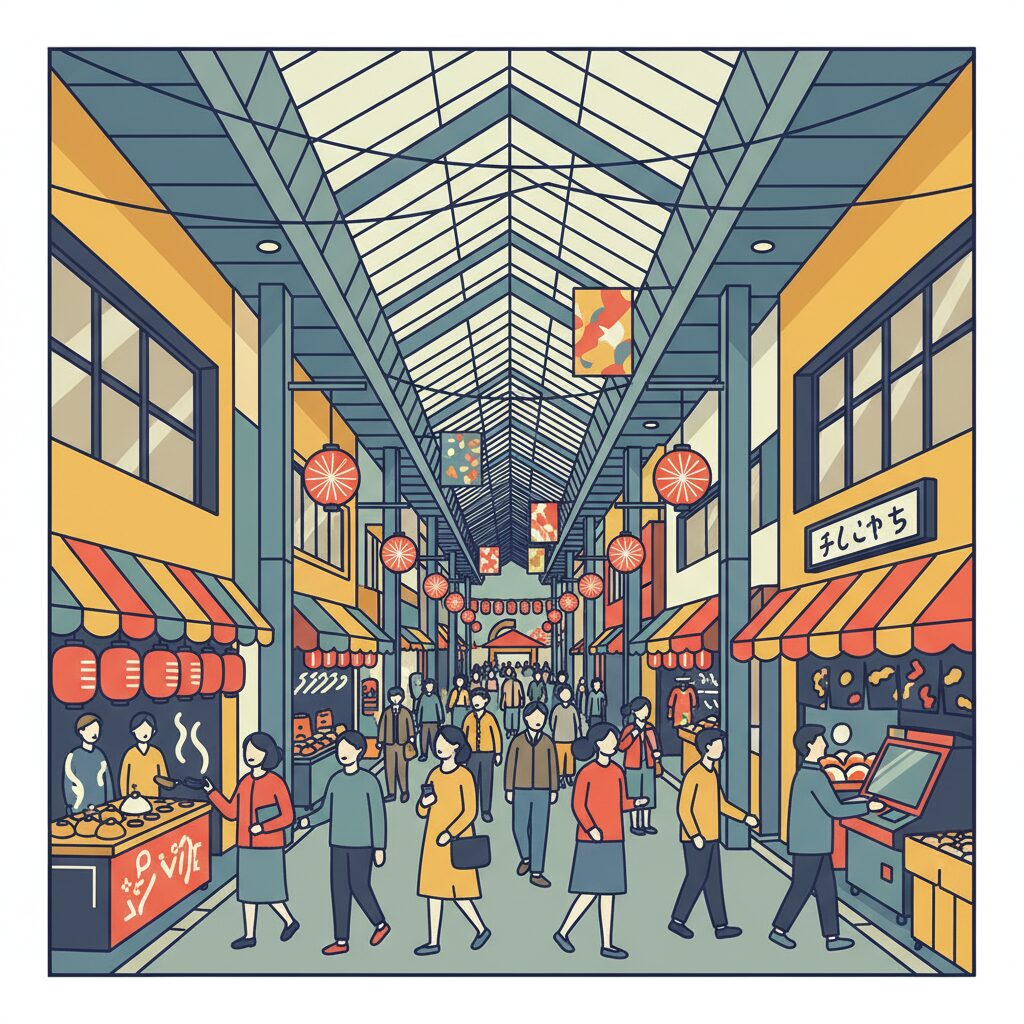
You’ve seen them, of course. The covered arcades, the shotengai, stretching like long, tiled arteries through Osaka’s neighborhoods. From a distance, they might look like just a practical solution to Japan’s rainy seasons, a slightly worn-down version of a shopping mall, a relic from a time before convenience stores colonized every corner. You might wander through, snap a photo of the paper lanterns or the colorful banners, buy a takoyaki, and think you’ve understood it. But that’s like looking at a photograph of the ocean and thinking you understand the tide. The shotengai isn’t just a place to buy groceries. It’s the city’s living room, its kitchen, and its unfiltered social media feed, all rolled into one noisy, delicious, and intensely human package. It’s where the unwritten rules of Osaka life are practiced, performed, and perfected every single day. Forget the quiet, minimalist aesthetic you might associate with Japan. Here, life is loud, transactions are personal, and the space between vendor and customer is a stage for a daily drama of banter, bargaining, and belonging. To understand the shotengai is to get a direct line to the city’s beating heart, a rhythm that feels fundamentally different from the polished, polite pulse of Tokyo. This isn’t a museum of old-timey commerce; it’s a living, breathing organism, and once you learn its language, you’ll never see it as just a market again.
Osaka’s vibrant streets continue their lively narrative into the early hours, where a distinctive morning service culture sets the stage for each day’s unfolding drama.
The Shotengai as a Social Stage
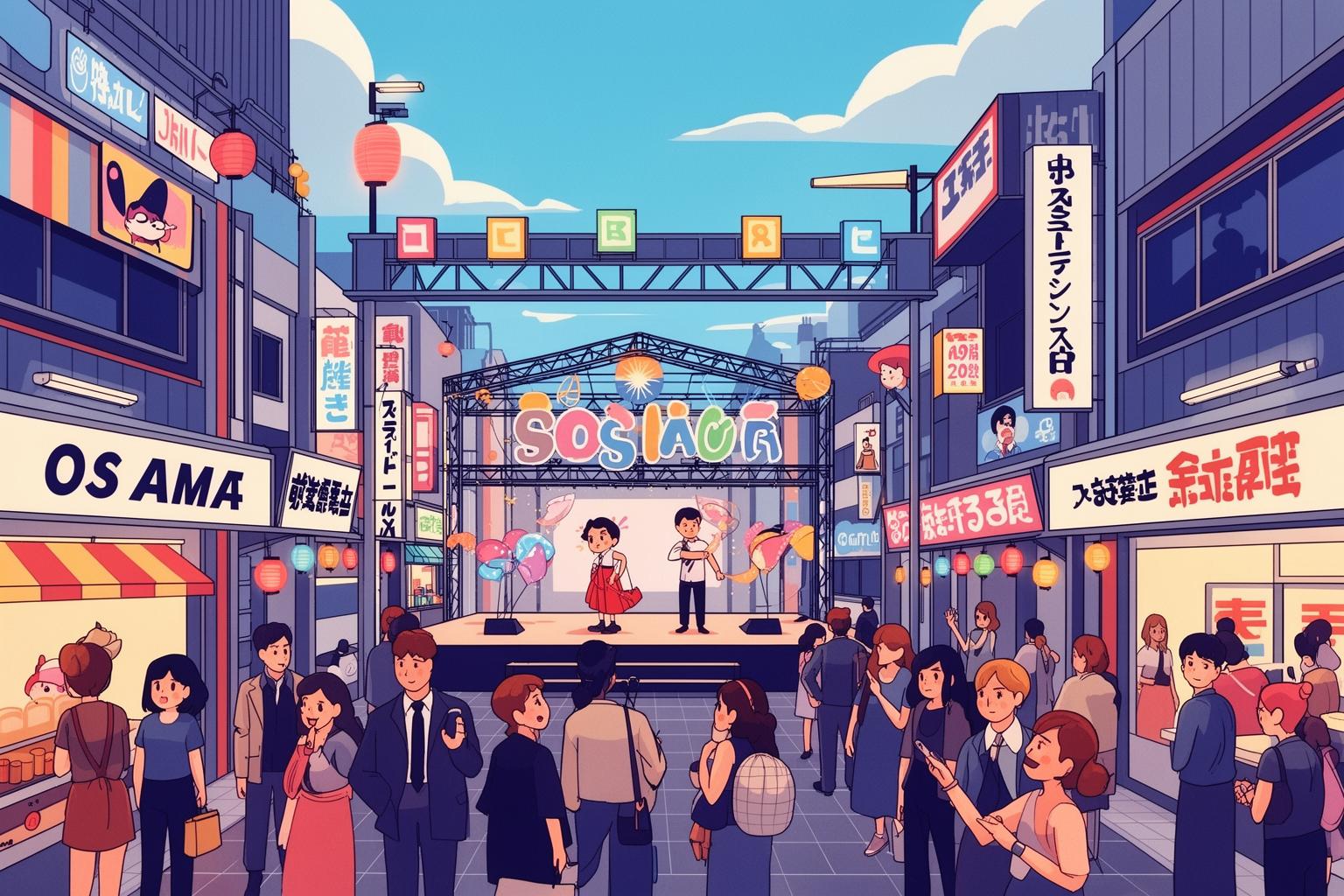
Step into a shotengai, and the first thing that strikes you isn’t a product, but a sound. It’s a barrage of noise, a symphony of overlapping conversations, vendors shouting, pans clattering, and the constant rumble of bicycle wheels on tile. This isn’t mere background noise; it’s the main attraction. In Osaka, commerce is a dialogue, and the shotengai serves as its grand stage. Every interaction, no matter how trivial, is a chance for connection, a performance unfolding for an audience of neighbors and passersby.
The Art of the Daily Banter (and Why It’s More Than Small Talk)
In many places around the world, and especially in Tokyo, shopping is a quest for efficiency. You come in, get what you need, and leave. The exchange remains silent, polite, and anonymous. In an Osaka shotengai, that same transaction marks the beginning of the show. The greengrocer isn’t just waiting for you to pick your daikon radish—he’s shouting, a booming proclamation to the entire arcade: “These tomatoes are sweet today, a real bargain!” This is more than advertising. It’s an icebreaker, an open invitation. He’s setting the topic for conversation across the street.
A customer, usually an older woman with a shopping cart, will wander over and challenge him. “Sweet, you say? Sweeter than yesterday? You said the same thing yesterday!” This isn’t a complaint; it’s a cue. The grocer laughs, a deep, hearty sound. “Ah, but today they’re even sweeter! My wife said so herself, and she’s my toughest critic!” This is the rhythm. A playful, continuous back-and-forth that strengthens bonds. It’s a type of verbal sparring rooted in the comedic duo tradition of `boke` (the silly one) and `tsukkomi` (the straight one). The shopkeeper plays the `boke`, making a slightly exaggerated claim, and the customer delivers the `tsukkomi`, a witty, corrective retort. Joining in, even with a simple laugh or brief comment, signals that you belong. A silent, smiling customer can feel stranger here than one who good-naturedly debates the price of mackerel. To outsiders, the loudness and directness might seem startling, but it’s seldom hostile. It’s the sound of a community checking in, exchanging information, and strengthening ties through shared language and laughter.
“Maido!” and “Oki ni!”: The Osaka Welcome Mat
As you stroll through the arcade, you’ll hear two phrases repeated like a chant: “Maido!” and “Oki ni!” You won’t hear them nearly as often in Tokyo, where the polished, formal “Irasshaimase!” (Welcome!) and “Arigato gozaimasu!” (Thank you!) reign supreme. These Osaka expressions are fundamentally different in their intent and vibe. “Maido” literally means “every time,” but it carries much more weight. It’s shorthand for “Thank you for your continued patronage.” It acknowledges an ongoing relationship. When a shopkeeper says “Maido!” to you, they mean, “I see you. I remember you. You belong here.” It transforms an anonymous purchase into a moment of recognition.
“Oki ni” is the flip side. While it means “thank you,” it exudes a warmth and casualness that `arigato` often lacks. It’s closer to saying “Much appreciated!” It’s the kind of thank you shared among friends. Using it yourself as a customer is a small but meaningful gesture. Responding to a shopkeeper’s “Maido!” with your own cheerful “Oki ni!” closes the social circle. It shows that you understand the local language and, more importantly, the local spirit of warmth and mutual appreciation. These are not just words; they are the verbal glue of the shotengai, turning a row of shops into a community of neighbors.
The Unspoken Economics of Neighborhood Life
The financial transactions in a shotengai follow a different logic than those in a modern supermarket. The aim isn’t simply to maximize profit per square foot. Instead, it’s about creating a sustainable, long-term ecosystem of loyalty and trust. This economy is built on faces, not data points; on relationships, not reward cards. It runs according to a set of unwritten rules that can be puzzling to outsiders.
The Power of the “Omake” (The Little Extra)
One of the most treasured traditions of the shotengai is the `omake`, which means a little something extra—a bonus or a gift. You buy three croquettes, and the lady behind the counter includes a fourth with a wink and a “This one’s for you.” You buy a bag of oranges, and the fruit vendor adds an extra as he weighs them. This isn’t a sale or a discount. It’s a deeply social gesture. The `omake` is a tangible expression of the shopkeeper’s goodwill, a way of saying “Maido!” without words. It conveys appreciation for your loyalty far more effectively than any punch card.
For a foreigner, receiving an `omake` can be a rite of passage. On your first few visits, you are just another customer—you pay the price and receive your goods. But as you become a familiar face and start engaging in friendly banter, a change occurs. When you get your first `omake`, it’s a sign. It means you’ve moved from “customer” to “regular.” You’ve become part of the ecosystem. The crucial rule for outsiders is this: you never, ever ask for an `omake`. It’s a gift, and requesting one completely misses its purpose. Asking breaks the social grace of the gesture. The `omake` must be freely given, a spontaneous act of generosity that strengthens the invisible ties within the community.
Price Haggling: A Delicate Dance, Not a Battle
Osaka is often reputed as a city of merchants where everything is negotiable. This is a risky oversimplification. Walking into a shotengai and trying to haggle over every item will get you nowhere quickly. It’s regarded as rude and ignorant. Genuine Osaka-style haggling is a subtle art, practiced only in certain contexts and with a keen understanding of the social dynamics. It’s not about aggressively lowballing a vendor to save a few yen, but rather a playful negotiation rooted in relationships.
You wouldn’t haggle over a bottle of soy sauce or a pre-packaged bento. But if you’re at an independent fish stall late in the day, buying several items, you might smile and say, “Chotto makete kureru?” (“Can you give me a little discount?”) This is the opening move in a dance. The vendor might sigh theatrically, grumble about slim margins, and then either reduce the price slightly or, more likely, give you an `omake` instead. The exchange is light-hearted. The aim isn’t to win a financial battle but to participate in a ritual that strengthens your friendly relationship. It’s a discussion about value, not just price. For foreigners, this is advanced-level practice. The best advice is to observe and listen. Learn how locals do it. Until you’ve built a genuine rapport with a vendor, it’s best to pay full price and focus on cultivating the relationship first. The deals will come, but they’ll take the form of an `omake`, not a hard-fought discount.
A Sensory Map of Daily Routines
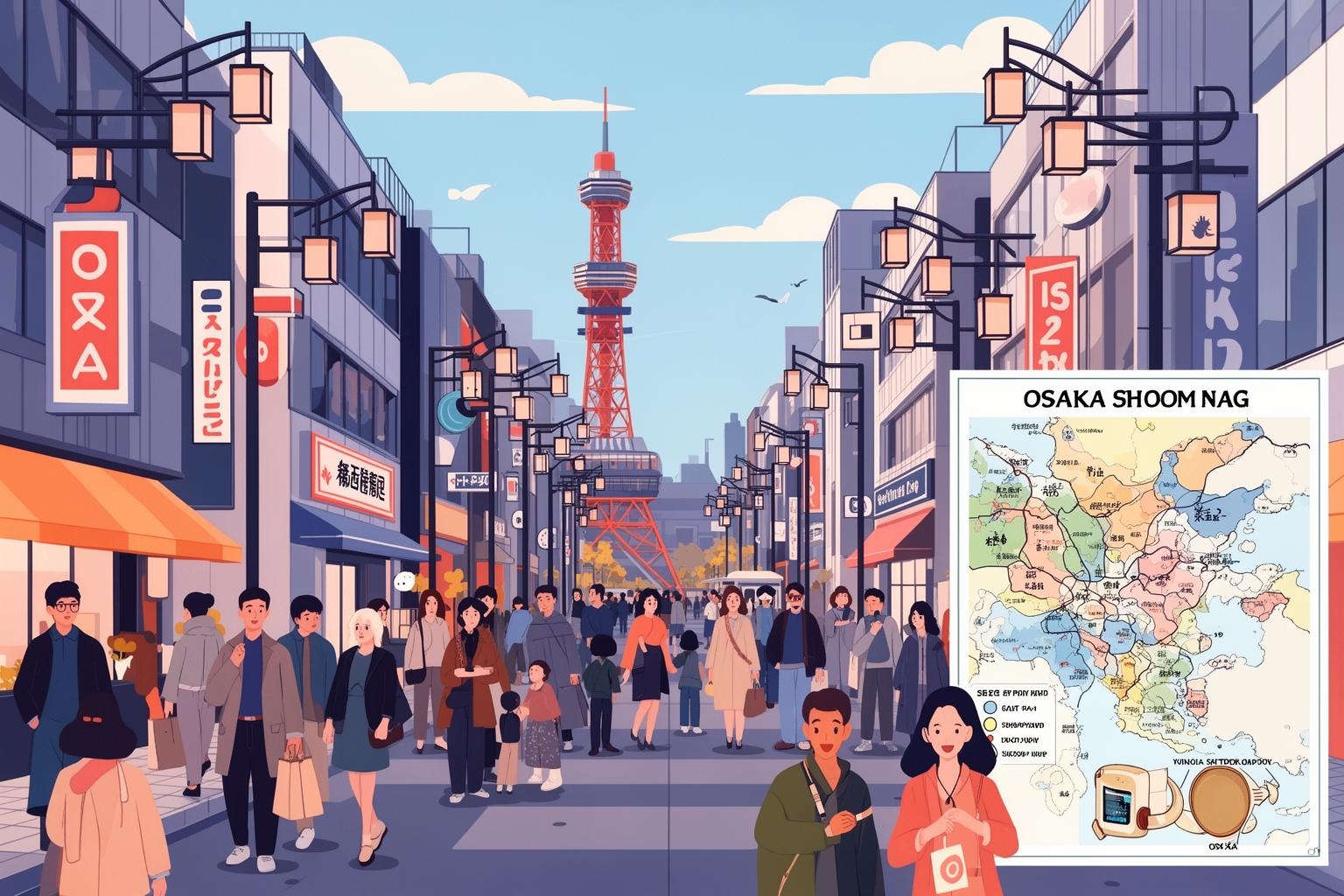
The shotengai is far from a static place. Its character, sounds, and scents shift dramatically throughout the day. It has a unique pulse, a daily rhythm that reflects the lives of the people it serves. Grasping this flow is essential to understanding its role within the neighborhood.
The Morning Rush: The Sound of Shutters and Bicycles
The shotengai awakens with a metallic clang. One by one, the shops’ roll-down shutters are cranked open, a sound that reverberates through the long arcade. This is soon joined by the whir of bicycle tires and the cheerful ding of bells. These aren’t sleek road bikes; they are the workhorses of Osaka, the `mamachari`, or “mom’s chariots,” often equipped with a child seat and a large front basket. Housewives on their morning grocery run, elderly men heading to their favorite coffee shop, and shop owners transporting goods all navigate the narrow lanes with instinctive grace. The air fills with the first scents of the day: the yeasty promise of fresh bread from the corner bakery, the clean, slightly sweet smell of steamed rice from the bento shop, and the sharp, salty aroma of fish being laid out on ice. The energy is brisk and purposeful. Conversations are short and direct. This is the shotengai in work mode, the essential first stop in the neighborhood’s daily routine.
The Afternoon Lull and the Social Club
After the lunchtime rush, a calm settles over the arcade. The pace slows, the noise diminishes. This is when the shotengai reveals another role: it becomes an open-air community center. Shopkeepers, with no customers to attend to, pull up stools and chat with neighbors across the lane. They share gossip, grumble about the weather, and discuss the Hanshin Tigers baseball team. Elderly residents, having completed their chores, gather on the few benches scattered throughout the arcade. They don’t always speak much; they simply sit, watch, and exist in a shared public space. For many, especially older people living alone, this is their main social outlet. It’s a reason to leave the house, a way to stay connected. The shotengai provides a vital, informal social safety net. It’s a place where someone will notice if you haven’t appeared for a few days. It’s proof that a community needs more than just shops; it needs a place to simply be.
The Evening Scramble: The Symphony of “Time Sales”
Around 5 PM, the energy shifts once more. A new wave of people floods the arcade—office workers heading home, parents picking up children from school. Along with them comes a new chorus of sounds. From the delis and prepared food shops (`o-sozai-ya`), calls ring out: “Taimu seru!” (Time sale!) and “Waribiki desu!” (It’s discounted!). Red and yellow stickers are slapped onto packs of fried chicken, tempura, and salads. This is the evening scramble, a daily ritual born of Osaka’s famous pragmatism. Fresh food must be sold by the day’s end. It cannot be wasted. So, prices drop. This isn’t seen as a desperate move by shops; it’s an expected and celebrated part of the daily economy. Locals time their shopping to coincide with these sales, planning dinner around the best bargains. The atmosphere is energetic and a bit competitive, but friendly and communal. Everyone shares the same mission: to find a delicious, affordable meal. It’s a perfect snapshot of the Osaka mindset: savvy, resourceful, and deeply appreciative of good food at a good price.
Beyond the Groceries: The Shotengai’s Hidden Layers
While the primary function of the shotengai is commercial, its true significance lies in the deeper, often unseen roles it plays in the life of a neighborhood. It serves as a guardian of traditions, a venue for celebrations, and a tangible anchor of community identity amidst an ever-changing urban environment.
The Guardians of Tradition (and Community Secrets)
Look beyond the chain drugstores and 100-yen shops that have appeared in some arcades, and you will discover the real spirit of the shotengai: the multi-generational family businesses. The tofu shop where the same family has risen at 4 AM for three generations to prepare fresh tofu and soy milk. The tiny tea shop run by an elderly woman who can recommend the perfect green tea for any occasion. The dusty futon store, the old-fashioned candy shop, the small, family-owned bookstore. These establishments are more than mere businesses; they are living archives of the neighborhood’s history. The owners act as its unofficial guardians. They hold the knowledge of everything: which families have lived here for a century, whose son just passed university exams, who is currently facing illness. They are the community’s eyes and ears. In a vast, impersonal city, these shopkeepers offer a sense of permanence and continuity. They function as a human database of local knowledge, a network of care based entirely on trust and familiarity.
When the Shotengai Becomes a Festival Ground
The shotengai is a flexible space. On ordinary days, it is a bustling marketplace. But on special occasions, it transforms entirely. During summer, it becomes a gallery for Tanabata, adorned with colorful streamers and handwritten wishes hanging from the ceiling. In the days leading up to New Year’s, it turns into a lively, festive center for purchasing special foods and decorations. And when the local shrine holds its annual `matsuri` (festival), the shotengai often forms part of the parade route. The portable shrine, or `mikoshi`, is carried through the arcade on the shoulders of chanting locals, while shops set up temporary stalls selling festival foods and games. In these moments, commerce pauses. The arcade stops being just a market and becomes what it truly is at its core: the neighborhood’s public square. It is the place where the community gathers to celebrate its shared culture and identity. These events highlight that the shotengai belongs to everyone, serving as the heart of their collective life rather than merely a group of individual businesses.
Navigating the Shotengai: A Foreigner’s Field Guide
For someone new, the shotengai can seem like a confusing, impenetrable maze. However, once you grasp the unwritten rules of interaction, navigating it becomes instinctive. It’s less about following strict instructions and more about tuning into the local rhythm.
The Bicycle Conundrum
The steady stream of bicycles weaving through thick crowds of pedestrians can feel overwhelming. It appears to be a recipe for chaos, yet accidents are surprisingly uncommon. This is because an unspoken system operates here, a kind of urban ballet founded on mutual awareness. The key for pedestrians is predictability. Walk straight ahead. Avoid sudden stops or erratic movements. Listen carefully for the faint ding of a bell, signaling a bike approaching from behind. For those daring enough to bike through the arcade, the rule is to match the speed of the crowd rather than that of the bicycle. Be ready to dismount and walk during busy periods. It’s not about asserting your right of way; it’s about blending smoothly with the collective flow. It’s a dance, and your role is to learn the moves.
To Smile or Not to Smile?
In many Western cultures, a quiet, friendly smile is the standard polite way to interact with a shopkeeper. In an Osaka shotengai, this can come across as aloof or uninterested. Here, interaction is verbal. A simple, clear “Konnichiwa” when entering a shop, a “Sumimasen” to get someone’s attention, and an “Oki ni” when leaving are far more effective than just a smile. The real aim is to engage in the small talk. Even with limited Japanese, trying to respond to a shopkeeper’s remarks about the weather or their goods shows cultural understanding. A clumsy but eager reply is often more valued than flawless, silent politeness. It signals a willingness to engage on their terms, to join the social performance, not just watch it.
The True Meaning of “Local”
At its core, what defines the shotengai as the essence of Osaka is how it reflects the city’s fundamental values. It is practical, deeply human, and down-to-earth. It sharply contrasts with the sleek, curated, and often impersonal consumerism found in Tokyo and other global cities. The shotengai demands that a transaction be more than just money for goods; it should be an exchange of energy, stories, and recognition. It’s where you go not only to buy fish but to ask the fishmonger the best way to cook it. It’s where the vegetable seller remembers you prefer your onions firm. It’s where the apparent chaos isn’t a flaw but the very heartbeat of the place. To live in Osaka without embracing the shotengai is to miss its essence entirely. It is not a relic to be preserved; it is a living, vibrant, noisy lesson in how a city of millions can, in its key spaces, still feel like a small town.








