
You’ve just landed in Osaka, ready to work. You’ve heard the stories. People are louder, friendlier, maybe a little more… direct. You’ve prepared for the cultural shift from whatever you knew back home, or even from the buttoned-up world of Tokyo. Then you have your first real business meeting. You expect a quiet exchange of bows and business cards, a cautious, formal dance of corporate speak. Instead, five minutes in, the client leans forward, laughs, and asks, “So, what’s the bottom line? Is this actually going to make us money?” Welcome to Osaka. You’ve just met the Akindo Damashii—the Merchant’s Spirit. This isn’t just a historical footnote; it’s the living, breathing operating system of the city, and understanding it is the key to navigating everything from negotiating a contract to networking for your next career move. Forget the stereotypes of a monolithic “Japanese” business culture. Osaka plays by its own rules, forged in centuries of trade, commerce, and a relentless pursuit of a good deal. It’s a culture where business is personal, humor is a tool, and value is the ultimate currency. To thrive here isn’t just about learning the language; it’s about learning the rhythm of the hustle, the logic of the trade, and the art of the relationship. This is the real Osaka, a city built not by samurai or bureaucrats, but by merchants who knew that the best deals are made between people, not just companies.
Osaka’s merchant spirit not only fuels innovative business deals but also transforms everyday routines, as locals enjoy remarkable grocery savings by tapping into the vibrant shotengai culture.
The Ghost in the Machine: What is ‘Akindo Damashii’?
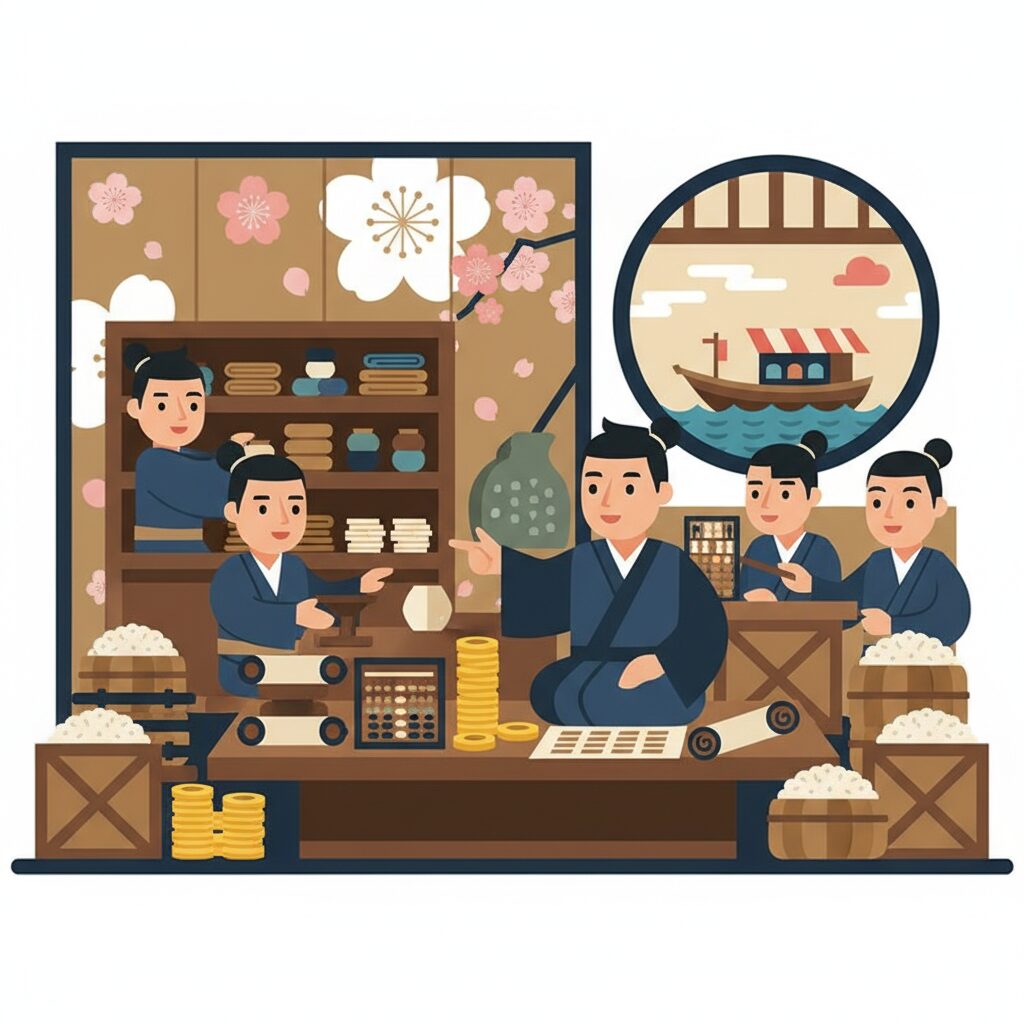
To understand Osaka, you must grasp its history. While Tokyo (then Edo) was the shogun’s power base—a city of warriors and politicians—Osaka served as the nation’s engine room. Known as tenka no daidokoro, the “nation’s kitchen,” its ports and storehouses handled rice, sake, textiles, and goods from across Japan. Power here wasn’t defined by the sword or imperial decree; it was measured by the clatter of the abacus. The heroes of Osaka weren’t samurai, but shrewd merchants who could forecast market trends, build expansive distribution networks, and generate wealth from the ground up.
This history ingrained a distinctive mindset into the city’s DNA: the Akindo Damashii, or Merchant’s Spirit. This philosophy stands in sharp contrast to the samurai-derived bushido code that subtly shapes much of Tokyo’s corporate culture. Whereas bushido values loyalty to a lord (or company) above all else, strict adherence to form, and stoic reserve, the Merchant’s Spirit is pragmatic, adaptable, and fiercely results-driven.
It’s not merely about greed or profit maximization—this is a common misconception. Akindo Damashii embodies a complex mix of attitudes:
A Passion for ‘Shōbai’ (Business/Trade): In Osaka, business is respected. It’s seen as a craft, a game, and a source of civic pride. People discuss business openly and enthusiastically. The typical Osaka greeting, “Mōkarimakka?” (“Making money?”) isn’t an intrusive question about your finances; it’s the local equivalent of “How’s it going?” It acknowledges commerce as the city’s and its people’s lifeblood, a way to connect over a shared enthusiasm.
Rationality Over Rigid Rules: An Osaka merchant immediately questions any pointless rule with “Why?” If a process is inefficient or lacks value, it is deemed illogical and worth challenging. This can be surprising in a country known for following procedures closely. In an Osaka workplace, a sensible, cost-cutting suggestion from a junior employee might be welcomed, whereas in a more conventional Tokyo office, it might be seen as bypassing the proper chain of command.
The Sanctity of the Win-Win: This principle lies at the heart of the spirit. A true Osaka akindo (merchant) understands that the best business isn’t about tricking someone into a bad deal—that’s a one-off transaction. The real money, the true shōbai, comes from building long-term relationships where both sides feel they’ve benefited. It’s about cultivating a reputation for fairness, reliability, and outstanding value. Pressing a customer for every last yen today risks losing their loyalty—and their network—tomorrow. That’s simply bad business.
Resilience and Cleverness: Osaka merchants have endured fires, earthquakes, wars, and economic downturns. Their spirit is one of bouncing back and finding new approaches when old ones fail. It’s about kufū—ingenuity and creative problem-solving. This mindset is less risk-averse than in other parts of Japan. The readiness to try new ideas and pivot quickly defines the Osaka business environment.
This historic spirit isn’t confined to museums. It thrives in the gleaming office towers of Umeda, echoes through deals struck in Shinsaibashi’s back alleys, and shapes the rhythm of your daily interactions at work.
The Sound of Business: How the Merchant Spirit Shapes Communication
If Tokyo’s communication style is like a carefully orchestrated symphony of indirectness and polite suggestion, Osaka’s is more akin to free-form jazz. It’s spontaneous, lively, and goes straight to the main theme. For a foreigner, this contrast can be one of the most striking adjustments.
The Death of ‘Tatemae’
Across much of Japan, social interactions are shaped by the concepts of honne (one’s true feelings) and tatemae (the public face or official stance). You learn to sense the underlying message, to understand what remains unsaid. In Osaka, however, that atmosphere is much more transparent. The divide between honne and tatemae is far narrower, and in many business situations, it almost disappears entirely.
An Osaka colleague is far more likely to say directly, “I don’t think that idea will work, and here’s why,” instead of commenting, “That is a very interesting perspective; we should explore it further,” which often serves as a polite way of saying “no.” This is not intended to be rude but rather a sign of respect for your time and intellect. The reasoning is simple: why spend a week pretending to consider a poor idea when five minutes could be better spent finding a superior one? This efficiency stems directly from the shōbai mindset. Time is money, and ambiguity is the enemy.
Humor as a Lubricant and a Litmus Test
In Osaka, humor isn’t a distraction from business; it’s an integral part of it. Meetings might begin with self-deprecating jokes or some playful teasing. This is not unprofessionalism. Instead, it’s a refined social ritual that serves several purposes.
First, it helps break the ice and build personal connections. Before we are Company A and Company B, let’s be Tanaka-san and Smith-san. Can we share a laugh? If yes, collaboration is more likely. Second, it’s a way to assess personality and intelligence. Can you keep up with the banter? Can you deliver a witty reply? This verbal sparring demonstrates that you are sharp, confident, and composed—traits valued in a business partner.
A common dynamic is the tsukkomi and boke routine, the foundation of Japanese manzai comedy, which originated in Osaka. One person says something silly (boke), and the other quickly corrects them (tsukkomi). This pattern is frequently seen in offices. For example, a boss might suggest an overly ambitious sales goal (boke), and a trusted subordinate responds, “Buchō, are you dreaming again?” (tsukkomi). What might seem like insubordination elsewhere is actually a sign of a strong, trusting relationship.
The Language of Value
Listen closely to conversations in an Osaka office, and you’ll notice certain words and phrases recurring—words centered around value and pragmatism.
- “De, kekkyoku…?” (“So, in the end…?”): The ultimate conversation ender. It cuts through fluff and corporate speak to get to the core. What’s the conclusion? What’s the next actionable step?
- “Sore,ナンボのもんや?” (“What’s that worth?”): Sometimes literal—“What’s the price?”—but often used figuratively. “Is that idea truly valuable?” “What real benefit does this strategy offer?” It’s an ongoing, informal audit of value.
- “Shānai nā” (“Can’t be helped, I guess”): This phrase epitomizes Osaka-style pragmatism. It acknowledges that the situation isn’t perfect but is good enough to move forward. It signifies compromise to keep the business moving rather than getting bogged down by ideals.
Grasping this communication style is essential. If you approach with a formal, indirect Tokyo-style manner, you may be seen as cold, evasive, or even untrustworthy. They want to see the genuine you and want to get straight to business.
The Art of the Deal: Negotiation, Osaka Style
Negotiation in Osaka is a dynamic, highly personal process. It involves less following a script and more intuitively understanding your counterpart, building rapport, and collaboratively exploring a solution that leaves everyone feeling satisfied. It’s a dance, and you need to learn the steps.
Step One: The Personal Connection
Negotiations rarely start with numbers; they begin with conversation. Where are you from? Do you like baseball? (If so, you’d better say you support the Hanshin Tigers). Have you tried the takoyaki from that spot down the street? This isn’t mere small talk. Your counterparts are evaluating you as a person. Are you trustworthy? Someone they’d enjoy having a drink with? Business in Osaka is built on human relationships. They decide whether they want to do business with you, not just your company.
This is where a sense of humor becomes vital. Being able to crack a self-deprecating joke or share a funny story is more valuable than a slick PowerPoint. It shows confidence and warmth. If you make them laugh, you’ve already won half the battle. They like you now; next, they just need to see if the deal makes sense.
Step Two: The ‘Naniwa Soroiban’ (The Osaka Abacus)
Once rapport is established, attention shifts to the deal’s substance. The “Naniwa Soroiban” symbolizes the quick mental calculation of costs, benefits, and value that runs through the mind of an Osakan businessperson. They excel at seeing the full picture.
When presenting your proposal, they’re not merely focused on the price. They assess total value. What are hidden costs? What are long-term benefits? How does this simplify their life or boost their business profitability? Your role is to make that calculation straightforward. Be transparent. Be direct. Don’t hide details in fine print.
They’ll ask sharp, probing questions—this isn’t an attack; it’s due diligence. They respect those who know their business thoroughly and can defend their proposal with logic and data. Be ready to justify every part of your offer in terms of the value it provides. Vague terms like “synergy” or “strategic alignment” won’t suffice. They want to know, “How does this impact my bottom line?”
Step Three: The Collaborative Haggle (‘Ne-giri’)
Here it comes—the part many foreigners, and even some Japanese, find daunting: the ne-giri or price negotiation. In Osaka, this isn’t an adversarial battle but a natural, even enjoyable, phase of the process. Failing to negotiate might seem odd, as if you’re indifferent to securing the best value.
However, “haggling” isn’t quite right. It’s more collaborative problem-solving. The initial price is almost always the starting point for discussion. When they say, “It’s a bit expensive,” they’re not rejecting your offer; they’re inviting you to work together to find a mutually agreeable solution.
The dance goes like this:
- Them: “Your price is a little high.”
- Wrong Response: “That’s our final price. Take it or leave it.” (This kills the relationship).
- Right Response: “I understand. The price reflects the quality and service included. But let’s discuss it. What part of the proposal is most challenging for your budget?”
This opens the door for creativity. Maybe you can’t lower the base price, but can you offer a longer warranty? Include free training? Adjust the delivery schedule to ease their cash flow? Offer discounts for larger volumes or longer contracts?
The aim of the ne-giri is to end the negotiation with both parties feeling satisfied. You feel good because you maintained your margin, and they feel good because they negotiated extra value. It reinforces a win-win mindset. They’ll remember you as a flexible, reasonable partner, which is priceless for future business.
Building Your Network: It’s Not Who You Know, It’s Who You Drink With

In the hyper-formal world of Tokyo business, networking often feels like a rigid, ritualized exchange of business cards (meishi). You gather a stack of cards, exchange a few polite remarks, and hope something develops. In Osaka, however, the business card is merely the gateway to the real event: the after-party.
Networking is a contact sport, and the playing field is typically an izakaya (a Japanese-style pub) or a restaurant. This is where nomi-nication—a blend of the Japanese word for drink, nomu, and “communication”—takes center stage.
Formal meetings in the office are for discussing data and details. The izakaya is where trust is built and the person behind the title is understood. This is where you learn about their family, hobbies, and frustrations with their boss. This is where genuine alliances form. An Osakan businessperson might hesitate to sign a deal with someone they haven’t shared a meal or drink with. After all, how can you trust someone you don’t know personally?
To a foreigner, this can feel like a tiring, obligatory social duty. But it’s crucial to see it differently. This is the real work. Developing these personal relationships is as vital as perfecting your product. Your skill as an engaging, interesting, and trustworthy dinner companion is a key professional asset in this city.
Don’t confuse the casual atmosphere with a lack of seriousness. People are still watching you. Are you a good listener? Can you hold your liquor? Do you treat restaurant staff with respect? They are collecting data points to form a complete impression of you. A successful night of nomi-nication can advance your career more than a month’s worth of formal emails.
What You’re Probably Getting Wrong About Osaka
The city’s distinctive culture often causes a few typical misunderstandings among outsiders. Overcoming these clichés is the crucial first step to genuinely understanding the local way of thinking.
Misunderstanding 1: “They are greedy and only care about money.”
This is the most shallow and inaccurate perception. Osakans are not fixated on money itself; they are focused on value. They detest waste in all its forms: wasted money, wasted time, wasted effort, wasted potential. This explains why they are such tough negotiators—they want to ensure that every yen spent delivers maximum value.
On the other hand, they are extremely generous when they recognize real value. They will willingly pay a premium for superior craftsmanship, excellent service, or a product that truly addresses a problem. They also show strong loyalty to businesses and people who have treated them fairly. The emphasis isn’t on hoarding money, but on keeping it circulating wisely and efficiently for everyone’s benefit. Think of it as a respect for economic efficiency, not mere greed.
Misunderstanding 2: “Their bluntness is just plain rude.”
In a culture that values indirectness, Osaka’s straightforwardness can come across as harsh. Yet it is almost never meant to be hurtful. It stems from pragmatism and, in a sense, respect. The unspoken message is, “We are both busy professionals. Let’s not waste each other’s time with polite facades. Let’s get straight to the point and find a solution.”
They are paying you the compliment of regarding you as a rational peer, capable of handling an honest opinion. Concealing their true thoughts would be viewed as dishonest and inefficient. Understanding this directness as a form of professional respect is a significant revelation for any foreigner working here. You always know where you stand, and in business, that transparency is invaluable.
Misunderstanding 3: “It’s all chaotic and unprofessional.”
The jokes, the relaxed atmosphere, the loud talking—it may all appear unprofessional to someone used to quiet, formal offices. This is a serious misconception.
Do not confuse an informal style with a lack of professional substance. The Osaka businessperson cracking a bad pun is, moments later, capable of performing a complex profit-and-loss calculation that would baffle an accountant. The casual manner is a cultural veneer on a foundation of sharp business insight. They are utterly serious about one thing: achieving excellent results. They’ve simply realized that being quiet and solemn isn’t necessary for success—in fact, it may even hinder it.
A Practical Guide to Thriving in the Osaka Workplace
So, how do you apply all of this in practice? How do you adjust your style to thrive in this distinctive environment?
Embrace the Banter: Don’t be a bystander. When someone makes a joke, laugh. If they tease you kindly, tease them back. You don’t have to be a stand-up comedian, but demonstrating a sense of humor and not taking yourself too seriously will earn you significant social capital.
Be Radically Honest (But Polite): Work on being more straightforward in your communication. State your opinions clearly and support them with logic. Instead of saying, “Perhaps we could consider another option,” try, “I have a concern about this approach. Here’s an alternative I believe is more efficient.” Your honesty will be valued.
Always Talk Value: When presenting an idea, product, or proposal, highlight its value. Explain how it will save time, generate money, or reduce hassle for the other person. Connect every feature to a clear benefit. Use your mental abacus.
Never Accept the First Offer (and Don’t Expect Them To): Treat negotiation as the beginning of a creative dialogue. Enter meetings knowing your ideal outcome, your acceptable outcome, and a few creative concessions you can offer to achieve it. Be ready to discuss, compromise, and collaborate on solutions.
Say Yes to the Drink: When invited out after work, accept. This isn’t optional overtime; it’s the core event. Listen more than you speak, be authentic, and focus on building genuine human connections. This is where your most important business relationships will form.
Living and working in Osaka means immersing yourself in a different mindset. It can be challenging, noisy, and occasionally confusing. But it’s also refreshingly honest, profoundly human, and incredibly dynamic. The city rewards pragmatism, personality, and a sincere desire to create mutual value. Master the rhythm of the Akindo Damashii, and you won’t just survive the Osaka workplace—you’ll thrive in it. Behind the hustle and haggling, you’ll discover a community of people who take their work seriously, but not themselves, and who recognize that the best business is always personal.








