
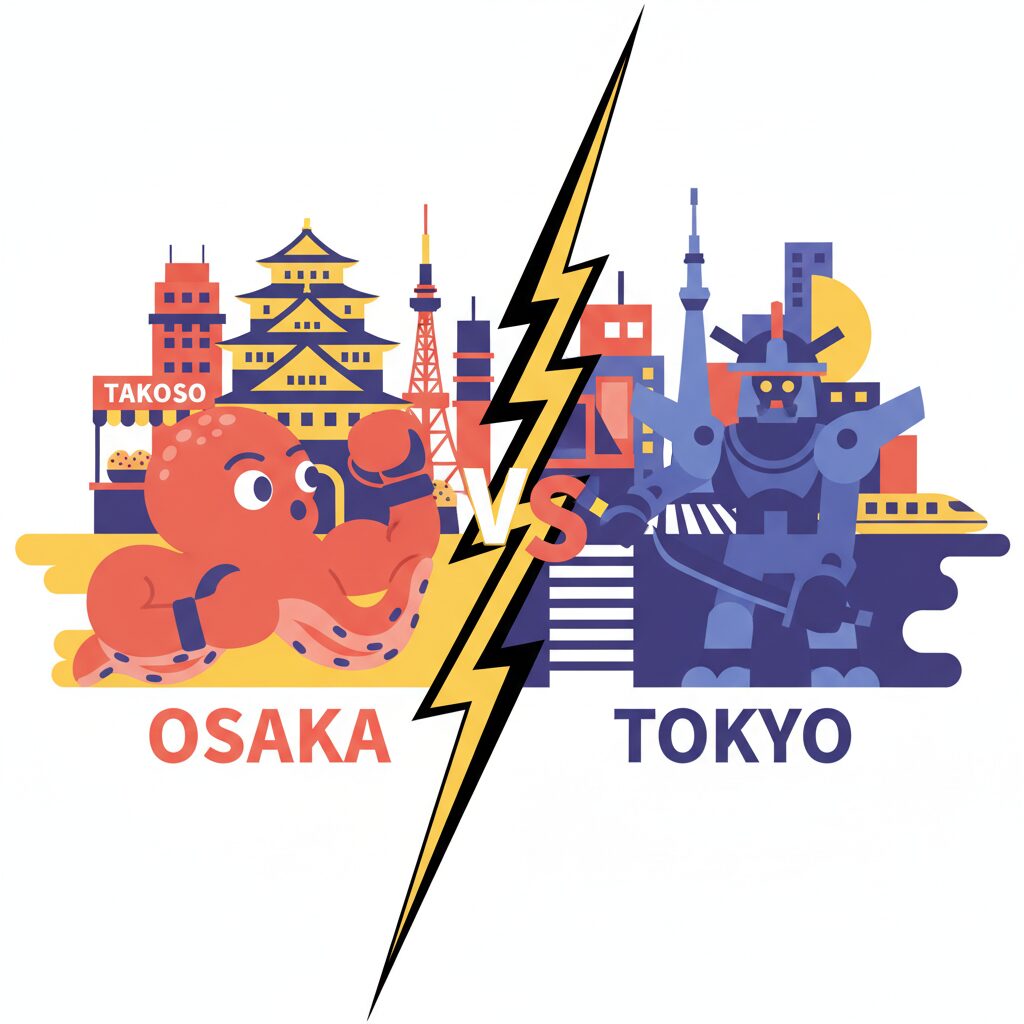
You hear it before you even arrive. It’s one of the first cultural lessons anyone learns about Japan. Tokyo is the polished, sophisticated, high-powered capital. Osaka is its loud, funny, food-obsessed cousin from the south. One is about order, the other is about energy. One is a sleek electronic ballad, the other is a boisterous street festival with taiko drums. The rivalry is legendary, a constant punchline in comedy shows, a fierce battleground in baseball, and a fundamental binary in the national consciousness. But when you move here, when you’re navigating the aisles of a Life supermarket or figuring out which train to catch at Umeda Station, how much does this epic clash of titans actually show up in your day-to-day life? The answer is: more than you think, but in ways you’d never expect.
The rivalry isn’t a series of overt confrontations. You won’t see gangs of Osakans and Tokyoites facing off in the streets. It’s something more subtle and pervasive. It’s the cultural source code that runs in the background of every social interaction, every business meeting, and every public announcement. It’s a low-frequency hum that defines the city’s unique personality. From my perspective as someone who studies the nuances of East Asian cultures, this isn’t a petty squabble. It’s a profound difference in the philosophy of urban living. It shapes expectations, dictates unspoken rules, and ultimately, determines the very texture of reality in Japan’s second city. To understand this rivalry is to understand the soul of Osaka.
This nuanced cultural divide even shapes business practices, as seen in the distinct merchant spirit that infuses Osaka’s vibrant commercial life.
The Sound of the City: Language as Identity
More Than Just an Accent
The most immediate and noticeable sign of the Osaka-Tokyo divide is the language. In Tokyo, you hear Hyojungo, the standard Japanese used in national news broadcasts and taught in textbooks. It’s clear, formal, and carries the authority of officialdom. In Osaka, you’re surrounded by Kansai-ben, a dialect so unique and full of character that it feels almost like a separate language. Osakans proudly wear it as a symbol of their identity.
This isn’t just about different vocabulary, like using akan instead of dame (no good) or honma instead of hontou (really). It’s about the whole musicality of speech. Kansai-ben features a melodic, rising and falling rhythm that feels more expressive and emotional. It’s a language made for storytelling, bargaining, and humor. When a shopkeeper enthusiastically greets you with a drawn-out “Maidoooo!” (Thanks for your business!), it’s a world apart from the polite, standardized “Irasshaimase!” heard in Tokyo department stores. One feels like a personal greeting; the other, a corporate routine.
For foreigners, this is one of the first challenges you’ll encounter—and also one of your best opportunities. A common misconception is that Kansai-ben is “improper” or “less polite” Japanese. This perspective is Tokyo-centric. In Osaka, speaking standard Japanese can sometimes create distance, making you sound like a remote news anchor or a government official. Even a small attempt at Kansai-ben—a simple ookini for “thank you”—is warmly welcomed and appreciated. It shows that you’re not just a passing visitor to “Japan” but are genuinely trying to connect with Osaka. The dialect is more than just a way of speaking; it’s audible proof of a proudly independent cultural identity.
The Flow of the Crowd: Public Space and Personal Boundaries
Escalator Etiquette: The Classic Showdown
Every travel guide points it out, and for good reason. In Tokyo, you stand on the left side of the escalator to allow people to pass on the right. In Osaka, it’s the reverse: stand on the right and walk on the left. This might seem like a minor difference, a quirky local custom. But living here, you come to see it as a strong, non-verbal assertion of regional identity. It’s a daily, silent vote on belonging.
The rule isn’t about greater efficiency. It’s a collective, unconscious way of marking “us” versus “them.” It’s Osaka staking its claim on every moving staircase in the city. When you spot a tourist or visitor from Tokyo instinctively standing on the left, you sense a subtle shift in the crowd. There are no angry outbursts, but you may notice a sigh, a quiet cough, or a series of people awkwardly maneuvering past. It’s a moment of cultural tension that reveals a deeper reality: in Osaka, even standing still can be an expression of identity.
This small gesture is a microcosm of a broader philosophy about public space. Tokyo’s public areas often feel designed to reduce friction and interaction. People move in quiet, orderly lines, honoring invisible personal boundaries. Osaka’s public spaces are more lively, more social, and frankly, more human.
The Train Commute: A Tale of Two Realities
Ride the Yamanote Line in Tokyo during rush hour, and you’ll encounter a collective, silent meditation. The train is crowded, yet the noise level is remarkably low. Everyone keeps to themselves, focused on their phones, avoiding eye contact, maintaining a stoic public demeanor. The train car serves as a vessel transporting individual units from point A to point B.
Now, take the Midosuji Line in Osaka. The train is equally packed, but the vibe is completely different. You might hear friends laughing loudly or an elderly woman striking up a conversation with a stranger about the weather. The personal bubble, so sacrosanct in Tokyo, is smaller and more permeable here. The air carries the scent of takoyaki from a vendor just outside the station gates. It’s not that Osakans lack manners; their sense of public space is simply more communal. The train car is not just a means of transit, but a temporary shared living room.
From an East Asian cultural perspective, this reminds me of the classic contrast between northern and southern cities in China. The north tends to be more reserved, formal, and mindful of public decorum, much like Tokyo. The south is livelier, more commercial, and relational, much like Osaka. The central question differs. In Tokyo, it is: “How can we all navigate this public space with minimal disruption?” In Osaka, it’s: “Since we share this public space, what’s going on?”
The Currency of Connection: Humor, Money, and Honesty
Laughter as a Social Lubricant
Tokyo boasts sophisticated arts and high culture. Osaka is known for manzai—a traditional form of two-person stand-up comedy featuring rapid-fire exchanges between a straight man (tsukkomi) and a funny man (boke). This style forms the cultural foundation of the city. But manzai isn’t just entertainment on TV; its spirit is deeply embedded in everyday conversation.
In Osaka, humor serves as a social tool. It breaks the ice, expresses affection, aids negotiation, and offers gentle criticism. Conversations often resemble friendly verbal sparring. If you wear a new shirt, a Tokyo friend might say, “That looks nice.” An Osaka friend is more likely to respond, “Wow, spending all your money on clothes again, huh?” This isn’t an insult but an invitation to join the playful exchange and fire back a comeback. The tsukkomi jab signifies closeness; receiving it means you’re regarded as a friend—someone close enough to tease.
Foreigners often misinterpret this directness and teasing as rude or aggressive. However, in Osaka, humor is essential—without it, people may seem cold or untrustworthy. Laughter acts as the key currency of social connection. The butcher joking about your chicken purchase, or the elderly man at the bus stop making self-deprecating remarks about his bad back, are both part of a city-wide ritual of social bonding. While Tokyo interactions are typically shaped by politeness and reserve (tatemae), Osaka’s are driven by a desire for genuine, unscripted responses (honne).
The Merchant’s Mindset: Value Over Veneer
Osaka has been Japan’s commercial center for centuries, famously called tenka no daidokoro—the nation’s kitchen. This legacy as a city of merchants rather than samurai or bureaucrats has fostered a strong pragmatism among its people. What counts is substance, not appearance; value, not brand. This attitude is evident daily in how locals approach money.
Tokyo is a city of brands and image. People pay extra for the experience of shopping in beautifully designed stores in Ginza or Omotesando. In contrast, Osaka’s greatest thrill lies in finding a bargain. The city is crisscrossed by shotengai, covered shopping arcades that pulse with vibrant local commerce. Here, the spirit of negiri (haggling), though less common than before, still thrives in the relentless quest for value.
Osaka residents will proudly recount how they walked an extra ten minutes to a different supermarket just to save 30 yen on milk. They debate the cost-performance of instant noodle brands with the same seriousness art critics use. This isn’t about being cheap; it’s about being wise. Securing a good deal is a point of pride—a small victory in the game of life. This mindset is captured by the philosophy of kuidaore—to eat until you drop, or more precisely, to spend so much on food you could go bankrupt. It’s not about extravagant meals but about getting the most delicious and satisfying food for the best possible price. A 500-yen bowl of kitsune udon that delights the palate is far more esteemed than a 10,000-yen meal that’s only mediocre. In Tokyo, the question is, “Is it fashionable?” In Osaka, it’s, “Is it worth it?”
The Professional Arena: Work, Business, and Getting Things Done
Meetings in Motion
Cultural differences are distinctly evident in the workplace. Tokyo’s business culture is well-known for being meticulous, process-oriented, and hierarchical. Meetings tend to be lengthy, formal events focused on building consensus through a process called nemawashi—literally meaning “turning the roots”—where everyone is informally consulted before a formal decision is reached. The process is often just as important as the result.
In contrast, Osaka’s merchant spirit dominates. Business there is direct, fast-moving, and results-focused. An Osaka businessperson wants to get straight to the point. They are more likely to interrupt a lengthy presentation with questions like, “So what does this mean for us?” or “What’s your best price?” This can be surprising to those used to Tokyo’s more indirect approach and may be mistaken for impatience or rudeness. However, from the Osaka viewpoint, it reflects efficiency and respect for everyone’s time. Why spend an hour talking around an issue when it can be resolved in fifteen minutes?
This straightforwardness stems from a history where one’s reputation was founded not on family name or government rank, but on the ability to close deals and fulfill promises. It’s a culture that prioritizes action over deliberation.
The Human Network
Both cities place great importance on networking, though they approach it differently. In Tokyo, networking often involves a formal exchange of business cards (meishi) and polite conversation, where company rank and job titles carry significant weight. Relationships are usually developed within the formal corporate framework.
In Osaka, relationships are paramount but built on a more personal basis. Connections form not just through exchanging business cards but by sharing drinks, meals, and laughter. People want to know you—your personality, sense of humor, and your reliability—not just your professional status. Trust is cultivated face-to-face, often in informal settings like an izakaya or a tachinomi (standing bar). This human-centered approach means that once you are “in” with someone in Osaka, you gain a fiercely loyal partner who is invested in you as a person, not merely as a business contact.
So, Does the Rivalry Actually Matter?
When It Surfaces (and When It Doesn’t)
After living here, you come to realize that the rivalry is more of a playful performance. It serves as a cultural touchstone that Osakans use to define themselves, mainly for their own amusement.
The rivalry becomes especially significant when the local baseball team, the Hanshin Tigers, faces Tokyo’s Yomiuri Giants. The city transforms into a sea of yellow and black, and the collective roar from the stadium can be heard for miles. On these occasions, the rivalry is the only thing that matters.
It also plays a big role in discussions about food. An Osakan will fervently defend the superiority of their okonomiyaki and takoyaki, dismissing Tokyo’s versions as pale imitations. And don’t even get them started on the proper way to make dashi broth (Osaka’s is lighter, made with kombu seaweed).
However, the rivalry fades instantly when it truly matters. During national crises like earthquakes or typhoons, regional differences are set aside. The shared identity of being Japanese takes precedence over everything else. On a personal level, people from Tokyo and Osaka collaborate, become close friends, and marry every day. The rivalry is like a sibling rivalry—full of teasing and competition but founded on a deep, unspoken bond.
A Foreigner’s Place in the Play
As a foreigner living in Osaka, you hold a unique and privileged vantage point. Being an outsider to this long-standing domestic rivalry lets you observe, learn from, and even participate in it without the weight of historical tensions.
Your first step is learning to stand on the correct side of the escalator. Next comes trying to order in clumsy Kansai-ben. And the moment you laugh off a friendly jab and throw one back, you truly start to fit in. By embracing the Osaka way, you show locals that you see them for who they are, not just as a variation of a Tokyo-centric Japan.
In the end, the so-called rivalry isn’t about hatred or real conflict. It’s about identity. Osaka defines itself in opposition to Tokyo, revealing what it cherishes most: pragmatism over pretension, community over cold efficiency, and a hearty laugh over stoic silence. Living here is a daily reminder that Japan is not a monolith. It’s a rich, complex tapestry of competing histories and philosophies. And the vibrant, unapologetically human thread running through it all? That’s Osaka.








