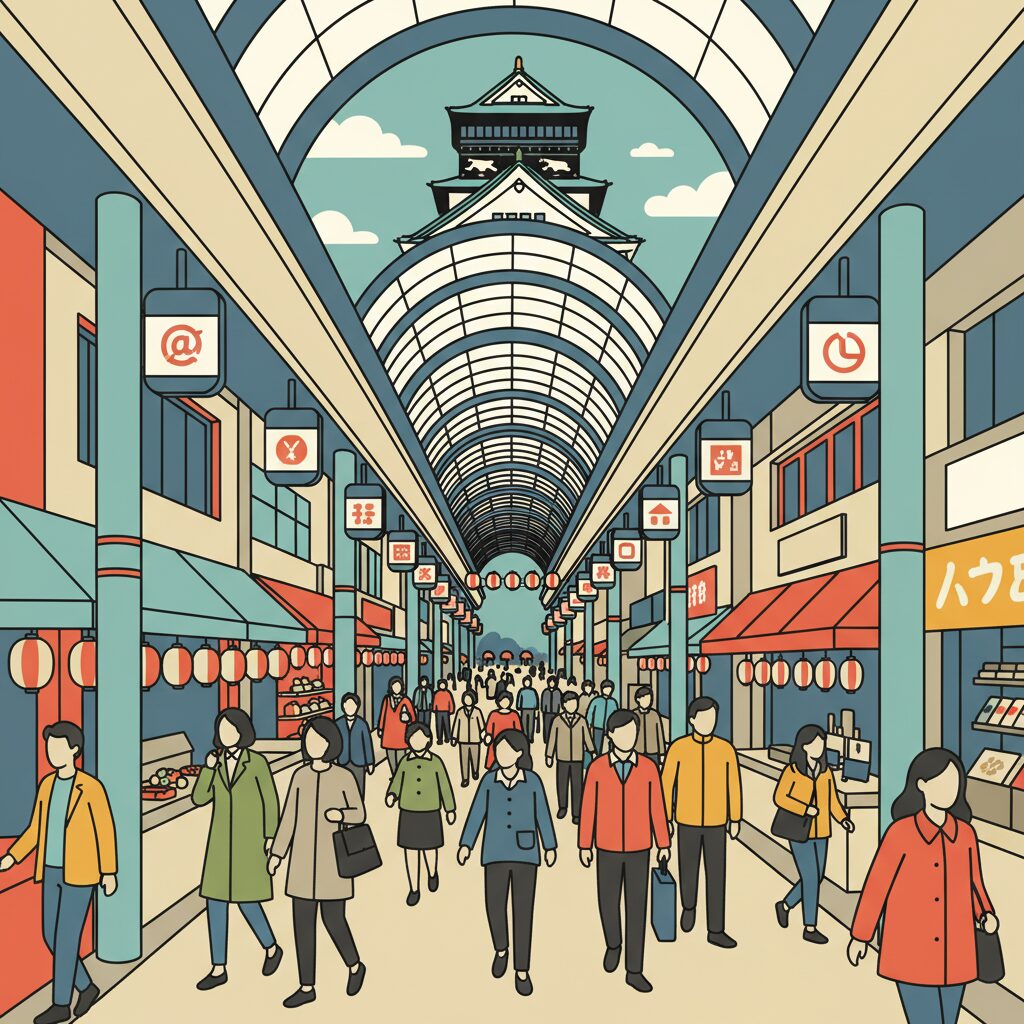
You feel it the first time you step out of a sterile, silent supermarket and into the controlled chaos of an Osaka shotengai. The air changes. It’s thick with the scent of grilled eel, freshly fried tempura, and the sweet perfume of seasonal fruit. It hums with the rhythmic calls of vendors, the laughter of neighbors catching up, and the gentle rumble of bicycles navigating the narrow lane. This is where the city’s heart beats, not in its gleaming towers, but in these covered arcades pulsing with daily life.
Then, one day, something strange happens. You’re at your local greengrocer, a tiny stall overflowing with pristine daikon radishes and shiny eggplants. You buy a few things—potatoes, carrots, a bundle of spring onions. The old man behind the counter, the one you’ve started to recognize, tallies the price on a wooden abacus or an ancient calculator. He tells you the total. You pay. As he bags your vegetables, he pauses, grabs an extra onion, and with a slight nod, tosses it into your bag. “Hai, o-make,” he grunts, a twinkle in his eye. You’re confused. You didn’t pay for that. Is it a mistake? A promotion? A trick?
Welcome to one of the most fundamental, misunderstood, and rewarding aspects of daily life in Osaka. This is ‘o-make’ culture, and it’s about so much more than a free onion. It’s a social currency, a relationship receipt, and a practical way for savvy residents—including foreigners who learn the rhythm of the city—to lower their grocery bills while weaving themselves into the fabric of their community. This isn’t about a loyalty card you scan; it’s about a human connection you build, one small conversation at a time. Forget the tourist traps and the flashy billboards. If you truly want to understand how Osaka works, how its people think, and how you can thrive here, you need to understand the art of the o-make.
This intimate fusion of tradition and modernity not only enriches everyday encounters but also mirrors how Osaka’s emerging luxury hospitality is reshaping the city’s urban landscape for both residents and newcomers.
The Unspoken Transaction: What Exactly is ‘O-make’?
Let’s get one thing clear right from the start: o-make is not a sale. It isn’t a “buy one, get one free” offer, nor is it truly a discount in the Western sense. The term itself provides a hint. The ‘o’ is an honorific prefix, adding a sense of respect to the action. ‘Make’ derives from the verb ‘makeru,’ which can mean to lower a price, but primarily means ‘to lose’ or ‘to be defeated.’ So, in a sense, the vendor is accepting a small, symbolic ‘loss’ for your sake.
However, it’s a willing loss, a gesture. It’s a subtle recognition of a relationship. It physically expresses ‘ninjo’ (人情), a fundamental concept in Japanese culture roughly translating to ‘human feeling’ or ‘empathy.’ It represents the network of obligations, kindness, and emotional ties that connect people. In much of Japan, ninjo is a gentle, often reserved presence. But this is Osaka, the historic merchant capital of the country. Here, ninjo is stronger, more practical, and often closely linked with business.
The logic of an Osaka merchant is elegantly straightforward and highly effective: a customer who feels appreciated is a customer who returns. O-make is a long-term investment. It’s the shopkeeper’s way of saying, “I see you. I value you. Here’s a little something extra because our relationship matters.” It’s an analog signal of trust in a world that is increasingly digital and impersonal. It might be an extra handful of beansprouts, a slightly bruised yet perfectly good persimmon they can’t sell, or simply rounding a 680 yen bill down to 650 yen with a casual wave of the hand. The monetary value is small, but the social significance is immense. It’s a whisper, not a shout, and you need to be attentive to grasp its meaning.
Welcome to the Shotengai: Osaka’s Living Room
This culture of o-make cannot survive in the harsh environment of a corporate supermarket. It requires a specific habitat to flourish, and that habitat is the shotengai, the local shopping arcade. These covered streets serve as the lifeblood of Osaka’s neighborhoods. They are vibrant ecosystems of commerce and community, completely different from the silent, fluorescent-lit aisles of a modern grocery chain.
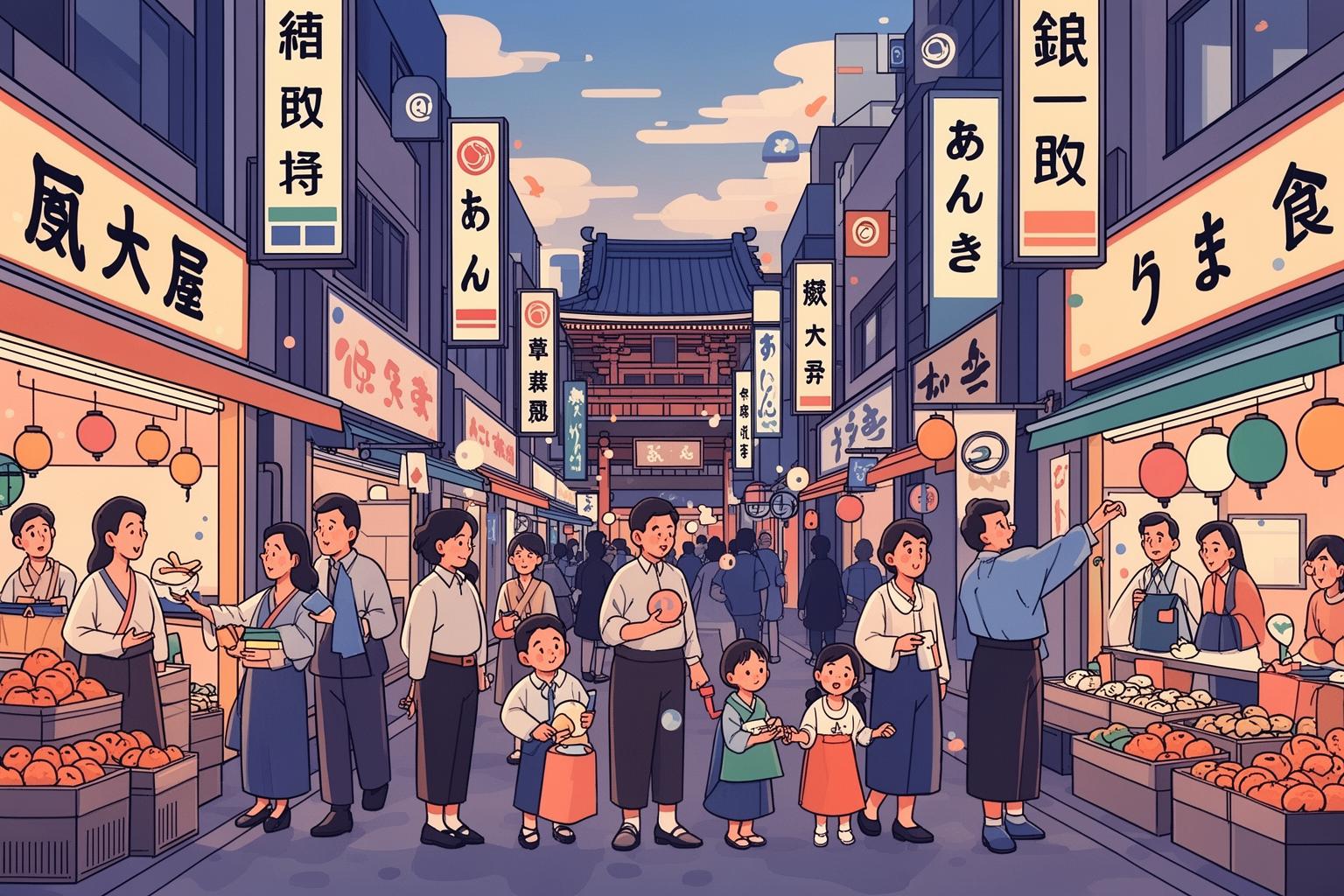
Step into a shotengai in the morning, and you’ll hear the metallic clatter of shop shutters rolling open. The air is filled with a symphony of scents: the salty brine from the fishmonger’s ice beds, the sweet and savory aroma of soy sauce and mirin simmering at the 惣菜屋 (sozai-ya, a shop for prepared side dishes), and the earthy fragrance of fresh burdock root at the greengrocer. Vendors call out their daily specials, their voices blending into a distinct Osaka melody: “Yasuide, yasuide!” (“It’s cheap, it’s cheap!”), “Maido, ooki ni!” (“Thanks for your continued patronage!”).
This place is not for passive consumption; it’s a stage for active interaction. Grandmothers with pushcarts exchange gossip as they decide on dinner. A butcher offers a mother advice on how to cook a certain cut of pork. The tofu maker knows exactly which customer prefers the firmer ‘momen’ style versus the silky ‘kinu.’ The shotengai is the neighborhood’s living room, where commerce is personal and human. In a supermarket, you are an anonymous consumer pushing a cart. In the shotengai, you are a face, a neighbor, a potential ‘joren’—a regular.
It is this environment of familiarity and daily interaction that creates the fertile ground for o-make to thrive. The system depends on sight, recognition, and repeated encounters. The anonymous checkout counter, with its unyielding scanner and insistence on exact change, is a barren desert for this kind of subtle, human exchange.
The Art of Becoming a ‘Joren’: How to Earn Your O-make
So, how can you, as a foreign resident, access this wonderful system? You can’t simply walk up and ask for it. In fact, that’s the one thing you should never do. Earning o-make is a delicate process—a gradual progression from being a faceless customer to becoming a “joren-san,” a valued regular. It takes patience, attentiveness, and a bit of effort, but the benefits are well worth it.
Show Up and Be Seen: The Power of Consistency
This is the essential first and most important step. Choose your vendors and remain loyal to them. Buy your vegetables from the same stall, your fish from the same shop, and your tofu from the same elderly woman who makes it herself. At first, you’ll just be another customer, but by your third or fourth visit, a flicker of recognition will emerge. They might begin greeting you with a more personal “Konnichiwa.” You become a familiar presence in their daily routine. You are no longer random—you have become predictable. This consistency forms the foundation of the entire relationship. They need to trust that you’ll return. You’re making an unspoken promise, and over time, they will do the same for you.
A Little Chat Goes a Long Way: Breaking the Language Barrier
Fluency in Japanese is not necessary. In fact, stumbling through a few phrases with a sincere smile often feels more genuine than delivering a flawless, robotic sentence. The aim isn’t deep conversation—it’s connection. Begin simply. A warm “Konnichiwa!” on arrival and a heartfelt “Arigato gozaimasu!” on departure are essential.
Then, take it a step further. Point to a vegetable you don’t recognize and ask, “Kore wa nan desu ka?” (What is this?). Ask for their recommendations. “Kyo no osusume wa?” (What do you recommend today?) works like magic. It shows respect for their expertise. They are masters of their craft, and allowing them to share that knowledge is a powerful way to build rapport. Listen carefully. Purchase their suggestions. This small effort shifts you from being someone who simply grabs items off the shelf to someone who truly engages with both the seller and their products.
From Customer to Neighbor: The Relationship is the Reward
Once you consistently show up and engage in conversation, the dynamic naturally changes. You begin sharing small glimpses of your life, and they share theirs. Maybe you mention what you cooked with the vegetables you bought last time: “I made nikujaga with your potatoes. It was delicious!” This closes the circle, letting them know their products were appreciated and well used.
Pay attention to them as well. Notice details. If the shopkeeper’s grandchild is around, say “Kawaii desu ne!” (So cute!). If they mention an upcoming festival, ask about it. Bit by bit, conversation by conversation, you move from being a ‘customer’ to a ‘neighbor.’ This is where the magic happens. O-make starts to appear—not as a calculated business tactic, but as a natural gesture of goodwill between two people sharing a small part of life in the same neighborhood. The extra apple they give you symbolizes this genuine and human connection.
What to Say (and What Not to Say): The Golden Rules
Understanding some unspoken rules is crucial to navigating this.
DO:
- Greet vendors warmly with “Konnichiwa” or, once you become a regular, the classic Osaka merchant greeting, “Maido!”
- Always express thanks clearly. A loud and sincere “Arigato gozaimasu!” is vital. If you receive an o-make, an additional “Sumimasen, arigato gozaimasu!” (a polite thank you acknowledging their kindness) is perfect.
- Say “Gochisosama deshita” (It was a feast) if you see them the day after enjoying something they recommended.
DO NOT:
Most importantly, never, under any circumstances, ask for o-make. Don’t say things like, “Chotto makete kurenai?” (Can you give me a little discount?) or “O-make shite?” (How about a little extra?). This isn’t a bazaar in Marrakesh. Haggling is not part of this culture. Asking for o-make instantly breaks the social contract. It turns a potential gift into a demand, brands you as greedy and ignorant, and ensures you will never receive one. O-make must be freely given, never demanded.
Beyond the Bottom Line: The Real Value of O-make
The greatest charm of o-make is that while it does help your budget, its true worth isn’t financial. Saving a few hundred yen each month is nice, but it’s insignificant compared to the other advantages.
The genuine value lies in the sense of belonging. Living in a foreign country, especially in a bustling city like Osaka, can feel incredibly isolating. You might feel invisible, lost in the crowd. But when the fishmonger spots you coming down the arcade and calls out, “Ah, Li-san! I saved a good piece of salmon for you today!” you suddenly become visible. You are recognized. You are known. You are part of the community. That feeling is invaluable.
Additionally, you gain access to a wealth of insider knowledge. Your butcher will recommend the best cut of beef for sukiyaki tonight. Your greengrocer will inform you that the sweet potatoes from Kagoshima are especially good this week and show you the best way to roast them. This is highly localized, expert advice you can’t find on a sticker on a plastic-wrapped tray.
This connection counters the anonymity of modern life. It’s a small act of rebellion against the efficiency-driven, transactional nature of the global economy. It’s a reminder that commerce can be, and perhaps should be, fundamentally human.
Osaka vs. The World: Why This Culture is So Osakan
If you try to apply this approach in Tokyo, you will likely encounter polite confusion. Tokyo, despite its many charms, operates on a different wavelength. It is a city that values precision, formality, and strict adherence to the system. The price on the sticker is the price you pay. The rules are the rules. Attempting to create a flexible, relational transaction might be seen as disrupting the ‘wa’ (harmony) of the carefully organized system.
Osaka’s ‘wa’ is distinct. It represents a more robust, flexible harmony based on mutual benefit and human connection. This is the city of merchants, not samurai. Its identity was shaped in the marketplace, not the feudal court. Osakans have a deep, historical appreciation of business as a relationship. The well-known Osaka greeting, “Mokkari makka?” (“Are you making a profit?”) followed by the typical reply, “Bochi-bochi denna” (“So-so, getting by”), reflects this mindset. Business is part of everyday conversation, and nurturing good, long-term relationships is simply good business.
From my perspective as someone from China, this aligns with the concept of ‘guanxi’ (关系), the intricate network of personal relationships that is vital in society. However, Osaka’s o-make culture feels more immediate and less strategic. It’s ‘guanxi’ with a cheerful smile and a warm, down-to-earth vibe. It doesn’t carry the intense pressure of haggling common in other Asian markets; it’s not a contest of wits to secure a better price. Instead, it’s a cooperative dance where both parties leave feeling positive.
Your Shotengai Starter Kit
Feeling ready to get started? Don’t try to change everything at once. Begin by shifting just one part of your grocery shopping from the supermarket to the shotengai.
- The Yaoya (Greengrocer): Skip the pre-packaged, perfectly uniform vegetables. Choose the loose items instead. Buy what is clearly in season—it will be cheaper, fresher, and more flavorful. Ask the owner how they like to prepare it, and you’ll often receive a recipe along with your purchase.
- The Tofu-ya (Tofu Shop): Your experience will be transformed when you try tofu made just hours earlier. It has a creamy texture and a subtle soybean sweetness that supermarket tofu lacks. Try the ‘atsuage’ (thick fried tofu) to add to miso soup or the ‘ganmodoki’ (fried tofu fritter with vegetables) for an easy, tasty side dish.
- The Sakanaya (Fishmonger): This can be the most intimidating stop, but often the most rewarding. Look for a shop bustling with locals. Don’t worry if you don’t know all the fish names. Just point and use the magic phrase: “Osusume wa?” They will almost always prepare the fish for you—scaling, gutting, and filleting—a service rarely found elsewhere.
A Final Word on a Priceless Gesture
Remember that first extra onion? It wasn’t an accident. It wasn’t a random gesture. It was an invitation—a sign from the community that if you’re willing to engage, the community will engage with you in return.
O-make is the secret handshake of daily life in Osaka. It’s the currency of a community that values human connection over cold efficiency. It won’t show up on any financial statement, but its value grows daily, enriching your life with a sense of place, a network of friendly faces, and the simple, profound joy of being treated not just as a customer, but as a neighbor.
So, the next time you need to buy groceries, step past the supermarket’s automatic doors. Find your local shotengai. Duck under the cloth ‘noren’ curtain of a small shop. Take a deep breath. Say hello. Begin your journey from stranger to ‘joren.’ In Osaka, you’ll discover that the best things in life are often the little extras, freely given and gratefully received.